Wednesday, February 9, 2011

24-Hour View of the sSky

from Earth Science "Picture of the Day


Photographer Chris Kotsiopoulos; Chris’ Website
Summary Author: Chris Kotsiopoulos

After wondering for some time whether it was possible to image the sky from one morning to the next where I live in Athens Greece, I decided to give it a try. After hours of planning and preparation, and a full day of shooting, the image above is the result of this labor of love. It took me about 12 hours to pull together and process a single image that included over 500 star trails, 35 shots of the Sun and 25 landscape pictures. My plan was to make the image on the day of the solstice (December 21) when the Sun’s stay in the sky was short (in the Northern Hemisphere) and the star trail durations were long. Of course, trying to find clear weather for a given 24-hour period is not an easy chore. However, I was patient, and the weather eventually cooperated (on December 30-31, 2010). I had to stay at the same place for approximately 30 hours. In addition, I was on location 2-3 hours before sunrise in order to make the preparations and test shooting. I also needed to stay an extra 2-3 hours the second day so as to shoot part of the Sun's sequence that I lost the first morning due to clouds. I chose Sounion (Temple of Poseidon) as the setting for this project. Click on image to see labels.

I began the shooting the morning of December 30, 2010, taking photos with my camera on a tripod facing east. The day portion of this shoot is composed of a dozen shots covering the landscape from east to west as well as the Sun's course across the sky, from sunrise to sunset. I recorded the Sun's position exactly every 15 minutes using an intervalometer, with an astrosolar filter adjusted to the camera lens. In one of the shots, when the Sun was near its maximum altitude, I removed the filter in order to capture a more dramatic shot that showed the Sun's “glare.” After sunset, I took various shots with the camera facing west-northwest in order to achieve a more smooth transition from the day portion to the night portion of the image. The night portion is also composed of a dozen landscape shots but this time from west to east. After the transition” shots, I took a short star trail sequence of approximately half an hour duration, with the camera facing northwest. At 7:30, I turned the camera to the north and started taking the “all-night” star trail shots -- lasting almost 11 hours. After accomplishing this, I then turned the camera to northeast and shot another short half an hour star trail sequence, and then finally, with the camera now facing east-northeast, I took a series of night-to-day transition shots.


(click on images to see larger and further info)

Tuesday, February 8, 2011

This just in: Reagan presidency recalled accurately!

from DangerousMinds:

Paul Slansky is guest blogging at Dangerous Minds about life during the Reagan era.

This is the first in a series of posts reminding those who lived through it – and informing those who didn’t – that contrary to relentless media efforts to portray Ronald Reagan as a great President and his reign as an era of national bliss, he was actually a lazy ignoramus who couldn’t tell fact from fiction, and whose eight years of callous actions (and inactions) had disastrous and ongoing consequences for the country.  And here’s how it started:

11/4/80 At 8:15pm EST, with a mere five percent of the vote counted, NBC declares former Hollywood actor Ronald Reagan the 40th President of the United States.  “I’m not bitter,” says President Jimmy Carter, who concedes the election hours before polls in the west have closed. “Rosalynn is, but I’m not.” Adds the First Lady, “I’m bitter enough for all of us.”

11/20/80 President-elect Reagan arrives at the White House to receive a job briefing from President Carter, who later reveals that Reagan asked few questions and took no notes, asking instead for a copy of Carter’s presentation.

11/27/80 At halftime during its Thanksgiving football game, CBS interviews President-elect Ronald Reagan, who reminisces about his days as a radio sportscaster and fondly recalls his penchant for enhancing the events by “making things up.”

12/11/80 Presidentelect Reagan’s first eight Cabinet appointments – including Donald Regan (Treasury), David Stockman (Budget Director), Caspar Weinberger (Defense) and William Casey (CIA) – are announced.  Reagan not only doesn’t attend the half hour ceremony but he can’t even be bothered to watch all of it on TV.

12/12/80 Denying a report that Nancy Reagan “can’t understand” why the Carters don’t move into Blair House during the transition so she can have a head start on redecorating the White House, a spokesperson explains that the First Ladyin-waiting merely suggested that she might do that favor for the next First Family.  Says one Carter aide, “I wouldn’t be surprised if we have to fend off the moving vans.”

12/18/80 Washington Post: REAGAN ON THE SIDELINES / HE OFTEN SEEMS REMOTE FROM TRANSITION

12/19/80 Washington Post: REAGAN ‘IS REALLY RUNNING THINGS,’ MEESE TELLS PRESS

12/31/80 Nancy Reagan is reported to be insisting that whoever is hired as her husband’s press secretary must be “reasonably goodlooking.”

1/17/81 The most expensive Inaugural celebration in American history – an $11 million four day parade of limousines, white ties and mink that prompts Reagan partisan Barry Goldwater to complain about such an “ostentatious” display “at a time when most people can’t hack it” – gets underway in Washington.

1/20/81 At noon, promising an “era of national renewal,” Ronald Wilson Reagan becomes the oldest man to take the oath of office as President of the United States.  In a stunning coincidence, just as he completes his speech, the 52 hostages held in Tehran for 444 days begin their journey home.  Suspicion lingers to this day about whether behind-the-scenes machinations by the Reagan transition team – machinations which would have been nothing less than treasonous – might have played a part in delaying this moment for days or even weeks in order that it might provide this spectacular opening to the surreal movie about to be filmed.

Later, President Reagan visits Tip O’Neill’s office, where the House Speaker shows him a desk that was used by Grover Cleveland.  Reagan claims to have portrayed him in a movie.  O’Neill points out that Reagan in fact played Grover Cleveland Alexander, the baseball player, not Grover Cleveland, the President.

1/21/81 At his first Cabinet meeting, President Reagan is asked if the Administration has plans to issue an expected Executive Order on cost‑cutting. He shrugs. Then, noticing budget director David Stockman nodding emphatically, he adds, “I have a smiling fellow at the end of the table who tells me we do.”

1/21/81 On his first full day on the job as National Security Adviser, Richard Allen receives $1,000 and a pair of Seiko watches from Japanese journalists as a tip for arranging an interview with Nancy Reagan.

2/2/81 At his hearing to become Under‑secretary of State, Reagan crony William Clark is subjected to a current events quiz. Is he familiar with the struggles within the British Labour Party? He is not. Does he know which European nations don’t want US nuclear weapons on their soil? He does not. Can he name the Prime Minister of South Africa? He cannot. The Prime Minister of Zimbabwe? “It would be a guess.” Despite his wide-ranging ignorance, he is confirmed.

2/5/81 Testifying before Congress, Interior Secretary James Watt – of whom President Reagan says, “I think he’s an environmentalist himself, as I think I am” – is asked if he agrees that natural resources must be preserved for future generations. Yes, Watt says, but “I do not know how many future generations we can count on before the Lord returns.”

2/11/81 Labor Secretary Raymond Donovan eases requirements for the labeling of hazardous chemicals in the workplace.

3/6/81 New York Times: REAGAN IS MOVING TO END PROGRAM THAT PAYS FOR LEGAL AID TO THE POOR

3/18/81 Responding to charges that three Baltimore slums he owns should have been boarded up months ago, White House aide Lyn Nofziger says, “If I didn’t own them, somebody else would ... It’s much ado about nothing.”

3/30/81 Following Reagan’s shooting, Secretary of State Alexander Haig rushes to the White House briefing room where, trembling and with his voice cracking, he seeks to reassure our allies that the government continues to function: “As of now, I am in control here, in the White House, pending return of the vice president.” Afterward, Defense Secretary Caspar Weinberger confronts Haig and informs him that he has misstated the line of succession, which actually places the Speaker of the House and the president pro tempore of the Senate ahead of the Secretary of State. Snarls Haig, “Look, you better go home and read your Constitution, buddy. That’s the way it is.”

3/31/81 An ABC News/Washington Post poll shows that President Reagan’s popularity rating went up 11 points after he was shot, though not everybody suddenly adores him. One student writes in his college newspaper that he hopes Reagan dies of his wounds, prompting Nancy to inquire about the possibility of prosecuting him.

4/1/81 CNN airs a videotape of psychic Tamara Rand “predicting” the Reagan shooting on a Las Vegas talk show reportedly taped on January 6th. Rand said she felt Reagan was in danger “at the end of March” from “a thud” in the “chest area” caused by “shots all over the place” from the gun of a “fair‑haired” young man named something like “Jack Humley.” Four days later Dick Maurice, the show’s host, admits that this astonishing “prediction” was actually taped the day after the shooting. Still, she had it pegged pretty close.

5/9/81 New York Times: C.I.A. SEEKS LAW FOR SURPRISE SEARCHES OF NEWSROOMS

5/10/81 Washington Post: REAGAN WANTS TO ABOLISH CONSUMER PRODUCT AGENCY

5/11/81 Ed Meese calls the American Civil Liberties Union “a criminals’ lobby.”

5/21/81 New York Times: WHITE HOUSE SEEKS EASED BRIBERY ACT / SAYS 1977 LAW INHIBITS BUSINESS ABROAD BY U.S. CORPORATIONS

6/12/81 President Reagan fails to recognize his only black Cabinet member, Housing Secretary Samuel Pierce, at a White House reception for big‑city mayors. “How are you, Mr. Mayor?” he greets Pierce. “I’m glad to meet you. How are things in your city?”

6/16/81 President Reagan holds his third press conference, where he responds to questions on the Israeli attack on Iraq (“I can’t answer that”), Israel’s refusal to sign the Nuclear Non‑proliferation Treaty (“Well, I haven’t given very much thought to that particular question there”), Pakistan’s refusal to sign the treaty (“I won’t answer the last part of the question”), Israeli threats against Lebanon (“Well, this one’s going to be one, I’m afraid, that I can’t answer now”), and the tactics of political action committees (“I don’t really know how to answer that”). As for skepticism about his administration’s grasp of foreign affairs, the President declares, “I’m satisfied that we do have a foreign policy.”

7/23/81 Invited by Treasury Secretary Donald Regan to join the negotiating session at which his tax bill is being shaped, President Reagan chuckles and says, “Heck, no. I’m going to leave this to you experts. I’m not going to get involved in details.”

8/5/81 The Reagan Administration begins sending dismissal notices to over 5,000 striking members of the Professional Air Traffic Controllers Union (PATCO). By week’s end, the union is broken.

8/6/81 Washington Post: WHITE HOUSE SEEKS TO LOOSEN STANDARDS UNDER CLEAN AIR ACT

8/13/81 President Reagan takes time out from his summer vacation at his home in Santa Barbara, California – which is oddly called a “ranch” though no livestock or crops are raised there – to sign the largest budget and tax cuts in history into law. When his dog wanders by, a reporter asks its name. “Lassie,” the President replies, then corrects himself. “Millie!” he says. “Millie. Millie’s her name.” Everyone laughs and laughs, because it’s just so funny when someone forgets his own dog’s name and confuses her with a movie dog.

8/19/81 White House counselor Ed Meese sees no need to wake President Reagan just to tell him the Navy has shot down two Libyan jets. Defending Meese’s decision, Reagan explains, “If our planes are shot down, yes, they’d wake me up right away. If the other fellows were shot down, why wake me up?”

8/31/81 Former movie actor Rex Allen, who spent 45 minutes with President Reagan after presenting him with four pairs of free boots, says, “He acted like there was nothing else in the world he had to do, nothing else on his mind.” Says an unnamed White House aide, “There are times when you really need him to do some work, and all he wants to do is tell stories about his movie days.”

9/4/81 The Agriculture Department proposes cutting the size of school lunches and offering tofu, yogurt, cottage cheese or peanuts as viable meat substitutes. Also, condiments such as ketchup and pickle relish would be reclassified as actual vegetables.

9/23/81 President Reagan plays host to welterweight champion Sugar Ray Leonard and his wife. “We’re very proud,” says the President, “to have Sugar Ray and Mrs. Ray here.”

9/25/81 President Reagan announces that he has withdrawn the proposal to cut school lunches. He suggests that a dissident faction in the Agriculture Department might have come up with the idea as a form of “bureaucratic sabotage.” And just to set the record straight, aide James Johnson explains, “It would be a mistake to say that ketchup per se was classified as a vegetable. Ketchup in combination with other things was classified as a vegetable.” And what things would ketchup have to have combined with to have been considered a full‑blown vegetable? “French fries or hamburgers.”

10/2/81 At a White House briefing with Caspar Weinberger, President Reagan is asked how his MX missiles will be deployed. “I don’t know but what maybe you haven’t gotten into the area that I’m gonna turn over to the, heh heh, to the Secretary of Defense,” he says sheepishly. “The silos will be hardened,” Weinberger says, then nods approvingly as Reagan ad-libs, “Yes, I could say this. The plan also includes the hardening of silos.”

11/13/81 The White House announces that the Justice Department is investigating a $1,000 payment given to National Security Adviser Richard Allen by a Japanese magazine after he helped arrange a brief post‑inaugural interview with Nancy Reagan. “I didn’t accept it. I received it,” says Allen, who explains that “it would have been an embarrassment” to the Japanese to have returned the money. He takes a leave of absence while the investigation continues, embarking on a doomed attempt to save himself by going on TV and taking his case directly to the people, who couldn’t care less who the National Security Adviser is as long as they’re not required to know his name. The President hails his integrity, then names noted foreign policy non-expert William Clark to succeed him.

11/13/81 Dismissing charges that Reagan economic policies are unfair, GOP finance chairman Richard DeVos scoffs, “When I hear people talking about money, it’s usually people who don’t have any.”

11/23/81 President Reagan vetoes a stopgap spending bill, thus forcing the federal government – for the first time in history – to temporarily shut down. Says House Speaker Tip O’Neill, “He knows less about the budget than any president in my lifetime. He can’t even carry on a conversation about the budget. It’s an absolute and utter disgrace.”

12/2/81 Following a four‑month investigation into William Casey’s business dealings, the Senate Intelligence Committee gives the CIA Director the rousing endorsement of being not “unfit to serve.”

12/5/81 New York Times: REAGAN WIDENS INTELLIGENCE ROLE; GIVES C.I.A. DOMESTIC SPY POWER

12/20/81 New York Times: REAGAN OFFICIALS SEEK TO EASE RULES ON NURSING HOMES / PROPOSALS INCLUDE REPEAL OF REGULATIONS ON SANITATION, SAFETY AND CONTAGION

12/22/81 As Christmas approaches, President Reagan authorizes the distribution of 30 million pounds of surplus cheese to the poor. According to a government official, the cheese is well over a year old and has reached “critical inventory situation.” Translation: it’s moldy.

1/8/82 The White House announces that President Reagan – who often wonders why people think he’s anti‑civil rights – has signed off on Ed Meese’s plan to grant tax‑exempt status to South Carolina’s Bob Jones University and other schools that practice racial discrimination.

1/12/82 President Reagan explains that there must have been some kind of “misunderstanding” regarding his efforts to grant tax exemptions to segregated schools, since he is “unalterably opposed to racial discrimination in any form.”

1/15/82 President Reagan phones The Washington Post to explain that when his new policy toward segregated schools was announced, he “didn’t know at the time that there was a legal case pending.” CBS quickly obtains a memo in which intervention in the Bob Jones University case was specifically requested, and on which Reagan had written, “I think we should.”

1/15/82 Press secretary Sheila Tate says that Nancy Reagan “has derived no personal benefit” from her acceptance of thousands of dollars worth of clothing from American designers, explaining that the First Lady’s sole motive is to help the national fashion industry. So, getting fabulous clothes for free should not be considered a “personal benefit.”

1/19/82 President Reagan holds his seventh press conference, where he claims there are “a million people more working than there were in 1980” (though statistics show that 100,000 fewer people are employed); contends that his attempt to grant tax‑exempt status to segregated schools was meant to correct “a procedure that we thought had no basis in law” (though the Supreme Court had clearly upheld a ruling barring such exemptions a decade earlier); claims that he has received a letter from Pope John Paul II in which he “approves what we’ve done so far” regarding US sanctions against the USSR (though no such approval was mentioned in the papal message); responds to a question about the 17% black unemployment rate by pointing out that “in this time of great unemployment,” Sunday’s paper had “24 full pages of ... employers looking for employees” (though most of the jobs available – computer operator, for example, or cellular immunologist – require special training, for which Reagan cut funds by over 30%); and responds to a question about private charity by observing, “I also happen to be someone who believes in tithing – the giving of a tenth” (though his latest tax returns show charitable contributions amounting to a parsimonious 1.4%).

2/16/82 The public is informed by an aide to Nancy Reagan that the First Lady will no longer accept free clothing “on loan” from top designers because “she really just got tired of people misinterpreting what she was doing.” In October 1988, her spokesperson, Elaine Crispen, confirms that, despite her pledge not to do it anymore, she has continued to receive free designer clothing throughout her husband’s presidency. “She made a promise not to do this again and she broke her little promise,” says Crispen, who points out – as Reagan aides so often seem to do – that no actual laws were broken.

2/24/82 Addressing the Voice of America’s 40th birthday celebration, President Reagan reminisces about making up exciting details while announcing baseball games from wire copy. “Now, I submit to you that I told the truth,” he says of his enhanced version of a routine shortstop‑to‑first ground out. “I don’t know whether he really ran over toward second base and made a one‑hand stab or whether he just squatted down and took the ball when it came to him. But the truth got there and, in other words, it can be attractively packaged.” No one questions his premise that embellishing the truth does not compromise it.

2/27/82 The Congressional Budget Office finds that taxpayers earning under $10,000 lost an average $240 from last year’s tax cuts, while those earning over $80,000 gained an average of $15,130.

3/1/82 Sen. Bob Packwood (R‑OR) reveals that President Reagan frequently offers up transparently fictional anecdotes as if they were real. “We’ve got a $120 billion deficit coming,” says Packwood, “and the President says, ‘You know, a young man, went into a grocery store and he had an orange in one hand and a bottle of vodka in the other, and he paid for the orange with food stamps and he took the change and paid for the vodka. That’s what’s wrong.’ And we just shake our heads.”

3/1/82 In a speech to the Civil Defense Association, Ed Meese describes nuclear war as “something that may not be desirable.”

3/24/82 Agriculture official Mary C. Jarratt tells Congress her department has been unable to document President Reagan’s horror stories of food stamp abuse, pointing out that the change from a food stamp purchase is limited to 99 cents. “It’s not possible to buy a bottle of vodka with 99 cents,” she says. Deputy White House press secretary Peter Roussel says Reagan wouldn’t tell these stories “unless he thought they were accurate.”

4/15/82 Citing a favorite example of British jurisprudence, President Reagan says, “England was always very proud of the fact that the English police did not have to carry guns ... In England, if a criminal carried a gun, even though he didn’t use it, he was not tried for burglary or theft or whatever he was doing. He was tried for first‑degree murder and hung if he was found guilty.” White House spokesman Larry Speakes, on being informed that this fable is totally untrue, responds, “Well, it’s a good story, though. It made the point, didn’t it?”

4/30/82 President Reagan describes the Falkland Islands war as a “dispute over the sovereignty of that little ice‑cold bunch of land down there.”

5/10/82 Taking questions from students at a Chicago high school, President Reagan explains why his revised tax exemption policy could not possibly have been intended to benefit segregated schools. “I didn’t know there were any,” he says. “Maybe I should have, but I didn’t.”

5/21/82 Discussing Soviet weaponry at a National Security Council meeting, President Reagan asks CIA deputy director Bobby Inman, “Isn’t the SS‑19 their biggest missile?” No, Inman replies, “that’s the SS‑18.” “So,” says the President, “they’ve even switched the numbers on their missiles in order to confuse us!” Inman explains that the numbers are assigned by US intelligence.

6/17/82 Interior Secretary James Watt – one of whose semantic rules is, “I never use the words Democrats and Republicans. It’s liberals and Americans” – warns the Israeli ambassador that if “liberals of the Jewish community” oppose his plans for off‑shore drilling, “they will weaken our ability to be a good friend of Israel.”

6/20/82 Defense Secretary Caspar Weinberger explains the Pentagon’s position on a “protracted” nuclear war: “We don’t believe a nuclear war can be won,” but “we are planning to prevail if we are attacked.” The difference between winning and prevailing is not explored.

4/14/83 President Reagan is asked if his administration is trying to overthrow the Sandinistas in Nicaragua. “No,” he says, “because that would be violating the law.”

4/18/83 Seventeen Americans and 46 Lebanese are killed when a truck bomb plows into the US embassy in Beirut.

4/27/83 President Reagan asks Congress for $600 million for his Central American policies, pointing out – as if it had some relevance – that this “is less than one‑tenth of what Americans will spend this year on coin‑operated video games.”

5/4/83 President Reagan lauds the Nicaraguan contras as “freedom fighters” and observes that nuclear weapons “can’t help but have an effect on the population as a whole.”

5/18/83 During a speech to the White House News Photographers dinner, President Reagan sticks his thumbs in his ears and wiggles his fingers. Says the leader of the free world, “I’ve been waiting years to do this.”

5/28/83 Telling his aides that, rather than reading his briefing books, he spent the eve of the Williamsburg economic summit watching The Sound of Music, President Reagan says, “I put them aside and spent the evening with Julie Andrews.”

6/9/83 Addressing a forum in Minnesota, President Reagan is asked how the Federal Government plans to respond to a report on education that he has “approved ... in its entirety.” He is unable to provide anything more specific than that he is “going to have meetings,” and finally turns to Education Secretary T. H. Bell for help. “Could you fill in what I left out?” the President asks Bell. “I won’t be offended.”

6/10/83 Reacting to President Reagan’s claim that he has increased federal aid to education, House Majority Leader Jim Wright (D-TX) says, “It embarrasses all of us as Americans to have to point out that the President of the United States is not telling the truth ... I want to believe that he doesn’t know any better. I want to believe that those who furnish him those spurious statistics are the culprits and that the President of the United States is innocently making these statements, not aware of their total untruth.”

6/16/83 Ariela Gross, a 17‑year‑old New Jersey student, meets with President Reagan to present him with a petition supporting a nuclear freeze. She reports that the President “expressed the belief that there must be something wrong with the freeze if the Soviets want it.”

6/29/83 President Reagan suggests that one cause of the decline in public education is the schools’ efforts to comply with court‑ordered desegregation.

6/29/83 President Reagan appears on a TV tribute to James Bond, where he speaks about the fictional secret agent as if he was a real human. “James Bond is a man of honor,” says the President, “a symbol of real value to the free world.” Says Tip O’Neill aide Chris Matthews, “This is the kind of thing we all thought Reagan would be doing if he had lost the ‘80 election.”

7/26/83 Reagan appointee Thomas Ellis acknowledges at a Senate hearing that he belongs to an all‑white country club, was a recent guest of the government of South Africa (where he has extensive holdings) and served as director of a group that financed research on the genetic inferiority of blacks. Still, he says, “I do not believe in my heart that I’m a racist.” He withdraws his name two days later.

8/2/83 Rep. Pat Schroeder (D‑CO) says that Reagan is “perfecting the Teflon‑coated presidency ... nothing sticks to him. He is responsible for nothing – civil rights, Central America, the Middle East, the economy, the environment. He is just the master of ceremonies at someone else’s dinner.”

8/22/83 Barbara Honegger resigns her job at the Justice Department after writing an Op‑Ed piece for The Washington Post in which she calls Reagan’s policies toward women “a sham.” Described by a department spokesman as a “low‑level munchkin,” she holds a news conference three days later to display a photograph of herself with President Reagan. “They called me a Munchkin,” she says. “This is me with the Wizard of Oz.”

9/1/83 A Soviet fighter mistakenly shoots down Korean Air Lines flight 007 after it strays into Soviet airspace, killing 269. George Shultz calls Tip O’Neill to tell him about the incident. “What does the President think about this?” asks O’Neill. “We’ll tell him when he wakes up,” says Shultz. Only after CBS shows President Reagan on horseback at his ranch as the crisis unfolds does he reluctantly return to Washington.

9/15/83 President Reagan wears his new hearing aid at a state dinner, prompting fashion‑conscious guest Merv Griffin to exclaim, “I think everybody’s running out to get them whether they need them or not.” Despite Griffin’s fatuous comment, there is in fact no surge in the purchase of unnecessary hearing aids.

9/21/83 Interior Secretary James Watt describes the makeup of his coal‑leasing commission to a group of lobbyists. “We have every kind of mix you can have,” he says. “I have a black, I have a woman, two Jews and a cripple.” As a public furor erupts, a spokesman explains that Watt “was attempting to convey that this is a very broadly based commission.”

9/27/83 Polio victim Bob Brostrom arrives at the White House on crutches to present 120,000 pieces of mail supporting James Watt. If Watt loses his job for saying “cripple,” argues Brostrom, then hospitals for “crippled children” should change their names.

10/4/83 At a meeting with congressmen to discuss arms reduction, President Reagan – in office for almost three years – says he has only recently learned that most of the USSR’s nuclear arsenal is land‑based. This elementary information is essential to any rational thinking about disarmament.

10/9/83 Claiming that his “usefulness” to President Reagan “has come to an end,” James Watt resigns. “The press tried to paint my hat black,” he says of his troubled tenure, “but I had enough self‑image to know the hat was white.” He later assumes a crucifixion pose for photographers.

10/13/83 Senate Majority Leader Howard Baker is informed that President Reagan has appointed William Clark – as unqualified for this job as for all his others – to be the new Secretary of the Interior. “You’re kidding,” says Baker. “Now tell me who it really is.”

10/19/83 Asked at a press conference about the safety of the US Marines in Beirut, President Reagan says, “We’re looking at everything that can be done to try and make their position safer. We’re not sitting idly by.”

10/23/83 A truck bomb at the US barracks in Beirut kills 241 Marines.

10/24/83 In the face of political strife on the island of Grenada, White House spokesman Larry Speakes calls press speculation about a US invasion “preposterous.”

10/25/83 Claiming that US medical students there are in grave danger, President Reagan diverts attention from the Beirut fiasco by launching an invasion of Grenada. Lest there be any doubt about Presidential involvement in this decision, photos are released showing a pajama‑clad Reagan – up at 5:15 a.m.! – being briefed on the situation. Curiously, reporters are prevented from covering the invasion.

10/26/83 American students from Grenada kiss the tarmac upon landing in South Carolina. Scoffs school bursar Gary Solin, “Our safety was never in danger. We were used by this government as an excuse to invade Grenada.” President Reagan says US troops “got there just in time” to prevent a Cuban takeover.

11/3/83 President Reagan explains that the military action he ordered in Grenada was not an invasion but was, rather, a “rescue mission.” As for a UN resolution deploring this action, “It didn’t upset my breakfast at all.”

12/3/83 Concrete barricades are erected in front of the White House to prevent truck bombers from cruising in as easily as they seem to in Beirut.

12/6/83 The Israeli newspaper Maariv reports that during a meeting with Prime Minister Yitzhak Shamir, President Reagan – who spent World War II making training films in Hollywood – claimed to have served as a photographer in an army unit filming the horrors of Nazi death camps. Shamir says Reagan also claimed to have saved a copy in case there was ever any question as to whether things had really been so bad. When asked just that question by a family member, Shamir quotes him as saying, “This is the time for which I saved the film, and I showed it to a group of people who couldn’t believe their eyes.”

12/6/83 Revealing his rather disturbing view about the “coming of Armageddon,” President Reagan says, “[Not] until now has there ever been a time in which so many of the prophecies are coming together. There have been times in the past when people thought the end of the world was coming, and so forth, but never anything like this.”

All entries are excerpted from the “Reagan Centennial Edition” of my 1989 book The Clothes Have No Emperor,

available here as an eBook. Much more to come.

Monday, February 7, 2011

Is There Life Out There?
—The Most Thrilling Question We Can Answer


"Science—knowledge—only adds to the excitement, the mystery, and the awe of a flower. It only adds. I don't understand how it subtracts."

That's one of the first comments the late, great physicist Richard Feynman makes in a wide-ranging interview from the 1981 television documentary, The Pleasure of Finding Things Out. I recommend you watch it, if you have the time. The title comes from Feynman's description of the visceral thrill that accompanies discovery, a thrill that intensifies in direct proportion with the discovery's profundity and certitude.

I was reminded of Feynman's documentary and quote one day in 2009, during a hike on a telescope-studded Chilean mountaintop with the astronomer Debra Fischer. Fischer is a planet-hunter, one of a handful of individuals around the globe who have discovered dozens of alien worlds, and who are bent on finding more planets like our own. She was using a telescope there to search for terrestrial planets around Alpha Centauri, the nearest neighboring stellar system to our own Sun.

It was a clear, sunny afternoon, with only a single condor spiraling in the sky—a good omen for telescope work, since more soaring condors would have meant hot, rising air, atmospheric disturbance, and muddy views of the night sky through the telescope. We also found an apricot tree, improbably laden with fruit in the midst of what was essentially high desert. Barely touched, the ripe apricots fell into our open hands, and as we paused and ate, we speculated on how the tree had come to be there, and how it had managed to grow and bloom and bear fruit. (The explanation turned out to involve a beneficent groundskeeper who had planted the tree and hooked up an irrigation line, but bear with me.)

You can, of course, trace such a question back to the rarefied abstraction of why there's anything at all rather than nothing whatsoever, but I prefer the more concrete consideration that, without a rocky, warm, wet planet to support a complex biosphere, neither Fischer's apricot nor Feynman's flower could have existed in the first place, let alone be savored and appreciated.

Science is filled with big questions, and astronomy and its subfields are blessed with some of the biggest. For example, where did the universe come from? How is it that its expansion is accelerating? Why is it that time only moves in one direction? These are great, worthy mysteries ... but no matter how many billions of dollars we throw at them, I'm not at all convinced that we'll be definitively answering any of them anytime soon—or that we even know how to properly address them yet.

Looking for other habitable or inhabited planets is different, partially because we already have such a well-characterized template to guide us: Earth, and its defining, life-enabling properties.

Many of our planet's most salient features—its liquid-water ocean, its atmospheric composition, and its global population of living things—appear relatively straightforward to remotely detect across the vast distances of interstellar space. That's largely why I believe that, quite possibly for the remainder of my lifetime, the most profound question that can be answered with reasonable certainty—the most pleasurable thing that can be imminently found out—is the frequency of living worlds around other stars.

I'm admittedly biased (just look at my Twitter feed—it's clear what my interests are), but my argument rests on facts: The research architectures and observational capabilities required to find Earth-like planets in our region of the galaxy, and determine whether or not some of them harbor life, are already reasonably well-defined. Public interest in (if not knowledge of) the search for alien life is high, and nearly universal. And, in comparison to tasks like finding the Higgs boson, establishing the precise nature of dark energy, or experimentally validating string theory, completing much (though not all!) of this "planetary census" simply isn't that expensive.

Imagine if we eventually discover tens, even hundreds of potentially habitable planets within a few hundred light-years of our solar system. Or, instead, imagine that we somehow find no worlds remotely suitable for life as we know it. Either result, and all those in between, would constitute a shocking revelation.

What if we are cosmically alone, on a planet as anomalously unlikely and fertile as a fruit tree flourishing in an arid wasteland, or a flower blooming in a desert? What if worlds like ours are common as grains of sand? Does the universe hum and throb with life, or does eternal silence and sterility reign outside of our small planet? The truth is, no one really knows. But that will soon change. And when it does, this knowledge can only fill our lives, our world, and our future with more excitement, mystery, and awe.

This week, NASA is releasing a new batch of discoveries from its premier planet-seeking spacecraft, Kepler. The editors at BoingBoing have kindly invited me to come aboard to blog about these discoveries, and other insights from exoplanetary research. My goal is to take you on a journey through the past, present, and future of the search for habitable exoplanets, so that you can better understand—and, potentially, even get involved in—this exhilarating scientific frontier.

Some rights reserved by NASA Goddard Photo and Video

Sunday, February 6, 2011

Five myths about Ronald Reagan's legacy


from the Washington Post:
On Sunday, America [NOT ANYONE I KNOW] celebrates the 100th birthday of Ronald Reagan, whose presidency is a touchstone for the modern conservative movement. In 2011, it is virtually impossible for a major Republican politician to succeed without citing Reagan as a role model. But much of what today's voters think they know about the 40th president is more myth than reality, misconceptions resulting from the passage of time or from calculated attempts to rebuild or remake Reagan's legacy. So, what are we getting wrong about the Gipper?

1. Reagan was one of our most popular presidents.

It's true that Reagan is popular more than two decades after leaving office. A CNN/Opinion Research poll last month gave him the third-highest approval rating among presidents of the past 50 years, behind John F. Kennedy and Bill Clinton. But Reagan's average approval rating during the eight years that he was in office was nothing spectacular - 52.8 percent, according to Gallup. That places the 40th president not just behind Kennedy, Clinton and Dwight Eisenhower, but also Lyndon Johnson and George H.W. Bush, neither of whom are talked up as candidates for Mount Rushmore.

During his presidency, Reagan's popularity had high peaks - after the attempt on his life in 1981, for example - and huge valleys. In 1982, as the national unemployment rate spiked above 10 percent, Reagan's approval rating fell to 35 percent. At the height of the Iran-Contra scandal, nearly one-third of Americans wanted him to resign.

In the early 1990s, shortly after Reagan left office, several polls found even the much-maligned Jimmy Carter to be more popular. Only since Reagan's 1994 disclosure that he had Alzheimer's disease - along with lobbying efforts by conservatives, such as Grover Norquist's Ronald Reagan Legacy Project, which pushed to rename Washington's National Airport for the president - has his popularity steadily climbed.

2. Reagan was a tax-cutter.

Certainly, Reagan's boldest move as president was his 1981 tax cut, a sweeping measure that slashed the marginal rate on the wealthiest Americans from 70 percent to 50 percent. The legislation also included smaller cuts in lower tax brackets, as well as big breaks for corporations and the oil industry. But the following year, as the economy was mired in recession and the federal deficit was spiraling out of control, even groups such as the Business Roundtable lobbied Reagan to raise taxes. And he did: The Tax Equity and Fiscal Responsibility Act of 1982 was, at the time, the largest peacetime tax increase in U.S. history.

Ultimately, Reagan signed measures that increased federal taxes every year of his two-term presidency except the first and the last. These included a higher gasoline levy, a 1986 tax reform deal that included the largest corporate tax increase in American history, and a substantial raise in payroll taxes in 1983 as part of a deal to keep Social Security solvent. While wealthy Americans benefitted from Reagan's tax policies, blue-collar Americans paid a higher percentage of their income in taxes when Reagan left office than when he came in.

3. Reagan was a hawk.

Long before he was elected president, Reagan predicted that the Soviet Union would collapse because of communism's inherent corruption and inefficiency. His forecast proved accurate, but it is not clear that his military buildup moved the process forward. Though Reagan expanded the U.S. military and launched new weapons programs, his real contributions to the end of the Cold War were his willingness to negotiate arms reductions with Soviet leader Mikhail Gorbachev and his encouragement of Gorbachev as a domestic reformer. Indeed, a USA Today poll taken four days after the fall of the Berlin Wall found that 43 percent of Americans credited Gorbachev, while only 14 percent cited Reagan.

With the exception of the 1986 bombing of Libya, Reagan also disappointed hawkish aides with his unwillingness to retaliate militarily for terrorism in the Middle East. According to biographer Lou Cannon, the president called the death of innocent civilians in anti-terror operations "terrorism itself."

In 1987, Reagan aide Paul Bremer, later George W. Bush's point man in Baghdad, even argued that terrorism suspects should be tried in civilian courts. "A major element of our strategy has been to delegitimize terrorists, to get society to see them for what they are - criminals - and to use democracy's most potent tool, the rule of law, against them," Bremer said. In 1988, Reagan signed the United Nations Convention Against Torture, which stated that torture could be used under "no exceptional circumstances, whatsoever."

4. Reagan shrank the federal government.

Reagan famously declared at his 1981 inauguration that "in the present crisis, government is not the solution to our problem; government is the problem." This rhetorical flourish didn't stop the 40th president from increasing the federal government's size by every possible measure during his eight years in office.

Federal spending grew by an average of 2.5 percent a year, adjusted for inflation, while Reagan was president. The national debt exploded, increasing from about $700 billion to nearly $3 trillion. Many experts believe that Reagan's massive deficits not only worsened the recession of the early 1990s but doomed his successor, George H.W. Bush, to a one-term presidency by forcing him to abandon his "no new taxes" pledge.

The number of federal employees grew from 2.8 million to 3 million under Reagan, in large part because of his buildup at the Pentagon. (It took the Democratic administration of President Bill Clinton to trim the employee rolls back to 2.7 million.) Reagan also abandoned a campaign pledge to get rid of two Cabinet agencies - Energy and Education - and added a new one, Veterans Affairs.

5. Reagan was a conservative culture warrior.

Reagan's contributions to the culture wars of the 1980s were largely rhetorical and symbolic. Although he published a book in 1983 about his staunch opposition to abortion (overlooking the fact that he had legalized abortion in California as governor in the late 1960s), he never sought a constitutional ban on abortion. In fact, Reagan began the odd practice of speaking to anti-abortion rallies by phone instead of in person - a custom continued by subsequent Republican presidents. He also advocated prayer in public schools in speeches, but never in legislation.

In 1981, Reagan unintentionally did more than any other president to prevent the Roe v. Wade abortion ruling from being overturned when he appointed Sandra Day O'Connor to the Supreme Court. O'Connor mostly upheld abortion rights during her 25 years as a justice.

No wonder that home-schooling advocate Michael Ferris was one of many right-wing activists complaining about Reagan by the end of his presidency, writing that his White House "offered us a bunch of political trinkets."

Will Bunch is the author of "Tear Down This Myth: The Right-Wing Distortion of the Reagan Legacy." He is a senior writer for the Philadelphia Daily News and a senior fellow with Media Matters for America.

Want to challenge everything you know? Visit the Five Myths archive.


Besides all this, in case you didn't live through his years, Reagan was a fucking dumb asshole, only Geoge W. rivaled him in ignorance. Most americans were as embarrassed by him when he left office as they were about George W., it's fucking insane to to think and see how his history has been re-written over the years.

Here's another from CNN: Reagan's Myth Has Grown Over Time

Happy Birthday and Thanks, Arabella

Saturday, February 5, 2011

Shinmoedake erupts: lava, ash and lightning over Japan


Lightning dances in Shinmoedake's volcanic plume, the eruption having already led Japanese authorities to call on those living nearby to evacuate. Seen from Kirishima city, the light shows last only for a few moments, but the ash and rocks fall relentlessly between the prefectures of Miyazaki and Kagoshima. One of Kirishima's many calderas, Shinmoedake is 4,662 feet tall. Photo: Minami-Nippon Shimbun


An aerial view shows Shinmoedake peak erupting between Miyazaki and Kagoshima prefectures last week. The evacuation zone extends 1.2 miles from the volcano; farmers nearby report that their crops have been coated in ash. Photo: Reuters/Kyodo


Shinmoedake peak erupts, as seen from Takaharu Town Office. The evacuation advisory there was issued at 11:50 p.m. Sunday, according to the Associated Press, which added that the lava dome continued to swell. According to Reuters, Shinmoedake has not been this active in nearly 300 years. Photo: Takaharu Town Office

from: BoingBoing - read the rest with some more photos here.

Friday, February 4, 2011

HOWTO make health-care cheaper by spending more on patients who need it

from BoingBoing:
Atul Gawande's New Yorker feature "The Hot Spotters" is a fascinating look at a small group of doctors and medical practitioners who are working on reducing systemic health care costs by doing data-analysis to locate the tiny numbers of chronically ill patients who consume vastly disproportionate resources because they aren't getting the care they need and so have to visit the emergency room very often (some go to the ER more than once a day!) and often end up with long ICU stays.

The approach is marvellous because it is both data-driven (data-mining is used to identify which patients aren't getting the care they need) and extremely compassionate ("super-utilizers" are voluntarily enrolled in programs where they get 24/7 guaranteed access to doctors, nurses and social workers). The programs are successful, and even though they cost a lot to administer, they still generate system-wide savings -- one patient helped with this sort of care had previously cost $3.5 million a year because of heavy ER and ICU use. In other words, providing excellent, personalized care to the small number of patients who don't fit the system's model saves far more money than making the system more stringent, with more paperwork, higher co-pays and other punitive measures. It's a win-win.

Except that it's not really catching on. Some of the doctors pioneering this approach are frustrated because they can save Medicare or an insurer millions, but they can't get funded by Medicare or the insurers -- instead, they have to fundraise from private foundations.
As he sorts through such stories, Gunn usually finds larger patterns, too. He told me about an analysis he had recently done for a big information-technology company on the East Coast. It provided health benefits to seven thousand employees and family members, and had forty million dollars in "spend." The firm had already raised the employees' insurance co-payments considerably, hoping to give employees a reason to think twice about unnecessary medical visits, tests, and procedures--make them have some "skin in the game," as they say. Indeed, almost every category of costly medical care went down: doctor visits, emergency-room and hospital visits, drug prescriptions. Yet employee health costs continued to rise--climbing almost ten per cent each year. The company was baffled.

Gunn's team took a look at the hot spots. The outliers, it turned out, were predominantly early retirees. Most had multiple chronic conditions--in particular, coronary-artery disease, asthma, and complex mental illness. One had badly worsening heart disease and diabetes, and medical bills over two years in excess of eighty thousand dollars. The man, dealing with higher co-payments on a fixed income, had cut back to filling only half his medication prescriptions for his high cholesterol and diabetes. He made few doctor visits. He avoided the E.R.--until a heart attack necessitated emergency surgery and left him disabled with chronic heart failure.

The higher co-payments had backfired, Gunn said. While medical costs for most employees flattened out, those for early retirees jumped seventeen per cent. The sickest patients became much more expensive because they put off care and prevention until it was too late.
Lower Costs and Better Care for Neediest Patients

Thursday, February 3, 2011

Charlie Booker: How TV Ruined Your Life

from DangerousMinds

You gotta love Charlie Brooker. He’s on a one man mission to tear television apart from the inside. Nowhere is that more clear than in the title of his new show, the first episode of which looks at how and why fear dominates the airwaves. His new series How TV Ruined Your Life debuted on the BBC on Tuesday, and some helpful person has gone and uploaded it to YouTube, in two parts. If you live in the UK you can see the full show, unbroken, on the BBC iPlayer for the next week.

In an age where dwindling ratings are forcing channels and shows to become more extreme, we need voices like Brooker’s more than ever. He seems like the only one left trying to fill a Chris Morris-shaped hole in on mainstream UK TV (he and Morris worked together on 2005’s Nathan Barley series), speaking what seems a glaringly obvious truth to power. Most of the televisual references here are British, but it doesn’t really matter as it’s the same fundamental principles all over the globe. People are biologically trained to be alert to warnings, we find it hard to look away - fear sells, and Charlie helps us laugh at it.

On another level, this also gives non-British viewers a chance to see some of the terrible crap that has come out of the goggle box in the UK over the years. It’s not all as good as Fawlty Towers.


Wednesday, February 2, 2011

India's most expensive movie yields most astonishingly violent and demented action-scene in cinematic history

This is just plain stupid fun.

from BoingBoing
Imagine that you took the Axe Cop kid and teamed him up with the Wachowskis, along with every serious SFX wizard on the subcontinent, and said, "Go ahead kid, spend whatever it takes to make the most demented, blood-drenched, bullet-addled, ultra-super-duper-violent action sequence in the history of films." Then you waited a generation for another Axe Cop kid to be born and raised on the first kid's output, to grow to maturity, and you gave her the same challenge: that's about one tenth of one percent as demented, glorious and violent as this ten-minute climactic scene manages.

Killer robots, a seeming infinitude of them, outnumbered only by the endless cannon-fodder Indian soldiers, each with his own machinegun. There are many like it, but this one is his. And it will soon be the killer robots. They will form into enormous, improbable geometrical solids, and they will improvise with those guns to create enormous whirling ballistic buzz-saws of death, except when they're forming up into huge, stylized cobras and such. And there are lorries filled with gas bottles, daring kamikaze missile-firing choppers (each more doomed than the last), and, of course, a software worm with the power to overcome them. Or does it?

There are only two copies of this movie for sale on Amazon (as of this writing), though I expect that will self-correct shortly, as this clip (with its curiously fitting Russian-language descriptive track) is ripping through the Anglo Internet, where thousands of potential watchers wait only for the opportunity to snap up their own copy of this genuinely unprecedented monsterpiece.

Endihran DVD (Amazon)

Tuesday, February 1, 2011

Sergio Leone remix of truck-eating bridge


It 11foot8.com, a website devoted to a low-clearance bridge in Durham, North Carolina that shaves the tops off of about a dozen trucks a year, created this video compilation of the nine trucks and one RV that were can opened in 2010. As Mr. Jalopy would say, "This is my favorite kind of problem - someone else's."

The Good, The Bad and Some Ugly Crashes

thanks, BoingBoing

Monday, January 31, 2011

Tea Party Express founder Sal Russo in cringeworthy (and hilarious) ‘Hardball’ appearance

Another great commentary from Richard Metzger over at DangerousMinds


I’m perhaps a little bit late on this one, but this has to be the single funniest clip of a Tea bagger having his ass handed to him on a silver platter that I have ever seen. I snickered derisively throughout this as Hardball host Chris Matthews hangs Tea Party Express founder Sal Russo out to dry on a hook for the world to see. To be fair, Russo was cast in the unenviable role of having to intellectually defend gross misstatements of historical fact by Rep. Michele Bachman, who just makes shit up that sounds good, or that seems to bolster her other misstatements of fact, as she goes along. A tough act to follow. But he tried! What a fool he looks trying.

Russo keeps trying to maneuver it so he can repeat one of his Tea party talking points, but Matthews will have none of it. Bachmann, it’s obvious to almost anyone with an IQ over 50, is a complete buffoon and yet she is the de facto spokesperson for Sal’s organization. And he can’t make even a single valid point to defend her! It gets even funnier as it goes on and Joan Walsh really rips Russo a new one as well.

I like “Balloonhead” as a name for Bachmann, too. I hope it sticks!

Note to Russo: Matthews treated you with the respect that you deserved, which is to say: none. You might want to reconsider making TV appearances where you are called upon to defend something which is intellectually indefensible (and you even know it, beforehand!). This is what’s gonna happen anytime you venture out of the FOX News echo-chamber with your lame-o talking points, buddy. You got no game, Russo. None. Do you really need to see yourself on TV so badly that you’re willing to look this bad?

Can you imagine how Russo felt after this taping? Ouch. HIs ass must’ve hurt.

The Ultimate Collection Of Bad Michele Bachmann Quotes (BuzzFeed)

Sunday, January 30, 2011

CHRISTIAN FICTION


Can I get an “amen”?

from Richard Metzger (DangerousMinds) Via Jesus Needs New PR

Saturday, January 29, 2011

What should be the LAST post on Kodachrome.
from the London Review of Books

Short Cuts
Julian Stallabrass
The longest-lived of camera films has just ended its 75-year history. The only laboratory that still processed Kodachrome, the first commercially available colour slide film, stopped doing so at the end of last year. Kodak progressively withdrew the film from sale between 2002 and 2009, though many photographers loved it enough to buy large stocks to keep in their freezers. Amateurs cannot develop Kodachrome, which requires a large number of carefully controlled treatments, so, with the end of laboratory processing, the film is finished.

Kodachrome is made up of layers of black and white film, each of which responds differently to coloured light, and a series of filters. Only during processing are the appropriate dyes added to each layer to produce a colour transparency. Compared to other colour films, at least up until 1990 when Fuji introduced the garish Velvia, Kodachrome had unique advantages: its colours were rich and naturalistic, its blacks did not have the greyish cast of so many colour films, it had remarkable contrast, its greys were subtle, and the lack of colour couplers between its layers (which tend to diffuse light) gave the film extraordinary sharpness.

Getting my first yellow box of processed Kodachrome 25 through the post in 1982, and holding the cardboard-mounted slides up to the window, is an experience I won’t forget. I had no idea that a photograph could be so vivid, so rich in tonal range or so finely detailed. The mystery of these dark rectangles that sprang to life when backlit was further enhanced by the tiny and intricate engraving on their reverse side, visible when the slide was held in a raking light so that the contrasting lines of the image appeared in low relief.

‘25’ meant 25 ASA, a measurement of the film’s (low) sensitivity to light but also an indication of its resolution, since slow, insensitive films tend to have the smallest grain and thus the greatest ability to render detail. Most general purpose films are at least quadruple the speed of this slowest and finest of Kodachromes, which was meant for use in bright light. It was often used in the spot-lit or flash-lit studio, where its dark monochrome layer was banished by fields of flat, brilliant colour, but it was also used to record, under sun or leaden sky, in narrow bands of sharp focus and in muted colours, US farmers in the Great Depression, Nazi parades and the battlefields of World War Two.

Kodachrome was for decades the film in which the colours of commerce were written. It reproduced more beautifully than any other film, and was a mainstay of the great illustrated magazines which, before colour television, were the most advanced arena for the visual propagation of capitalist values. While it was best known as a 35mm film, used by amateurs and professionals alike, it was for a time available in medium and sheet film format, which opened it up to commercial use. The complexity of its processing, however, meant that commercial photographers tended to prefer films which could be processed more rapidly. Even so, it was the mainstay of many magazines. National Geographic, in particular, used Kodachrome to bring the world’s exotica to its readers in millions of living-rooms and waiting-rooms. Steve McCurry used Kodachrome for his famous (and in some circles, infamous) 1985 National Geographic cover photograph of a girl in Afghanistan with striking green eyes, and for most of his work over 35 years. He arranged to shoot the last roll of the film to come off Kodak’s production line and, piling elegy on elegy, used part of it to photograph members of a vanishing tribal people in Rajasthan.

Kodachrome, for a very long time the only colour film capable of retaining its colours across generations, is also, very largely, the surviving colour of interwar history. It was a demanding film to use, requiring precise exposures that could only be achieved with skill and a reasonably sophisticated camera. Kodak had good reason not to boast of Kodachrome’s durability, for fear questions would be asked about its other films. It kept the matter secret for 40 years, by which time it was plain for all to see in the faded, yellowing ruins of all other colour pictures, and the remaining brilliance of Kodachrome (provided it was stored in the dark). Other film manufacturers were complicit in this extraordinary act of corporate bad behaviour: all of them kept the ephemerality of their colour films secret.

When I started to use the film, its stability was well known (and still unique), and was a strong consideration in my choosing it: the little rectangles into which I poured such labour would still be readable in 50 or 100 years’ time. The commercial look of Kodachrome was also important for I was trying to turn the most advanced visual means of commerce against itself in recording the ruins of Thatcher’s first recession: the boarded-up shop fronts, derelict workplaces and unswept streets. Outdoors, under gloomy British skies, Kodachrome’s deep blacks – its shadow layer – became, with a touch of underexposure that also saturated the colours, wells of melancholy.

Should we mourn the passing of a commercial product, particularly one with such a mixed history? Most cultural works are made with such products. Duchamp pointed out that even paintings could be thought of as ‘ready made’, being mere reorganisations of material squeezed from off-the-shelf tubes. Just as it takes practice and time to learn how to use a camera or a lens, so it does to know how both will interact with a type of film. The technical conservatism of professional photographers is purposeful. They are defending their hard-won knowledge: in what circumstances is a film best used, how does it bear detail in highlight and shadow, how does it behave in different lighting conditions? So the end of Kodachrome may be regretted as an abrupt extinction of techniques, practices and knowledge.

Digital cameras are quite different, binding together the optics and mechanical elements of analogue cameras with a light-sensitive array which, alongside elaborate software processing, acts as a simulation of a remarkable range of film-like behaviour – fast and slow, warm and cool, colour and monochrome. Advanced cameras allow the user to precisely configure the colour temperature for which the virtual film is balanced along with the vividness of its colours and its sharpness. The effect is similar to the move to satellite and cable TV: much greater choice and with it a splintering of communities once formed by their shared consumption.

from the London Review of Books.

thanks, Doug!

Friday, January 28, 2011

My Last Kodachrome


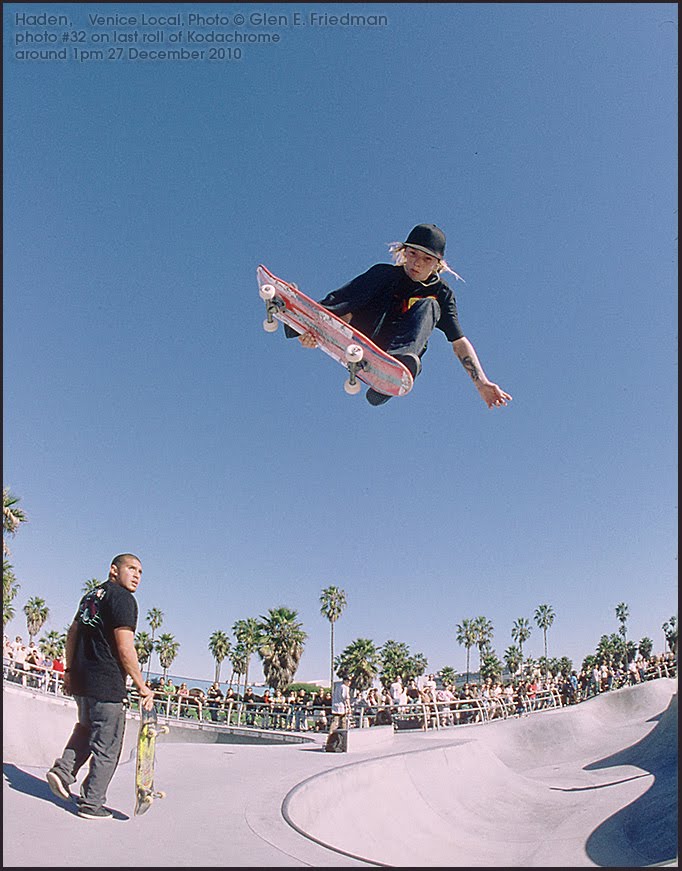
Well almost a month after I shot them, my last roll of Kodachrome film finally came back from the only lab on the planet that still processed the stuff, and no longer does. I was really hoping to shoot the last roll of Jay Adams since he was the subject of my 1st published photo, but parole difficulties had him back in Hawaii. Then I hit up Alva, who's always down to skate a secluded backyard pool, which would have been great, but he had a serious foot injury he was trying to heal while i was out west, so he couldn't be on it either. So I just headed down to the Venice skatepark made some calls on the way to one of my old best friends Steve Olson, see if he wanted to come down with his now "famous" son who's following in the footsteps. I also spoke to the folks at Juice magazine who mentioned the young local Haden McKenna, they have been trying to encourage to take a good path, so I kept an eye out for him, he' caught my attention briefly last year when i was out, besides I knew his father as a Marina skatepark local many years ago. So if he had a good attitude and was doing anything interesting i'd take a look through the lens and think about shooting.


(click on any of the images to see them bigger)

When I got there Haden was already warming up (btw. you may have seen the photos i posted last month of him from the same week while i shot him with a borrowed digital camera and got smashed in the face), got a call from Steve too, the Olson's, father and son were just a few minutes away. Got some cool stuff of the local and the old man, and even a good shot of the "kid" after harassing him about a sticker he had on the bottom of his board representing a company that stole from me, i wouldn't even point the camera in his direction until the sticker was removed, the "star" didn't take me seriously until an hour later so in the end we were both lucky i still had the last few frames I could shoot of him, including my very last one. Here they are, with a bonus shot of Jesse Martinez, the Godfather of the Venice Skatepark, I also shot on Kodachrome, on my second to last roll started a few days earlier.


p.s. don't be confused! Indeed this is my last Kodachrome ever, but by no means does that mean I have finished shooting on FILM, just not that type of film anymore.

ONWARD!

Thursday, January 27, 2011

We're Losing Our Intelligence -- How the Purge of True Dissent Has Starved Our Discourse

from TruthDig via AlterNet
By Chris Hedges

The blacklisted mathematics instructor Chandler Davis, after serving six months in the Danbury federal penitentiary for refusing to cooperate with the House Un-American Activities Committee (HUAC), warned the universities that ousted him and thousands of other professors that the purges would decimate the country’s intellectual life.

“You must welcome dissent; you must welcome serious, systematic, proselytizing dissent—not only the playful, the fitful, or the eclectic; you must value it enough, not merely to refrain from expelling it yourselves, but to refuse to have it torn from you by outsiders,” he wrote in his 1959 essay “...From an Exile.” “You must welcome dissent not in a whisper when alone, but publicly so potential dissenters can hear you. What potential dissenters see now is that you accept an academic world from which we are excluded for our thoughts. This is a manifest signpost over all your arches, telling them: Think at your peril. You must not let it stand. You must (defying outside power; gritting your teeth as we grit ours) take us back.”

But they did not take Davis back. Davis, whom I met a few days ago in Toronto, could not find a job after his prison sentence and left for Canada. He has spent his career teaching mathematics at the University of Toronto. He was one of the lucky ones. Most of the professors ousted from universities never taught again. Radical and left-wing ideas were effectively stamped out. The purges, most carried out internally and away from public view, announced to everyone inside the universities that dissent was not protected. The confrontation of ideas was killed.

“Political discourse has been impoverished since then,” Davis said. “In the 1930s it was understood by anyone who thought about it that sales taxes were regressive. They collected more proportionately from the poor than from the rich. Regressive taxation was bad for the economy. If only the rich had money, that decreased economic activity. The poor had to spend what they had and the rich could sit on it. Justice demands that we take more from the rich so as to reduce inequality. This philosophy was not refuted in the 1950s and it was not the target of the purge of the 1950s. But this idea, along with most ideas concerning economic justice and people’s control over the economy, was cleansed from the debate. Certain ideas have since become unthinkable, which is in the interest of corporations such as Goldman Sachs. The power to exclude certain ideas serves the power of corporations. It is unfortunate that there is no political party in the United States to run against Goldman Sachs. I am in favor of elections, but there is no way I can vote against Goldman Sachs.”

The silencing of radicals such as Davis, who had been a member of the Communist Party, although he had left it by the time he was investigated by HUAC, has left academics and intellectuals without the language, vocabulary of class war and analysis to critique the ideology of globalism, the savagery of unfettered capitalism and the ascendancy of the corporate state. And while the turmoil of the 1960s saw discontent sweep through student bodies with some occasional support from faculty, the focus was largely limited to issues of identity politics—feminism, anti-racism—and the anti-war movements.

The broader calls for socialism, the detailed Marxist critique of capitalism, the open rejection of the sanctity of markets, remained muted or unheard. Davis argues that not only did socialism and communism become outlaw terms, but once these were tagged as heresies, the right wing tried to make liberal, secular and pluralist outlaw terms as well. The result is an impoverishment of ideas and analysis at a moment when we desperately need radical voices to make sense of the corporate destruction of the global economy and the ecosystem. The “centrist” liberals manage to retain a voice in mainstream society because they pay homage to the marvels of corporate capitalism even as it disembowels the nation and the planet.

“Repression does not target original thought,” Davis noted. “It targets already established heretical movements, which are not experimental but codified. If it succeeds very well in punishing heresies, it may in the next stage punish originality. And in the population, fear of uttering such a taboo word as communism may in the next stage become general paralysis of social thought.”

It is this paralysis he watches from Toronto. It is a paralysis he predicted. Opinions and questions regarded as possible in the 1930s are, he mourns, now forgotten and no longer part of intellectual and political debate. And perhaps even more egregiously the fight and struggle of radical communists, socialists and anarchists in the 1930s against lynching, discrimination, segregation and sexism were largely purged from the history books. It was as if the civil rights movement led by Dr. Martin Luther King Jr. had no antecedents in the battles of the Wobblies as well as the socialist and communist movements.

“Even the protests that were organized entirely by Trotskyists were written out of history,” Davis noted acidly.

Those who remained in charge of American intellectual thought went on to establish the wider “heresy of leftism” in the name of academic objectivity. And they have succeeded. Universities stand as cowardly, mute and silent accomplices of the corporate state, taking corporate money and doing corporate bidding. And those with a conscience inside the walls of the university understand that tenure and promotion require them to remain silent.

“Not only were a number of us driven out of the American academic scene, our questions were driven out,” said Davis, who at 84 continues to work as emeritus professor of mathematics at the University of Toronto. “Ideas which were on the agenda a hundred years ago and sixty years ago have dropped out of memory because they are too far from the new center of discourse.”

Davis has published science fiction stories, is the editor of The Mathematical Intelligencer and is an innovator in the theory of operators and matrices. He is a director of Science for Peace. He also writes poetry. His nimble mind ranges swiftly in our conversation over numerous disciplines and he speaks with the enthusiasm and passion of a new undergraduate. His commitment to radical politics remains fierce and undiminished. And he believes that the loss of his voice and the voices of thousands like him, many of whom were never members of the Communist Party but had the courage to challenge the orthodoxy of the Cold War and corporate capitalism, deadened intellectual and political discourse in the United States.

During World War II Davis joined the Navy and worked on the minesweeping research program. But by the end of the war, with the saturation bombings of Dresden and Tokyo, as well as the dropping of the nuclear bombs on Hiroshima and Nagasaki, he came to regret his service in the military. He has spent most of his life working in a variety of anti-war and anti-nuclear movements.

“In retrospect I am sorry I didn’t declare myself as a conscientious objector,” he said. “Not at the beginning of the war, because if you are ever going to use military force for anything, that was a situation in which I would be happy to do it. I was wholehearted about that. But once I knew about the destruction of Dresden and the other massacres of civilian populations by the Allies, I think the ethical thing to do would have been to declare myself a CO.”

He was a “Red diaper baby.” His father was a professor, union agitator and member of the old Communist Party who was hauled in front of HUAC shortly before his son. Davis grew up reading New Masses and moved from one city to the next because of his father’s frequent firings.

“I was raised in the movement,” he said. “It wasn’t a cinch I would be in the Communist Party, but in fact I was, starting in 1943 and then resigning soon after on instructions from the party because I was in the military service. This was part of the coexistence of the Communist Party with Roosevelt and the military. It would not disrupt things during the war. When I got out of the Navy I rejoined the Communist Party, but that lapsed in June of 1953. I never got back in touch with them. At the time I was subpoenaed I was technically an ex-Communist, but I did not feel I had left the movement and in some sense I never did.”

Davis got his doctorate from Harvard in mathematics and seemed in the 1950s destined for a life as a professor. But the witch hunts directed against “Reds” swiftly ended his career on the University of Michigan faculty. He mounted a challenge to the Committee on Un-American Activities that went to the Supreme Court. The court, ruling in 1960, three years after Joseph McCarthy was dead, denied Davis’ assertion that the committee had violated the First Amendment protection of freedom of speech. He was sent to prison. Davis, while incarcerated, authored a research paper that had an acknowledgement reading: “Research supported in part by the Federal Prison System. Opinions expressed in this paper are the author’s and are not necessarily those of the Bureau of Prisons.”

Davis, who has lived in Canada longer than he lived in the United States, said that his experience of marginalization was “good for the soul and better for the intellect.”

“Though you see the remnants of the former academic left still, though some of us were never fired, though I return to the United States from my exile frequently, we are gone,” he said. “We did not survive as we were. Some of us saved our skins without betraying others or ourselves. But almost all of the targets either did crumble or were fired and blacklisted. David Bohm and Moses Finley and Jules Dassin and many less celebrated people were forced into exile. Most of the rest had to leave the academic world. A few suffered suicide or other premature death. There weren’t the sort of wholesale casualties you saw in Argentina or El Salvador, but the Red-hunt did succeed in axing a lot of those it went after, and cowing most of the rest. We were out, and we were kept out.”

“I was a scientist four years past my Ph.D. and the regents’ decision was to extinguish, it seemed, my professional career,” he said. “What could they do now to restore to me 35 years of that life? If it could be done, I would refuse. The life I had is my life. It’s not that I’m all that pleased with what I’ve made of my life, yet I sincerely rejoice that I lived it, that I don’t have to be Professor X who rode out the 1950s and 1960s in his academic tenure and his virtuously anti-Communist centrism.”

Chris Hedges, a Pulitzer Prize-winning reporter, is a senior fellow at the Nation Institute. He writes a regular column for TruthDig every Monday. His latest book is Empire of Illusion: The End of Literacy and the Triumph of Spectacle.

Wednesday, January 26, 2011

Thousands Of Fishermen Empty Lake In Minutes

On one day of the year the Dogon people of Mali can fish in the sacred water of Lake Antogo. It's every fisherman for himself as the lake is emptied in minutes.


thanks PreSurfer

Tuesday, January 25, 2011

Preparations for alien contact


from BoingBoing:
If we do make contact with extraterrestrial intelligence, what happens next? Well, assuming the ball is in our court, the Search for Extra-Terrestrial Intelligence (SETI) project has a plan. In fact, SETI even has a Post-Detection Taskgroup made up of scientists, journalists, philosophers, and, of course, science fiction writers. Astrobiologist Paul Davies of Arizona State University leads the bunch. From Smithsonian:
Their job is to advise relevant parties—other scientists, governments, the United Nations—about what to do if a SETI signal or any "putative evidence of extraterrestrial intelligence" were detected. While waiting for a contact, the group deliberates about what the consequences might be. While a discovery of microscopic life on another body in our solar system would be "of profound significance, which would change our worldview," Davies says, "it's not one of these things that is going to be disruptive to society." But the discovery of a signal from intelligent extraterrestrials could lead to "mayhem." (former of head of NASA's SETI program John) Billingham agrees. "Some people will think that this is a natural event in the continuing work on scientific questions," he says, and others will ask, in panic, "What do we do now?"

People would likely fall into two camps. Catastrophists, as one of the camps is called, might well predict the end of humanity as we know it, or at least the end of our current culture. In 2010 Stephen Hawking said that making contact with aliens would be "a little too risky" and compared the event to Columbus arriving in the New World, "which didn't turn out very well for the Native Americans." But millenarian enthusiasts anticipate revelations of rapture: how to cure cancer, solve the energy crisis or win world peace. And if aliens did manage to come to Earth, says (Center for SETI Research director Jill) Tarter, an admitted enthusiast, "they would likely have outgrown the aggressiveness that has served us so well."

"Ready for Contact"

Monday, January 24, 2011

Orson Welles's Future Shock documentary

Here, in five parts, is Orson Welles rather obscure documentary adaptation of Alvin Toffler's Future Shock.


"In 1970, sociologist and futurist Alvin Toffler, the Ray Kurzweil of his day, wrote a book entitled Future Shock, which proposed a certain distressing psychological state , induced by change so rapid the human mind can't digest it, and introduced the notion of "information overload" for the first time. In 1972, the book, already a bestseller, was adapted into a little-known documentary of the same name, narrated by Orson Welles. Exploring the shift from industrial society to what Toffler calls "super-industrial society," the film tackles notions of consumerism and information overload -- think BBC's The Century of the Self meets Nicholas Carr's The Shallows."


Thanks, BoingBoing

Sunday, January 23, 2011

Surfing Killer 30-40 Foot Waves in the Dark


from Surfer Mark Visser:
It wasn’t until I saw the pictures I realized how big it was. This project has been two years in the planning and it was the scariest, but most exciting thing I have ever done,” says Visser. “Riding in complete darkness meant I had to go off feeling. I had to zone out from how you normally ride and just be part of the wave. I am so pumped to achieve something that no one thought possible and that I was told was couldn’t be done.
Transworld Surf has the scoop. Read it here. via DangerousMinds

Saturday, January 22, 2011

To Play and To Fight

To Play and To Fight presents the captivating story of the Venezuelan Youth Orchestra System - an incredible network of hundreds of orchestras formed within most of Venezuela's towns and villages. Once a modest program designed to expose rural children to the wonders of music, the system has become one of the most important and beautiful music phenomena in modern history. To Play and To Fight presents interviews and performances by many of the world's most renowned musicians including the great tenor Placido Domingo, Claudio Abbado, Sir Simon Rattle, Guiseppe Sinopoli, and Eduardo Mata, as they reflect on the impact of such a far-reaching social project. The documentary also presents the inspirational stories of world class musicians who have been trained by the Venezuelan system, including The Berlin Philharmonic's youngest player Edicson Ruiz and world class conductor Gustavo Dudamel.

Friday, January 21, 2011

1986 New York City Hip-Hop Doc. from Holland uncovered

Incredibly classic Grand Master Flash, Doug E. fresh, Biz Markie, Roxanne Shante, Bill Adler and Russell Simmons in front of the the original Def Jam office at 298 Elizabeth street, I used to hang out at every day. Run-DMC also out in front of the office and in the studio, LL Cool J at his grandma's house i visited many times myself, his interview is incredible of the era. One of the original "Last Poets" gets his educational rap and hate on the current generation, then Schooly D. performing at the legendary "Latin Quarter" (what's got to be his worst song ever), and closes with a pretty cool interview.

Funny that when the film starts the RUN-DMC tour book i designed and photographed sits on the desk of the announcer.

via DangerousMinds
Shot in New York City in 1986 by Dutch filmmaker Bram van Splunteren, Big Fun In The Big Town contains a motherlode of amazing footage
I look at the new rock ‘n rollers…it’s a shame what they did to it, and I hope that rap don’t go that same route – where they take the rawness away…just then make it too pretty! I don’t think rock ‘n roll was meant to be pretty. Rock was meant to be bad – just like rap” - Schoolly-D