Showing posts with label 60's. Show all posts
Showing posts with label 60's. Show all posts
Wednesday, February 15, 2017


Saturday, November 7, 2015
Behind the scenes with James Bond in
'You Only Live Twice'
from Dangerous Minds:
GO See The New "SPECTRE" it's great!
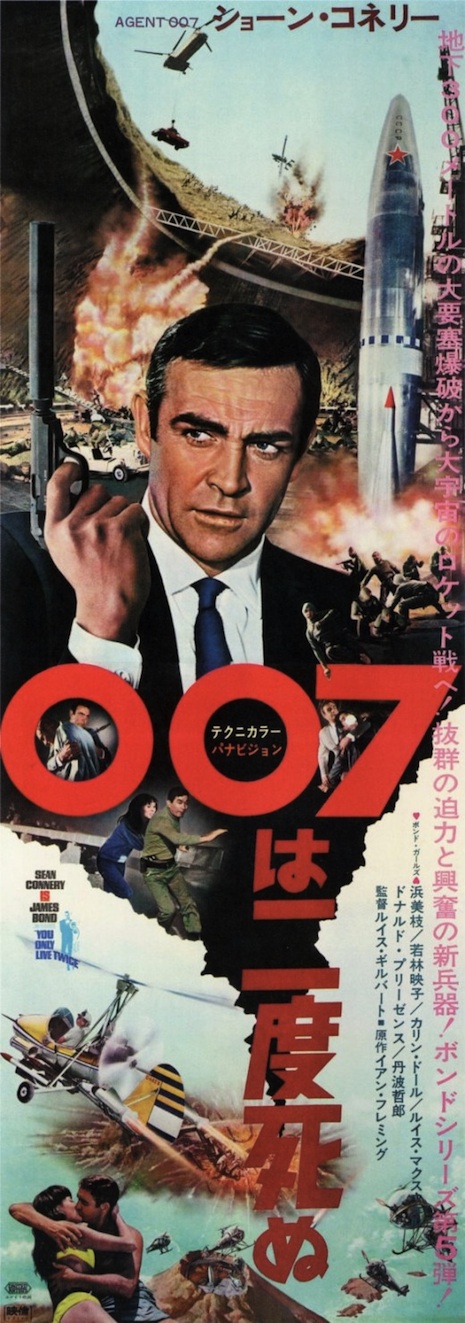
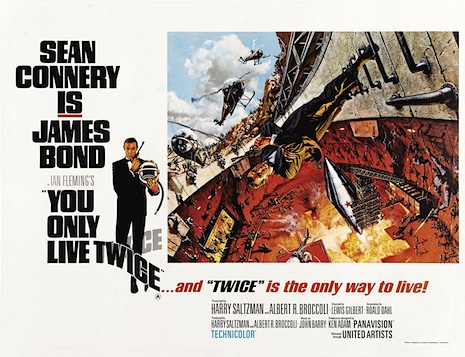
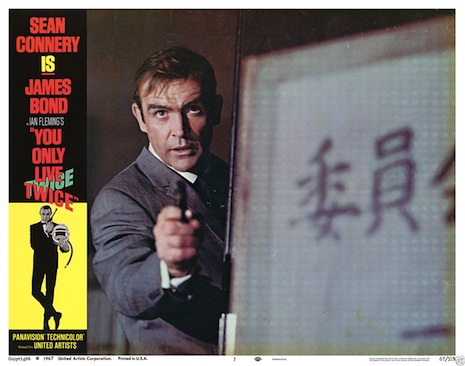
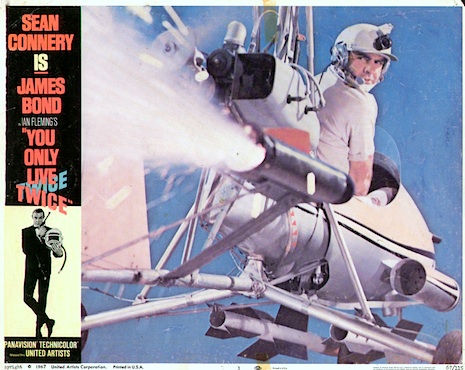
The revolution of the sixties kicked off on October 5th, 1962. This was the day The Beatles released their first single “Love Me Do” and Sean Connery was launched on to the big screen as James Bond in Dr. No. Between these twin poles of movies and music the decade began. By 1967, The Beatles were the most influential band on the planet while Connery was the world’s best known actor, and iconic star of the most successful movie franchise of all time.During the filming of the fifth James Bond movie You Only LIve Twice journalist and presenter Alan Whicker—best known for his rather snide, tabloid and often condescending reporting—made a documentary examining the success and cultural obsession with Ian Fleming’s super spy, or as he termed it “Bondomania.” Whicker bangs on about sex, sadism, amorality and violence, quizzing Connery, producers Cubby Broccoli and Harry Saltzman, and screenwriter Roald Dahl—who disagrees with Whicker’s insinuation, describing Bond as a “tough, rather insensitive fellow who’s very good at his job.”
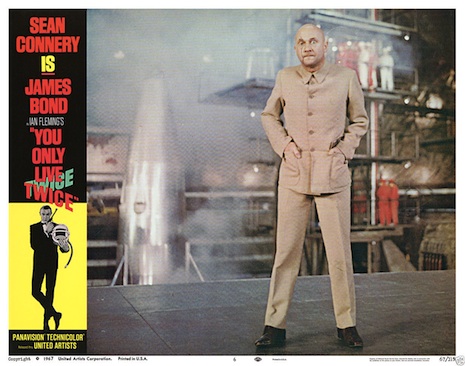
The Bond format of gadgets, girls and guns was set by the previous two movies Goldfinger and Thunderball. This time Dahl’s screenplay pushed the form to the limit—dumping most of Ian Fleming’s original novel and inventing his own comic book narrative—an action scene on average every five minutes—throwing Bond into unrelenting danger until the final climactic moments.Dahl considered You Only Live Twice to be “Fleming’s worst book, with no plot in it,” and he therefore filled the movie with his own quirky inventions—rocket gobbling spacecraft, a volcanic island disguised as a mini Cape Canaveral, and so on. I think Dahl’s criticism harsh, as I am on the side who think Fleming’s books are actually superior to the films, as they reveal a conflicted Bond, insecure, violent, remorseful, smoking, drinking and popping pills to keep himself functioning. Fleming gave Bond an emotional narrative—from strong, confident agent to broken, haunted spy obsessing over his own mortality—which the films have generally ignored.
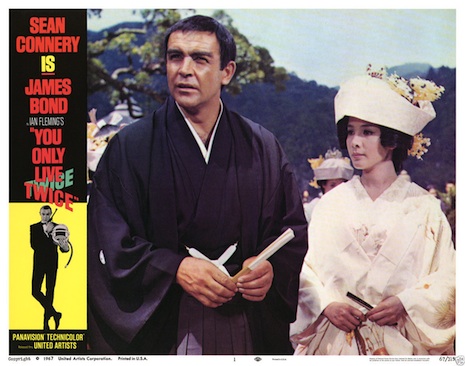
You Only Live Twice was the last Bond novel published in Fleming’s lifetime—he died of a heart attack, aged 56, two months after its appearance—the last novel The Man with the Golden Gun and the story collection Octopussy and The Living Daylights were published posthumously. The film was to be Connery’s last Bond until Diamonds Are Forever in 1971. The title comes from a haiku Bond writes when he is “reborn” as “Taro Todoroki,” a mute Japanese coal miner, to gain access to Dr. Guntram Shatterhand or rather Ernst Stavros Blofeld’s Garden of Death.
You only live twice:
Once when you are born
And once when you look death in the face.In Whicker’s film Sean Connery ‘fesses up to having only read one-and-half of the Fleming’s novels (which two I wonder?), and said that although he liked the author, he thought Fleming had no sense of humor. It’s one of the many little highlights this Whicker’s World special contains (others include Ken Adams discussing his set design—which apparently cost as much as the first Bond Dr. No—and an interview with Roald Dahl), but as Whicker obsesses about the “sadism and sex,” he tends to ignore the bigger issue why Bond is such an attractive figure to millions of fans.
GO See The New "SPECTRE" it's great!
Tuesday, November 25, 2014
Skateboard Shindig! 1965
Classic Skateboarding and Music from the 1960's featuring 2013 Skateboarding Hall of Fame Inductee Wendy Bearer Bull riding the Skateboard.
Tuesday, March 4, 2014
Slot Car Racing?
check it out!

I took my son to Buzz's place out in Brooklyn this past weekend after finding out on line, there was only one Slot Car track left in the 5-Boroughs - "Buzz-A-Rama" - He's been there almost 50 years! We, as well as all the kids in the packed house, had a blast!
I did this stuff before Skateboarding, and before BMX, this shit is real Old School ...
here's how it was done in '66 in the UK
and here's a peek at the freak shit these old racers are doing now
(watch full screen to get full effect):
BUZZ-A-RAMA
Saturday, April 21, 2012
The Liver Birds

from DangerousMinds
Originally named The Debutones, England’s The Liverbirds (aka The Liver Birds) moved from Liverpool to Hamburg, Germany in 1963 where they became a popular band on the Star-Club circuit. Although they never became big stars their contribution to rock and roll is historically significant in that they were the first serious all-girl rock band to play their own instruments and do it on the same turf as male rock n’ rollers.
“Girls with guitars? That’ll never work”. John Lennon.
Well, it did work for The Liverbirds who managed to record two albums, achieve a Top 10 hit in Germany with their single, “Diddley Daddy,” and last four years before splitting up in 1967.
Pamela Birch - guitar/vocals, Valerie Gell - guitar/vocals, Mary McGlory - bass guitar/vocals, Sylvia Saunders - drums.
from Psychorizon
Have you ever wondered, how The Beatles would have looked like, if they were women? Well, here you go: The Liverbirds.
They were a female British Rock ‘n’ Roll band from Liverpool. The four band members Pamela Birch (vocals / guitar), Valerie Gell (vocals / guitar), Mary McGlory (vocals / bass guitar) and Sylvia Saunders (drums) have been active between 1962 and 1967. They were one of very few female bands on the Merseybeat scene and one of the first rock band, which consisted only of female members.
Valerie Gell, Sylvia Saunders, singer Irene Green and guitarist Sheila McGlory founded the band in early 1962 under the name “The Debutones“. Irene Green and Sheila McGlory left the band very early on and joined other bands. They were replaced by Mary McGlory – the sister of Sheila McGlory – and Pamela Birch.
The band’s name derived from the fictional figure of the Liver Bird, the Tower of the Liver Building, which is the symbol of their native Liverpool.
The Liverbirds achieved more commercial success in Germany than in their homeland. Early in their career, they followed in the footsteps of colleagues such as The Beatles and Rory Storm & the Hurricanes. In May 1964 the four girls first appeared in Hamburgs legendary “Star Club” as “the female Beatles” from Liverpool. There they were one of the top attractions and released two albums and several singles. One of these singles, a cover of Bo Diddley’s “Diddley Daddy”, climbed to number five on the German charts. In 1967, the band broke up, but still inspired lots of young rock musicians in the world for years to come.


Subscribe to:
Posts (Atom)


