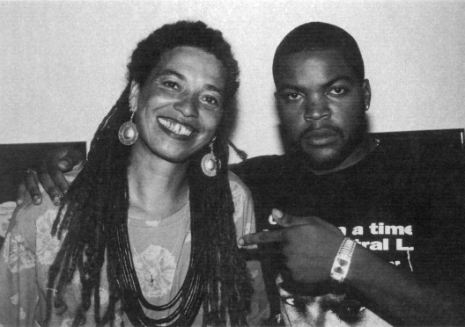
Before the release of Ice Cube’s Death Certificate, renowned black radical Angela Y. Davis interviewed him for Transition Magazine. It’s probably the first and last time a magazine has used a Gramsci quotation to introduce its readers to Ice Cube.
Davis, a former student of Herbert Marcuse, had been targeted by Governor Ronald Reagan in 1969 and 1970, when she was an assistant professor in UCLA’s Philosophy Department. At the governor’s urging, she was fired (twice), and Reagan vowed that she would never teach at the University of California again. Because who was better qualified to evaluate the work of philosophy professors than like Ronald Reagan? (Today, Davis is Distinguished Professor Emerita in the History of Consciousness and Feminist Studies Departments at UC Santa Cruz, and “Reagan” is a pair of syllables that stands for mental decay.) In ‘80, a decade after she was arrested because of her association with the Soledad Brothers, and again in ‘84, she was the vice-presidential candidate on the Communist Party USA ticket.
Ice Cube was coming from a different place. You couldn’t call his analysis Marxist, and “feminist” would have been a real stretch: he was reading The Final Call, not People’s World. This was during the period of Cube’s loudest advocacy for the Nation of Islam—before Friday, long before Are We There Yet?—when he was advocating black self-reliance (“We’ve got to start policing and patrolling our own neighborhoods,” he told Davis), endorsing an antisemitic NOI book called The Secret Relationship Between Blacks and Jews, and arguing that the Hon. Elijah Muhammad was more important than Malcolm X. He and Davis had plenty to talk about.
Angela Davis and Ice Cube in Transition #58
Hip-hop historian Jeff Chang, who thinks this meeting likely took place in July of ‘91, writes in Can’t Stop Won’t Stopthat publicist Leyla Turkkan set up the interview, hoping it would position Ice Cube as “an inheritor of the Black radical tradition.” Chang continues:
The interview was a provocative idea—one that both Davis and Cube welcomed. But none of them had any idea how the conversation would turn when they got together in Cube’s Street Knowledge business offices.
To begin with, Davis only heard a few tracks from the still unfinished album [Death Certificate], including “My Summer Vacation,” “Us” and a track called “Lord Have Mercy,” which never made it to the album. She did not hear the song that would become most controversial—a rap entitled “Black Korea.” In another way, she was at a more fundamental disadvantage in the conversation.
Like Davis, Cube’s mother had grown up in the South. After moving to Watts, she had come of age as a participant in the 1965 riots. While Cube and his mother were close, they often argued about politics and his lyrics. Now it was like Cube was sitting down to talk with his mother. Davis was at a loss the way any parent is with her child at the moment he’s in the fullest agitation of his becoming.
Cube sat back behind his glass desk in a black leather chair, the walls covered with framed gold records and posters for Boyz N The Hood and his albums. Copies of URB, The Source and The Final Call were laid out in front of him. Davis asked Cube how he felt about the older generation.
“When I look at older people, I don’t think they feel that they can learn from the younger generation. I try and tell my mother things that she just doesn’t want to hear sometimes,” he answered.
Read the Transition article in full here. According to Chang, Priority Records released a 20-minute cut of Davis/Cube as a promotional video. The MC is surprisingly soft-spoken in the short clip of the interview that aired on Rap City, which you can see below at the (cough) 4:20 mark.
Bye, Felicia.
Showing posts with label angela davis. Show all posts
Showing posts with label angela davis. Show all posts
Tuesday, February 23, 2016
Radical thinker Angela Davis interviews Ice Cube, 1991
from Dangerous Minds:



Sunday, July 7, 2013
The rise of Angela Davis posters
Collectors Weekly has an article about the rise of Angela Davis posters. (thanks BoingBoing)


read the whole piece here at Collectors Weekly


On August 18, 1970, Angela Yvonne Davis’s name was added to the FBI’s Ten Most Wanted List for kidnapping, murder, and interstate flight. Davis was already a darling of the left for her membership in the Communist Party and outspoken support for the Black Panthers, which caused then-California governor Ronald Reagan to personally orchestrate the 26-year-old’s dismissal from a teaching post at UCLA. Being hunted by J. Edgar Hoover for a crime she clearly did not commit took Davis’s celebrity to a whole new level, instantly making her as famous or infamous, depending on your point of view, as revolutionaries such as Che and Mao.continued...
“I saw her as a righteous woman, a sister, an elder who didn’t crack.”
Almost from day one, posters were the way the world connected with Angela Davis. During the two months she was on the run, head shops did a brisk business selling reprints of the “Wanted” poster that graced the walls of post offices across the United States; by some accounts, Angela’s “Wanted” poster, with its appeal to call the FBI director personally at National 8-7117, was a better seller than hash pipes.
After she was apprehended on October 13, 1970, Davis’s release from prison became a cause célèbre—initially Aretha Franklin offered to post her bail, but in the end, after almost a year and a half in prison, it was a dairy farmer and a businessman who wrote the checks. During her incarceration, an international “Free Angela” movement sprang up. John Lennon and Yoko Ono recorded “Angela” for their album “Some Time in New York City.” Mick Jagger and Keith Richards wrote “Sweet Black Angel,” which was released on “Exile on Main Street.”
read the whole piece here at Collectors Weekly
Sunday, February 26, 2012
Angela Davis on eating chickens, Occupy, and including animals in social justice initiative of the 99%
from Sistah Vegan
On February 23, 2012, at University of California-Davis, I attended the Social Justice Teach-In. Keynote speaker was Angela Davis. I asked Angela Davis about extending compassion beyond humans as part of social justice and making Occupy Movement successful.
I got to ask her my question about something she alluded to in her keynote, that sounded like she is pro-vegan and anti-speciesist. My husband video recorded my question and the answer she gave me. I felt silly that I didn't have a copy of Sistah Vegan on me so she could have that reference! ARGGGHHH!!!
Wednesday, October 20, 2010
Angela Davis: the 40th Anniversary of Her Arrest and President Obama’s First Two Years
Cool interview from Democracy Now:
For over four decades, Angela Davis has been one of most influential activists and intellectuals in the United States. An icon of the 1970s black liberation movement, her work around issues of gender, race, class and prisons has influenced critical thought and social movements for years. She is a leading advocate for prison abolition, a position informed by her own experience as a fugitive on the FBI’s Top 10 most wanted list forty years ago. Davis rose to national attention in 1969 when she was fired as a professor from UCLA as a result of her membership in the Communist party and her leading a campaign to defend three black prisoners at Soledad prison. Today she is a university professor and the founder of the group Critical Resistance, a grassroots effort to end the prison-industrial complex. This year she edited a new edition of Frederick Douglass’s classic work, Narrative of the Life of Frederick Douglass, an American Slave, Written by Himself. We spend the hour with Angela Davis and play rare archival footage of her.
For over four decades, Angela Davis has been one of most influential activists and intellectuals in the United States. An icon of the 1970s black liberation movement, her work around issues of gender, race, class and prisons has influenced critical thought and social movements for years. She is a leading advocate for prison abolition, a position informed by her own experience as a fugitive on the FBI’s Top 10 most wanted list forty years ago. Davis rose to national attention in 1969 when she was fired as a professor from UCLA as a result of her membership in the Communist party and her leading a campaign to defend three black prisoners at Soledad prison. Today she is a university professor and the founder of the group Critical Resistance, a grassroots effort to end the prison-industrial complex. This year she edited a new edition of Frederick Douglass’s classic work, Narrative of the Life of Frederick Douglass, an American Slave, Written by Himself. We spend the hour with Angela Davis and play rare archival footage of her.
Subscribe to:
Posts (Atom)


