if there is one thing I have learned in my life from the concept drawings that i saw in the magazines as a kid that seemed unimaginable at the time, they eventually come true!
These few, similarly to the Mercedes clip i posted last year, are even more insane than the dream cars of my child hood, but they will probably happen sooner than we expect . . .
That said I have not owned a car for over 20 years, thankfully.
Living in NYC allows me the luxury of walking everywhere or using a pretty good MTA.
GEF
Showing posts with label cars. Show all posts
Showing posts with label cars. Show all posts
Wednesday, June 22, 2016


Thursday, November 15, 2012
2013 Motor Trend Car of the Year: Tesla Model S (it's ELECTRIC motherfuckers!)
Shocking Winner: Proof Positive that America Can Still Make (Great) Things
The 2013 Motor Trend Car of the Year is one of the quickest American four-doors ever built. It drives like a sports car, eager and agile and instantly responsive. But it's also as smoothly effortless as a Rolls-Royce, can carry almost as much stuff as a Chevy Equinox, and is more efficient than a Toyota Prius. Oh, and it'll sashay up to the valet at a luxury hotel like a supermodel working a Paris catwalk. By any measure, the Tesla Model S is a truly remarkable automobile, perhaps the most accomplished all-new luxury car since the original Lexus LS 400. That's why it's our 2013 Car of the Year.
Wait. No mention of the astonishing inflection point the Model S represents -- that this is the first COTY winner in the 64-year history of the award not powered by an internal combustion engine? Sure, the Tesla's electric powertrain delivers the driving characteristics and packaging solutions that make the Model S stand out against many of its internal combustion engine peers. But it's only a part of the story. At its core, the Tesla Model S is simply a damned good car you happen to plug in to refuel.
Engineering Excellence
Tesla claims it has 250 patents covering the Model S, and more pending. The body is light, thanks to its all-aluminum construction, yet strong and stiff. The front and rear suspension are also mostly aluminum. At the rear are extruded rear suspension links that provide the strength of forgings at much lower cost, while up front are hollow-cast front knuckles that weigh 25 percent less than a conventional knuckle of similar strength.
The electric motor sits between the rear wheels, contributing greatly to the 47/53-percent front/rear weight distribution. The motor is an AC-induction type, the basic principles of which were demonstrated in the 1880s by Nikola Tesla himself, and it doesn't need expensive rare earth metals. .
Tesla offers three lithium-ion battery packs for the Model S -- 40-kW-hr, 60-kW-hr, and 85-kW-hr -- that are claimed to provide ranges of 140, 200, and 265 miles, respectively. The base 85-kW-hr powertrain delivers a stout 362 hp and 325 lb-ft of torque, while the performance version makes 416 hp and 443 lb-ft.The battery packs are assembled at Tesla's plant in Fremont, California, using Panasonic cells with nickel-cobalt-aluminum cathodes. Situated under the floor, the battery pack is a stressed member that further improves torsional rigidity, and helps lower the car's center of gravity to just 17.5 inches, about the same as a Ford GT's.
SEE 55 Photos here >>>
Advancement in Design
Refreshingly, Tesla designer Franz von Holzhausen resisted the temptation to make the Model S look different for the sake of being different to call attention to the fact it has an electric motor. Former GM design boss Wayne Cherry, a consultant judge this year, summed up the exterior design theme of the Model S as "somewhat safe and conservative," but noted the beautifully executed design-enhancing proportions, the excellent stance and gesture, and the harmony and grace of its lines. His only criticism? "The front end is a missed opportunity to establish brand identity."
The Model S takes advantage of the packaging opportunities afforded by the compact EV powertrain. The cabin is roomy, though the raked roofline impinges on rear-seat headroom. With no engine up front, the "hood" covers a useful luggage space, and the rear hatch opens to a cavernous load area that gets even bigger when you fold the rear seats flat. Total load capacity is 63.4 cubic feet, not that far shy of the 63.7 cubic-feet in a Chevy Equinox, and despite its rakish looks, the Model S is the first hatchback in the world to offer third-row seating.
A number of the interior design solutions need more polish. However, all judges were impressed with the Tesla's unique user interface, courtesy of the giant touch screen in the center of the car that controls everything from the air-conditioning to the nav system to the sound system to the car's steering, suspension, and brake regeneration settings. The system means the Model S interior is virtually button-free, and the car has been effectively future-proofed: More functionality is only a software update away.
Efficiency
Whatever what you use -- gasoline, electricity, hamsters in a wheel -- making a vehicle move requires the consumption of energy. The laws of physics are immutable. The question is, how efficiently can it be done?
In the case of the Tesla Model S, the answer is very. The best energy consumption figure we've returned is 118 mpg-e for a 212-mile run from the eastern fringe of the Los Angeles sprawl to Las Vegas, Nevada. For the 313 miles of road loops during the COTY evaluation, where the car was driven at normal speeds by all the judges with the air-conditioning running, it averaged 74.5 mpg-e.
Impressive numbers, especially considering the 4766-pound Tesla Model S Signature Performance version will nail 60 mph in 4.0 seconds and the quarter in 12.4 seconds at 112.5 mph, with a top speed of 133 mph.
Read the rest here at MotorTrend.com
Sunday, November 4, 2012
George Barris, the 87-year-old King of "Kar Kustomizers," Profiled in LA Times
This guy was an incredible inspiration to so many of us in the late sixties as kids and to so many more as teenagers. Great piece. Watch the video at least.


By W.J. Hennigan, Los Angeles Times
Cut-up photographs of a black Ford F-150 lie scattered across George Barris' desk, forming a mosaic of fenders, headlamps and rear-quarter panels.
Barris' eyes flicker over each fragment as he rearranges the parts of a normal-looking pickup truck and transforms it into the lunatic hot rod vision he has bouncing around in his head.
He dabs glue onto one scrap and sets it on paper. Then, another and another. Finally, he stands back and examines what has come together. The disorder has taken the shape of a mean-looking motor machine with a modified front grill, flared fenders and enlarged hood scoop.
"Pretty cool, isn't it?" he asks. "Wait until you see the real thing."
Barris has worked this way — using scissors and glue — for the last 70 years, taking ordinary vehicles and mutating them into hell-for-leather roadsters. Many of them have found a place in automotive history.
Others have been immortalized on television and in the movies. He turned a 1955 Ford Lincoln Futura into the Batmobile. He stretched out a Model T body and, with a few tweaks, made it into the ghastly vehicle that the Munsters drove in the TV show.
Barris, 87, was one of the first Southland car customizers to chop, channel and re-engineer automobiles. Detroit produced the cars, but it was Southern California that souped them up, customized them and delivered hot rods.
What began as a slightly subversive trend in the '40s is now a bona fide profession, running at full speed today behind garage doors — even in a world where gas-sipping hybrids and subcompact cars seem to be getting all the attention.
Many hot rodders and customizers see their work as art and Barris as an old master.
"He's a legend when it comes to developing the passion, sport or whatever you want to call the hot rod industry," said Troy Ladd, the founder of Hollywood Hot Rods, a custom car shop in Burbank.
Barris will hold court this week in Las Vegas, where about 125,000 hot rodders and auto enthusiasts are expected to gather for an annual after-market car trade show. He will be wearing his signature wraparound rose-colored sunglasses and bright yellow windbreaker with Barris Kustom Industries stitched on the back.
---
Barris' love of cars came early. By the time he was 7 years old, he was piecing together balsa wood car models, changing the way they'd look, maybe with a dash of paint or a modification to the body. His attention to detail paid off. It didn't take long before he was entering and winning model contests sponsored by hobby shops.
His family wanted him to work at its Greek restaurant in a Sacramento suburb, but Barris resisted. When he was a teenager, he rushed to sweep floors at a local auto body shop as soon as school let out. Before long, he was handling a blowtorch, shaping the immense metal auto bodies of the era.
When he turned 18, Barris left and moved to Los Angeles to become part of the emerging teen car culture. With his savings, he opened Barris Custom Shop on Imperial Highway in Bell. He later switched it to "Kustom" because it looked more creative.
"Because I was Greek, I spelled it with a K," Barris said. "I wish I would have trademarked that. I'd be a millionaire."
He would try anything to get the right look. Barris would cut a car's suspension coils so it would ride lower in front and be kicked up in the rear. He'd "french" the headlights, meaning he'd mold them into the body to get a smoother look on the car. Once, to get the ideal shade of pearl, he grated the scales off a sardine and mixed them up in paint.
He and other teenagers showed off their flashy custom cars at drive-ins and hamburger stands across Southern California. Barris' 1936 Ford roadster drew a lot of admiring looks. He gave it a custom silver paint job and removed the door handles to make it look more streamlined. He took the running boards off and shaved the fenders to make the front end pointed.
"I had just come from Sacramento, and I wasn't supposed to know anything," Barris told Tom Wolfe in "The Kandy-Kolored Tangerine-Flake Streamline Baby," a book of essays that celebrated SoCal's custom car industry. "I was a tourist but my car was wilder than anything around. I remember one night this kid comes up with a roadster with no handles. It looked real sharp, but he had to kick the door from the inside to open it. You should have seen the look on his face when he saw mine — I had the same thing, only with electric buttons."
Soon, Barris' custom cars were causing a buzz. People sought him out, and his business took off.
His work caught the attention of Robert E. Petersen (the name behind Petersen Automotive Museum), who published Hot Rod, Street Rodder and Motor Trend magazines. After Barris' curvy, candy-colored cars appeared in print in 1948, he began getting more attention than the top designers in Detroit. Hollywood took notice too.
In 1955, James Dean came in and asked Barris to work on his new Porsche Spyder. Barris employees painted the number 130, racing stripes and "Little Bastard" on the car.
Less than a month later, the Spyder was found wrecked at the junction of routes 466 and 41 near Paso Robles. Dean, who was behind the wheel, was killed.
"I told Jimmy he shouldn't drive all the way up there," Barris said. "He wouldn't listen."
---
The entertainment industry turned to Barris to create cars for films with titles like "High School Confidential!" (1958) and "For Those Who Think Young" (1964). More cars ended up becoming major figures in scripts.
When producers of the "Batman" television show asked for a car that Adam West could battle villains with, Barris turned out a midnight-black and fluorescent-red pinstriped monster. The car features bulletproof plexiglass bubble windshields; the Bat Ray (dual 450-watt laser beams that blasted obstacles to bits); the Bat-O-Meter, which identified where the bad guys were; and the oil squirters (once lawn sprinkler heads) to foil evildoers.
"I saw the script and it said, 'Bang,' 'Pow,' 'Boom,' " Barris said. "That's exactly what I wanted the car to be able to do. I wanted it to be as big a character as the actors themselves."
Barris said he transformed the Lincoln in just 15 days for $15,000.
Producers of "The Munsters" asked Barris to get a hearse for the TV family's car. But he had a better idea: He welded together three Model T bodies, put casket handles around the engine and decked out the interior in blood-red velvet.
Under the hood, he put a Ford Cobra engine with 10 chrome-plated carburetors. Barris designed and built it for $18,000 and called it "The Munster Koach."
Elvis Presley, a frequent customer, became a close friend. Barris decorated the ceiling of Elvis' 1960 Cadillac limo with gold records and built in a 24-karat gold cabinet with a gold-plated swivel for a TV.
Frank Sinatra asked Barris to darken all his car windows because he didn't like being recognized. After Barris blacked them out, Sinatra complained, saying, "George, I couldn't see a … thing."
Michael Jackson came in with a Rolls-Royce, which had been scratched up: "My car has been hurt," Barris recalled Jackson telling him. Barris said he would fix it in the next day or two. Jackson left but came back half an hour later and put Band-Aids over every single scratch.
Barris has a photo of Jackson and almost every other star who walked into his shop. The postcard-sized shots line the walls of his shop in North Hollywood.
There he is standing next to Bob Hope. Chatting up John Wayne about a station wagon. Grinning alongside John Lennon and Yoko Ono.
"They were friends who wanted outrageous things done to their automobiles," Barris said. "And they knew I could make it happen."
---
Although his work is widely regarded, Barris hasn't escaped critics. He is known as a ceaseless promoter, and some say he claims credit for work that isn't his.
One time in front of his shop, he showcased the famous DeLorean DMC-12 featured in the "Back to the Future" films. Universal Studios, believing that Barris was misrepresenting his involvement with the movie, obtained a cease-and-desist court order in 2007.
Barris said the car belonged to a friend. He said he had never claimed he built or designed it and had displayed it to promote the car industry. "That's my passion, and something I've always done," he said.
Barris still rides around in style. His everyday car is a gold-painted Toyota Prius with emerald green metallic accents. Its doors? They slide up, opening like a Lamborghini.
Barris Kustom Industries is now on Riverside Drive in North Hollywood. It is packed with toy cars and action figures and posters from the projects Barris worked on. Some of those famous cars, including the original Batmobile and the Munster Koach, are stored in a gallery there.
Barris' phone — its ring tone is a familiar theme song: "Na na na na na ... Batman" — doesn't ring nearly as often with crazy requests as it once did. He's always had help running the business. First he worked with his brother, Sam. Then with his wife, Shirley. Now his daughter and other family members have taken on a larger role.
His grandson Jared, 23, took what Barris had pasted on paper and created a computerized model of the reimagined F-150. The two said they blended their "new school and old school" techniques and refined the truck's design. Then they fabricated a custom grill. They lowered the frame about 10 inches. They built new side rails on the bed of the truck.
After five months, they ended up with a black-and-red roadster with sharp bat-wing fenders — a new spin on the classic Batmobile.
There's a video, too (non-embeddable).

Monday, September 10, 2012
Comedians in Cars Getting Coffee :
Mad Man in a Death Machine
Jerry Seinfelds's guest is Ricky Gervais in this episode of Comedians In Cars Getting Coffee.
Sunday, June 26, 2011
Transparent Pontiac for sale

from BoingBoing
This beautiful, skeletal Pontiac was built for the GM pavilion at the 1939 New York World's Fair. It's up for auction in Plymouth, Michigan, with an estimated sale price of $275,000 - $475,000.As of yet, RM doesn't have any detailed information about the Pontiac, but from an article in Special Interest Autos #34, we see that GM built two - possibly three - transparent cars for the New York World's Fair of 1939-1940, one of which was a Deluxe seven-window touring sedan (B-body), the other of which was a Torpedo five-window touring sedan (C-body)...The Tin Indian that wasn't: RM to offer see-through Pontiac
Visitors to General Motors' "Highways and Horizons" pavilion at the 1939-40 New York World's Fair came away awed by a vision of the future. The work of renowned designer Norman Bel Geddes, GM's "Futurama" exhibit foretold the communities and transportation systems of 1960, many of which came to pass. Other peeks at the future included "Previews of Progress," inventions that seemed like magic: "Yarns made of Milk! Glass that bends! The Frig-O-Therm that cooks and freezes at the same time! The Talking Flashlight transmitting speech over a light beam!" exclaimed the exhibit's guidebook. Sharing top billing with the Futurama and Previews of Progress, however, was the "'Glass' Car - The first full-sized transparent car ever made in America."
Thursday, June 23, 2011
Hot Wheels!
Tanner Foust, an American professional racing driver and stunt driver, broke the world record for a distance jump in a four-wheeled vehicle at the Indianapolis 500 on May 29th, 2011. Watch as Tanner Foust drops 10 stories down 90 feet of orange track and soars 332 feet (101 meters) through the air.
quick replacement for the deleted video below
Thanks, Presufer
quick replacement for the deleted video below
Thanks, Presufer
Tuesday, January 18, 2011
Cruisin Casket for Only the Most Serious O.G.


For if you want to leave this world in style.thanks, Presurfer
Cruisin Caskets is the first and only of it's kind. We are a casket fabricating company that creates custom car designs for the car lover that wants to leave this world in style. We are currently taking orders for a 1950's style Merc coffin.
The specially designed, car-shaped coffin opens as conventional coffins do, with a hinged top portion, and features the same type of upholstered interior as standard coffins. Cruisin Caskets have a fiberglass body and may come in a variety of paint colors and designs.
Sunday, January 16, 2011
Super Cars of the Future: Inspiring Future thinking in Car Design
Love/Hate relationship with automobiles continues:
from Design Juices
this storyy "The EN-V – Is this the Car of the Future?" should make up for the above
from Design Juices
I think we have all ambitions to own a super car in the future, maybe your even lucky enough to be close to reaching that ambition. Whether your after and old school american muscle car, or a new-wave carbon fibre body super car; we are all interested in the new technologies of making the car as sexy in its aesthetics and also as fast as possible.
Here I look to highlight and showcase several amazing concept (and possible production) super cars who are all using new technologies and new ways of designing the super car of the future.
SC Ultimate Aero 2
This is the super car which is on its way to becoming the fastest mass-production car; the SC Ultimate Aero 2. It can achieve a maximum speed of 440km/h, its modern design is the work of Jason Castriota and takes advantage of Carbon Fibre. The SC Ultimate Aero 2 is available at a snap at €696,000. Found on Fubiz
Halo Intersceptor
You maybe thinking what if i could combine my personal super car and boat; well now you can with the Halo Inspector. This hybrid vehicle concept aims to become the icon on every extreme sports addict, its aesthetics certain attract your eyes attention. Found on Tuvie.
Hussar Dakar
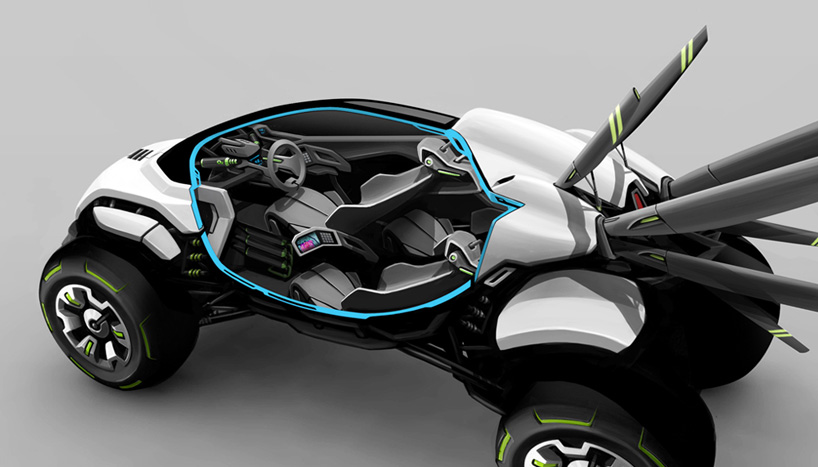
This vehicle is a concept that design Klaud wasiak has taken inspiration from winged polish calvary soldiers names hussars; the Hussar Dakar. The car is designed as a rally car and uses the wings to create kinetic energy during the vehicles movement. Found on Design Boom.
Citroen Survolt & Agni Z2<
These two machine have been designed to compliment one another; Citroen Survolt and Agni Z2. The two of them are both powered with a electric drivetrain and make them a team of almost silent racers, it also features an emission-free and eco-friendly engine which ensure smooth driving up to 200km/h. Found on Tuvie.
Mob Sports Car (Made from Wood)
The Mob is an extreme racing sports car which has been designed by Jorge Marti vidal, the whole car is envisioned to be created with a strip; two films that create the vehicles structure. The idea would be to use liquid wood, organic material sthat come from waste wood and can be moulded into different shapes. From Tuvie.
AMV-R
This design is the work of Alexei Mikhailov, it is almost a mis-mash of different styles; it encorporate both Italian and German design. It works with the pure italian fluid (almost) organic design and the German sports lines, which emphasise the overall quality of the cars design. Found on Tuvie.
Tesla EYE Concept
Considering there’s almost no chance we’ll ever see the EYE concept cruising the streets, we’ll just have to enjoy the car for what it is: a good-looking show car with a Tesla badge. Sure, we can imagine putting an electric powertrain in there and showing up at the soccer game in one of these, but for now we’ll just have to ask ourselves if the IED students managed to create a new status symbol with the EYE, something they said they were shooting for. From Autoblog.
Lamborghini Concept EV
Flavio Adriani, the designer, created the Lamborghini Concept EV as a tribute to the man who changed everything about sportcars, Ferrucio Lamborghini. The design, the lines, the impact of the car derive from a beautiful, almost perfect combination of the Diablo and Gallardo. Found on Tuvie.
Saab Spyker 9+ Tribue
The Saab Spyker 9+ Tribute is a concept car imagined by Swedish designer Eduard Gray, graduate of the Coventry University (UK), with a Bachelor Degree 2:1 in Industrial Product Design.The exterior design is pure Saab, featuring simple lines, turbine-style wheels, trademark headlights and the Saab grille, but also a big windshield that extends over the entire roof top. Via Concept Supercars.
Audi A0 QS
The Audi A0 QS, Q stands for four-wheel drive and S for sports, has been specially designed for athletes and rich people to enhance their active lifestyles. This small and dynamic sports car is equipped with electric motor and a hydrogen engine that make the car entirely hybrid. Found on Tuvie.
Bentley Aero Ace Speed VI Concept
The Bentley Aero Ace project Speed VI concept car is an independent design proposal from Royal College of art student Gabriel Tam. The designer has given the Speed VI concept a futuristic treatment, but at the same time, the concept looks back at the original Bentley Speed 6 for inspiration, and seeks to celebrate the sporting heritage of Bentley. Found via Greenpacks.
Lamborghi Countach EV Concept
The design of the Lamborghini Countach EV, a 3D concept electric car, has been inspired by the fascinating Countach by Marcello Gandini which is an unforgettable piece for every Lamborghini fans. This redesigned car features more clean curves without changing the standard appearance such as doors, wings, front lights, etc. Found on Tuvie.
Mobius Car
The vehicle you’re about to glance upon is the Mobius, this one designed by Tommaso Gecchelin who aims to merge aesthetic suggestions of both math and geometry into one harmonious shape. Via Yanko Design.
Opel Flextreme GT/E Concept
Opel is all set to unveil its new concept car at the 80th edition of the Geneva Motor Show, the Opel Flextreme GT/E. The idea of this concept is to show how extended-range electric vehicle (E-REV) systems can be integrated into larger cars, a mid-size five-door hatchback in this case. Via Concept Supercars.
TVR Throne Concept Car
Hussien Al Jammazi has envisioned an excellent and unique car concept name TVR Throne that has all the aesthetical aspect to make a person get amazed. The designer has given his maximum effort to make unique components for the car. From Tuvie.
Ghepardo De Tomaso
Designer Frederik Tjellsesen has done one heck of a job creating a concept to catch their eye. Tjellsesen’s created a four-door sports car by the name of “Ghepardo,” accenting the fabulously modern gray with a smooth, sensual purple. From Yanko Design.




this storyy "The EN-V – Is this the Car of the Future?" should make up for the above
Saturday, December 18, 2010
Revenge Of The Electric Car Trailer Hits!
One of my favorite documentaries of the last 5 years "Who Killed The Electric Car" is about to be followed up with it's sequel! "RevengeOf The Electric Car".
While Bill O’Reilly and David Letterman sit wondering where all the electric cars are, Director Chris Paine has actually been out there documenting their resurgence. The result is his documentary “Revenge of the Electric Car”, a sequel to the hit 2006 film “Who Killed the Electric Car?”.from Ecorazzi
With their official Facebook page hitting 10,000 fans this week, the first trailer for the flick (complete with thumping Gregorian chants) is now online. In an email to AutoblogGreen, the producers wrote, “The fact that so many people want to see this film and spread the word proves how important it is for everyone to learn about electric vehicles as an alternative to gasoline-powered cars and to be informed about new developments in EV production and what kind of options there are out there for consumers ready to shift into an electric gear.”
Check out the trailer below.
Wednesday, October 13, 2010
Car Part Art
James Corbett makes cool pieces of art from old car parts.
From his website:


from Now That's Nifty
From his website:
James, from Ningi, Queensland, Australia has been sculpting his incredibly life like pieces since early 1999, and since that time his unique works have found homes in all capital cities in Australia, also England, Switzerland, New Zealand, Japan, the United Arab Emirates and the U.S.A. He discovered his talent for creating his amazing pieces of art whilst running an auto recycling business in Brisbane.


from Now That's Nifty
Sunday, October 10, 2010
Cars that Drive Themselves, in Traffic

smarter than you think
Google Cars Drive Themselves, in Traffic
from the New YorkTimes: by JOHN MARKOFF
MOUNTAIN VIEW, Calif. — Anyone driving the twists of Highway 1 between San Francisco and Los Angeles recently may have glimpsed a Toyota Prius with a curious funnel-like cylinder on the roof. Harder to notice was that the person at the wheel was not actually driving.Woody Allan had them in "Sleeper" and every time I go to Los Angeles and have to drive I think "why not?" Next thing i'll be looking for will be electric power strips in the road similar to the old "slot cars" we used to race as kids, powering and guiding the automobiles.
The car is a project of Google, which has been working in secret but in plain view on vehicles that can drive themselves, using artificial-intelligence software that can sense anything near the car and mimic the decisions made by a human driver.
With someone behind the wheel to take control if something goes awry and a technician in the passenger seat to monitor the navigation system, seven test cars have driven 1,000 miles without human intervention and more than 140,000 miles with only occasional human control. One even drove itself down Lombard Street in San Francisco, one of the steepest and curviest streets in the nation. The only accident, engineers said, was when one Google car was rear-ended while stopped at a traffic light.
Autonomous cars are years from mass production, but technologists who have long dreamed of them believe that they can transform society as profoundly as the Internet has.
Robot drivers react faster than humans, have 360-degree perception and do not get distracted, sleepy or intoxicated, the engineers argue. They speak in terms of lives saved and injuries avoided — more than 37,000 people died in car accidents in the United States in 2008. The engineers say the technology could double the capacity of roads by allowing cars to drive more safely while closer together. Because the robot cars would eventually be less likely to crash, they could be built lighter, reducing fuel consumption. But of course, to be truly safer, the cars must be far more reliable than, say, today’s personal computers, which crash on occasion and are frequently infected.
The Google research program using artificial intelligence to revolutionize the automobile is proof that the company’s ambitions reach beyond the search engine business. The program is also a departure from the mainstream of innovation in Silicon Valley, which has veered toward social networks and Hollywood-style digital media.
During a half-hour drive beginning on Google’s campus 35 miles south of San Francisco last Wednesday, a Prius equipped with a variety of sensors and following a route programmed into the GPS navigation system nimbly accelerated in the entrance lane and merged into fast-moving traffic on Highway 101, the freeway through Silicon Valley.
It drove at the speed limit, which it knew because the limit for every road is included in its database, and left the freeway several exits later. The device atop the car produced a detailed map of the environment.
The car then drove in city traffic through Mountain View, stopping for lights and stop signs, as well as making announcements like “approaching a crosswalk” (to warn the human at the wheel) or “turn ahead” in a pleasant female voice. This same pleasant voice would, engineers said, alert the driver if a master control system detected anything amiss with the various sensors.
The car can be programmed for different driving personalities — from cautious, in which it is more likely to yield to another car, to aggressive, where it is more likely to go first.
Christopher Urmson, a Carnegie Mellon University robotics scientist, was behind the wheel but not using it. To gain control of the car he has to do one of three things: hit a red button near his right hand, touch the brake or turn the steering wheel. He did so twice, once when a bicyclist ran a red light and again when a car in front stopped and began to back into a parking space. But the car seemed likely to have prevented an accident itself.
When he returned to automated “cruise” mode, the car gave a little “whir” meant to evoke going into warp drive on “Star Trek,” and Dr. Urmson was able to rest his hands by his sides or gesticulate when talking to a passenger in the back seat. He said the cars did attract attention, but people seem to think they are just the next generation of the Street View cars that Google uses to take photographs and collect data for its maps.
The project is the brainchild of Sebastian Thrun, the 43-year-old director of the Stanford Artificial Intelligence Laboratory, a Google engineer and the co-inventor of the Street View mapping service.
In 2005, he led a team of Stanford students and faculty members in designing the Stanley robot car, winning the second Grand Challenge of the Defense Advance Research Projects Agency, a $2 million Pentagon prize for driving autonomously over 132 miles in the California desert.
Besides the team of 15 engineers working on the current project, Google hired more than a dozen people, each with a spotless driving record, to sit in the driver’s seat, paying $15 an hour or more. Google is using six Priuses and an Audi TT in the project.
The Google researchers said the company did not yet have a clear plan to create a business from the experiments. Dr. Thrun is known as a passionate promoter of the potential to use robotic vehicles to make highways safer and lower the nation’s energy costs. It is a commitment shared by Larry Page, Google’s co-founder, according to several people familiar with the project.
The self-driving car initiative is an example of Google’s willingness to gamble on technology that may not pay off for years, Dr. Thrun said. Even the most optimistic predictions put the deployment of the technology more than eight years away.
One way Google might be able to profit is to provide information and navigation services for makers of autonomous vehicles. Or, it might sell or give away the navigation technology itself, much as it offers its Android smart phone system to cellphone companies.
But the advent of autonomous vehicles poses thorny legal issues, the Google researchers acknowledged. Under current law, a human must be in control of a car at all times, but what does that mean if the human is not really paying attention as the car crosses through, say, a school zone, figuring that the robot is driving more safely than he would?
And in the event of an accident, who would be liable — the person behind the wheel or the maker of the software?
“The technology is ahead of the law in many areas,” said Bernard Lu, senior staff counsel for the California Department of Motor Vehicles. “If you look at the vehicle code, there are dozens of laws pertaining to the driver of a vehicle, and they all presume to have a human being operating the vehicle.”
The Google researchers said they had carefully examined California’s motor vehicle regulations and determined that because a human driver can override any error, the experimental cars are legal. Mr. Lu agreed.
Scientists and engineers have been designing autonomous vehicles since the mid-1960s, but crucial innovation happened in 2004 when the Pentagon’s research arm began its Grand Challenge.
The first contest ended in failure, but in 2005, Dr. Thrun’s Stanford team built the car dubbed Stanley that won a race with a rival vehicle built by a team from Carnegie Mellon University. Less than two years later, another event proved that autonomous vehicles could drive safely in urban settings.
Advances have been so encouraging that Dr. Thrun sounds like an evangelist when he speaks of robot cars. There is their potential to reduce fuel consumption by eliminating heavy-footed stop-and-go drivers and, given the reduced possibility of accidents, to ultimately build more lightweight vehicles.
There is even the farther-off prospect of cars that do not need anyone behind the wheel. That would allow the cars to be summoned electronically, so that people could share them. Fewer cars would then be needed, reducing the need for parking spaces, which consume valuable land.
And, of course, the cars could save humans from themselves. “Can we text twice as much while driving, without the guilt?” Dr. Thrun said in a recent talk. “Yes, we can, if only cars will drive themselves.”

Thursday, September 9, 2010
GM’s assembly line delivers bouncing baby Volt
 Director Chris Paine (above) is still filming the follow-up.
from his "Revenge of the Electric Car" blog, the director of one of the great documentaries of the last decade: "Who Killed The Electric Car".
Chris Paine and the Revenge crew (Sean, Craig, Jessie, and Jessica) are proud to say that they are among the first film crews ever to professionally film mass production of an EV. (Of course, this is mostly because no one has made them in so long.) Since GM will be one of the first to the EV market with its Volt in 2011, we came to film them being put together through the multiple stages of the car manufacturing process. Chris is pleased to announce that he and his crew were there live to see the completion of Chevy Volt pre-production car #100 at the Hamtramck Assembly Plant in Michigan. The delivery was made at 9:25AM, August 25, 2010. The baby is 177 inches, 3500 pounds. One fine beauty. And accompanied by quite a few of the Volt’s siblings in all colors.and in the comments section i found this little diddy:
How the world has changed in five years!In 2005 we were editing Who Killed the Electric Car? and trying to put together the pieces behind the ridiculous decision by car makers to terminate their advanced electric car programs. Now here we are in 2010, as welcomed guests of GM no less, watching electric cars roll off the assembly line for the first time since the EV1 stopped production in 1999. So it was very, very cool to see! And we feel that some very real changes are coming to the car industry.
In short, we had a great final shoot in Detroit.
Being in a state-of-the-art factory certainly updates every cliche of 1950′s car manufacturing. Robotic body and frame welding, magnetic delivery systems for motor/engine marriage to the carriage, dashboard installation by hand, battery pack installation by dolly, tires being torqued into position by wrench jockeys… it was a glorious sight. Hamtramck has an extremely complex integration of Auto Union procedures (and Hamtramck has a great local Union from what we could tell), management, workers, managers, conveyor belts carrying car parts, hundreds of components and thousands of processes. Torque pressure monitors, zipping airguns, palettes of parts, and layers of quality control processes. People plus machines plus computers plus experience.Our favorite visuals of the shoot were or those Volts being manufactured on the same line as old-school gasoline guzzlers. How great to see a new Volt coming off the line after 6 Cadillac SRXs. With consumer demand for EVs (that means you, gentle reader) and continued government support, one day that ratio will be reversed. 1 Cadillac SRX to every 6 Volts. Or better yet the Cadillac SRXs will be electric too.


"Seems the electric car killer really hasn’t changed their ways".
Wednesday, September 1, 2010
Bike Lane Indicators Get Straight to the Point
from my friend Sean Bonner's Tumblr:

This photograph was taken by Carlton Reid, and the stencil street art it documents is the work of Peter Drew of Adelaide, Australia.

This photograph was taken by Carlton Reid, and the stencil street art it documents is the work of Peter Drew of Adelaide, Australia.
Wednesday, August 11, 2010
Ed "Big Daddy" Roth
Tales of the Rat Fink
the documentary is now online
Ed "Big Daddy" Ed Roth was an artist and cartoonist who created the hot-rod icon Rat Fink and other extreme characters. As a custom car builder, Roth was a key figure in Southern California's Kustom Kulture and hot-rod movement of the 1960s.
Lots of kids my age and older dudes were incredibly inspired by this guy. I met him and got a custom air brushed t-shirt from him at the Hot Rod show when it came to the New York Coliseum (which used to be up by Columbus circle here in NYC) back in the late 60's or early 70's. I saw the "Red Baron" there in person as well!
anyway, here's the doc:
Tales of The Rat Fink
(thanks, Luke)
Wednesday, June 23, 2010
Ingenious Flipper Bridge Melds Left-Side Drivers With Right-Side Drivers
or
How To Switch To The Other Side Of The Road Without Causing A Pile
from Fast Company
Hong Kong drives on the left side of the road, mainland China on the right. So how do you prevent crashes when driving between them?Thanks, Presurfer
One of the most vexing aspects of traveling between mainland China and Hong Kong is the car travel: People in the former drive on the right side of the road; people in the latter drive on the left (a vestige of the British empire).
So to quell confusion at the border and, more importantly, to keep cars from smashing into each other, the Dutch firm NL Architects proposed a brilliant, simple solution, the Flipper bridge.
The bridge does exactly what the name suggests: It flips traffic around. The key here is separating the two sides of traffic, using a figure-eight shape. One side of the road dips under the other, funneling cars that were traveling on the left to the right (and vice versa), without forcing them to encounter head-on traffic at an intersection. The bridge makes what should be a disorienting switch exquisitely easy. Check out PixelActive's 3D model of the traffic flow below:
Say, for instance, you're coming from Zhuhai. As you cross the bridge on the right into Hong Kong, the highway slopes downward to let you pass under the oncoming traffic. As it slopes back up, you reemerge on the left. No cars barreling straight at you. No concrete labyrinth to maneuver through. No sweat (and, ostensibly, no blood).
The bridge is part of a master plan NL Architects floated for an ideas competition on the Hong Kong-Zhuhai-Macau Bridge, a complex of bridges and tunnels connecting the west side of Hong Kong to mainland China and Macau. (As clever as their idea was, NL Architects, alas, didn't prevail; first prize in the professional category went to a proposal called "Under One Roof" that unctuously billed itself as "China, Macau and Hong Kong as one big family," all but ensuring a win.)
In some ways, though, perhaps the Flipper bridge may be too good of an idea. One of the great paradoxes of driving, as Tom Vanderbilt highlights in his terrific book Traffic, is that dangerous roads are actually safer precisely because they're perceived as dangerous; that is, they make drivers more vigilant and therefore less likely to get into a collision. (Which explains the seemingly inexplicable appeal of European roundabouts.)
In 1967, Sweden switched over to right-side driving, after years on the left, and everyone steeled themselves for a spike in accidents. Instead, incidents plummeted. Facing apparent peril, people became more cautious behind the wheel (and others probably stayed off the road altogether).Sure, the Flipper bridge seems like a fail-safe idea. But what if a driver, lulled by the easy left-right transition, forgot that the change over had even been made? You can bet a horrifying accident would result. Sometimes, a little danger is a good thing.


Subscribe to:
Posts (Atom)


