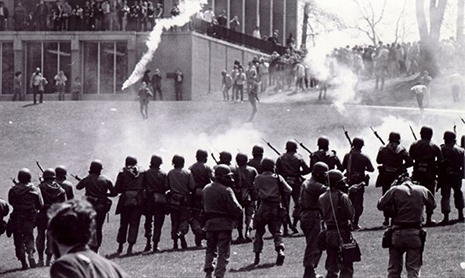
The Kent State massacre, 45 years later, remains a red mark on our nation’s history. On a sunny spring day, May 4th, 1970, National Guardsmen attacked—with a 13 second barrage of bullets—a group of unarmed students, gathered for an anti-war protest. Nine were wounded, and four (Allison Krause, Jeffrey Miller, Sandy Scheuer and William Schroeder) were killed. Those four, forever immortalized in Neil Young’s “Ohio,” bear witness to a divisive political landscape that exists as much today as it existed in 1970. The recent events in Ferguson and Baltimore make the remembrance of this national tragedy all the more timely.
Alan Canfora, a young student at Kent State, and a member of the Students for a Democratic Society (SDS), was involved in the Kent protests during the days leading up to the massacre. These protests, sparked by Nixon’s announcement that the Vietnam War was to be expanded into Cambodia, came at a particularly emotional time for Canfora. A few days earlier, he had attended the funeral of his friend, Bill Caldwell, who was killed in Vietnam. As a memorial, Canfora prepared a black flag for the May 4th demonstration, declaring “I purposefully chose black material to match my dark mood of despair and anger following the recent death of my friend.”
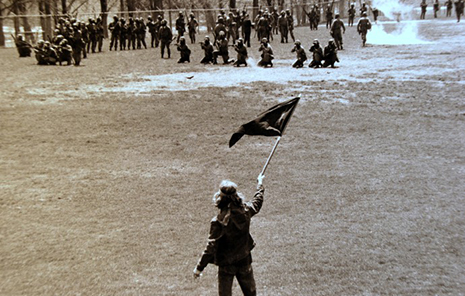
A photograph of Canfora waving the black flag before a crouched, aiming regiment, moments before they fired 67 rounds into a group of unarmed demonstrators and bystanders, has become one of the iconic images of that tragic event and of the anti-war movement itself.
Alan Canfora, on the practice football field, 250 feet away from aiming Guardsmen. Ten minutes before the massacre. Photo by John Filo.
Minutes after that photo was snapped, the National Guard fired a volley into the crowd. Canfora, who was shot through the wrist by an M-1 bullet, claims that only eight of the thirteen victims were active in the protest. Five were simply bystanders, including Sandra Scheuer and William Schroeder who were killed while walking to class.
Canfora’s website contains a heart-breaking account of the events of May 4th. What is noteworthy, throughout Canfora’s recollection, is the utter disbelief that the Guard would be using “real” bullets on unarmed students:Just as I reached safety, kneeling behind that beautiful tree during the first seconds of gunfire, I felt a sharp pain in my right wrist when an M-1 bullet passed through my arm. With shock and utter disbelief, I immediately thought to myself: “I’ve been shot! It seems like a nightmare but this is real. I’ve really been shot!” My pain was great during that unique moment of unprecedented anguish but I had another serious concern: the bullets were continuing to rain in my direction for another 11 or 12 seconds.
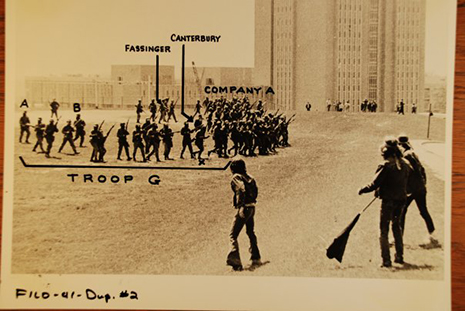
Among the 76 Ohio National Guard soldiers stretched across the hilltop, only about a dozen members of Troop G—the death squad—stood calmly aiming in a firing line. They killed four Kent State University students and wounded nine others, including me. One wounded victim, Dean Kahler, remains paralyzed as a result.
During the gunfire, I was in great pain and distress but quite aware that I had to remain tucked behind that narrow, young tree which absorbed several bullets intended for me.
I then heard my roommate Tom Grace screaming his severe pain after a bullet passed through his left ankle. While the bullets were still flying, I yelled over to my best friend, Tom Grace, “Stay down! Stay down! It’s only buckshot!”
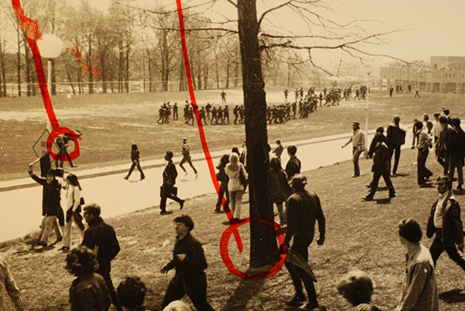
Canfora, wounded, kneeling behind a tree, an M-1 bullet wound having pierced his right wrist—225 feet downhill from Ohio National Guard shooters. This tree saved Canfora as well as Tom “Aquinas” Miller, who was standing behind the tree. Canfora and Miller are looking right to Tom Grace who was shot through his left foot nearby.
Even as he had reached the hospital for treatment of his wound:When I got to the hospital, as I walked alone toward the emergency room door, I looked inside the open rear door of a parked ambulance. I saw my friend Jeff Miller lying dead and bloody on a stretcher. I assumed he was only unconscious from a facial flesh wound. I still wrongly-assumed non-lethal shotguns shot us.
During those terrible seconds as I stood alone gazing at my friend’s bloody form, I vainly hoped that plastic surgery would repair Jeff’s face where a gaping 2-inch bloody hole destroyed Jeff’s always-smiling face. I did not know that a powerful M-1 bullet had passed through Jeff’s head and he was killed instantly.
Photo by John Filo
Canfora went on to graduate Kent State with a Bachelor’s Degree in General Studies and a Master’s Degree in Library Science, and has remained a vociferous activist, both as a student organizer, and in the justice movement for the victims of May 4. He took time out of his busy schedule, working on the 45th anniversary commemoration, to talk to Dangerous Minds about the events at Kent State and their repercussions today.
The iconic photograph of you waving the black flag before a National Guard regiment, with weapons raised and pointed at you, has been compared to the image of the so-called “tank man” at Tiananmen Square. Both photographs evoke a David vs Goliath sentiment—standing up to a monstrously armed force of authority. Of course, our cultural narrative programming has us shocked that an unarmed student would be fired upon in the United States—and maybe also shocked that a man standing in front of a tank in Communist China could stop that tank from rolling forward. Do you see similarities in the two images?
Alan Canfora: The “tank man” definitely was risking his life, at a time when many students were actually killed. By standing in front of the tank he showed great courage. It’s similar to my situation in 1970 in that he did risk his life for the cause that he believed in.
So, when that image was taken, at that moment you felt that your life was in danger?
AC: Absolutely. I think any time that there’s someone aiming guns at you with their fingers on the triggers, you definitely think that your life may be in danger. I had to confront the possibility at that moment. I certainly didn’t plan for the moment. I had no idea I would be in that situation until the Guardsmen got down and started aiming at me. It seemed like an absurd situation—I didn’t think that I was doing anything to deserve being shot or to even have guns aimed at me—I was 150 feet away—it was broad daylight—they hadn’t shot anyone while the National Guard was on campus the two previous evenings, even though some students were stabbed by bayonets, and other students were beaten with clubs the night before on May 3rd. I just didn’t think that in broad daylight on a sunny Spring afternoon that they would just start shooting into a crowd of unarmed students.
At that moment I started thinking about why I was there. Only ten days prior, myself and my roommates had attended the funeral of a nineteen-year-old soldier who was killed in Vietnam—his name was Bill Caldwell—so we were at that funeral on April 24th, and we were already very anti-war, and some of us were very experienced with protest actions… and at that funeral we swore a vow that we would take action at the soonest opportunity to send our message to President Nixon that he should stop the war in Vietnam. Too many young people were coming home dead or wounded, and we understood that the war in Vietnam was genocidal—our government was killing two or three million Asians.
Six days after that funeral, Cambodia was invaded by Nixon—the war was expanded into another country. We watched the announcement on television, and we were very angry, and we said tomorrow night we are going into action. From May 1st through 4th, we were some of the leading militants on the streets of Kent. And so when I was out there with them aiming the guns at me, that was the culmination of four days of protests—and I didn’t anticipate that moment, but I had to think to myself “this is why we’re out here—to make the most powerful statement that we can about stopping the war.” So I didn’t back down, I stood my ground there, and I basically tried to communicate with the Guardsmen who were aiming at me from 150 feet away… I remember shouting at them “if you support the war in Vietnam, then why aren’t you IN Vietnam?” I said “my friend was killed there just a few days ago, and we attended his funeral, and that’s why we’re out here—we’re trying to stop the war.”
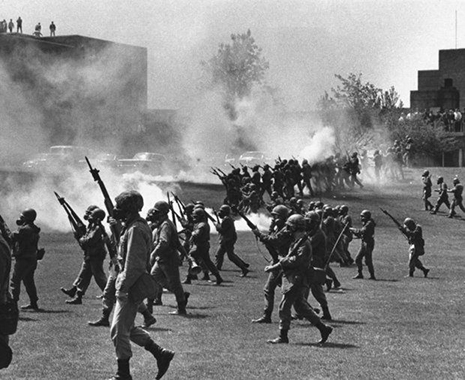
Their commanding officer ordered them to stand up and then march away—it looked like a retreat—they started going back up this hill, and then when they got to the hilltop, that’s when they got the order to turn and fire.
The Guardsmen depart the practice field in what many thought was a retreat. They soon marched uphill & fired 67 gunshots downhill into a crowd of unarmed students. Canfora was shot when he ran to a tree—225 feet away from the hilltop shooters.
That’s what seems so absurd—there was no imminent threat to them whatsoever.
AC: They were under no significant threat throughout the entire twenty-four minute confrontation—we all knew that they had stabbed people the night before—every step of the [confrontation] is on film and you can see second-by-second that every time they marched toward the students, the students evacuated.
Just as they started to shoot, there was one student standing off to the side raising his middle finger toward the Guard—he was shot twice—once in the stomach, once in the ankle. He was 72 feet away. Another student behind him was 90 feet away, just taking pictures—he got shot in his chest. Down near the bottom of the hill is where I was—225 feet away when I got shot through my right wrist. When I heard the guns firing I thought “they must be firing blanks, there’s no reason to shoot.” But I thought “just in case these are real bullets,” I started to zig and zag as the bullets were flying around me and I jumped behind a tree, and just as I did I felt a bullet go through my right wrist.
Having read your heart-breaking account of those events, what affected me the most was the confusion you felt. The assumption that the Guardsmen would not have bullets in their guns—and then, even when you were aware that you had been shot, you were still assuming that it must have been “buck shot”—I get the sense that the realizations about the use of deadly force in that moment may have been just as traumatic for you as the physical pain of being wounded.
AC: It just didn’t seem like any kind of a shooting situation, in fact, when you consider what had happened already on May 1st in downtown Kent—about 43 windows were smashed out—about 28 of those were in one bank, and other specific corporate targets were hit like the gas company, the electric company, the telephone company, the conservative Republican newspaper—those windows were all smashed out and nobody got shot down there that night—fourteen students were arrested. The next night, the Kent State ROTC building was burned down—the National Guard arrived that evening and they didn’t shoot anybody—so, by May 3rd several students were bayoneted after a peaceful sit-in in the street. Several male and female students were slashed and stabbed by the National Guard, and a bunch of students were beaten with clubs—but no one was shot. [By comparison] the rally on May 4th was anti-climactic. We didn’t have any plan or agenda—it was just a gathering. As soon as one student got up and spoke about a national student’s strike, that’s when the Guardsmen attacked with teargas and then [shortly thereafter] began aiming guns at me and others. To attack our rally on May 4th—we were doing NOTHING wrong—we were just standing there starting to chant anti-war slogans. One kid just started to speak, and that’s when they attacked. Ultimately they shot 67 gunshots into a crowd of unarmed students—and that was the ultimate absurdity.
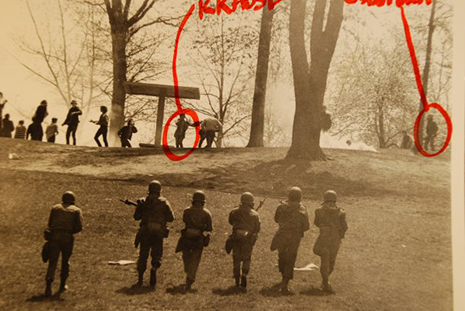
Canfora, upper right in photo, face covered by scarf, with black flag at hilltop as Ohio National Guard attack and chase students away from Victory Bell and over Blanket Hill. Note KSU student, Allison Krause, under concrete “pagoda” at hilltop. Allison was shot in the chest & killed 20 minutes later.
There’s no logic to it.
AC: It’s so illogical unless you understand that among the 26 Guardsmen who marched out against us, tear-gassing us, chasing us over a hill, there was a small group there called Troop G of the 107th cavalry unit, there were about a dozen of them and several of their officers—they were like the cream of the crop of the hardcore nastiest National Guardsmen on the scene. When those guys knelt and started aiming, those guys were picking out their targets, and who they were aiming at?—there were two black flags that day, I made both of them, and my room-mate was carrying the other one—who’s carrying a black flag? Who’s throwing stones? Who’s giving the finger? Who’s cursing at them? Who’s taunting them? And among the group that they ended up shooting, Jeff Miller was very active—he was killed. Allison Krauss threw a couple of stones—she was killed. I was waving a black flag—I got shot. Joe Louis was giving the finger—he got shot. John Grace was a protester standing next to me when he got shot through his foot. Eight of the thirteen victims were active in the protest. Five were just by-standers.
You had a group of Guardsmen who were on a twenty-four minute hunting expedition, seeking human prey. And once they committed that massacre, they simply turned, regrouped, and marched away. Mission accomplished.
And what did the Guard do after the shooting?
AC: They had three big lies that they tried to perpetrate. The general had two news conferences that afternoon and said, first of all, “the students were shooting at us, there was a sniper, and we returned gunfire.” That was a lie. The second big lie was “the students were about five feet from us, about to overrun us, we thought our lives were in danger, and we thought they were gonna take our guns from us.” Well, the photographs came out the next day, and the closest student was not five feet away, but 72 feet away. The third big lie was they said the students were throwing rocks, bottles, and other objects, and their lives were in danger so they fired in self-defense. That was proven to be false. When the FBI came to town over the next two months, at the end of their investigation, the Department of Justice concluded that the National Guard’s claim of self-defense was, and I quote, “fabricated, subsequent to the events.”
Some people were throwing stones, some people felt so provoked that they picked up whatever was lying on the ground—but there was such a distance between the students and Guardsmen that day, that the stones fell short—there were also photographs showing Guardsmen throwing stones at students—and those fell short too. So both sides stopped that—it was basically a stalemate. And then when the [Guardsmen] were retreating, we felt “the confrontation is over, they’re going away.” And they got to the top of the hill and that’s when there was a verbal command, “Right here. Point. FIRE.”
A student cassette recording made at the scene was found which corroborates this—verified so far by three digital audio analysts.
All of this information and evidence is on my website alancanfora.com and on may4.org.
>This was an intentional massacre based on an order to fire.
Canfora returns a tear-gas cannister toward the attacking Guardsmen.
Discussion of the events at Kent State seems especially timely considering many of the events that have recently occurred in Ferguson and Baltimore. We have seen the National Guard called out, and it seems to have the opposite of the intended effect, making people much more frustrated, angry, and volatile.
AC: I think it does. For example, when we saw those 1200 Guards rolling into Kent on May 2nd, we thought it was provocative to send in armed troops against students who were only assaulting property. And we knew that same thing was happening all across the country. It was like throwing fuel onto the fire. Especially with those “weekend warriors,” as they were known. These were not full-time, professional, law enforcement personnel. They were beating the students, and stabbing the students, and ultimately they shot us. They were poorly trained, they were over-armed, and they had very poor leadership—unlike full-time professional law enforcement personnel. It’s really a recipe for disaster.
I don’t think the National Guard should be called into a civic disturbance. No longer are National Guardsmen sent into a crowd control situation armed with M-1 rifles. Now days they try to emphasize non-lethal weapons, which of course are still actually lethal. But I don’t think you’ll see another situation where they shoot 67 gunshots into a crowd of unarmed protesters. That was such an extreme example of excessive force. It was about a year after Kent State that they started using rubber bullets, plastic pellets, beanbags, and different things like that. I don’t think you’ll see the same kind of carnage on a mass scale—at least I hope not. When you consider the volatility of our country right now, when you have people that are so oppressed because of income inequality and class discrimination—people that are driven further and further down into poverty, that they are so desperate that they go into the streets—I think there’s a danger that this could be happening not just in Baltimore or in Ferguson, but it could start happening across the country simultaneously [and if this occurred] people would realize that our country had descended into a revolutionary situation.
There’s a cultural polarization that takes place that allows for events such as these, and then people are actually surprised when it happens!
AC: Our governor at the time, James Rhodes, was very hostile against civil rights protests in the urban areas, but he was also very hostile to student protests - especially the ones right before the upcoming election - he was already the governor of Ohio but he was seeking to become a US senator - and he was 8% behind in the public opinion polls [due to student protests]. So he was desperate, and he had to act like he was cracking down on the protesters. He came to Kent and gave a news conference on May 3rd, the day before the massacre, and was pounding his fist on the podium with all of the TV cameras pointed at him, and he said “these Kent State students are the worst type of people we harbor in America. They’re worse than the Communists and the Brownshirts.” And he pounded his fists and said “we’re going to eradicate the problem.” He exaggerated the situation in order to appeal to the conservative Republican voters that were going to be voting in that primary election on May 5th. And he basically provoked or incited the National Guard to commit violence that evening when they stabbed students, and also the next day when they shot us.
April 7, 1970, less than a month before the Kent State shootings, Governor Ronald Reagan in California said “these students want disruption - if it takes a bloodbath, let’s get it over with.”
There is a real danger when a situation is polarized—and then you put guns into the hands of the people that are the most hateful, and that’s a formula for a disaster. They hated us, they didn’t understand us, they resented us, to the point where they shot us with absolutely no hesitation.
Canfora and roommate confront Ohio National Guard from 250-feet distance on practice football field minutes before Guardsmen march uphill & shoot.
Anyone who experiences a traumatic situation like this deals with effects of it for the rest of their lives. Many members of the radical left or anti-war movement of the Vietnam era have assimilated into mainstream culture. Would you say that being shot in 1970 was a crystallizing moment that kept you dedicated to activism?
AC: No. My father was a union activist in Akron, Ohio, with the UAW; and he was very political, and raised all four of his kids to be very strongly liberal and progressive minded. He led a two month strike against Goodyear in the 1950s. In the ‘60s he was on our hometown City Council as a liberal Democrat—a very progressive guy. So we were already politicized in my family from the time, even back to the 1950s when my dad opposed a “right to work” law—he had us aware of that stuff even when I was nine years old. When I saw the students beaten in the streets at the 1968 Democratic Convention in Chicago, I knew that I wanted to become an activist—to try to fight for the same cause. At Kent State, I first joined the College Democrats, and within a month I quit them and joined the SDS, because they were more leftist intellectuals - the leadership of the SDS at Kent was among the most brilliant and militant in the whole country.
Jerry Casale from DEVO[was in the Kent State SDS, and] was there, and he witnessed the massacre. Two of his good friends, Jeff Miller and Allison Krauss were killed, and that radicalized a whole lot of people who witnessed the event including Jerry Casale who was already a radical. He formulated his theory of de-evolution—that human society was de-evolving, and the Kent State massacre helped him reach that conclusion—that society was not evolving any longer.
Terry Robbins [of the Weathermen], who got blown up in a townhouse, saw me at the SDS events and looked at me and said “you’re an action freak.” For Terry Robbins to call me an “action freak”... I consider that to be quite a compliment.
By 1969 most of the leadership of SDS had gone underground and joined the Weathermen. I did not. I thought that was a tactical mistake. I thought we had to stay above ground and continue to organize and fight against the war, out in the open. There were only a few of us from SDS still there, and we continued to remain anti-war, and when the invasion of Cambodia happened in the Spring of ‘70 we were among the most active students, sparking the protests. I don’t think that being shot made me more of an activist, but it made me more of a proponent for justice against the cover-up of murder.
“They hated us, they didn’t understand us, they resented us, to the point where they shot us with absolutely no hesitation.”
In finishing up our conversation, I mentioned, off-the-cuff, that many people consider Canfora to be an American hero. He was very quick to dismiss such praise, stating, “I’ve never considered myself to be a hero - I consider myself a foot soldier in the anti-war army.”
Canfora will be participating in the 45th annual commemoration at Kent State and is currently in final-edit of his memoir, which should be wrapped up by Summer. His website contains volumes of information on the events at Kent State, and is well worth your time and research.
Showing posts with label civil disobedience. Show all posts
Showing posts with label civil disobedience. Show all posts
Tuesday, May 5, 2015
On the 45th anniversary of the Kent State massacre, a talk with one of the students who got shot
from Dangerous Minds:





Monday, October 21, 2013
The Right to Remain Silent.
a short film by By Phil Brown
The film covers the mass arrests of nearly 2000 peaceful protesters during the COP 15 in Copenhagen (environmental meeting), whilst following effected activists and discussing the wider ramifications of the growing trend around the world of criminalizing protests.
Wednesday, June 6, 2012
Has the FBI Launched a War of Entrapment Against the Occupy Movement?
from AlterNet:
By Arun Gupta
With the high-profile arrest of activists on terrorism charges in Cleveland on May Day and in Chicago during the NATO summit there, evidence is mounting that the FBI is unleashing the same methods of entrapment against the Occupy Wall Street movement that it has used against left movements and Muslim-Americans for the last decade.
In Cleveland the FBI announced on May 1 that “five self-proclaimed anarchists conspired to develop multiple terror plots designed to negatively impact the greater Cleveland metropolitan area.” The FBI claimed the five were nabbed as they attempted to blow up a bridge the night before using “inoperable” explosives supplied to them by an undercover FBI employee.
Then on May 19, the day before thousands marched peacefully in Chicago to protest NATO-led wars, the Illinois State Attorney hit three men with charges of terrorism for allegedly plotting to use “destructive devices” against targets ranging from Chicago police stations to the home of Mayor Rahm Emanuel. Defense attorneys for the Chicago activists claim their clients, like the Cleveland activists, were provided with supplies for making Molotov cocktails by undercover agents in an operation that included the participation of the FBI and Secret Service. This was followed up on May 20 by the arrest of two other men on terrorism charges in Chicago for statements they made, which critics say amount to thought crimes. The Chicago cases are also reportedly the first time the state of Illinois is charging individuals under its post-September 11 terrorism law.
To hear FBI officials describe it, “Law enforcement took swift, collaborative action…to eliminate the risk of violence and protect the public.” To many observers, however, the government itself is the overarching threat, systematically repressing peaceful dissent.
Will Potter, who analyzes FBI entrapment plots in his book Green is the New Red, says the two incidents are “a reflection of an ongoing pattern of behavior from the FBI of singling out political activists and having a direct influence in creating so-called terrorist plots for the purpose of proclaiming a victory in the war on terrorism.” Potter claims, “There have been many other cases like these in which the FBI had a role in manufacturing the plot itself. We’ve seen this time and again with animal rights activists, environmental activists and the anarchist movement.”
Simply put, the Cleveland and Chicago cases appear to be instances of the federal government foiling its own terror plots. Two days before the Cleveland plot was supposedly thwarted, David Shipler, author of Rights at Risk: The Limits of Liberty in Modern America, presciently described in the New York Times the mechanics of the FBI trap about to be sprung. Shipler wrote that FBI terror stings typically begin by targeting “suspects for pure speech” such as comments, emails and “angry postings” on the Internet. The suspects are then “woo[ed] into relationships with informers, who are often convicted felons working in exchange for leniency, or with FBI agents” working undercover. Some suspects are “incompetent and adrift, like hapless wannabes looking for a cause that the informer or undercover agent skillfully helps them find.” Noting that the FBI is “cultivating potential terrorists,” Shipler asked, “would the culprits commit violence on their own?”
That’s what the FBI claims – that it thwarted the deadly plans of Brandon Baxter, 20; Anthony Hayne, 35; Joshua Stafford, 23; Connor Stevens, 20; and Douglas Wright, 26. The plot allegedly began last fall after Doug Wright discussed deploying smoke bombs as a decoy while individuals toppled bank signs from skyscrapers in downtown Cleveland, and evolved with FBI planning into using “C4 plastic explosive devices” to demolish a bridge connecting the Ohio communities of Brecksville and Sagamore Hills.
Stephen Anthony, Special Agent in Charge of the FBI's Cleveland office, claimed during the May 1 press conference “that at no time during the course of the investigation was the public ever in danger.” So if the public was never in danger, was there ever a threat?
To get to the bottom of the story I traveled to Cleveland shortly after the arrests and interviewed about 20 friends and family members of the "Cleveland 5," as supporters are calling them. They describe a group of naïve, vulnerable and even desperate individuals that the FBI preyed on. A government informant provided the five with jobs, money, a place to live, a friendly ear, beer, pot, the prescription stimulant Adderall, and most significant, the ideas and means to carry out a plot conceived by the Bureau itself.
The Lost Boys
Friends describe the five – everyone calls them boys or kids – as “quasi-hobos” and on the losing end of society. Lea Tolls, a 46-year-old mother and self-described “Occu-mom,” says, “Except for Connor [Stevens] they were destitute. They are angry, some have mental illnesses, and there is alcoholism and abuse in their families.”
Kaiser, a Cleveland occupier, told me that Doug Wright, the alleged ringleader, was “like a big brother to me. He ran away from his parents when he was 12.” Everyone invariably mentioned Wright was a train hopper, an explanation that accounts for his mangled nose, missing teeth and abrasive manner. Ben Shapiro, 26, an environmental organizer who was active with Occupy Cleveland last fall, said, “Doug was poor. He was angry, had a hard time dealing with people and was short-tempered.” Nonetheless, numerous youth said Wright was protective of and cared about them and was a hard worker. Zachy, a lanky 21-year-old who hung out with the five, says, “Doug actually did shit. He was running logistics at the Occupy camp. He was the one that knew how to tie knots and put tarps on the tents.”
The story is the same for the others: lost souls wanting to help others. Most Cleveland Occupiers were wary of Anthony Hayne, the oldest of the accused, labeling him a “con man,” “swindler” and “schemer.” Lea Tolls defended him, stating, “Tony was an addict, and we treated him accordingly.” Others added that Hayne's mother died a week before Occupy Cleveland began. Jonnie Peskar, 22, a member of Occupy Cleveland, says one night another defendant, Brandon Baxter, told him his life story, “He grew up in violence. He and his dad would fist fight. Brandon talked about how he was traumatized growing up.”
Gloria, a friend of Brandon Baxter's, called him “an absolute joy to be around. He wants to help everyone he comes in contact with.” But he also suffered from “horrible depression” and tried to kill himself in February by jumping off a bridge before being talked down by cops, she claimed. “He spent weeks in the hospital from the suicide attempt.” As for Joshua Stafford, who is known as Skelly, his mother anonymously told the media of a troubled life, saying he had been “in and out of hospitals, prisons, jails. He's just been a troubled soul since he's been born.”
Joshua Stafford and Brandon Baxter are also described as highly impressionable. Tolls says Stafford, “would have done anything anyone told him to, just to have friends.” Peskar says Brandon Baxter admitted to him, “‘I’m easily brainwashed because I was pulled into being a Neo-Nazi.’ Brandon was in a very confused state. He always contradicted himself. He didn’t know what he wanted.”
Of the five, only Brandon Baxter and Connor Stevens appear to be in contact with their families. Curious as to how Stevens was caught up in the trap, I sat down with his family in their modest ranch house in the suburbs of Cleveland to hear of a thoughtful and passionate young man trying to surmount life’s obstacles on the path to adulthood. Stevens' mother Gail describes her son as “extremely intelligent" although "school didn’t engage him.” Connor Stevens dropped out his junior year. In his sophomore year, Stevens and some friends founded a social justice group called “Fighters for Freedom” that was quickly shut down by the school administration. He was also elected class president, but was not allowed to serve because of a low grade point average. When he was 16 he told his family he was gay, which his siblings said neither surprised nor fazed them.
Gail also spoke of family troubles that affected Connor and her other children deeply – her mother and sister passing away in quick succession, followed less than a year later by her husband James running afoul of the law in 2001, which resulted in more than two years in prison for him and the dissolution of their marriage. Gail went from a stay-at-home mom to the sole breadwinner and had to handle the stress of moving her family into her father’s house.
Occupy gave Connor Stevens a sense of belonging. Gail says, “I was excited for him. There was something he could actually be part of in Cleveland.” In early 2012 he began to say “he wanted to be a pastor. He felt he was being called.” She read a letter Stevens sent her from the Corrections Corporation of America facility near Youngstown, Ohio, where he is being held. He wrote:“I am in good spirits and feel at the top of my game physically, mentally, spiritually. … I have great faith and do not underestimate the power of prayers. The bible I’m reading, the New American, in which I’ve been focusing on the Old Testament, speaks constantly of the Lord’s uplifting the oppressed, siding with the poor, the downtrodden, the widows and the orphans. I believe God is on our side. The scripture you quoted from Jeremiah is very fitting. And just before I came down to our last visitation … I read Psalms 27:1. This is my rock, this passage. It conveys everything.”The Plot Begins
Cleveland 5 supporters claim that Connor Stevens and possibly others were threatened to participate in the plot. Others interpret as a threat a comment in the FBI affidavit in which the informant tells the group they are “on the hook” for the explosives. Interviews with more than a dozen Cleveland activists also provide evidence that a possible FBI asset by the name of Ryan is still floating around Cleveland and is cryptically mentioned just once as “Ryan LNU” (Last Name Unknown) in the criminal complaint against the five.
The FBI plot begins on October 21. On that day the city of Cleveland announced it was shutting down the two-week-old occupation in the downtown Public Square. Organizers say Occupy Cleveland held a rally on Oct. 21 more than 500 strong, including nonviolent civil disobedience, while choosing to roll up dozens of tents in the camp so as to save its equipment from imminent confiscation by the police.
Also on Oct. 21, the FBI’s “Confidential Human Source” (CHS), subsequently identified as Shaquille Azir, made contact with Douglas Wright. The affidavit states: “Based on an initial report of potential criminal activity and threats involving anarchists who would be attending an event held by a protest group, the Cleveland FBI directed the CHS to attend that event.” That night, the FBI report continues, while most occupiers were engaged in protest, a group of seven men “was constantly moving throughout the crowd expressing displeasure at the crowd's unwillingness to act violently.”
Numerous friends of the five dispute this account, saying violence was never raised. Because there is no audio recording of the encounter, as there are for many others, the FBI claims could easily be fabricated, which would mean the basis for the investigation was spurious. People present say there was a tactical dispute between “do-it-yourself” punk kids, which the five identified with, who wanted to keep the camp going, and more mainstream, college-educated occupiers who agreed to take down dozens of tents while staging a nonviolent civil disobedience action to demonstrate support for free speech rights. Zachy and Natalie, friends of the five, say the punk kids were disillusioned with both the decision to end the occupation and what they saw as an ineffectual protest, but no one discussed violence.
'Silly Kid Things'
Zachy says, “About a week after the collapse of tent city on Oct. 21, we created a group called the Revolutionary People’s Army. We were being romantic. We were drunk and high … Doug, Connor, Brandon, Joshua and Tony were all involved in the RPA. There were a couple of serious meetings and it turned into spray painting Guy Fawkes masks, 'Rise Up' and 'RPA' and 'circle A' anarchist symbols around town. We also plastered 'Wake Up' with circle A and Occupy stickers. RPA was real tongue-in-cheek. It was silly kid things.”
Tolls calls them “boys playing cowboys and Indians with fireworks and spray paint," adding, "They were trying to empower themselves and passionately wanted to change their world. Occupy gave them hope. They were targeted by the FBI and culled from a peaceful group. They were guided toward this by individuals who provided the means and motivation. They didn’t have these violent actions in them.”
It was from these childish antics that the FBI claims that Doug Wright conjured up the initial plot – deploying smoke bombs as cover as while toppling bank signs from buildings such as the Key Bank tower. Friends of Doug Wright laugh at the allegations. They mention that with Wright’s smashed-up face and punk attire he would not even be allowed into the building, much less be able to scale the 947-foot-tall skyscraper and blast off the enormous red key affixed to the outside.
Ben Shapiro, who is highly regarded in the activist community, says he noticed suspicious activities he interprets as police disruption. “Certain people were actively trying to isolate the Cleveland 5 from other organizers last fall by spreading rumors they were FBI agents.” Additionally, says Shapiro, during the first few weeks of the occupation at the centrally located Public Square, “We saw people in strange white vans circling around the square, conducting surveillance. They were parked in an area downtown where anyone else would have been towed or ticketed within minutes.”
After the encampment ended, Shapiro says he was concerned about the punk kids and cautioned them against engaging in unsafe behavior. “They had every reason to be frustrated – there were poor group dynamics and an inability to reoccupy the square.” At the same time, he adds, “They were good kids and were coming up with elaborate plans on how to hide their tents in backpacks.” Shapiro says the activity wasn’t a strategic answer to the loss of space, but “it was very spirited.”
In hindsight, says Shapiro, there was “evidence of narcs … People spreading rumors, isolating members of the community, providing money, transportation and space.” He emphasizes he is referring not only to Shaquille Azir, but to the shadowy Ryan as well. When he heard news of the arrests, Shapiro says, “I saw the list of names. I saw this group of kids that had been targeted was now entrapped. It seems so fabricated.”
Zachy says during the next few months the five except for Anthony Hayne (whom he said was serving a jail sentence) would regularly stop by the one remaining tent downtown to pull night shifts. Zachy adds that in early November Ryan tried to recruit him to meet Shaquille Azir, telling him, “This guy is buying us breakfast and will give us a house with no strings attached.” Zachy says he was suspicious and declined the offer. Despite multiple claims that Ryan is in contact with Azir and even recruiting people to meet him in the fall, Ryan is only mentioned once in the affidavit in February 2012.
Over the winter, according to the FBI affidavit, the contact between Shaquille Azir and Doug Wright is sporadic. Azir and Wright reconnect in mid-February at the same time Occupy Cleveland rents a warehouse as a crash pad for occupiers who were maintaining a presence at the tent.
Anarchist Romper Room
In mid-May, I ventured to the red-brick warehouse dubbed the "fortress.” Entering the decrepit building was like walking into an anarchist Romper Room: tents pitched indoors, graffiti, belongings strewn about, people dozing mid-day, dirty dishes and pungent toilet odors. It was here that Brandon Baxter, Connor Stevens, Tony Hayne and Joshua Stafford reassembled. I joined half a dozen people around a table as they puffed hand-rolled cigarettes incessantly. They were clearing out as the lease was up the next day. Right off the bat, Zachy said, “A lot of us had never lived in a communal situation. This was the first time living away from our parents. Dishes were always a fight. We’re a bunch of uneducated kids.”
When the topic of cleaning came up, Rachel jumped in, “I got the name ‘mother hen’ for always complaining. ‘Come on guys, clean this trash up.’”
The discussion repeatedly circled around to Ryan. The warehouse crew expressed suspicion because Ryan appeared in mid-October, saying he drove up from Florida, but soon had connections to Azir, whom virtually no one ever met outside the five. They also mentioned Ryan would take regular road trips in his car and claim his steady source of income was via his parents wiring money to him.
In April everything comes to a head. Jonnie Peskar said Doug Wright seemed excited one day in early April. He says Wright told him, “Today is going to be a really good day. My boss has some joints waiting.” Peskar continues, “Shortly thereafter Doug asked Connor if he wanted work. They told me multiple times, ‘It’s a really cool job. He gives us beer. He smokes us out.’”
Gail said this is the first job her son ever had in his life, the first time he made money – five bucks an hour. She showed me text messages Connor Stevens sent her at the time:“A long day of labor for me. Made $60, long day 9:30 am to 9:30 pm … If I wanna do it again, I gotta get up at 9 tomorrow. Lifes rough.”As the alleged plot to blow up the bridge takes shape, the warehouse members say Shaquille Azir would swing by the warehouse in the morning to pick up the boys to do home repairs, but he would sit in the car and never interact with anyone else. Rachel says she asked Doug Wright for work with Azir, but was rebuffed, as were others who offered their services. Friends of Baxter's say Wright hooked him up with work with Shaquille April.
“I kinda feel like an ant”
“My friend doug got me the job. The $ goes fast. Turned out not to have work today. Still needa get footwear.”
Peskar says jobs weren’t the only thing Azir was hooking them up with. Baxter admitted to him that he was taking Adderall, a widely abused prescription stimulant. Peskar says, “Connor was also taking it, and mentioned, ‘I have a connect for Adderall.’ Both Wright and Baxter said the connection for the Adderall was Azir. I asked Baxter where he got it from, and he said ‘Doug’s boss.’”
The warehouse was also buzzing with rumors that something was afoot. One individual told me that someone asked him, “Did you hear that Doug is trying to blow up a bridge?” The individual said, “I literally laughed it off. I said Doug is a moron. He doesn’t know how to do anything like that.” Another person fingered Ryan as the source of the rumors. Ryan allegedly told them in early April, “The warehouse is going to get raided. There are people who are going to do something dangerous with explosives. It’s sitting at a house.”
I pointed out to the warehouse group that after such a dramatic incident like the arrest of the five on terrorism charges, there is a tendency to see everything that happened over the previous months in a paranoid light. Julia Boyd, who is active with Occupy Cleveland, says, “A lot of the detrimental effects of this is everyone is suspicious of everyone else.”
I suggested maybe Ryan is just crazy, not an FBI operative. One person got Ryan on the line and put him on speaker phone. After a minute of small talk, Ryan claimed someone they all knew had been arrested. Everyone was concerned this signaled a wider sweep of activists on terrorism charges. Except hours later I met up with the person in question who was never arrested and was adamant that Ryan is an FBI operative. I was able to find Ryan’s number and called him. A male answered who claimed he wasn’t Ryan and hung up after a minute. Subsequent attempts to contact Ryan by phone were unsuccessful.
It remains to be seen if Ryan is on the FBI payroll or just mentally unhinged, but lawyers told me that at minimum Ryan would be of interest for the defense lawyers for the five and it might be possible to determine if he is a paid agent. Another lawyer, who has been handling high-profile political cases like the Cleveland 5 for nearly 40 years, mentioned that in addition to the use of undercover agents and informants, the FBI employs "agent provocateurs" to infiltrate and discredit political movements, changing the name of programs to make it appear as if it has reformed its underhanded ways.
In the case of the five Chicago activists who have been swept up on terrorism charges, defense attorneys charge that two police informants nicknamed “Mo” and “Gloves” were the masterminds. In the post-9/11 era the FBI has up to 60,000 informants and spies around the United States, according to an expose by Mother Jones. The FBI cut its teeth as a repressive police force during the Red Scare after World War 1, raiding homes and deporting thousands of legal foreign-born radicals in the labor, anarchist and socialist movements. After World War II, the FBI destroyed thousands of lives and decimated the left during the McCarthy Era. The FBI famously spied on Martin Luther King, Jr., during the 1960s and at one point thousands of agents were devoted to disrupting and sabotaging the anti-Vietnam War, student and black liberation movements.
During the 1980s the FBI spied on Central American solidarity activists. Since Sept. 11 the FBI has snared hundreds of Muslim Americans in cases involving informants who supplied the ideas, motivation and means for a terrorist plot. In recent years the FBI has termed “animal rights and environmental extremists,” as well as anarchists as some of the main domestic terrorist threats. It has used infiltrators, most infamously one code-named Anna, to entrap environmental activists. In 2008, the FBI sent a snitch by the name of Brandon Darby on a fishing expedition, and he managed to cajole and push two Austin, Texas youth into agreeing to make Molotov cocktails at the Republican National Convention in St. Paul, Minn. These were all political cases as are the two against the Cleveland 5 and the Chicago group.
The fact that the FBI sprang cases during the biggest Occupy events this year – May Day and NATO – indicates it has the Occupy movement in its sights. They are hardly the only ones. Reams of federal government documents secured by the Partnership for Civil Justice Fund reveal widespread government surveillance and information gathering on the movement ranging from the Department of Homeland Security to the Pentagon. The public interest legal organization asserts that the documents regarding Occupy Wall Street “scratch the surface of a mass intelligence network including Fusion Centers, saturated with 'anti-terrorism' funding, that mobilizes thousands of local and federal officers and agents to investigate and monitor the social justice movement."
For now the Cleveland 5 are languishing in jail. Connor Stevens and Doug Wright have been on suicide watch according to those who visited them. Brandon Baxter wrote in a letter dated May 19, “So Skelly was just dragged out of his cell a bit ago, He wrote ‘They all want me to DIE’ all over his walls, They said they'll bring him back, but he may be a suicide watch for awhile.”
Their trial has been set for September 17, 2012, the one-year anniversary of Occupy Wall Street, after the defense objected to Sept. 11, which was originally scheduled as the trial start date.
Summing up the feeling of many supporters, Lea Tolls says, despite their hard backgrounds the five “all have good hearts and souls. I tried to give them comfort, guidance and stability. I used to call them my lost boys, and now they’re very lost. The richest country in the world can’t support them, give them healthcare, a proper education and they end up falling through the cracks. Instead of helping them, the FBI targets them for something nefarious and violent. It’s just disgusting that the government uses them towards this end.”
Arun Gupta is a founding editor of The Indypendent newspaper. He is writing a book on the decline of American Empire for Haymarket Books.
© 2012 Independent Media Institute. All rights reserved.
Sunday, April 29, 2012
Sunday, October 30, 2011
Photographers harassed
ACLU sues L.A. Sheriff's Department
from the Los Angeles Times
The ACLU of Southern California sued the Los Angeles County Sheriff’s Department and several of its deputies Thursday alleging they harassed, detained and improperly searched photographers taking pictures legally in public places.Thanks, Linde Law
The federal lawsuit alleges the Sheriff's Department and deputies "have repeatedly" subjected photographers "to detention, search and interrogation simply because they took pictures" from public streets of places such as Metro turnstiles, oil refineries or near a Long Beach courthouse.
"Photography is not a crime. It's protected 1st Amendment expression," said Peter Bibring, senior staff attorney for the American Civil Liberties Union of Southern California. "It violates the Constitution's core protections for sheriff’s deputies to detain and search people who are doing nothing wrong. To single them out for such treatment while they’re pursuing a constitutionally protected activity is doubly wrong."
Bibring said the policy and practices of the Sheriff's Department reflect a widespread misuse of "suspicious activity reporting" under the auspices of Homeland Security and counterterrorism. Similar suits have been filed in several other states.
Los Angeles County sheriff's Capt. Mike Parker said it is a deputy's duty to ask questions.
"Should we really ignore suspicious activity?" Parker asked. "We have an obligation to the public to answer questions and we are going to ask people why are you taking that picture. It is our duty to protect the public."
Parker said the department has not had a chance to review the lawsuit and could not answer specific questions about the incidents.
Thursday's suit was filed on behalf of three photographers, who among them have been detained or ordered not to take pictures on at least six occasions.
Professional photographer Shawn Nee was detained and searched Oct. 31, 2009, for shooting images at the turnstiles of the Los Angeles subway system. Nee was shooting newly installed turnstiles at the Metro Red Line's Hollywood and Western station when a deputy asked why he was taking pictures. Nee told the deputy he was not doing anything, the deputy warned him that photography was prohibited at the station because it is a terrorist target.
"Al Qaeda would love to buy your pictures, so I want to know if you are in cahoots with Al Qaeda to sell these pictures to them for terrorist purposes," Deputy Richard Gylfie then reportedly told him.
The deputy grabbed Nee, pushed him against a wall, searched him and lectured him about terrorism, the lawsuit alleges. He also threatened to forward Nee's name to counterterrorism so it could be added to an FBI "hit list"
The incident was captured on video. According to the suit, the deputy was not disciplined despite a complaint.
Earlier this year, deputies ordered Nee not to photograph on the sidewalk outside the W Hotel at Hollywood Boulevard and Vine Street on the Hollywood Walk of Fame.
Greggory Moore, a reporter who works for the Long Beach Post, was on a public sidewalk taking pictures of passing drivers for a story on Distracted Driving Awareness month in June when several sheriff's deputies surrounded, frisked and interrogated him. They said that because he was taking pictures across the street from the Long Beach Superior Court building, his behavior was suspicious.
"I was surrounded by deputies and frisked just blocks from my house, just for taking photographs in the middle of the day on a public sidewalk," Moore said. According to the suit, Moore was forced to show deputies his photos to support his story. Later, a sheriff’s sergeant told Moore the investigation was related to terrorism. In response to a letter from the National Press Photographers Assn., Sheriff Lee Baca defended the deputies' actions.
In another incident, deputies detained and searched Shane Quentin, a photographer with a master's in fine arts from UC Irvine while he was taking pictures of brilliantly lighted refineries in South Los Angeles on Jan. 21. Deputies frisked Quentin and placed him in the back of a police cruiser for about 45 minutes before releasing him. Two years before, Quentin had been ordered twice by deputies to stop taking photos of the refineries, according to the suit.
The lawsuit was filed in the U.S. District Court Central District and asks that the court order the Sheriff’s Department to stop detaining people solely on the fact that they are taking pictures. It also seeks compensatory and punitive damages.
Over the last several years, many police departments have instituted "suspicious activity reporting" programs designed to train officers to report certain activities in an effort to detect early surveillance by terrorist groups of potential targets.
In addition to the named plaintiffs, the suit alleges that several other photographers were detained for taking pictures of public buildings. Freelance photographer Ted Soqui was detained on the sidewalk outside the downtown jail while taking pictures for an L.A. Weekly story on jail abuse. Similarly, Catherine Dent was taking exterior photos of Men’s Central Jail for a school project and was detained and questioned.
“Photographers in Los Angeles and nationwide are increasingly subject to harassment by police officers,” said Mickey H. Osterreicher, general counsel for the National Press Photographers Assn. “Safety and security concerns should not be used as a pretext to chill free speech and expression.”
Thursday, October 20, 2011
#OWS - Times Square, October 15, 2011
Two incredibly inspiring people.
This guy Chris Hedges actually knows what's going on and has seen it around the world before, an amazing voice and moment in time.
I'm beginning to believe we're putting a lot of eggs in this basket, I hope all he's saying comes true, with all my heart.
Bonus: More, In DC at Freedom Plaza recently
This Marine doing what any and every one should be doing, but he can do it easier since he has his uniform and size. Either way another incredible display of humanity and freedom and speaking truth to power.
short version
Long version from a different angle
This guy Chris Hedges actually knows what's going on and has seen it around the world before, an amazing voice and moment in time.
I'm beginning to believe we're putting a lot of eggs in this basket, I hope all he's saying comes true, with all my heart.
On October 15th Occupy TVNY met with Pullitzer prize-winning author and journalist Chris Hedges in Times Square, New York City where tens of thousands of people assembled on a global day of action. Chris shares his feelings on where the Occupy movement has come from and where it is heading.
Bonus: More, In DC at Freedom Plaza recently
This Marine doing what any and every one should be doing, but he can do it easier since he has his uniform and size. Either way another incredible display of humanity and freedom and speaking truth to power.
short version
US Military veteran (Sgt Shamar Thomas, USMC) rants at NYPD over their brutality and reprehensible tactics, including kettling & mounted units (animals on horses), during the Times Square protest organized by Occupy Wall Street.
Long version from a different angle
United States Marine Corps. Sgt. Shamar Thomas from Roosevelt, NY went toe to toe with the New York Police Department. An activist in the Occupy Wall Street movement, Thomas voiced his opinions of the NYPD police brutality that had and has been plaguing the #OWS movement.
Thomas is a 24-year-old Marine Veteran (2 tours in Iraq), he currently plays amateur football and is in college.
Thomas comes from a long line of people who sacrifice for their country: Mother, Army Veteran (Iraq), Step father, Army, active duty (Afghanistan), Grand father, Air Force veteran (Vietnam), Great Grand Father Navy veteran (World War II).
Subscribe to:
Posts (Atom)


