From freecycling to Fairphones: 24 ways to lead an anti-capitalist life in a capitalist worldAs the new Amazon advert goes, can you feel it? Amid the encroaching dark and increasingly foul weather, December is synonymous with stampedes to the supermarket, endless online clicks and the massed roar of delivery lorries – or, to be reductive about it, capitalism at its most joyful and triumphant.
We asked readers for their thoughts on ‘non‑capitalist living’ and were deluged with replies. Here are their ideas for everyday ways to buck the system
Clearly, though, such things are only part of who we are, even at this time of year. As the American activist Rebecca Solnit puts it in her short but brilliant book Hope in the Dark: “Vast amounts of how we live our everyday lives – our interactions with and commitments to family lives, friendships, avocations, membership in social, spiritual and political organisations – are in essence non-capitalist or even anti-capitalist, full of things we do for free, out of love and on principle.”
The internet has made these deeply political activities even more visible. From growing your own food, through refusing to buy a car, on to freecycling and volunteering, there are no end of ways that people quietly reject the imperatives of pounds and profit, and thousands of initiatives and organisations that allow them to do so.
When I asked Guardian readers recently for examples of “everyday things that represent non-capitalist living”. I received a deluge of replies, full of very useful advice and an appealing spirit of qualified hope. “I am frequently filled with despair at the way things are going in the world at the moment, and doing this small thing at least makes me feel as though I’m doing something positive,” said one participant, which gets to the heart of the idea, and the responses collected here.
Freecycle as much as possible
Millions of us know the basics of freecycling: when you’re lumbered with something you either don’t want or don’t need, you can connect via the internet with someone for whom it might have a use. Until 2009, the big player in this field was the Freecycle network, founded in Arizona in 2003 – but a disagreement about allegedly heavy-handed management and the stifling of local initiatives saw the birth of the UK group Freegle, which has about 2.5 million members. Both were recommended by scores of readers, who are evidently luxuriating in less cluttered lives, and – to cite a few local odds and ends I found offered online – free beds, pianos, bikes, solitary wing mirrors and propane gas canisters, not to mention a “bag of makeup and toiletries, opened but still usable”.
Chris Everitt lives in Berlin. “There’s a German concept of leaving Sperrmüll – household objects you don’t want – on the street outside,” he says. “People can just take them, but if they’re still there the next day they’re collected as refuse. We have a little covered alleyway just off our high street where people leave things all the time: books, furniture, clothes, knick-knacks, even food. If you see something useful, you can just take it, and when you have something that no longer serves you in your life, you can place it there. Within a few hours it will be gone and part of someone else’s life.”
Make your own clothes
“I no longer buy clothes,” says Clea Whitley, 33, from London. “I’ve spent the past 11 months learning how to make them myself. I do have to buy fabric – organic and natural fibres as much as possible, and only from small, independent haberdashers – and clothing patterns, but I only buy what I need, and there’s hopefully no child labour, toxic chemicals or animal cruelty involved.” If this sounds like too much effort, you can always just cut down the volume of clothes you own.
Stop buying soap
This may not be for everyone, and is certainly complicated. But a reader who wishes to remain anonymous says: “I haven’t bought washing detergent, shampoo or conditioner since June. I wash my hair with soapnut liquid followed by apple cider vinegar. It takes a bit of pre-planning because the soapnut liquid spoils after a week, but it takes no time at all to boil the soapnuts on a Sunday evening or mix the vinegar with water. Essential oils are added to both the mixtures – this part is crucial, otherwise there would be an unpleasant smell. All my clothes washing is done with some soapnuts thrown in a muslin bag with added drops of eucalyptus oil.” In case anyone was wondering, soapnuts come from the Sapindus mukorossi tree, are part of the lychee family and are available online. What are you waiting for?
Don’t use banks
Kevin McCarron is a civil servant. “I have kept my money out of banks since the mid-1980s,” he says. “I keep my money only in credit unions.” Superficially, this may suggest a rather onerous lifestyle involving old-fashioned regular withdrawals of cash. But no: scores of credit unions offer a payment card called Engage, which also works with Google Pay.
Ditch the gym
A 23-year-old sociology graduate who lives in Salford, Greater Manchester, writes: “I once had a gym membership: £25 a month to be breathing in warm air laced with sweat, and listening to extremely loud pop music, forever showing off and promoting the glamorous, indulgent lifestyle that capitalism can provide. I also found that much more pressure was placed on me to obtain an ‘ideal’ weight and body shape because of the functions on machines, such as calorie counts, effort level and speed. I now enjoy jogging in the park, where I can be in a peaceful environment. I allow myself time to breathe and enjoy nature while exercising, in what I believe is a much healthier and productive way. There are no mirrors to show you how ‘good’ or ‘bad’ you look, and no measures of productivity, which may allow someone to put themselves down or pump their ego up. Just pure, natural exercise, which our bodies know how to do without a treadmill.”
Set up a collective bike workshop
“As a volunteer, I co-run a community bicycle workshop, helping people repair their bikes,” said a reader in Essex. “We have built a team of local volunteers and open the workshop twice a week all year round. Anyone can drop in and we’ll help them use the right tools and fix any kind of problem.”
Quit Facebook
“I have no social media accounts, which is a massive help as I don’t find myself lusting after influencers’ latest ‘fashion steals’ or their new ‘favourite items’,” says another anonymous anti-capitalist. “Not having social media minimises my exposure to advertising.”
Root through rubbish
“One thing that gives me perverse joy is finding great stuff in skips,” writes a resident of Manchester. “I have found thousands of pounds’ worth of gear such as radiators, doors, stained glass, tiles and stone flooring, joists and floorboards, which I have used in my own home or passed on.”
Found a community interest company
CICs let you help the community with fewer of the demands that are placed on charities – as Miles Berkley, who lives in Eastbourne, well knows. “I volunteer as a director of a local digital CIC that provides opportunities for seven- to 17-year-olds to develop their skills through projects and work experience,” he says. “Also I’m part of a group that has formed another CIC to take over a theatre, which will combat loneliness in our community. The rewards of stronger connections in the town and people feeling loved are worth it.”
Make your own spreadable butter
A small contribution, perhaps, but creditably ingenious. You just have to mix butter with oil, preferably something without too strong a taste. “It’s easier to spread, and reduces the amount of butter we use,” advises an anonymous Guardian reader from the home counties. “It’s an alternative to spreads in plastic tubs, and those that use palm oil. Although I am concerned about the treatment of cows, I don’t contribute to the destruction of Borneo’s forests, which are the habitat of orangutans. Orangutans are endangered. Cows are not.”
Stop buying Cillit Bang
Not so long ago, one respondent had a look around her kitchen and bathroom and came to a watershed conclusion. “I systematically assessed every single cleaning product as they ran out, then decided what better product I would replace it with, if at all,” she says. “Most household cleaning products have been replaced with a homemade mix of white vinegar and water, 1:3 parts. Bicarbonate of soda works, too.”
Go online, then visit the library
“Search for books on Amazon, read the reviews and then switch to the public library website to make an online reservation for £1,” advises Kath, from Oxford. Obviously, this may be difficult if austerity has done for your local library service, but it’s still a good idea. Libraries, in fact, came up quite a lot in people’s responses. A reader from Austin, Texas, called Sarah got in touch to pay tribute to their non-capitalistic wonders. “Social and civic institutions like libraries are the closest thing Americans have to palaces,” she says. “We can walk among a wealth of riches, being inspired by not jewels, but ideas and stories.”
Allotments are the answer to almost everything
“Keeping fit by cultivating the allotment means no gym fees,” offers a retired art teacher. “The excess produce is handed out to people as we walk home after harvesting. We are up the allotment most days from May to September and probably give out produce to about four people each week, but not always the same people.” She goes on: “In summer we are self-sufficient as far as vegetables are concerned, and in winter we have enough potatoes, squash and onions to use until March. In autumn, jams and chutney are made and passed out to friends and helpers.” As seen with Jeremy Corbyn’s allotment, this is an aspect of 21st-century British socialism that deserves more attention.
Share your food
Rachel Cox lives in Keyworth, near Nottingham, and echoes some of the same themes. “Since 2010 I’ve been involved with a project in my village called Abundance,” she says. “Every year throughout the summer and autumn we go and pick fruit for people from their gardens (generally older people who can’t do it themselves). Whatever they don’t want we then give away to local residents, mainly through a stall on a Saturday morning.”
Share discarded food
“I volunteer for Manchester FoodCycle,” says 42-year-old Jo Harvey. “Once a week we collect surplus food from local shops and supermarkets, then in the evening we make a three-course meal from the ingredients, free for anyone who turns up. We use a local kitchen and hall for free, the meal is cooked by volunteers and the food is free as it would otherwise be thrown away.”
Shop selectively
Obvious, but a big part of anyone’s anti-capitalist armoury. “I’ve actively chosen not to buy from certain companies for several years,” says a reader who wants to remain nameless. “This includes Topshop/Philip Green-owned companies, Mike Ashley companies, restaurant chains owned by big finance companies, Amazon and eBay. I don’t use companies whose tax activity is suspect or who I think dominate sections of business that could be open to others. I won’t go to Starbucks, Costa, Caffe Nero etc. And I use local shops as often as possible.”
If you’re feeling really ambitious, try a smallholding
Basically an allotment on steroids. “We live on a smallholding,” says John Ellis, 71. “Winter heating is mainly log-burners (cut from our own land) with some night storage heaters. We grow our own vegetables and run some livestock, although meat-eating has been reduced considerably.”
Join a climate action group
“I’m part of Sustainable Didcot, one of a network of local carbon action groups,” offers a reader called Emma. “These are grassroots organisations working on anti-capitalist endeavours – edible public planting, composting coffee grounds from cafes, networks of places where you can refill your water bottle, pop-up shops that sell food without packaging and Freecycle events where you can swap unwanted things.”
Don’t drive
“I have never driven a car and aim never to,” says Sara Gaynor. “I decided from 1988, after living in Copenhagen, that I would never be part of car culture and all that goes with it – petrol, pollution, traffic jams, supporting the car, oil and advertising industries. I cycle every day to work. I do my shopping using my bike, and my kids were brought up travelling around by bike and public transport.” She also attends Critical Mass events: the idea originated in early-90s San Francisco, and involves mass gatherings of cyclists who temporarily reclaim the streets, usually on the last Friday of the month.
Try a Fairphone
The manufacture of smartphones often looks like a morass of appalling labour standards and toxic materials. Hence the Fairphone – a Dutch invention that uses the Android operating system, and offers a more ethical product than most mobiles. Charles, a 22-year-old reader from London, is a fan. “The major benefit for me is the phone’s modularity,” he says. “Each individual piece can be sent in to be repaired or updated, something all other phone companies, with their programmed obsolescence, actively discourage.”
Go to the pub when it is live‑music night
“You can make your own entertainment by walking into a pub where a folk session is going on and just joining in,” says Michael, from Oxford. “I only discovered this a few years ago when the young musician in the family turned into a crazy folkie and encouraged me to join in. It negates the whole class divide of overhyped and overpaid celebrity performers versus paying audience – everybody can take part. No money changes hands, except for buying drinks – which also helps saving pubs.”
Always claim compensation for train delays
A reader from Worcester says he claims compensation for “every delay possible” from privatised rail companies. This presumably has the dual effect of undermining their profitability while exacting a polite kind of revenge for their regular uselessness.
Use your TV remote
Someone who wishes to remain anonymous got in touch with a vast amount of advice, much of which concerned making sure you never work too hard. “You should always have the energy when you get home to enjoy the evening,” he says. That’s pretty good, but as a means of sticking it to the Man and stepping outside neoliberalism, there is no beating this pearl of wisdom: “Turn the sound down when the adverts are on.”
Showing posts with label consumerism. Show all posts
Showing posts with label consumerism. Show all posts
Thursday, December 13, 2018
24 ways to lead an anti-capitalist life in a capitalist world
from The Guardian:


Monday, September 24, 2018
School of Life Monday:
HISTORY: CONSUMERISM
It’s only very recently in history that we’ve been able to buy more than the bare necessities. Can the history of consumption guide us to a wiser future?
Tuesday, November 14, 2017
Barbara Kruger’s Supreme Performance
from the New Yorker "Culture Desk"


ALSO NOTE AT THE "BARBARA KRUGER DROP" on saturday:
Saturday at 1pm at 427 Broadway, New York City

In 1927, back when fonts were still little metal glyphs in heavy wooden cases, the German company Bauer Type Foundry opened an office in New York City and launched a new typeface called Futura. The optimistic, sans-serif font was a hit, but the import tariffs of the Great Depression soon strained the available supply. To meet demand, American foundries launched their own faux Futuras, with names like Twentieth Century and Vogue. During the Second World War, Futura languished abroad as its ripoffs, the typographic equivalent of “freedom fries,” filled American pages. By the time the font was welcomed back, in the fifties, its fakes had secured a legacy in its image. Futura was a shorthand for modernity and hope, a staple in ads for the sleek consumer goods designed for the postwar suburban middle class.

A few years later, in the mid-nineteen-sixties, Barbara Kruger was losing her enthusiasm for art school, so she left and took a job at Condé Nast, designing mail-order ads for the back of Mademoiselle. She returned to making art in the seventies, weaving hangings from ribbon and bits of metallic yarn as an exploration of “women’s work,” but felt it was frivolous. In the fall of 1976, she went to teach at the University of California, Berkeley, and shortly thereafter turned to collage, reviving the skills that she’d honed as an ad designer. This work paired scenes from banal consumer life with text that reframed the implied motives of her subjects. In one black-and-white work, from 1979, a woman reading Marie Claire appears beside the headline “deluded.” In 1981, Kruger’s art appeared in a group show titled “Public Address,” alongside work by Jean-Michel Basquiat and Jenny Holzer. There, she débuted her now iconic style: white Futura text in red boxes.

In 1990, Kruger made what would become her most well-known work, which features a model’s hand holding a red box that reads, “I Shop Therefore I Am.” Since then, her red-and-white Futura has filled the lower lobby of the Hirshhorn Museum, in Washington, and hovered over the breasts of a naked Kim Kardashian on the cover of W (“It’s all about me I mean you I mean me”). What began as a way of subverting the vernacular has become a part of the vernacular itself. Like the Absolut Vodka ads of the eighties, Kruger’s format is easily copied by anyone with a computer and a yearning for subversion. In 1994, the downtown streetwear brand Supreme cribbed Kruger’s red-and-white Futura for its logo—teasing the boundary between homage, parody, and theft. Supreme has earned international appeal by releasing weekly product “drops,” including T-shirts, sweatshirts, boxing gloves, bolt cutters, and, this past February, a limited-edition MetroCard, which draw long lines outside Supreme stores. (Original fans lambaste the non-skating arrivistes as “hypebeasts.”) In 2013, Supreme sued the clothing brand Married to the Mob for infringing on its red-and-white Futura logo. “What a ridiculous clusterfuck of totally uncool jokers,” Kruger told Complex, when asked for her response to the lawsuit. “I make my work about this kind of sadly foolish farce. I’m waiting for all of them to sue me for copyright infringement.”

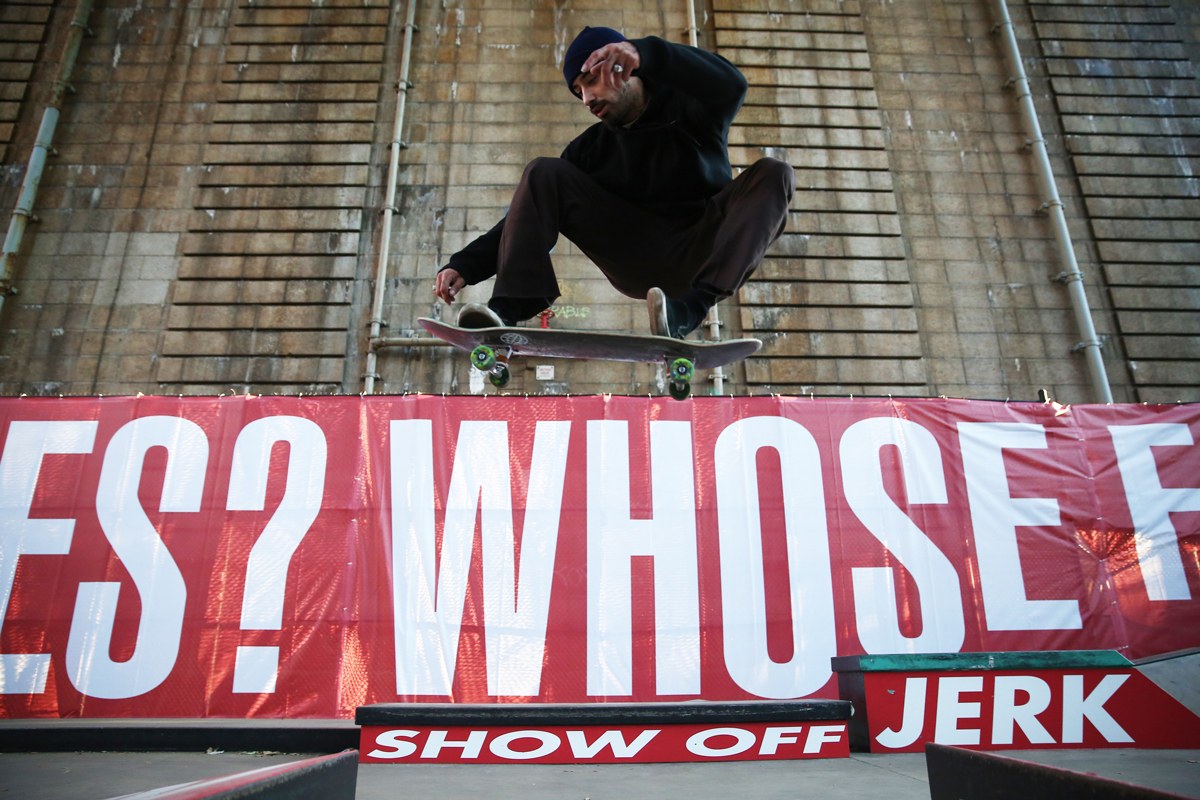
Last week, Kruger, who is seventy-two, installed five new works in red-and-white Futura as part of this year’s Performa biennial. The commission includes a billboard in Chelsea, a roving yellow school bus, a limited-edition MetroCard, and an installation at the skatepark in Coleman Square Playground, which pose questions like “Who owns what?” on red vinyl decals wrapping the ramps. The installation seems to nod at Supreme in a way that is more than oblique or accidental, and yet Kruger was reluctant to confirm that the work was meant as a direct address to the brand. “The whole idea of streetwear being branded and corporatized is only something that’s emerged with this sort of power over the past fifteen to eighteen years,” she told me over the phone last week. “I think it’s sort of interesting, and it’s very complicated but compelling, that my work and ideas and visuality have been drawn into so many sites of communication.” Kruger has a savvy, forthright way of speaking. She brackets loaded words with “quote-unquote” to suggest a degree of eye-rolling distance. When I asked about the Supreme lawsuit, she said, “I thought it was so amusing. Here are these people, so cool—like, you know, totally rad, out of the bubble—and there they are suing each other on the most conventional, proprietary, monetary level.” She paused. “I really make my work about those kind of moments. I tried to reply on that level in three sentences,” she said, referring to her “clusterfuck” comment. “It has nothing whatsoever to do with Supreme quote ‘ripping me,’ unquote. They’ve been doing that forever. I don’t care!”
The centerpiece of the Performa commission is Kruger’s first live performance, a recurring event titled “Untitled (The Drop).” Last Thursday, outside a former American Apparel store in SoHo, a line of guests for the opening stretched around the block. Hired bouncers managed the crowds. A woman in Pucci sneakers asked to skip ahead, but was sent to the back like everyone else. Two teen skateboarders did ollies in the street; it was hard to tell if they were part of the performance.

One woman with bleached-blond hair told a friend, “Now I just feel like one of those teen-agers in line for Supreme. It’s making me feel really embarrassed.” Five minutes later, she got frustrated and left. The line continued its slow creep forward. Patrons left the storefront with brown shopping bags. Visitors would be allowed ten minutes in the space, and purchases were limited to only two items. “Maybe they’ll be selling skateboards,” one man hoped.Jamie Lauren Keiles is a freelance writer.
Inside the store, the set was arranged to look like a store. Everyone clumped at the door to take photos of the red-and-white Futura items for sale, including an embroidered beanie with the phrase “Want it Buy it Forget it” (forty dollars) and T-shirts that read “Whose hopes? Whose fears? Whose values? Whose justice?” (forty-five dollars). The man bought his skateboard deck (sixty-five dollars). A sign, in Futura, hanging by the register said that the proceeds would benefit Performa. Near the door, a woman took a selfie. Outside, the line had doubled in length. It was hard to tell exactly who was ripping whom.
ALSO NOTE AT THE "BARBARA KRUGER DROP" on saturday:
Saturday at 1pm at 427 Broadway, New York City

As Performa 17 examines the sociopolitical context informing contemporary art today, with work examining immediate and critical concerns confronting our urban centers, the shifting political and cultural currents of our world today, and the role of the arts and of artists in supporting afflicted communities, Heavy Discussion v.3 examines skateboarding through a female perspective, reflecting on skateboarding as an art and women in skateboarding as the afflicted community. Due to major political and cultural shifts within that community, including the recent induction of skateboarding in the upcoming Tokyo 2020 Olympic games, increased normalization of skateboarding in popular culture increasing female participation, and expanding corporate interest, now is a perfect time to foster dialogue.
Panelists / Alexis Sablone / Kea Duarte / Sara Kay / Jaime Reyes / Elissa Steamer
Sunday, October 29, 2017
HIJACKING CAPITALISM ONE ADVERT AT A TIME
from Dangerous Minds





I suppose some may say, “It’s not big. It’s not clever.” But still, it is quite amusing. Artist provocateur Hogre is waging a war against capitalism, consumerism, right-wing politics, and religion one advert at a time.
Hogre illegally takes over large billboards and bus stop advertising displays across London and reinvents them with subversive messages. Santa Claus is no longer celebrating Christmas with a Coke but preparing to start the revolution with a fiery Molotov cocktail. Neighborhood Watch is really Neighborhood Snitch. And car companies are shitting all over the world because “Why worry about Global Warming? We all die anyway!”
Originally from Italy, Hogre’s been making his presence known for about ten years with his clever, amusing stencils and inventive acts of vandalism. It’s all jolly good fun and thought-provoking to boot but I do wonder if such well-intended artistic anarchy is more likely to result in Hogre’s work being curated in an art gallery than awakening the “sheeple” from their addiction to consumerism. But I suppose one can hope.
See more of the mighty Hogre’s art here.


Monday, October 10, 2016
School of Life Monday
History: Consumerism
and The $265 Black Flag T-Shirt mention
In the Wall Street Journal
It’s only very recently in history that we’ve been able to buy more than the bare necessities. Can the history of consumption guide us to a wiser future?
from THE WALL STREET JOURNAL
Page ONE - 7 October 2016

Thursday, August 4, 2016
A must watch:
AdBusters editor Micah White interviewed
How do we recognize the mental toxins in our world that fight against being truly human?
Adbusters editor Micah White says we must "celebrate a new aesthetic that cherishes subsistence over surplus, local over national and play over work." The myth of consumerism is that 'more is better'. "But to this lie, we will with great strength respond that only by consuming less can we live more."
Filmed at Q: http://www.qideas.org/
Join Adbusters at http://adbusters.org/
Wednesday, August 3, 2016
Junk Thought
Written and narrated by Adbusters editor Micah White, this video was animated and produced by http://thoughtcafe.ca/
Monday, September 28, 2015
Thursday, December 19, 2013
Santa the Hutt mocks Christmas gluttony and excess
from Dangerous Minds

The BetaBrand store, located in San Francisco’s Mission district, has a vile, blobby yuletide greeting I can totally get on board with: Santa the Hutt!
According to Chris from BetaBrand:
Our aim: To poke fun at holiday excess and explore anti-Santa sentiment. Our achievement: Over a thousand people have taken holiday photos at our Valencia Street store since rolling him out last week.snip~
Santa the Hutt seems unlikely to be posing for Playgirl anytime soon…He now begrudgingly poses for holiday photos with Valencia Street shoppers if only because he’s too obese to move.


Via Boing Boing
Tuesday, December 3, 2013
DRONES for Amazon.com?
This is some crazy shit . . .
Amazon Prime Air: drone-based 30 minute delivery
from Boing Boing:
Amazon Prime Air: drone-based 30 minute delivery
from Boing Boing:
Jeff Bezos took to 60 Minutes to announce Prime Air, a drone-based 30-minute delivery system for densely populated areas that comes with its own video design-fiction illustrating how it might work. The vision is an exciting one, but the designfic elides some important questions like the regulatory framework under which thousands (millions?) of drones might share the sky as businesses compete to do airborne delivery; whether that framework would be sufficient to actually maintain public safety (hello midair drone collision over a busy highway with attendant plummeting shrapnel into the path of speeding cars!); and what the energy and carbon footprint of drones would be, especially with comparison to conventional delivery logistics.
On the last point, I'm somewhat optimistic. One big problem with renewables is storing excess power generated during peak periods (tidal inflows/outflows, high wind events, strong sun), and having fleets of independent, battery-powered systems handy presents a solution: use their batteries as storage for this excess capacity. So if you imagine networks of drone-depots topped with solar arrays and/or windmills (or near to tidal generators on the coast), these could use drone batteries to both store energy for the drones, and as a storage medium to draw upon for internal power usage (pick-and-pull robots, etc) during the troughs in renewable output.
Saturday, May 4, 2013
Barbara Kruger Responds to SHITpreme's Lawsuit:
'A Ridiculous Clusterf**k of Totally Uncool Jokers'

mostly from Complex, [and my comments]:
One of the most coveted [read: exploitative] skate brands in the world is suing an artist to protect their [that's questionable] name, their logo, and their aesthetic [specializing in the unoriginal]. After years of not talking about it, the artist who inspired so much of their aesthetic finally has something to say.
The elite [read exploitative capitalist pig] streetwear and skateboarding brand powerhouse [read shithouse] ofJames Jebbiaand company—Supreme—has a substantial history of officially co-opting [and straight out stealing] the work of more than a few famous artists. For example, take their collaborative output with Damien Hirst, Takashi Murakami, or George Condo, whoseSupremeskateboard decks now go for $3,500 on eBay.
And then, there's the not-so-collaborative work. For example:Supremerecently filed a lawsuit against one Leah McSweeney and her Married to the Mob brand for using the words 'Supreme Bitch' in shirts, in the style of theSupremelogo. McSweeney managed to get the civil rights attorney and legal heavyweight Norman Siegel to take on her case.
And in the response toSupreme, he argued that McSweeney had been putting out Supreme Bitch shirts since 2004, when she was 22. Nine years later,JebbiaandSupremehave attempted to sue her for millions of dollars, arguing copyright infringement against the brand. A brand that, by the way, has definitely incorporated other people and other companies' design elements itself. [including stealing my work]
One of those people? American conceptual artist Barbara Kruger, whose work explicitly inspired not just Supreme's ubiquitous red-and-white logo (see above), but so many other brands like it, and legions of other fairly famous artists as well. But in the past, Kruger—who now teaches at UCLA—has been pretty quiet on the connections, deferring questions about the commercial entrepreneurs who've culled from and profited off of the template she inarguably set. But we thought we'd give it a shot, and Complex reached out to Kruger anyway, asking her what she made of the lawsuit, as well as both McSweeney andJebbia'spositions, and the appropriation of her ideas and work at-large.
This afternoon, Kruger responded to us in the form of a blank email, with an attachment. We opened it, and this is what we found:


EXCELLENT BARBARA!
Saturday, February 27, 2010
Vivienne Westwood says "Stop Buying Clothes"
I've been saying fashion is one of the most pure expressions of how rotten the capitalist consumerist system is. So let's read Vivienne Westwood's take.

From Richard Metzger at Dangerous Minds:
Westwood Condemns Consumerism After London Show (ABC News)
Vivienne Westwood meets James Lovelock and talks climate change on video (Dazed Digital)

From Richard Metzger at Dangerous Minds:
Vivienne Westwood’s pointedly anti-consumerist remarks backstage at London Fashion Week after her big show were taken by some as more “dotty” remarks by the great British designer, but they didn’t seem that way to me. Yes, there is certainly a, uh, tension between showing a new collection of clothes and then telling everyone assembled not to buy them, but do you think Westwood doesn’t know that?
And besides, since when is the pure act of telling the truth, somehow dotty in the first place? Have I missed something here? The woman’s 1000% correct. She should be commended for her commitment to the future of mankind—and speaking with common sense—and not mocked.
I actually met her once about ten years ago and she was a trip. My close friend Oberon Sinclair was doing some PR work for the opening of the Westwood boutique in New York and there was a big sit down dinner for a lot of people. Westwood didn’t know a lot—if any—of the people present and Genesis Breyer P-Orridge, who I attended the dinner with, gallantly and sweetly, sat down with Westwood to put her at ease. So I was along for the ride and we sat across from her for about two hours and she was a delight, if a little non-sequitur at times. (Not a judgement, just a description. People must say that about me all the time…)One-of-a-kind designer Vivienne Westwood Sunday night presented a gorgeous collection of autumn and winter outfits at London Fashion Week, then went backstage and told reporters she hopes people stop buying her clothes.Below is part one of Dame Westwood’s interview on Friday Night with Jonathan Ross last year. I thought she was fucking awesome when I saw this. Part II is here. Both parts are well worth watching. When is the last time you heard a public figure speak this passionately about something?
“Stop all this consumerism,” said Westwood, the former high priestess of punk who has increasingly used her catwalk shows to spotlight her concern about climate change.
“I just tell people, stop buying clothes. Why not protect this gift of life while we have it? I don’t take the attitude that destruction is inevitable. Some of us would like to stop that and help people survive,” she said.
Westwood Condemns Consumerism After London Show (ABC News)
Vivienne Westwood meets James Lovelock and talks climate change on video (Dazed Digital)
Subscribe to:
Posts (Atom)


