I [Richard Metzger] was on my old friend Douglas Rushkoff’s Team Human podcast. We taped this just before news of George Floyd’s murder became widely known, and talked for over four hours over the course of two long calls. The edited version is just under an hour. It’s always fun to have a conversation with him.Playing for Team Human today, counterculture icon and Editor of Dangerous Minds, Richard Metzger. Metzger envisions what life might look like on the dole and what that means for the future of the counterculture.
Rushkoff and Metzger consider whether the ideals of yesterday’s counterculture were so successful that they’ve become the new over culture? And if so, who really are the new revolutionaries? They also consider the effect Covid-19 will have on a new generation’s financial prospects, and whether the underlying flaws in capitalism will finally be laid bare.
In his monologue, Rushkoff looks at the way our policing problems can only be solved if we fund and utilize other kinds of civil servants instead of just ones with weapons.
Read “Good Cops Don’t Need Grenade Launchers” by Douglas Rushkoff from Medium’s GEN.
Showing posts with label dangerous Minds. Show all posts
Showing posts with label dangerous Minds. Show all posts
Wednesday, June 17, 2020
TEAM HUMAN: DOUGLAS RUSHKOFF
AND RICHARD METZGER TALK COUNTERCULTURE
(AND WHERE IT MIGHT BE HEADING)
from Dangerous Minds:


Saturday, June 10, 2017
THE MONKEES’ LAST STAND: THEIR FINAL 1969 TV SPECIAL ‘33⅓ REVOLUTIONS PER MONKEE’

from Dangerous Minds:
After the glorious fiasco that was the 1968 movie Head, the last project that the Monkees undertook as a quartet was a TV special for NBC called 33⅓ Revolutions Per Monkee. It’s basically the TV equivalent of Head, complete with corny jokes, audacious cameos, hummable ditties, and stuff that makes you scratch your noggin in puzzlement.
Like the band itself, 33⅓ Revolutions Per Monkee, which aired on April 14, 1969, is thoroughly of the Sixties, somehow managing to blend (say) the Batman TV show and Barbarella with musical performance shows of the day like Shindig! (which makes sense, as the producer of Shindig!, Jack Good, was involved with this as well.
The Monkees enlisted Brian Auger and Julie Driscoll to take care of the half-baked framing narrative, a crazed musical impresario (errr, Don Kirshner?) who turns the four Monkees into mindless automatons so that he can “brainwash the world!!” (I told you it was right out of Batman.) The Monkees’ arrival is highly reminiscent of the “beaming” effect on Star Trek, which had been out for a couple of years by that point, so that counts as a reference.
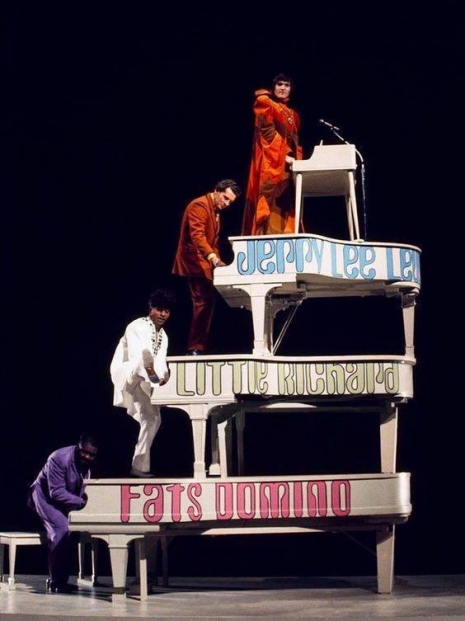
About a third of the way through the show, Auger (still in “sinister” character) explains the nature of the musical mind-control properties of the rock and roll piano chords via an audacious device—the camera shows Auger at the piano and strategically pans away from the action to reveal that Auger’s piano is perched on a piano played by Jerry Lee Lewis, which is perched on a piano played by Little Richard, which is perched on a piano played by Fats Domino. Like this:
It was probably no accident that the band chose a metaphor of being controlled by a sinister puppet master. After all, the Monkees’ story is the most vivid example in rock history of a band struggling to seize the means of production (we call them “instruments”) from the corporate overlords that had conjured them into being in the first place—in the show, Auger actually uses the word conjure to summon them into being. Later on in the show, the four fellows sing a discordant little ditty called “Wind Up Man” (as wind-up men), which included lyrics like this:
It was probably no accident that the band chose a metaphor of being controlled by a sinister puppet master. After all, the Monkees’ story is the most vivid example in rock history of a band struggling to seize the means of production (we call them “instruments”) from the corporate overlords that had conjured them into being in the first place—in the show, Auger actually uses the word conjure to summon them into being. Later on in the show, the four fellows sing a discordant little ditty called “Wind Up Man” (as wind-up men), which included lyrics like this:
I’m a wind up man
Programmed to be entertaining
Turn the key
I’m a fully automatic
Wind up man
Invented by the teeny bopper
Turn me on
And I will sing a song about a
Wind up man
As mentioned, it would seem that the stress of being the world’s first purely manufactured rock and roll TV sensation had gotten to the boys…...
The show features a fair bit of material that never made it onto any of the Monkees’ record releases. The most interesting of them, by far, is a composition written and performed by Nesmith called “Naked Persimmon” that shows as vividly as possible in what direction Nesmith’s musical ambitions were headed, namely the country rock of the First National Band, which would be Nesmith’s post-Monkees solo project. In case you were in any way unclear that Nesmith was looking to fuse country and rock, “Naked Persimmon” will remove all doubt. It’s a kind of portmanteau song that required some TV editing magic to present properly, as it featured two Michael Nesmiths trading “rock” and “country” verses, each Nesmith duly mystified whenever the other’s verse intrudes on his own.
The end sequence of the show is every bit the everything and the kitchen sink Sixties freakout that you would devoutly wish for and expect.
As with Head, it must be said that 33⅓ Revolutions per Monkee was not a resounding success in commercial terms. NBC was so unenthusiastic about the special that it chose to run it against the Oscar ceremony. Then some engineer accidentally presented it out of sequence, thus ensuring that nobody in the home audience would be able to follow any of the show’s thematic hijinks. Peter Tork left the band right after the special, buying himself out of his contract and bringing the main period of Monkees to a definitive end.
I find almost all of it pleasurable on its own terms, though, and I’d recommend it in a heartbeat for that patented Monkee note of amiable mindfuckery. See it now.
Friday, February 17, 2017
this week in 1970:
BLACK SABBATH INVENTED HEAVY METAL
from Dangerous Minds:
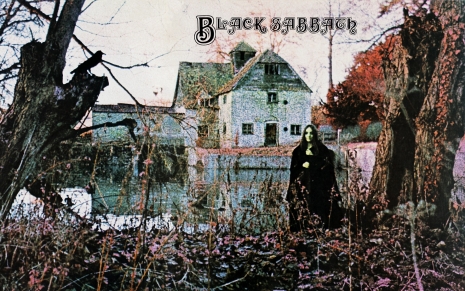
This morning I was alerted to the fact that the first Black Sabbath album was unveiled upon this world like an evil curse on this day 47 years ago. Try to imagine what kind of experience it was when someone first whacked Black Sabbath onto their turntable in 1970. There had never before been such a purposefully infernal-sounding racket in rock at that point and it set such a high watermark so as to almost never (ever?) have been topped in that category. Black Sabbath was radical, primal, primitive and quite unprecedented. The young group’s formula—Dennis Wheatley/Hammer Horror meets Cream/Vanilla Fudge—was ingenious and yet dumb enough to please the cheap seats.
At the time of the song’s composition, the group was still named Earth, which they knew they had to change due to another band already using it. When they noticed long lines waiting to get into a Boris Karloff film called Black Sabbath across the street from their rehearsal studio, they wondered if the punters would also line up for a sort of heavy horror rock. The band was renamed Black Sabbath and gained a new direction and winning formula that would make them famous and wealthy faster than a pact with Satan.

Writing at On This Deity, the Arch Drude Julian Cope had this to say about the album:
This morning I was alerted to the fact that the first Black Sabbath album was unveiled upon this world like an evil curse on this day 47 years ago. Try to imagine what kind of experience it was when someone first whacked Black Sabbath onto their turntable in 1970. There had never before been such a purposefully infernal-sounding racket in rock at that point and it set such a high watermark so as to almost never (ever?) have been topped in that category. Black Sabbath was radical, primal, primitive and quite unprecedented. The young group’s formula—Dennis Wheatley/Hammer Horror meets Cream/Vanilla Fudge—was ingenious and yet dumb enough to please the cheap seats.
What must Black Sabbath’s Black Sabbath‘s opening track “Black Sabbath” have sounded like when people got their first taste of the group? To properly appreciate how truly radical this must’ve been coming at you like a rock to the head just as the Sixties had ended—flower power this was definitely not—you’d really have to mentally erase the decades of imitators who have come since, which is difficult to do. If you trace heavy metal down to its root moment, its true moment of birth, it was when these four guys in their early twenties happened upon this sound:
At the time of the song’s composition, the group was still named Earth, which they knew they had to change due to another band already using it. When they noticed long lines waiting to get into a Boris Karloff film called Black Sabbath across the street from their rehearsal studio, they wondered if the punters would also line up for a sort of heavy horror rock. The band was renamed Black Sabbath and gained a new direction and winning formula that would make them famous and wealthy faster than a pact with Satan.
Writing at On This Deity, the Arch Drude Julian Cope had this to say about the album:
Cannily clad by their record company in a self-consciously Wiccan outer package more fustily archaic and holy than modern “secular” postwar New Testaments could ever have dared to be, and possessed at its centre of an enormous inverted cross, BLACK SABBATH summoned the ears of the Hippie Generation’s little brothers and dragged them jerking into the cold light of the 1970s. The Downer had begun.
And it ended earlier this month when Black Sabbath played their final show in their hometown of Birmingham, where Ozzy had a tram car named after him last year.
“N.I.B,” live at L’Olympia Bruno Coquatrix in Paris on December 20, 1970.
“Behind the Wall of Sleep,” Paris 1970.
Subscribe to:
Posts (Atom)


