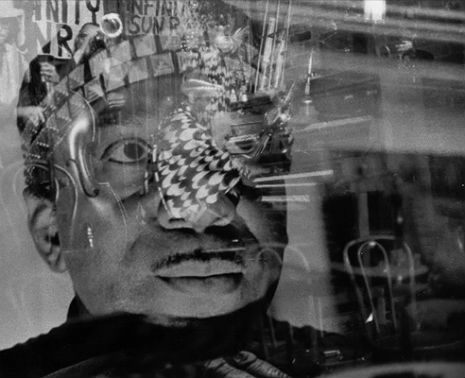
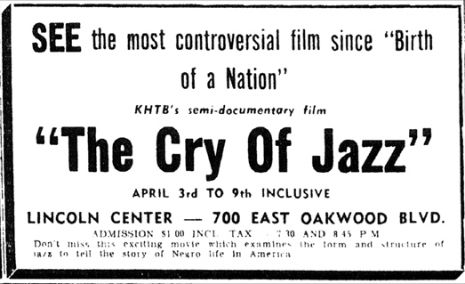
Composer/arranger Edward O. Bland’s 1958 quasi-documentary short, Cry of Jazzwas one of the first films to examine Black culture. Made during the Eisenhower era when that concept hardly had a meaning to the general public, it was also perhaps the first time that assumptions of white cultural supremacy were challenged by an African-American director in cinema history.
Today the little-known film is considered a lost classic and was selected for preservation in the United States National Film Registry by the Library of Congress in 2010:
Scenes of the Arkestra were filmed at 5 or 6 club gigs between 1956 and 1958. This was before the band and its leader began wearing the distinctive Egyptian and science fiction-styled headdresses and costumes they would later become known for.“[N]ow recognized as an early and influential example of African-American independent film-making. Director Ed Bland, with the help of more than 60 volunteer crew members, intercuts scenes of life in Chicago’s black neighborhoods with interviews of interracial artists and intellectuals. “Cry of Jazz” argues that black life in America shares a structural identity with jazz music. With performance clips by the jazz composer, bandleader and pianist Sun Ra and his Arkestra, the film demonstrates the unifying tension between rehearsed and improvised jazz. “Cry of Jazz” is a historic and fascinating film that comments on racism and the appropriation of jazz by those who fail to understand its artistic and cultural origins.”
The great revolutionary poet, John Sinclair, had this to say about Cry of Jazz
The Arkestra performances that provide the soundtrack for The Cry of Jazz underline and accent Bland’s relentlessly didactic story line and offer vivid visual contrast to the extended narrative scenes which depict a group of collegiate jazz enthusiasts heatedly engaged in a profound intellectual discussion centered on the politics of music and race and the definition, meaning and future of jazz.
Bland’s passionate, well-ordered polemic extremely advanced for the late 50s presents a systematic economic analysis of the social forces which produced and shaped the music called jazz, carefully relates them to the shape and form of the music then prevalent, and boldly forecasts what he calls the death of jazz that will be administered by a new experimental movement led by creative artists and composers (here typified by Sun Ra) who are dedicated to freeing the music from its historical strictures, reflecting the social conditions of the present, and projecting and interpreting the world of the future.
At first the story proceeds with excruciating slowness: A college jazz society meeting breaks up, leaving behind a group of stragglers a pair of white women, a white man and two black men who continue the discussion among themselves and soon reach sharp disagreement on the issues of where jazz originated, what forces shaped its development and why it sounded the way it did. Then one of the black men seizes center stage and carefully unfolds his increasingly radical analysis until his listeners are left virtually stupefied and without coherent response.
Sun Ra & the Arkestra lay down a pulsating track of sound under the narration and serve to punctuate the protagonist’s long, engrossing lecture with appropriate segments of performance footage and musical counterpoint. It’s easy to picture Sun Ra enthusiasts editing together these Arkestral appearances and eliminating the talking parts altogether, but inquisitive viewers may gain immensely from exposure to Bland’s fiercely iconoclastic exposition on the state of African American creative music on the historical cusp of the modern jazz era and the free jazz, avant garde, New Black Music movement of the 1960s.
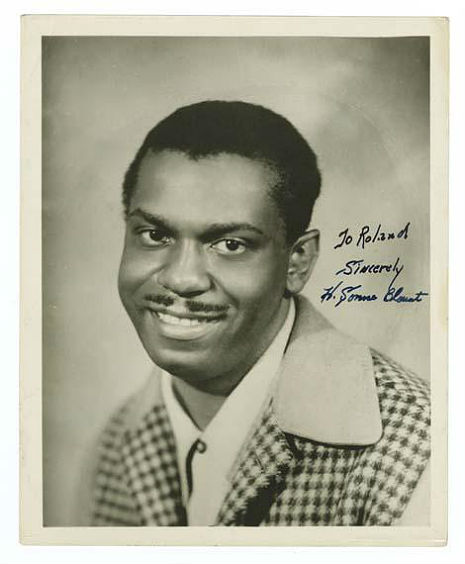
A young Herman Poole “Sonny” Blount, before he properly understood his intergalactic roots and legally changed his name to Le Sony’r Ra
Read more:
From Sonny Blount to Sun Ra: The Chicago Years
Sounds from Tomorrow’s World: Sun Ra and the Chicago Years, 1946-1961
Purchase the DVD of Cry of Jazz
Showing posts with label jazz. Show all posts
Showing posts with label jazz. Show all posts
Saturday, January 12, 2013
CRY OF JAZZ: Only Known footage of Sun Ra and His Original Aekestra, Chicago, 1950's
from DangerousMinds:


Friday, December 7, 2012
DAVE BRUBECK QUARTET: IN CONCERT, GERMANY 1966
Dave Brubeck claimed he had 2 ambitions when he first started out as a Jazz musician - “to play polytonally and polyrhythmically.”
He also said his inspiration for rhythm was the heart beat, for this was what we heard first, and last.
Brubeck was a giant of Jazz, whose passing at the age of 91, brings an end to one of the greatest eras of American Jazz.
He popularized Jazz like few other composers/musicians of his day, becoming a household name and the first million-selling Jazz musician, who also made the cover of Time magazine in 1954. The purists didn’t like him, and many classed his brand of Jazz as “easy listening”, but this is to do him and his music a great disservice.
Take a listen to the Dave Brubeck Quartet (Brubeck - Piano, Paul Desmond - Alto Saxophone, Joe Morello - Drums, Gene Wright - Bass), filmed in concert in Germany, November 6th, 1966.
Track LIsting:
01. “Take the ‘A’ Train”
02. “Forty Days”
03. “I’m in a Dancing Mood”
04. “Koto Song”
05. “Take Five”
R.I.P. Dave Brubeck 1920-2012
Sunday, September 30, 2012
GENIUS, HUSTLER, SUPERSTAR:
‘THE MILES DAVIS STORY

Miles Davis was one of the most influential musicians of the 20th century. He was at the forefront of various Jazz movements, including Be Bop, Cool, Modal and Fusion. He lived a life that was a complex mix of genius, superstar, pimp and street hustler. Duke Ellington nailed it when he described Davis as “the Picasso of Jazz”.
The Miles Davis Story is an Emmy-winning documentary that gives a fairly good overview of the man and his incredible career and controversial life, mixing interviews together with some amazing footage (including rare concerts from the 1960s and 1970s). There is a good selection of interviews, but occasionally I wanted to hear more from Davis and his music and less from the contributors. This small quibble aside, The Miles Davis Story is compelling viewing.
Thanks, DangerousMinds
Wednesday, August 31, 2011
Wednesday, April 20, 2011
Raymond Scott celebration
on Network Awesome

from DangerousMinds
Our pals at Network Awesome bring together the varied and disparate artifacts of your favorite geniuses for your trouble-free enrichment. Here’s a swell multi-pronged tribute to visionary composer and inventor Raymond Scott including an interview with Jeff Winner of the Raymond Scott Archives
video playlist:Jeff Winner is one of the chairmen of the Raymond Scott Archives, founder of raymondscott.com and co-producer of Manhattan Research, Inc.
, a 2-CD & book set of Scott’s early electronic work. That makes him totally the dude to talk to about Raymond Scott himself. And on top of being a total badass on Raymond Scott-ology, he was a nice enough guy to answer a few of our questions. The conversation goes everywhere - from Looney Tunes to Benny Goodman to Mark Mothersbaugh.
The Raymond Scott Quintette - War Dance For Wooden Indians
The Philharmonicas - Powerhouse
The Raymond Scott Quintette - Ali Baba Goes To Town (1937)
The Raymond Scott Quintette - Night and Day
Raymond Scott's Electronium: The Restoration
Designs in Music - Dorothy Collins, Raymond Scott on the Bell Telephone Hour
Raymond Scott: On To Something (trailer)
The Sound of Surreal: Interview with Jeff Winner on Raymond Scott
Friday, February 12, 2010
Charles Mingus - Fables of Faubus - Black History Month
from Jazz on the Tube
Thanks, Basheer!
In 1957 the Governor of Arkansas, Orval Faubus, ordered the state's National Guard to prevent the integration of Little Rock Central High School by nine African-American teenagers. President Eisenhower was slow to react and enforce the Supreme Court's decision, Brown vs Board of Education. Twenty days after the initial incident the President federalized the Arkansas' National Guard and sent in army's 101st Airborne Division to help the nine students enter the school safely. This event marked the first time racism in the South was on network television for the entire country to watch over almost a month long span.Click Here for more videos of Charles Mingus.
Charles Mingus wrote the song 'Fables of Faubus' as a response to this event and show his anger and disgust at the racism endured by black people in America. The song was first recorded for Mingus' album Mingus Ah Um in 1959 on the Columbia label though they would not allow the lyrics to be included. In 1960 Mingus was able to record the song on the Candid label with lyrics on his album Charles Mingus Presents Charles Mingus. The lyrics include a call and response between Mingus and drummer Dannie Richmond.
"Mingus, as you know, was outspoken. He used the bandstand as a soapbox to communicate what was on his mind—about the ills of society, the inequities and the social injustice. He spoke out at all times, not just about people making noise in clubs during performances but also about political and social issues. This was a musical communication about his feelings, not to be confused with political protest. Mingus only wrote six or seven political compositions with lyrics, but he was not didactic. His purpose with his music wasn’t to confront social injustice. He was too much of a composer for that. But he did vent on the bandstand vocally about anything he felt was wrong or unfair. Back then, that took courage." - Sue Mingus
Thanks, Basheer!
Monday, August 24, 2009
MIles Davis' "Kind Of Blue"
just turned 50 years old

Here's a piece of a great article on the first jazz album that i ever liked, and still remains my favorite.
Miles Davis’ Kind of Blue, which was released 50 years ago today, is a nearly unique thing in music or any other creative realm: a huge hit—the best-selling jazz album of all time—and the spearhead of an artistic revolution. Everyone, even people who say they don’t like jazz, likes Kind of Blue. It’s cool, romantic, melancholic, and gorgeously melodic. But why do critics regard it as one of the best jazz albums ever made? What is it about Kind of Blue that makes it not just pleasant but important?
On March 2, 1959, when its first tracks were laid down at Columbia Records' 30th Street Studio (the album would be released on Aug. 17), Charlie Parker, the exemplar of modern jazz, the greatest alto saxophonist ever, had been dead for four years, almost to the day. The jazz world was still waiting, longing, for "the next Charlie Parker" and wondering where he'd take the music.
Parker and his trumpeter sidekick, Dizzy Gillespie—Bird and Diz, as they were called—had launched the jazz revolution of the 1940s, known as bebop. Their concept was to take a standard blues or ballad and to improvise a whole new melody built on its chord changes. This in itself was nothing new. But they took it to a new level, extending the chords to more intricate patterns, playing them in darting, syncopated phrases, usually at breakneck tempos.
The problem was, Parker not only invented bebop, he perfected it. There were only so many chords you could lay down in a 12-bar blues or a 32-bar song, only so many variations you could play on those chords. By the time he died, even Parker was running out of steam.
When Miles Davis came to New York in 1945, at the age of 19, he replaced Gillespie as Parker's trumpeter for a few years and played very much in their style. A decade later, he, too, was wondering what to do next...
read the whole piece here Kind of Blue: Why the best-selling jazz album of all time is so great by Fred Kaplan
Subscribe to:
Posts (Atom)


