Taken at face value, rhetoric from the White House and the Department of Homeland Security (DHS) would lead Americans to believe that the United States is facing a terrorism crisis at our southern border. The picture being painted is one in which thousands of terrorists have been stopped crossing our southern border to infiltrate the Homeland. If that were true, that would indeed be a crisis.
In reality, no such crisis exists.
Our federal courthouses and prisons are not filled with terrorists we’ve captured at the border. There is no wave of terrorist operatives waiting to cross overland into the United States. It simply isn’t true. Anyone in authority using this argument to bolster support for building the wall or any other physical barrier along the southern border is most likely guilty of fear mongering and willfully misleading the American people.
Why do I know this? As Director of the National Counterterrorism Center (NCTC) from December 2014 until December 2017, it was my job to lead the government’s efforts to collect and analyze all available information about terrorist threats to the Homeland. It was my responsibility on behalf of the Intelligence Community to synthesize and present that terrorism picture to our most senior decision makers – up to and including the President of the United States — so that sound decisions could be made about how to protect the Homeland from terrorist attack.
Here is ground truth on this issue. Terrorist groups like al-Qa’ida and ISIS spend time talking about, brainstorming and even fantasizing about ways in which they can do harm to the United State. At times, those conversations have certainly included discussion of ways in which terrorist operatives might be inserted into the Homeland. But we also knew from intelligence reporting that terrorist groups have very high regard for our Homeland Security capabilities, including our border security. They know we had become a much “harder” target than at the time of 9/11 and that getting their operatives into the United States is an extremely challenging proposition.
In part, that’s why terrorist groups pivoted in recent years to a different business model. Rather than focusing on trying to insert a terrorist operative from abroad, it has proven to be far easier for an organization like ISIS or al-Qa’ida to inspire or motivate an individual already inside the United States to act on their behalf. That change has left us with the threat condition that prevails today, in which the greatest terrorism threat we face is from what we call Homegrown Violent Extremists (HVEs) – in most cases individuals who were either born here or have lived here for most of their adult lives.
The most recent public testimony of our intelligence community professionals – to include the Acting Director of NCTC and the FBI Director – makes that focus on homegrown extremists abundantly clear. What’s more, recent testimony by these officials has not highlighted serious terrorism related concerns about the southern border. It remains a theoretical vulnerability but not one that terrorists have been able to exploit.
So, what to make of these thousands of so-called terrorists prevented from entering the country across our southern border? Where do these numbers come from? What seems true is that our system of terrorist watch listing is in fact working. Though DHS has not provided data to support its claims, I suspect that on many occasions in recent years, perhaps adding up to thousands, individuals who live abroad and want to travel to the United States have been denied the opportunity to do so because of a concern about a potential nexus to terrorism. Such an individual would have their visa or ESTA application denied and no travel would occur. In other cases, so-called Special Interest Aliens (SIA) from countries of terrorism concern have likely been stopped at the border.
But each of those visa denials or SIA encounters hardly equates to disruption of a terrorist plot or the “capture” of a known terrorist. Our watchlisting system is predicated on a carefully calibrated risk management approach. When the intelligence community acquires information that points to a potential link to terrorist activity, individuals are not permitted to travel to the United States. But it should not be assumed that every individual who was denied the opportunity to enter the U.S. because of a potential terrorism link was in fact a would-be terrorist intent on doing us harm. We are certainly not facing a “crisis” of thousands of terrorists trying to cross our southern border.
For those not willing to take my word or others for it, there is a better indicator that the Administration’s arguments about a large-scale terrorist infiltration across our southern border are specious. If that proposition were true, there would certainly be current intelligence assessments laying out the details of this threat, even citing specific cases of imprisoned terrorists that had made their way through the criminal justice system. And if the Administration wished to provide support for its claims, I suspect it would have worked to declassify for public consumption relevant portions of those classified assessments or at the very least, highlighted past prosecutions using publicly available court documents. To my knowledge, no such effort is underway. That’s because the Intelligence Community is almost certainly not able to stand publicly behind what the White House and DHS are saying.
If the Administration and indeed the Congress were in fact looking for ways to make the American people safer from terrorist attack, there are things that should be done, apart from building walls at the border. Indeed, for every dollar spent on a $5 billion southern border wall, American public safety could benefit exponentially more from spending it on counterterrorism elsewhere.
First and foremost, we could expand our investment in prevention programs aimed at countering violent extremism here in the U.S. This prevention work involves intensive engagement with communities at the state and local level and it is difficult, often frustrating work. Success or failure is hard to measure and it has proven challenging to build trust between the government and communities where extremism can take root. But walking away from these programs, as the current Administration has done, is hardly a recipe for success in countering extremism here in the United States. Even relatively modest sums would have significant impact in this area. We are talking millions, not billions.
Secondly, the government could accelerate investments aimed at modernizing our watchlisting systems. In the period since 9/11, much has been accomplished in this area, and we are probably better than any nation in the world when it comes to identifying bad actors and keeping them from entering our country. But there is much more to be done in terms of using modern information technology to enhance our risk management approach, including stepped up collection and analysis of biometric information. Dollars spent in support of these objectives would do far more to keep us safe than dollars spent on physical barriers.
Lastly, the government can and should increase programming and resources aimed at dealing with purely domestic terrorism which seems to be of growing concern. To its credit, the Administration gave attention to this issue in its recently published Counterterrorism Strategy. But it remains to be seen if dollars and programs will follow from that strategy document.
To be sure, there are terrorists located abroad who are intent on trying to enter the United States. But the number almost certainly isn’t in the thousands as has been claimed or implied by the Administration. Making such fantastic and unsupportable claims only undermines public trust and confidence in our watchlisting system and in our counterterrorism community. In other words, the rhetorical exaggerations themselves undercut our national security. Most importantly, responding to the challenge posed by terrorist travel is well within our capabilities as a nation – wall or no wall. The intelligence and law enforcement professionals charged with preventing terrorists from entering the United States are highly capable, extremely dedicated and equipped with a wide range of tools and capabilities to keep us safe. They deserve our trust and confidence. The political manipulation of real facts does both these professionals and the American public a deep disservice.
The views expressed in this publication are the author’s and do not imply endorsement by the Office of the Director of National Intelligence or any other U.S. government agency.
But you know so many just didn't want to vote the lesser of two evils ...
And then those so uneducated or selfish really believed the con man would help them ... such a motherfucking shame ...
Critics of "lesser evil voting" should consider that their footing on the high ground may not be as secure as they often take for granted.
By John Halle [1], Noam Chomsky [2] / Noam Chomsky's Official Site [3]
August 6, 2016
Among the elements of the weak form of democracy enshrined in the constitution, presidential elections continue to pose a dilemma for the left in that any form of participation or non participation appears to impose a significant cost on our capacity to develop a serious opposition to the corporate agenda served by establishment politicians. The position outlined below is that which many regard as the most effective response to this quadrennial Hobson’s choice, namely the so-called “lesser evil” voting strategy or LEV. Simply put, LEV involves, where you can, i.e. in safe states, voting for the losing third party candidate you prefer, or not voting at all. In competitive “swing” states, where you must, one votes for the “lesser evil” Democrat.
Before fielding objections, it will be useful to make certain background stipulations with respect to the points below. The first is to note that since changes in the relevant facts require changes in tactics, proposals having to do with our relationship to the “electoral extravaganza” should be regarded as provisional. This is most relevant with respect to point 3) which some will challenge by citing the claim that Clinton’s foreign policy could pose a more serious menace than that of Trump.
In any case, while conceding as an outside possibility that Trump’s foreign policy is preferable, most of us not already convinced that that is so will need more evidence than can be aired in a discussion involving this statement. Furthermore, insofar as this is the fact of the matter, following the logic through seems to require a vote for Trump, though it’s a bit hard to know whether those making this suggestion are intending it seriously.
Another point of disagreement is not factual but involves the ethical/moral principle addressed in 1), sometimes referred to as the “politics of moral witness.” Generally associated with the religious left, secular leftists implicitly invoke it when they reject LEV on the grounds that “a lesser of two evils is still evil.” Leaving aside the obvious rejoinder that this is exactly the point of lesser evil voting-i.e. to do less evil, what needs to be challenged is the assumption that voting should be seen a form of individual self-expression rather than as an act to be judged on its likely consequences, specifically those outlined in 4). The basic moral principle at stake is simple: not only must we take responsibility for our actions, but the consequences of our actions for others are a far more important consideration than feeling good about ourselves.
While some would suggest extending the critique by noting that the politics of moral witness can become indistinguishable from narcissistic self-agrandizement, this is substantially more harsh than what was intended and harsher than what is merited. That said, those reflexively denouncing advocates of LEV on a supposed “moral” basis should consider that their footing on the high ground may not be as secure as they often take for granted to be the case.
A third criticism of LEV equates it with a passive acquiescence to the bipartisan status quo under the guise of pragmatism, usually deriving from those who have lost the appetite for radical change. It is surely the case that some of those endorsing LEV are doing so in bad faith-cynical functionaries whose objective is to promote capitulation to a system which they are invested in protecting. Others supporting LEV, however, can hardly be reasonably accused of having made their peace with the establishment. Their concern, as alluded to in 6) and 7) inheres in the awareness that frivolous and poorly considered electoral decisions impose a cost, their memories extending to the ultra-left faction of the peace movement having minimized the comparative dangers of the Nixon presidency during the 1968 elections. The result was six years of senseless death and destruction in Southeast Asia and also a predictable fracture of the left setting it up for its ultimate collapse during the backlash decades to follow.
The broader lesson to be drawn is not to shy away from confronting the dominance of the political system under the management of the two major parties. Rather, challenges to it need to be issued with a full awareness of their possible consequences. This includes the recognition that far right victories not only impose terrible suffering on the most vulnerable segments of society but also function as a powerful weapon in the hands of the establishment center, which, now in opposition can posture as the “reasonable” alternative. A Trump presidency, should it materialize, will undermine the burgeoning movement centered around the Sanders campaign, particularly if it is perceived as having minimized the dangers posed by the far right.
A more general conclusion to be derived from this recognition is that this sort of cost/benefit strategic accounting is fundamental to any politics which is serious about radical change. Those on the left who ignore it, or dismiss it as irrelevant are engaging in political fantasy and are an obstacle to, rather than ally of, the movement which now seems to be materializing.
Finally, it should be understood that the reigning doctrinal system recognizes the role presidential elections perform in diverting the left from actions which have the potential to be effective in advancing its agenda. These include developing organizations committed to extra-political means, most notably street protest, but also competing for office in potentially winnable races. The left should devote the minimum of time necessary to exercise the LEV choice then immediately return to pursuing goals which are not timed to the national electoral cycle.
*****
1) Voting should not be viewed as a form of personal self-expression or moral judgement directed in retaliation towards major party candidates who fail to reflect our values, or of a corrupt system designed to limit choices to those acceptable to corporate elites.
2) The exclusive consequence of the act of voting in 2016 will be (if in a contested “swing state”) to marginally increase or decrease the chance of one of the major party candidates winning.
3) One of these candidates, Trump, denies the existence of global warming, calls for increasing use of fossil fuels, dismantling of environmental regulations and refuses assistance to India and other developing nations as called for in the Paris agreement, the combination of which could, in four years, take us to a catastrophic tipping point. Trump has also pledged to deport 11 million Mexican immigrants, offered to provide for the defense of supporters who have assaulted African American protestors at his rallies, stated his “openness to using nuclear weapons”, supports a ban on Muslims entering the U.S. and regards “the police in this country as absolutely mistreated and misunderstood” while having “done an unbelievable job of keeping law and order.” Trump has also pledged to increase military spending while cutting taxes on the rich, hence shredding what remains of the social welfare “safety net” despite pretenses.
4) The suffering which these and other similarly extremist policies and attitudes will impose on marginalized and already oppressed populations has a high probability of being significantly greater than that which will result from a Clinton presidency.
5) 4) should constitute sufficient basis to voting for Clinton where a vote is potentially consequential-namely, in a contested, “swing” state.
6) However, the left should also recognize that, should Trump win based on its failure to support Clinton, it will repeatedly face the accusation (based in fact), that it lacks concern for those sure to be most victimized by a Trump administration.
7) Often this charge will emanate from establishment operatives who will use it as a bad faith justification for defeating challenges to corporate hegemony either in the Democratic Party or outside of it. They will ensure that it will be widely circulated in mainstream media channels with the result that many of those who would otherwise be sympathetic to a left challenge will find it a convincing reason to maintain their ties with the political establishment rather than breaking with it, as they must.
8) Conclusion: by dismissing a “lesser evil” electoral logic and thereby increasing the potential for Clinton’s defeat the left will undermine what should be at the core of what it claims to be attempting to achieve.
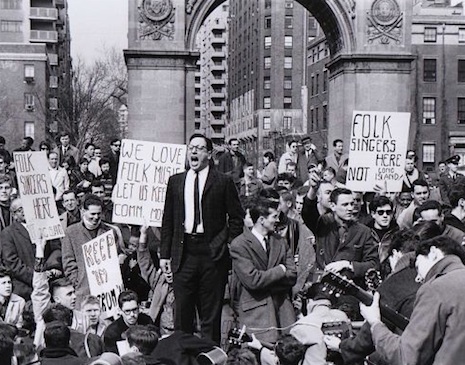
The protestors were peaceful. They didn’t look like revolutionaries. They were dressed in suits and ties. They were singing “The Star-Spangled Banner.”
But the cops still attacked them with billy clubs.
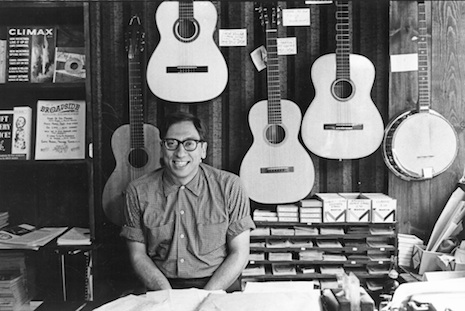
In the spring of 1961, Israel (“Izzy”) Young taped a sign to the window of his shop in Greenwich Village, New York. The handwritten sign announced a protest rally at the fountain in Washington Square Park at 2pm on Sunday April 9th .
Izzy was the proprietor of the Folklore Center at 110 MacDougal Street, a shop that sold books, records and everything else relating to folk music. Since it opened in 1957, the Folklore Center had been the focal point for young folk singers, beatniks and assorted musicians to gather together, hang out, talk, play and listen to music.
After the Second World War, Greenwich Village was the gathering point for all the disaffected youth who wanted to escape the conformity and boredom of suburbia. They were brought by the district’s association with the Beats and jazz musicians who had lived and played there during the 1940s and early 1950s. Often their first point of call was Izzy’s shop. Among the many youngsters who visited there was a young Bob Dylan. Izzy arranged Dylan’s first concert at Carnegie Hall. He “broke [his] ass to get people to come.” Tickets were two bucks apiece. Only 52 people turned up—though later hundreds would tell Izzy they were there.
Izzy Young in the Folklore Center circa 1960.
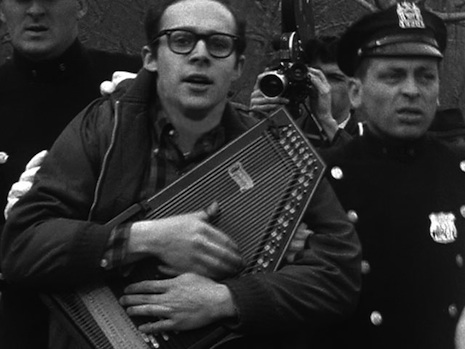
Since the late 1940s, folk musicians had gathered at the fountain in Washington Square Park. They brought their guitars and autoharps to play and sing songs. It was peaceable enough but some residents thought the Sunday gatherings brought “undesirables” to the neighborhood—by undesirables they meant African-Americans.
In April 1961, the new Commissioner of Parks Newbold Morris decided to take action. He banned singing in Washington Square Park. As Ted White later reported the events of that fateful day in the park in Rogue magazine, August 1961:
For seventeen years folksingers had been congregating on warm Sunday afternoons at the fountain in the center of the small park, unslinging their guitars and banjos and quietly singing songs. There would be a varied number of groups—perhaps ten or more—rimming the fountain, each singing a particular variety of folk music, from Negro work songs and blues to Kentucky hillbilly bluegrass, with perhaps an Elizabethan ballad from the West Virginia hills thrown in occasionally. As the years passed, the city government began showing an increasing hostility to the use of public facilities by the public, and for the last fourteen years, permits have been required before “public performances” could be given in any park. What this means is that a group of kids singing to each other on a weekday evening would be forcibly silenced by the ever-patrolling police for failing to possess a “permit,” or a young man playing a harmonica to himself quietly while sitting on a park bench might be suddenly ordered, “Move on, you!” and find himself run out of the park.
...
And now the new Parks Commissioner has refused a permit to the folksingers for their Sunday afternoon gatherings. Why? The same old story: “The folksingers have been bringing too many undesirable elements into the park.”
“Undesirable elements?” Yes, healthy young kids, racially mixed and unprejudiced enough not to care, concerned only with having the chance to assemble in the open sun and air and to be able to enjoy themselves harmlessly and happily. Sam Schwartz, a Brooklyn father, told me “Sure I let my kid—he’s a teenager—come and sing here. Why not? It’s a good, healthy activity. What’s wrong with folksongs?”
Ron Archer, a young jazz critic who lives in the West Village (an apparently less troubled area), said “Why shouldn’t people sing in the Square? If Morris is so concerned about the safety of the parks, why doesn’t he clean out the muggers and rapists in Central Park, where it isn’t safe to walk at night? Why doesn’t he go after the local punks who prowl the edges of this park at night? Why take after a group which is as harmless as the old men who play chess here, and who are just about as ’undesirable’?”
“You know what ’undesirable’ means, don’t you?” a name jazz musician told me. “It means ’Negro’. A few of the folksingers are Negroes.”
“I came up here from Mississippi,” says Bob Stewart, a Realist cartoonist who lives in the Village, “to get away from the prejudice, and now I get complaints from my landlord whenever I have a Negro friend up in my apartment.”
“The racial bias is definitely behind the whole thing,” Izzy summed it up. “It’s part of the big squeeze on the Italians.”
In response to the ban, Izzy applied for a permit to sing in the park. It was rejected. He therefore organized a protest rally.
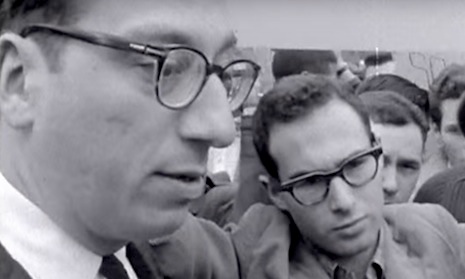
Izzy Young talks to a cop at the start of the demonstration.
On Sunday April 9th at 2pm, around 500 men and women—smartly dressed, some in suits and ties and carrying placards—peaceably approached the fountain at Washington Square Park. They were stopped by a cop. He wanted to know who was in charge. Izzy Young made his way to the front of the crowd and talked to the officer. He explained they were allowed to protest peaceably. It was within their constitutional rights to do so. The cop told Izzy they couldn’t sing, that singing was banned. They would be arrested if they broke the ban. Izzy countered by saying singing was a form of speech and they had a right to freedom of speech. He added:
It’s not up to Commissioner Morris to tell the people what kind of music is good or bad. He’s telling people folk music brings degenerates, but it’s not so.
The cops were not impressed. They began to move menacingly towards the demonstrators. Izzy thought if they started singing “The Star-Spangled Banner” the police would not hit them “on the head.” He was wrong. As the demonstrators sang the national anthem the cops started laying into them.
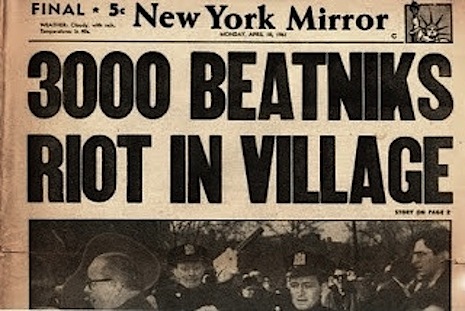
Ten demonstrators were arrested. Dozens were injured. The press hyped the story up as a ‘Beatnik riot’ where some 3000 people attacked the cops. This story was quickly dropped as it was widely known not to be true.
The rally marked a cultural shift between generations. As folk singers like Woody Guthrie and Pete Seeger understood, music brought people of a different background, class and color together. Music can be a cohesive force for change.
When filmmaker Dan Drasin heard about the rally, he borrowed one of D. A. Pennebaker’s cameras. He thought it would be an idea to capture the demonstration on film. His seventeen-minute-long documentary Sunday captured the events of that day, when “The Star-Spangled Banner” announced the start of the youth and cultural revolution that defined the 1960s.
Izzy Young moved to Sweden in the 1970s where he opened a new “Folklore Centrum” which he still manages to this day.
Yesterday at lunch, I was mulling over all the familiar laments we've heard this year about voter anger and America decline. And I thought: really, what's so bad? I should write a post about this.
Today I woke up, and in a remarkable example of precog telepathy, Politico's Michael Grunwald had written almost exactly the piece I had in mind:
Start with the economy....Unemployment has dropped from 10 percent during the worst of the Great Recession to 5 percent today....The housing market has also rebounded from the crisis, and after-tax corporate profits are at an all-time high....The oft-predicted doomsday scenarios of the post-crisis era—double-dip recession, runaway inflation, runaway interest rates, out-of-control energy prices, a health insurance death spiral, a Greek-style debt crisis, a run on the dollar—are still stubbornly refusing to materialize. Growth is modest but steady. Inflation is low....About 17 million uninsured Americans have gotten coverage in the past few years. The federal deficit has plunged from $1.4 trillion in 2009 to under $500 billion, while the dollar has gained strength against foreign currencies.
....Meanwhile, other recent developments—cheaper gas, free birth control and preventive care, the elimination of annual and lifetime caps on health insurance, expanded tax credits for the working poor, increased efficiency measures that lower energy bills, and much more—have put more money in the pockets of American families, even though their incomes have grown slowly.
....Crime in big cities dropped about 5 percent in 2015, and has been cut in half since 1990. The teen birth rate is down more than 60 percent since 1990....Carbon emissions have dropped 10 percent from 2005 levels. High school graduation rates are at an all-time high....And despite all the rhetoric about border crises and wall-building, America’s population of undocumented immigrants has remained stable for the past five years.
....Legislative gridlock in Washington eased significantly in 2015. After four years of divided-government paralysis, President Obama signed a slew of major bipartisan laws last year, including a bizarrely responsible reform of a long-standing Medicare funding problem and a sensible overhaul of the unpopular No Child Left Behind education law.
There's no need to be too Pollyannish, of course. Wages continue to be pretty stagnant. The Middle East is in flames. Reproductive rights are under sustained attack. Way too many unarmed blacks are being shot by police. Heroin use has become an epidemic. Etc.
But generally speaking, Grunwald is right. America weathered the Great Recession better than Europe, better than China, better than Japan, better than Russia, better than just about anybody. Health care costs have been growing slowly and more people are covered than ever before. Taxes are low on the middle class. The tech revolution has delivered an insane—and surprisingly high quality—number of entertainment options available to almost anyone. Campaign rhetoric notwithstanding, American military strength is unmatched by anyone in the world, and it's not even close. Telepathy has apparently been developed by the editors at Politico.
That's not bad, is it?
POSTSCRIPT: Normal griping about all our problems will resume shortly. Don't worry: I have not been taken over by aliens.
Confederate Flag: No Honor in Fighting for an Unjust Cause
Story of America with Eric Byler and Annabel Park in Columbia, South Carolina
Bill Starr has a South Carolina lineage that predates the Revolution, and ancestors who fought in the Civil War for the Confederate States of America. Hear why he wants the flag to come down.
The Confederate battle flag was raised over the South Carolina capitol dome in 1962 as a symbol of defiance of the Civil Rights movement. In 2002, a compromise in the state legislature moved the flag to a Confederate war memorial in front of the dome, with the United States flag and the South Carolina state flag replacing the Confederate flag atop the dome.
In the wake of the June 17, 2015 massacre at the Mother Emmanuel AME Church in Charleston, SC, lawmakers including both US Senators and the governor of the state (all Republicans) asked the legislature to vote to remove the flag from state grounds as a symbol of healing, unity and inclusion.
The American academic and firebrand campaigner talks about Britain's deep trouble, fighting white supremacy and where Obama is going wrong
Cornel West, the firebrand of American academia for almost 30 years, is causing his hosts some problems. They are on a schedule but such things barely move him, for as he saunters down the high street there are people to talk to, and no one can leave shortchanged. Everyone, "brother" or "sister", is indeed treated like a long lost family member. And then there is the hug; a bear-like pincer movement. There's no escape. It happens in New York, where the professor/philosopher usually holds court. And now it's the same in Cambridge.
The best students accord their visitors a healthy respect, but West's week laying bare the conflicts and fissures of race and culture and activism and literature in the US and Britain yielded more than that during his short residency at King's College. There are academics who draw a crowd, but the West phenomenon at King's had rock star quality: the buzz, the poster beaming his image from doors and noticeboards; the back story – Harvard, Princeton, Yale, his seminal work Race Matters, his falling-in and falling-out with Barack Obama.
Others can teach, and at Cambridge the teaching is some of the best in the world, but standing-room-only crowds came to see West perform. He performed. Approaching 60 now, he is slow of gait. But he always performs.
"Britain is in trouble," he tells me. "Britain is in deep trouble. The privatising is out of the control, the militarising is out of control and the financialising is out of control. And what I mean from that is you have a cold-hearted, mean-spirited budget that the Queen just read; you have working and poor people under panic, you have this obsession with immigration that tends to scapegoat the most vulnerable rather than confront the most powerful. And it is not just black immigrants, but also our brothers and sisters from Poland and Bulgaria, Romania; right across the board." He isn't ranting. He doesn't rant. He smiles, he growls gently, he leans in and whispers conspiratorily. There is an upside, he says. "Britain has a rich history of bouncing back too."
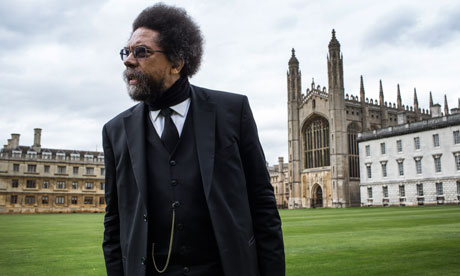
They looked after him at King's, he says. Incongruous in his trademark black three–piece suit, with fob watch and old-time, grey–flecked, fly-away afro, he berthed in the understated splendour of the Rylands room in the Old Lodge. Named after Dadie Rylands, the literary scholar and theatre director educated at King's and a fellow until his death in 1999, it was where Virginia Woolf lunched with Rylands and John Maynard Keynes. West likes such evocations. "I feel her spirit," he says, leaning back on a chair.
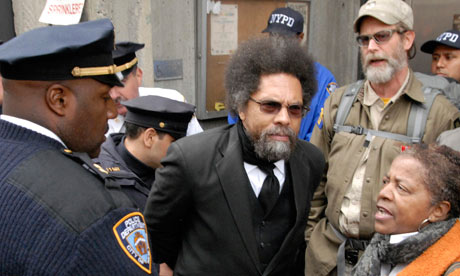
Activist ... Cornel West is arrested during a protest against policing methods in Harlem in 2011. Photograph: Stephanie Keith/AP
But then he is accustomed to the star treatment. A graduate of Harvard University in 1973, he received his PhD at Princeton; returning to both as professor of religion and director of the programme in African-American studies at Princeton and later professor of African-American studies at Harvard. He departed Harvard in 2002 after a bitter dispute with the then president of the university, Lawrence Summers, Bill Clinton's treasury secretary, who was later picked by President Obama to head the US National Economic Council. Some claim Summers's clash with West formed part of the spiral that led to his own departure from Harvard. West says Summers had an agenda to cut African American studies, and him, down to size. He "tangled with the wrong Negro", the professor said later. He returned to Princeton, from which he has recently retired. Now his centre of academic operations is the Union Theologiocal Seminary in New York, where he began his teaching career.
But he is multi-platform, which, critics contend, added something to the fall-out with Summers at Harvard. He is the author of 19 books and editor of another 13. A regular TV pundit. Co-star of the popular public radio show Smiley and West. Chair of the Democratic Socialists of America. He even played the wise Councillor West in The Matrix Reloaded. While the right throws the socialist tag at Obama like a poisoned dart, West wears it as a badge of honour. A "non-Marxist socialist" eschewing Marxism in favour of Christianity. A complex package. Hence the enthusiasm at Cambridge's Centre for Research in the Arts, Social Sciences and Humanities to invite him over and peel the layers.
Last week West appeared three times in conversation: on race and politics, with academic Paul Gilroy – their double header had to be moved to a larger venue and ended with a standing ovation; on philosophy and the public sphere, with philosopher MM McCabe; and with Ben Okri on literature and the nation. The fact is that he'll talk indefinitely and on anything. In between Cambridge appearances, he headed to Sheffield University to unveil a memorial to a previous visitor there, "my brother Malcolm X". Also to London to an event hosted by former race chief Trevor Phillips.
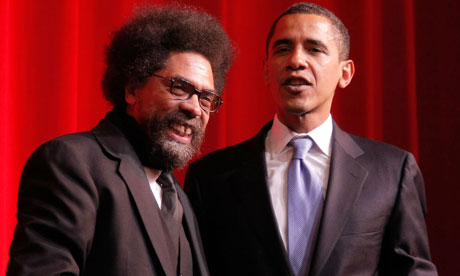
'White supremacy is still operating in the US, even with a brilliant black face in the White House' ... West with Barack Obama in 2007. Photograph: Jemal Countess/WireImage
For his radio show in the US, he also travelled to the Ecuadorian embassy for an encounter with Julian Assange. Exhilarating, by his account. "Boy, that was a rich one," he says. "Oh my God, we went on for an hour and a half: about the militarising of the internet and the use of US imperial power. They're trying to squelch any whistleblower who wants to reveal the secrets of the dirty wars of the US empires and other governments. We talked primarily about courage. He is a very smart man and very courageous too."
They found points of contact. "He talked about Martin Luther King's courage and how he has been inspired by Martin Luther King. We talked about the 3 June case with brother Bradley Manning and the witnesses the US government has lined up. I wanted people to hear his voice and to revel in his humanity; revel in his wrestling with his situation and to see what his vision is."
He found some optimism, he says. "He has this situation with the sisters in Sweden and that's got to be resolved, and I think that's in the process of being resolved. We have to be concerned about someone accused of violating anybody, but I think for the most part that is going to be resolved, and that was probably an attempt of the powers that be. One woman has already said she is pulling back and the other one admits it was consensual, so it is not as ugly as it was projected in the press. But once that is over he has got the big one coming. He has got a behemoth coming at him; the US empire and its repressive apparatus. That is a behemoth, man."
Race matters, West famously wrote. Does race still matter? "I think race matters deeply but it is in many ways denied," he says. "The form of institutional racism and informal racism is very much there. White supremacy is very much alive in Britain. If you scratch below the surface you can still see how race matters. It is not as raw and coarse as it is in the US. You have 10,000 professors in Britain and 50 professors of colour. Ten women. This is pathetic; this is ridiculous. The 'meritocratic' brothers and sisters say: 'It's just a matter of merit and if they were doing the work you would have a higher percentage.' And you say: 'Please, get off the crack pipe.' There are brilliant black and brown people who could gain access to these professorships. Something is happening."
He doesn't rant. He smiles, he growls gently, he leans in and whispers conspiratorially ... West in Cambridge. Photograph: David Levene for the Guardian
Of course, concerns extend beyond teaching staff. Cambridge, with Oxford, is regularly accused of doing too little attract minorities. Both say they are trying.
But he acknowledges green shoots too. "There are the magnificent relationships between black and white and brown and Asian, and the different marriages and relationships that flower. Those are beautiful. But that doesn't mean institutional racism is not strong."
What of America? "We elected a black president and that means we are less racist now than we used to be. That's beautiful. But when you look at the prison industrial complex and the new Jim Crow: levels of massive unemployment and the decrepit unemployment system, indecent housing: white supremacy is still operating in the US, even with a brilliant black face in a high place called the White House. He is a brilliant, charismatic black brother. He's just too tied to Wall Street. And at this point he is a war criminal. You can't meet every Tuesday with a killer list and continually have drones drop bombs. You can do that once or twice and say: 'I shouldn't have done that, I've got to stop.' But when you do it month in, month out, year in, year out – that's a pattern of behaviour. I think there is a chance of a snowball in hell that he will ever be tried, but I think he should be tried and I said the same about George Bush. These are war crimes. We suffer in this age from an indifference toward criminality and a callousness to catastrophe when it comes to poor and working people."
Can you not cut the president some slack, I ask? Think of what he faced. What did you expect? "I worked to get him elected," he says, almost indignant. "And I would do it again because the alternative was so much worse. But at the same time, I have to be able to tell the truth. I thought he was going to be a dyed-in-the-wool liberal rather than a weak centrist. I thought he would actually move towards healthcare with a public option. I thought he was going to try to bail out homeowners as he bailed out banks. I thought he would try to hit the issue of poverty head-on."
He and Obama, the first-time candidate, talked. And then West attended 65 events drumming up support. "He talked about Martin Luther King over and over again as he ran. King died fighting not just against poverty but against carpet-bombing in Vietnam; the war crimes under Nixon and Kissinger. You can't just invoke Martin Luther King like that and not follow through on his priorities in some way. I knew he would have rightwing opposition, but he hasn't tried. When he came in, he brought in Wall Street-friendly people – Tim Geithner, Larry Summers – and made it clear he had no intention of bailing out homeowners, supporting trade unions. And he hasn't said a mumbling word about the institutions that have destroyed two generations of young black and brown youth, the new Jim Crow, the prison industrial complex. It's not about race. It is about commitment to justice. He should be able to say that in the last few years, with the shift from 300,000 inmates to 2.5 million today, there have been unjust polices and I intend to do all I can. Maybe he couldn't do that much. But at least tell the truth. I would rather have a white president fundamentally dedicated to eradicating poverty and enhancing the plight of working people than a black president tied to Wall Street and drones."
Unsurprisingly, he and team Obama no longer speak. "They say I'm un-American."
His appearances on the platform are more scholarly. Alongside Okri, he talks poetry and theatre. They reference Chekhov, Shakespeare, Pushkin, Kierkegaard, the Bible and Shelley. Dante and Toni Morrison get weaved in. As do the merits of John Coltrane set against smooth jazz saxophonist Kenny G. West lauds Stephen Sondheim, and then his past collaborators in hip-hop, such as KRS1, Talib Kweli and Lupe Fiasco. The room is full, reviews are effusive. "His whole way of being an academic is different to Britain and different to Cambridge," says Malachi McIntosh, himself the first black fellow at King's in recent history. Critics in the US say West is too busy being a celebrity to be a top-ranked academic. McIntosh, an English lecturer, sees him differently. "The focus on the moral imperative and the lack of ego. Black students have felt catered to," he says.
Ahmad Husayni, 24, studying medicine, also detects stardust. "There's a sincerity that's missing from much of the public sphere. And then there is his way with words."
His tour ends in London, where even a man who looks like Cornel West can be anonymous if he needs to. But he didn't come to hide his light and so, after dinner at the high table at King's, he takes his encore in the studios of BBC Newsnight. Sitting with Gavin Esler, Obama's image dwarfs them both on a screen in the background. But West stands out here, as he stood out at Cambridge; as Esler frames the questions, he rocks back and forth, eyes narrowed, head nodding. One who had not seen it all before might be alarmed. But this is merely West in the zone, as sportspeople call it. Ready to go "deep". Primed for something "rich". The questions and answers are familiar to anyone who has seen him, as is the appearance: whip-sharp suit, watch and chain, the shock of steel-flecked hair; but what strikes is how he narrows the space between himself and his interlocutor. Esler becomes "my brother Gavin" and as the credits roll West grips the presenter's hand. The two chat, as if they had spent the previous hour over drinks and dinner. We don't get to see, but no doubt the encounter ended with a hug.
From Public Policy Polling: "Do you believe that shape-shifting reptilian people control our world by taking on human form and gaining political power to manipulate our societies, or not?"
Do 4%
Do not 88%
Not sure 7%
Democrats and Republicans differ on conspiracy theory beliefs
Raleigh, N.C. – PPP’s latest national poll finds the American public differing along party lines on many conspiracy theories involving issues like global warming and the Iraq War, although some of the more bizarre ideas merit bipartisan skepticism.
The poll finds 28% of voters believe that a secretive power elite with a globalist agenda is conspiring to eventually rule the world through an authoritarian world government, or New World Order. 34% of Republicans and 35% of independents believe in the New World Order threat compared to just 15% of Democrats.
44% of voters believe the Bush administration intentionally misled the public about weapons of mass destruction to promote the Iraq War, while 45% disagree. 72% of Democrats believed the statement while 73% of Republicans did not. 22% of Democrats, 33% of Republicans and 28% of independents believe Saddam Hussein was involved in the 9/11 terrorist attacks. Just 6% of voters think Osama bin Laden is still alive.
There is an intense partisan divide on whether or not global warming is a hoax: 58% of Republicans agree that it is a conspiracy, while 77% of Democrats disagree. 20% of Republicans believe that President Obama is the Anti-Christ, compared to 13% of independents and 6% of Democrats who agree. 51% of Americans believe there was a larger conspiracy at work in the JFK assassination, while 25% think Lee Harvey Oswald acted alone. 29% believe aliens exist and 21% believe a UFO crashed at Roswell in 1947.
“Even crazy conspiracy theories are subject to partisan polarization, especially when there are political overtones involved,” said Dean Debnam, President of Public Policy Polling. “But most Americans reject the wackier ideas out there about fake moon landings and shape-shifting lizards.”
5% of respondents believe that Paul McCartney died and was secretly replaced in the Beatles in 1966, and just 4% believe shape-shifting reptilian people control our world by taking on human form and gaining power. 7% of voters think the moon landing was fake.
PPP surveyed 1,247 registered American voters from March 27th to 30th. The margin of error for the overall sample is +/-2.8%. This poll was not paid for or authorized by any campaign or political organization. PPP surveys are conducted through automated telephone interviews.