Showing posts with label women. Show all posts

Tuesday, July 3, 2018

‘A NEW PARADIGM FOR FEMALES’: THE SLITS SMASHED EXPECTATIONS AND HAD FUN DOING IT
(a Dangerous Minds premiere)

from Dangerous Minds:


Formed in 1976, the Slits were one of the earliest all-female punk bands—if not the first. The fantastic, feature-length documentary on the group, Here to Be Heard: The Story of the Slits, was recently released in theatres. It’s about to come out on DVD, and we’re happy to say we have our favorite segment from the doc to share with you.


Here to Be Heard combines archival clips with new interviews of the surviving band members and notable admirers to tell the story of the Slits. The segment that’s getting its web premiere here features exciting early live footage and a spunky band interview excerpt. There’s also a look at how the Slits was covered in the media, and the ways Londoners reacted to a group of females who were smashing societal expectations on how young women presented themselves. As punk journalist Vivien Goldman puts it, “They were provocative, they were outrageous, but also they were having fun,” and doing it all on their own terms.


July 6 is the date Here to Be Heard: The Story of the Slits will be released on DVD, which will include 20 minutes of bonus content. Pre-order your copy through MVD or get it on Amazon.




Sunday, April 22, 2018

Atita Verghese & Lizzie Armanto: Power Of Girls Skateboarding In India


In India, girls have always played by society’s rules. But Atita Verghese has a new vision for girls. Here, she teams up with professional skateboarder Lizzie Armanto to show local girls how skateboarding can be more than just a sport - it can teach them to be whatever, choose whatever, and do whatever feels true to them.

"India" by Amritha Vaz / Nice Manners
"Tabla Drums" by Uday Deshpande (Ramdas)
"Billions of Eyes" by Lady Lamb
“Banshee Beat” by Animal Collective

Friday, March 9, 2018

There's a documentary on badass Justice
Ruth Bader Ginsburg: [The Notorious] 'RBG'

from Boing Boing:

Here's a film I'll be lining up to see. It's the story of U.S. Supreme Court Justice/hero/dissenter Ruth Bader Ginsburg and it will be told on the big screen in the upcoming documentary, RBG.
At the age of 84, U.S. Supreme Court Justice Ruth Bader Ginsburg has developed a breathtaking legal legacy while becoming an unexpected pop culture icon. But without a definitive Ginsburg biography, the unique personal journey of this diminutive, quiet warrior's rise to the nation's highest court has been largely unknown, even to some of her biggest fans – until now. RBG is a revelatory documentary exploring Ginsburg 's exceptional life and career from Betsy West and Julie Cohen, and co-produced by Storyville Films and CNN Films.


RBG will be in limited theatrical release starting on May 4.

Thursday, January 4, 2018

Skateboarding is Awesome: Check out Nora Vasconcellos

In celebration of the first female Pro rider to join the global adidas Skateboarding team, we are proud to present "Nora", a digital short documenting the birth of skate icon, Nora Vasconcellos. Earning the respect of her peers, both on and off the board, Nora shares the experiences that have shaped her life.

Monday, February 16, 2015

The Last of the Teddy Girls’:
Ken Russell’s nearly lost photographs
of London’s teenage girl gangs

from Dangerous Minds:
TGKR559.jpg

Though Ken Russell wanted to be a ballet dancer, his father wouldn’t hear of it—no son of his would ever be seen in tights—so the young Russell turned his attention to photography, a craft he thought he could make his name with. He attended Walthamstow Technical College in London, where he was taught all about lighting and composition. Russell would later claim that everything he did as a trainee photographer broke the rules—a trend he continued throughout his career as a film director when producing such acclaimed movies as Women in Love, The Music Lovers, The Devils, Tommy, Altered States and Crimes of Passion.

Russell became a photographer for Picture Post and the Illustrated Magazine, and during his time with these publications took some of the most evocative photos of post-war London during the 1950s. He spent his days photographing street scenes and his nights printing his pictures on the kitchen table of his rented one-bed apartment in Notting Hill.

TGKR551.jpg

TGKR552.jpg

For fifty years, it was believed Russell’s photos had been lost, but in 2005 a box marked “Ken Russell” was discovered in the archives of a photo library. Inside was over 3,000 of Ken’s negatives.

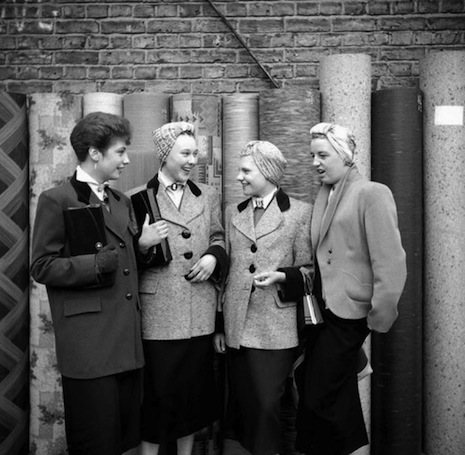
Among his most famous work from this period is “The Last of the Teddy Girls”—a series of photos documenting London’s girl gang subculture and their male counterparts. Russell was attracted to these young women for their sense of independence and style—dressing in suits, land army clothes—while rejecting society’s expectations of more traditional, feminine roles. (Teddy kids of either sex were known for fights breaking out wherever they congregated.) The images show Russell’s innate talent for composition and offer a fascinating look into a rarely documented female subculture.

TGKR555.jpg

TGKR558.jpg

TGKR554.jpg

TGKR557.jpg

TGKR553.jpg

TGKR5510.jpg

TGKR5511.jpg

TGKR556.jpg

Via Vintage Everyday.


Friday, August 16, 2013

A Few Bad Ass Young Women to Inspire You Today
And give you hope for the future


This post is all about Intelligence, Integrity and speaking out because you know you have to.
14 year old Rachel Parent debates Rude fucking asshole Kevin O'Leary on the issue of Genetically Modified Food

Rachel's website: http://www.gmo-news.com
What a sack of shit this old man is. What a hero Rachael is.


-------------------

11-Year-Old Yemeni Girl Speaks, Internet Listens
from Huffington Post

On Sunday morning, Reddit user Syd_G submitted a three-minute YouTube clip of 11-year-old Nada Al-Ahdal describing why she was running away from home to live with her uncle. According to a translation provided by subtitles (and more or less confirmed by several Reddit users), she starts off by saying:

It's true that I ran away from my family. I can't live with them anymore. Enough. I want to go live with my uncle. What about the innocence of childhood? What have the children done wrong? Why do you marry them off like that?

Four hours later, the video had been upvoted nearly 4,700 times (unusually high for Reddit) and began circulating in news stories across the world.

Details on the child's story are still unclear but her three-minute monologue on child marriage in Yemen is receiving rave reviews, and it's not hard to understand why: she speaks with excellent articulation and passion, and her eyes force the viewer not to break away from the screen.

Even if this was scripted as some have suggested, she is remarkably poised in describing her harrowing situation:

"I have managed to solve my problem, but some innocent children can't solve theirs, and they might die, commit suicide, or do whatever comes to mind."

Yemeni law holds that girls of any age are allowed to wed, and because of that, 52 percent of girls in Yemen are wed before the age of 18. However, the law also states that intercourse is prohibited until the child has reached puberty, a law that is ignored by many.

How generous of them.

In 2009, 10 year-old Nujood Ali successfully divorced after she was raped before the onset of puberty. Her case spurred action by the Supreme Council of Motherhood and Childhood, who proposed an age limit of 18 be set for marriage, which was knocked down to 17 when passed into law, and unfortunately, struck down the following day by parliamentary measures.

About Yemen, Sophie Ghaziri of Al Arabiya wrote in April, "Driven by poverty and a "traditional" way of thinking, girls under the age of eight can be seen in wedlock with children of their own by the time they hit puberty."

As Nada Al-Ahdal points out in her video, "There are many cases like that. Some children decided to throw themselves into the sea. They're dead, now."

This has long been a problem. Ghaziri highlights in her column that one in nine girls in the developing world will become child brides.

We can only hope that Nada's words will spur greater action by world leaders to halt the horrifying practice of child marriage and the human trafficking epidemic that feeds it.


-------------------

from Blindfold
The Girl Who Silenced the World For Five Minutes
Just twelve years old at the time, she seized her once-in-a-lifetime chance to tell every politician, businessman and journalist at the UN: “You are what you do, not what you say… I challenge you, please make your actions reflect your words.” More than 21 million people have watched the speech on YouTube, where you can see that her address to silenced the entire plenary session. Severn’s young voice made it unmistakably clear why we all must take immediate action to save the environment.


Twenty years have passed and Severn is now 32 years old, married, a mother of two young boys and an outspoken activist for environmental justice. She has received the United Nations Environment Programme’s Global 500 Roll of Honour, published a book, studied ecology and evolutionary biology at Yale University, co-hosted a children’s television series that aired on Discovery Kids, and launched an internet-based think tank called The Skyfish Project which was integral to the creation of the “Recognition of Responsibility” pledge at the World Summit on Sustainable Development in Johannesburg in August 2002.

On June 17th 2012, she returned to Rio de Janeiro to attend the Rio+20 UN Conference on Sustainable Development. When I recorded Severn’s speech three days ago at an event hosted by WeCanada and later met her for a short interview (coming soon), I was deeply inspired to see that she had stayed true to the same values she expressed so powerfully in 1992. Though her scientific education has made her statements more refined and her age has added experience and wisdom, her belief in the power of intergenerational love is still at the heart of her message.


“Twenty years on I come back to the same argument I made as a child with my presence at the summit. The strongest moral imperative that we have to act and change is our children. It is because of our children that we will bring back the connection between cause and effect, between choices, the global situation, between privilege and responsibility. In identifying our moral imperative lies hope and our hope is love – love for our children,” she said.

HELL Yes!

thanks, Amanda Charchian

Monday, June 24, 2013

Decline in fertility after age 30 may be vastly overstated


from Maggie Koerth-Baker at Boing Boing
As a woman, you do become less fertile as you get older, eventually culminating in menopause and the end of your potential babymaking years. But what does "less fertile" mean, and at what age, and how quickly does the drop-off in fertility happen?

According to this really fascinating piece by Jean Twenge at The Atlantic, some of the commonly cited scare stats — that one in three women ages 35 to 39 will not be pregnant after a year of trying, say — are based on extremely old data collected from historical birth records that don't necessarily reflect what's happening with real women who are alive right now. That statistic mentioned above, for instance, comes from French records (likely those collected by local church baptismal registries) for the years 1670 to 1830.

That matters because fertility is affected by things like quality of nutrition, infection rates, and even childhood illnesses — all of which have changed drastically for the average Western woman since the 19th century.

Look at more modern records, and the outlook for post-30 babymaking is completely different.

Surprisingly few well-designed studies of female age and natural fertility include women born in the 20th century—but those that do tend to paint a more optimistic picture. One study, published in Obstetrics & Gynecology in 2004 and headed by David Dunson (now of Duke University), examined the chances of pregnancy among 770 European women. It found that with sex at least twice a week, 82 percent of 35-to-39-year-old women conceive within a year, compared with 86 percent of 27-to-34-year-olds. (The fertility of women in their late 20s and early 30s was almost identical—news in and of itself.) Another study, released this March in Fertility and Sterility and led by Kenneth Rothman of Boston University, followed 2,820 Danish women as they tried to get pregnant. Among women having sex during their fertile times, 78 percent of 35-to-40-year-olds got pregnant within a year, compared with 84 percent of 20-to-34-year-olds. A study headed by Anne Steiner, an associate professor at the University of North Carolina School of Medicine, the results of which were presented in June, found that among 38- and 39-year-olds who had been pregnant before, 80 percent of white women of normal weight got pregnant naturally within six months (although that percentage was lower among other races and among the overweight). “In our data, we’re not seeing huge drops until age 40,” she told me.
Read the full story by Jean Twenge at The Atlantic