Once upon a time—midcentury America, to be precise—you couldn’t turn to the Google search bar with all your most deeply personal and/or random questions. Instead, there was the New York Public Library and its very patient librarians.
As NPR explained back in December (and our compatriots at io9 reported), the NYPL’s Reference and Research Services has fielded all manner of questions for decades. They stumbled across a box of queries from the 1940s through the 1980s, and they’ve been sharing them on their Instagram every since. Unless you’re following the account, you’ve been missing some gems. For instance:
Surely this came not from somebody with a very poor understanding of lunar cycles, but rather a pre-Internet troll.
If you have any questions for which Google just isn’t getting the job done, you can still turn to the NYPL. In the meantime, here’s a free prompt for a mystery novel.
Perhaps the disparaging “Smartphones and IPhones are ruining our society and slowly turning us into zombies” fad is getting a bit stale. I do understand why many people see phones as a brainsuck (and if you text while you drive, you’re a supreme asshole who might as well be drunk driving). But as I’ve said before, I love my iPhone. I just use it in moderation. That’s the key. It’s not rocket science. If I’m having dinner with someone, I put my damn phone away and concentrate on the person or people I’m sitting with. I don’t check my phone. Not even once. (My husband refuses to carry one to begin with, which is taking it to an extreme probably…).
Now on to the “SUR-FACE” the photo series by French photographer, Antoine Geiger. What you see are seemly casual photos of people using their smartphones that turn somewhat sinister once the face is stretched and pulled into the phone. Like our phones own us, not the other way around.
“It [places] the screen as an object of ‘mass subculture,’ alienating the relation to our own body, and more generally to the physical world,” Geiger writes in his description of the series.
Religion was an ingenious solution to many of mankind's earliest fears and needs. Religion is now implausible to many, but the needs remain. That is the challenge of our times. Please subscribe here: http://tinyurl.com/o28mut7
Help us to continue making films by visiting our online shop: http://theschooloflife.com/shop
It kinda sucks, but there's some good moments, the kid who plays Jay (Emile Hirsch) did a great job. For someone so close to it, it's hard to watch, but if you never have, and are at all interested, you kinda have to... see what hollywood can do.
The Globetrotters will celebrate their 90th year with over 330 games in more than 260 cities in North America starting December 26, 2015. The tour’s opening week will bring 10 games to six arenas in the NYC-area, including Madison Square Garden, Barclays Center and Prudential Center. The full schedule and ticket information can be found at harlemglobetrotters.com.
We are taught to think of modern civilization as inherently 'better' than the pre-industrial age - and take great pride in our gadgets and technology. That's why we need to tap into the caustic, liberating mindset of the great American political thinker, Thoreau – who escaped modern civilization to go and live in a cabin in the woods…
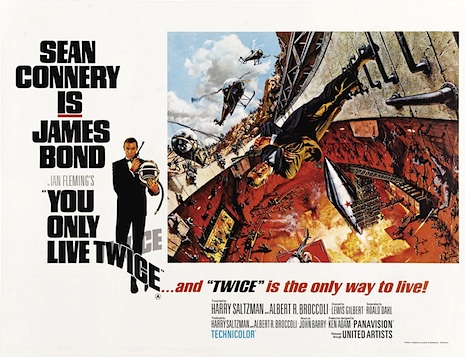
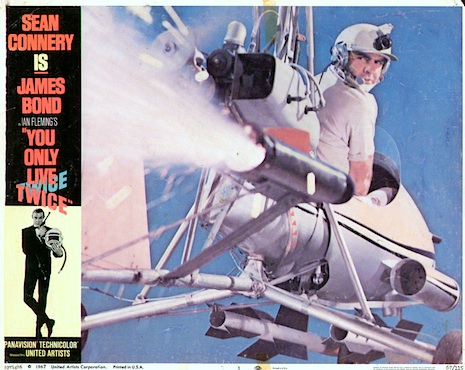
The revolution of the sixties kicked off on October 5th, 1962. This was the day The Beatles released their first single “Love Me Do” and Sean Connery was launched on to the big screen as James Bond in Dr. No. Between these twin poles of movies and music the decade began. By 1967, The Beatles were the most influential band on the planet while Connery was the world’s best known actor, and iconic star of the most successful movie franchise of all time.
During the filming of the fifth James Bond movie You Only LIve Twice journalist and presenter Alan Whicker—best known for his rather snide, tabloid and often condescending reporting—made a documentary examining the success and cultural obsession with Ian Fleming’s super spy, or as he termed it “Bondomania.” Whicker bangs on about sex, sadism, amorality and violence, quizzing Connery, producers Cubby Broccoli and Harry Saltzman, and screenwriter Roald Dahl—who disagrees with Whicker’s insinuation, describing Bond as a “tough, rather insensitive fellow who’s very good at his job.”
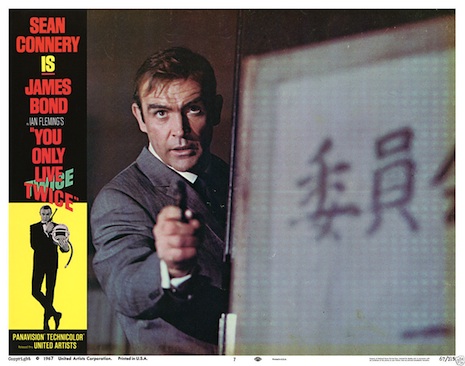
The Bond format of gadgets, girls and guns was set by the previous two movies Goldfinger and Thunderball. This time Dahl’s screenplay pushed the form to the limit—dumping most of Ian Fleming’s original novel and inventing his own comic book narrative—an action scene on average every five minutes—throwing Bond into unrelenting danger until the final climactic moments.
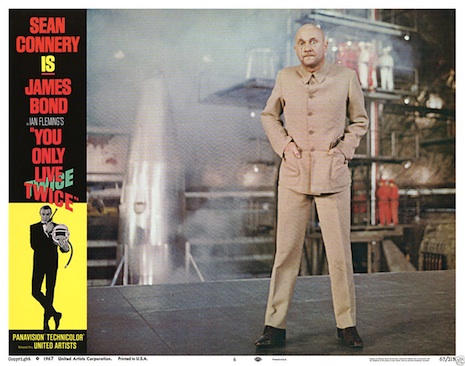
Dahl considered You Only Live Twice to be “Fleming’s worst book, with no plot in it,” and he therefore filled the movie with his own quirky inventions—rocket gobbling spacecraft, a volcanic island disguised as a mini Cape Canaveral, and so on. I think Dahl’s criticism harsh, as I am on the side who think Fleming’s books are actually superior to the films, as they reveal a conflicted Bond, insecure, violent, remorseful, smoking, drinking and popping pills to keep himself functioning. Fleming gave Bond an emotional narrative—from strong, confident agent to broken, haunted spy obsessing over his own mortality—which the films have generally ignored.
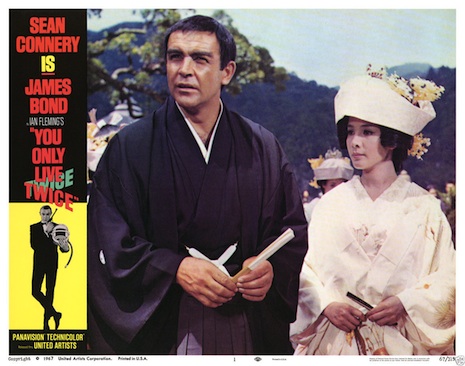
You Only Live Twice was the last Bond novel published in Fleming’s lifetime—he died of a heart attack, aged 56, two months after its appearance—the last novel The Man with the Golden Gun and the story collection Octopussy and The Living Daylights were published posthumously. The film was to be Connery’s last Bond until Diamonds Are Forever in 1971. The title comes from a haiku Bond writes when he is “reborn” as “Taro Todoroki,” a mute Japanese coal miner, to gain access to Dr. Guntram Shatterhand or rather Ernst Stavros Blofeld’s Garden of Death.
You only live twice:
Once when you are born
And once when you look death in the face.
In Whicker’s film Sean Connery ‘fesses up to having only read one-and-half of the Fleming’s novels (which two I wonder?), and said that although he liked the author, he thought Fleming had no sense of humor. It’s one of the many little highlights this Whicker’s World special contains (others include Ken Adams discussing his set design—which apparently cost as much as the first Bond Dr. No—and an interview with Roald Dahl), but as Whicker obsesses about the “sadism and sex,” he tends to ignore the bigger issue why Bond is such an attractive figure to millions of fans.
SAN JOSE, Calif. – A new driving app voiced by Henry Rollins is quickly becoming the go-to navigation choice for punk and hardcore kids on the go.
The new app, RatsEyes, gives driving directions to your destination while also shouting knowledge gained from the relentless work ethic of Rollins’ legendary hardcore group, Black Flag. The band’s groundbreaking and hard touring schedule often took them on very nontraditional routes across the country, as the app will frequently remind you.
While trying to drive from Los Angeles to Tucson, one user was directed to “Drive five miles to 7-11. Locate the nearest payphone and call Steve. Hopefully he’ll pick up and let you know where you need to be. Otherwise it’s just another overnight with Watt arguing about whatever bullshit he’s got up his ass this time.”
Noticeably absent from the app is a mute feature; any attempt to silence the app only makes the Rollins narration more irritated. Also, RatsEyes features long-winded talks from the former Black Flag frontman that can extend up to 20 minutes after you arrive at your destination. Some users with Wifi-enabled cars have reported a glitch where the car locks until the stories are over.
“I initially downloaded the app because I am a Rollins fan and the price was right,” said Amy Fuller. “But I ended up almost running out of gas because the app just told a 30-minute story about fighting skinheads at a nearby all ages venue that closed down in 1993.”
The app seems to be especially popular among millennial musicians who are looking to marry the modern conveniences of the digital age with the rugged authenticity of being an underground musician in the ’80s.
“We never realized just how difficult it must have been for Black Flag to find a Whole Foods to scam free vegan samples from back in the day,” said Walter O’Neal of hardcore band Unpleasant Flavors. “No wonder that dude turned into such an uptight motherfucker, this shit really fucking sucks.”
O’Neal concluded by saying, “To be honest, I’m probably gonna just delete this thing in a couple of days, you know, just disconnect myself.”
Local punk music icon and author Ian Svenonius will discuss his newest book on Tuesday. (Photo by Linda Davidson / The Washington Post)
Ian Svenonius has led an incredible string of bands over the years — Nation of Ulysses, the Make-Up, Chain and the Gang — but the D.C. punk frontman’s bibliography is slowly catching up with his discography.
If you’re smart enough to have made room for his work on your shelves, Svenonius might consider you an ally in the fight against Apple’s cloud-based “anti-stuff” ideology. As he writes in his latest book, “The hit TV show ‘Hoarders’ (A&E) identifies people with things as socially malignant, grotesque, primitive, dirty, bizarre. In a word: poor. Apple has turned the world upside down in making possessions a symbol of poverty and having nothing as a signifier of wealth and power.”
That kind of anti-authoritarian, half-winking intelligence fills every page of “Censorship Now!!,” Svenonius’s newest collection of essays. To answer your first question, yes, he really argues for censorship in hopes that it will “stop the radio from spewing its vomit” and prevent the mainstream media from creating “a fantasy version of world events and the intellectual framework for mass murder.” And to answer your second question, yes, he is serious — but also maybe not, in that Svenonius’s writing always has blended academic bluster and conspiracy theory into a sophisticated and singular brand of satire that ultimately points toward the truth.
And while putting a copy of this book on your nightstand would be a sign of good taste, who cares about good taste? Are you willing to be seen reading a book titled “Censorship Now!!” in public? If so, your skin might burn with funny glances from squares, scolds and looky-loos. But on the inside, you’ll feel your brain throbbing as it swells to accommodate some hilarious, absurd and radical new strategies on how to live in our ridiculous world.
Middletown, NJ – In an effort to be the change he wishes to see in the world, comedian John Stewart, after stepping down as host of “The Daily Show,” has started a sanctuary for abused factory farm animals called Bufflehead Farm.
Jon and wife Tracey announced on Saturday that they will become part of Farm Sanctuary’s network of animal safe havens at the annual Farm Sanctuary gala in New York City.
“We’re getting married! Farm Sanctuary and us, we’re getting married,”Tracey told star studded crowd of roughly 500.“We bought a farm in New Jersey with the intention of starting a farm sanctuary of our own with an educational center, but what I’m announcing tonight is that our farm is actually going to be the New Jersey branch of Farm Sanctuary. We’re going to build new advocates, new curious learners, and new leaders for this very important movement.”
Bufflehead Farm, located in Middletown, New Jersey, is a 12-acre non-profit animal rescue sanctuary owned by Jon and Tracey Stewart, which will soon become home to dozens of cows, pigs, sheep, turkeys and other animals rescued from factory farms.
Stewart has consistently been an animal welfare advocate on his show, once devoting a comedy segment to the foolishness of New Jersey Governor Chris Christie’s refusal to sign a bill that would end the lifelong confinement of pigs in crates too small for them to turn around.
Tracey Stewart is known for her advocacy on animal rights, recently publishing a book on the topic.
The project has long been a dream for Tracey Stewart, an animal advocate and former veterinary technician, who has tirelessly worked to promote a plant-based lifestyle, animal welfare issues, and support for organizations like Farm Sanctuary.
Her new book “Do Unto Animals” (currently the No. 1 bestseller in animal husbandry on Amazon) offers more than 300 pages of beautiful illustrations and promises to give readers “insights into the secret lives of animals and the kindest ways to live with and alongside them.”
“If everyone did a bit more, if they fell in love a little bit more, so much could happen,” Tracey Stewart told The New York Times. “It doesn’t have to be going vegan. You can advocate for them. You can show tenderness. You can play music for them. I really hope people can connect with animals the way most of us did as children.”
Jon Stewart, accompanied by his wife and two children, were honored at the awards ceremony held by Farm Sanctuary, an organization founded in 1986 to combat the abuses of factory farming and encourage a new awareness and understanding about farm animals.
“I’m a little uncomfortable. I’ve spent the last 20 years immersed in the world of Washington politics and the media landscape, so I don’t know how to deal necessarily with people who have empathy,” Stewart told the all-vegan banquet at The Plaza Hotel in New York.
The consistency of the Stewarts should be applauded. Rather than simply paying lip service to a cause, they are putting in the groundwork to support their espoused beliefs.
Similarly to how Morgan Freeman turned his estate into a bee sanctuary, Stewart has shown that celebrities have the ability to not only motivate others by raising awareness about issues, but to lay the actual foundation of real world change.
SOMETHING FROM NOTHING: THE ART OF RAP is a feature length performance documentary about the runaway juggernaut that is Rap music. At the wheel of this unstoppable beast is the film's director and interviewer Ice-T. Taking us on a deeply personal journey Ice-T uncovers how this music of the street has grown to dominate the world. Along the way Ice-T meets a whole spectrum of Hip-Hop talent, from founders, to new faces, to the global superstars like Eminem, Dr Dre, Snoop Dogg and Kanye West. He exposes the roots and history of Rap and then, through meeting many of its most famous protagonists, studies the living mechanism of the music to reveal 'The Art Of Rap'. This extraordinary film features unique performances from the entire cast, without resorting to archive material, to build a fresh and surprising take on the phenomenon that is Rap.
Historian Nicholas Rogers, exploring the origins of Halloween, notes that while "some folklorists have detected its origins in the Roman feast of Pomona, the goddess of fruits and seeds, or in the festival of the dead called Parentalia, it is more typically linked to the Celtic festival of Samhain, whose original spelling was Samuin (pronounced sow-an or sow-in)". The name is derived from Old Irish and means roughly "summer's end". A similar festival was held by the ancient Britons and is known as Calan Gaeaf (pronounced Kálan Gái av).
The festival of Samhain celebrates the end of the "lighter half" of the year and beginning of the "darker half", and is sometimes regarded as the "Celtic New Year".
The ancient Celts believed that the border between this world and the Otherworld became thin on Samhain, allowing spirits (both harmless and harmful) to pass through. The family's ancestors were honoured and invited home while harmful spirits were warded off. It is believed that the need to ward off harmful spirits led to the wearing of costumes and masks. Their purpose was to disguise oneself as a harmful spirit and thus avoid harm. In Scotland the spirits were impersonated by young men dressed in white with masked, veiled or blackened faces. Samhain was also a time to take stock of food supplies and slaughter livestock for winter stores. Bonfires played a large part in the festivities. All other fires were doused and each home lit their hearth from the bonfire. The bones of slaughtered livestock were cast into its flames. Sometimes two bonfires would be built side-by-side, and people and their livestock would walk between them as a cleansing ritual.
Another common practice was divination, which often involved the use of food and drink.
The name 'Halloween' and many of its present-day traditions derive from the Old English era.
As part of the DC Punk Archive one-year anniversary celebrations, Alec MacKaye will lead a talk with the iconic skate, punk and hip hop photographer, Glen E. Friedman, often called the most important photographer of his generation.
Friedman’s photographs of local groups Minor Threat, Fugazi, Bad Brains, as well as Black Flag, Public Enemy, Run-DMC, Beastie Boys, Dead Kennedy’s and Ice-T along with classic skateboarding originators Tony Alva, Jay Adams, Lance Mountain, Allan “Ollie” Gelfand and Tony Hawk, to name a few, are recognized internationally.
His definitive monograph, MY RULES, features never-before-seen images and personal reflections from some of his subjects, giving readers an unprecedented window into the most significant youth countercultures of the last 40 years. Upshur Street Books will have copies of MY RULES for sale, there will be a book signing after the event, and Smash Records will be in the building with some vinyl. Thank you to HIGHWAY Magazine and the DC Public Library Foundation for making this event possible.
This film explores the unique set of circumstances in 1970's Brisbane that fostered The Saints; the sweaty rebellion of Brisbane's oppressed youth as punk counterculture challenged QLD's notorious police force. Featuring interviews with the members of the band, including its leaders Ed Kuepper and Chris Bailey, as well as the likes of Sir Bob Geldof, former Dead Kennedys frontman Jello Biafra and Buzzcocks guitarist Steve Diggle, the documentary is set to examine how the oppressive and conservative government of Joh Bjelke-Petersen in the 1970s helped act as a catalyst for the rise of punk rock in Australia, and how as a result The Saints went on to be one of the most influential bands this country (Australia) has ever produced.
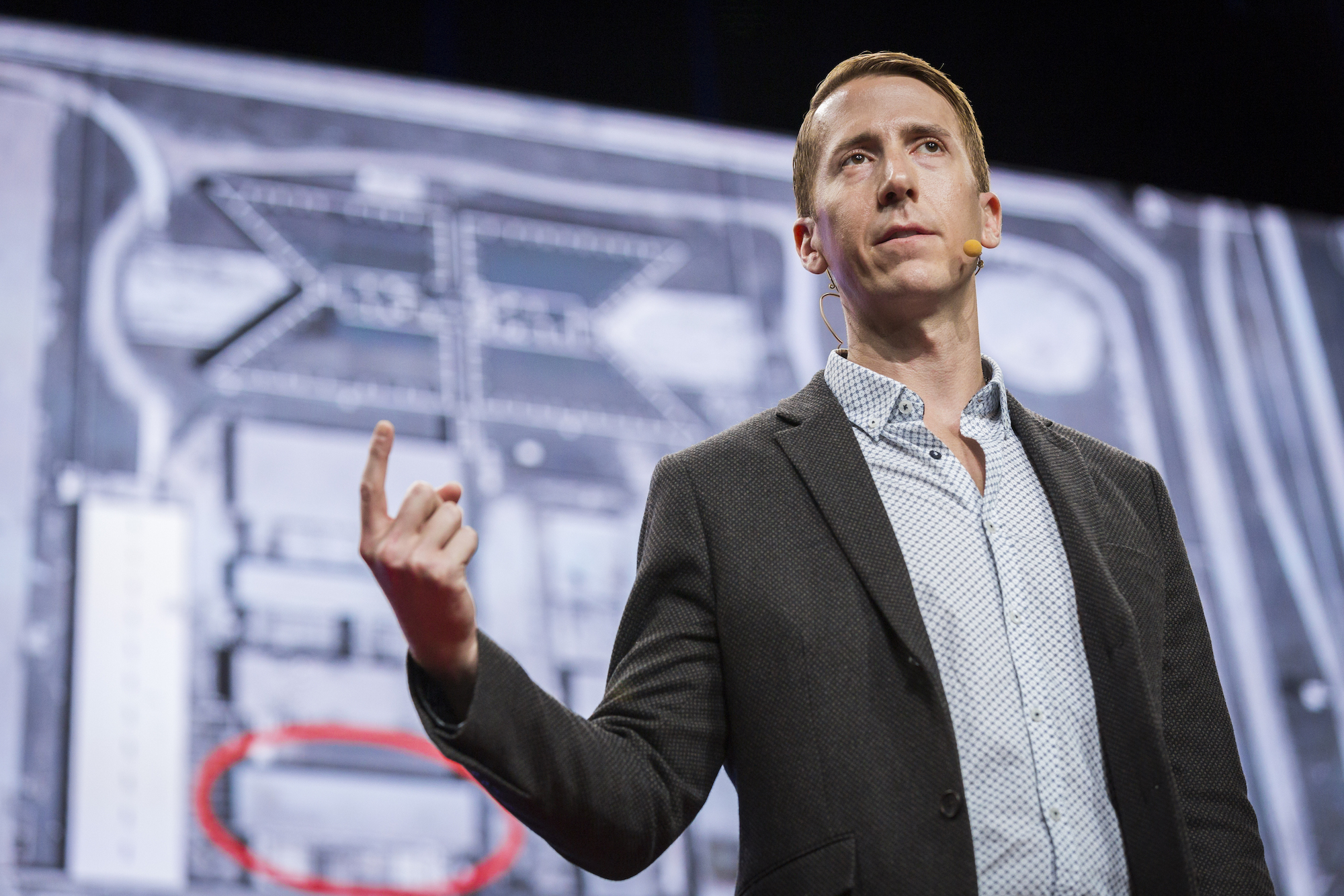
In a new TED Talk released today, investigative journalist and TED Senior Fellow Will Potter describes his experience as the first and only journalist to visit secretive prisons on U.S. soil that are referred to by prisoners and guards as “Little Guantanamo.”
Communications Management Units, or CMUs, are experimental prison units in the United States for so-called “second-tier terrorists.” There’s an estimated 60-70 prisoners in CMUs and they are overwhelmingly Muslim, along with several animal rights and environmental activists.
“According to the Bureau of Prisons, CMUs are for prisoners with quote ‘inspirational significance.’ I think that’s a polite way of saying they are political prisons, for political prisoners,” Potter says in the talk. “Prisoners are sent to the CMU because of their race, religion, or political beliefs.”
There are currently two CMUs, located within larger federal prisons in Terre Haute, Indiana and Marion, Illinois. Neither underwent the formal review process required by law when they were opened.
CMUs are not solitary confinement, but they radically restrict prisoner communications with the outside world to levels that meet or exceed the most extreme prisons in the country.Will Potter was allowed to visit environmental activist Daniel McGowan, who was being held at the CMU in Marion. Approval of this visit came as a shock since no other journalist has been allowed inside the CMUs and because documents obtained through the Freedom of Information Act have revealed that the Counter Terrorism Unit has monitored Potter’s speeches, articles, and his book Green Is The New Red. Attorneys and prisoners have said that inmates are transferred to the CMUs without notice and without opportunity to challenge their new designation, in what they say is a clear violation of due process rights.
“Three months after our visit, McGowan was transferred out of the CMU. Then without warning, he was sent back,” Potter says in the TED talk. “I had published leaked CMU documents on my website, and the Counter-Terrorism Unit said McGowan had called his wife and asked her to mail them. …For that, he was sent back to the CMU.”
Potter says CMUs are part of a dangerous post-9/11 trend that he has been documenting, in which the rhetoric of terrorism is used to justify rollbacks in fundamental rights.
“This story is not just about prisoners, it is about us,” he says. “It is about our own commitment to human rights.”
About Will Potter
Will Potter is an award-winning investigative journalist, author, and TED Senior Fellow based in Washington, D.C. He is the author of Green Is the New Red: An Insider’s Account of a Social Movement Under Siege. He specializes in civil liberties post-9/11 and how protest has been labeled as terrorism; Glenn Greenwald described Potter as “the most knowledgeable journalist in the country on these issues.” He is currently a Knight Fellow in Law Reporting at the University of Michigan.
McDonald's franchisees believe the brand is in a "deep depression" and could be facing its "final days," according to a new survey.
"We are in the throes of a deep depression, and nothing is changing," one franchisee wrote in response to the survey by Nomura analyst Mark Kalinowski. "Probably 30% of operators are insolvent."
Another wrote, "The CEO is sowing the seeds of our demise. We are a quick-serve fast-food restaurant, not a fast casual like Five Guys or Chipotle. The system may be facing its final days."
More than a dozen franchisees expressed frustration with McDonald's management, saying that CEO Steve Easterbrook's turnaround plan — which includes initiatives like all-day breakfast and a shift to digital ordering kiosks — is a distraction from the core issues of McDonald's, like food quality and customer service.
"The lack of consistent leadership from Oak Brook is frightening, we continue to jump from one failed initiative to another," one franchisee wrote.
A second wrote, "I have been in this business since the early 1970s but have not seen us this leaderless in all my time."
The company's reaction to their frustration, one franchisee claimed, is for operators to "get out of the system" and quit the business.
Several franchisees complained about all-day breakfast, saying that it has complicated kitchen operations and goes against Easterbrook's repeated promises to simplify the menu.
"The system is very lost at the moment," one franchisee wrote. "Our menu boards are still bloated, and we are still trying to be too many things to too many people. ... Things are broken from the franchisee perspective."
Franchisees also criticized the "Create Your Taste" program, which allows people to customize their burgers with premium ingredients.
"They are throwing everything they can against the wall to see what will stick," one franchisee wrote.
Kalinowski interviewed 29 US franchisees covering about 226 restaurants for the survey. McDonald's has more than 14,000 restaurants in the US.
In response to the survey, McDonald's said it's hearing a different story from franchisees — specifically pertaining to all-day breakfast.
"We’re hearing from customers and the overwhelming majority of our 3,100 franchisees that all-day breakfast is a hit!" a company spokeswoman told Business Insider. "In fact, since the launch, McDonald’s has reached its highest brand score in two years according to YouGov BrandIndex."
McDonald's is trying to revive business following seven straight quarters of same-store sales declines in the US.
In addition to adding all-day breakfast and "Create Your Taste," McDonald's has also made some changes to its core menu items.
The company started toasting its hamburger buns longer, making its beef patties slightly larger, and changing how the patties are seared.
McDonald's has also announced plans to remove antibiotics from its chicken.
There are at least a few franchisees who are on board with the changes.
Among the myriad negative responses to Kalinowski's survey, several franchisees expressed hopeful attitudes.
"I think our leadership is headed in the right direction," one wrote. "It will take time."
Another said, "The CEO seems to be doing OK so far!"
As part of the DC Punk Archive one-year anniversary celebrations, Alec MacKaye will lead a talk with the iconic skate, punk and hip hop photographer, Glen E. Friedman, often called the most important photographer of his generation.
Friedman’s photographs of local groups Minor Threat, Fugazi, Bad Brains, as well as Black Flag, Public Enemy, Run-DMC, Beastie Boys, Dead Kennedy’s and Ice-T along with classic skateboarding originators Tony Alva, Jay Adams, Lance Mountain, Allan “Ollie” Gelfand and Tony Hawk, to name a few, are recognized internationally.
His definitive monograph, MY RULES, features never-before-seen images and personal reflections from some of his subjects, giving readers an unprecedented window into the most significant youth countercultures of the last 40 years. Upshur Street Books will have copies of MY RULES for sale, there will be a book signing after the event, and Smash Records will be in the building with some vinyl. Thank you to HIGHWAY Magazine and the DC Public Library Foundation for making this event possible.
For more information about the DC Punk Archive visit dclibrary.org/punk
After seeing the popularity of its new veggie sliders, White Castle veganized its buns, making the sliders entirely vegan. This move prompted us to present the restaurant chain with a Kind Fast Food Award.
The new veggie slider burger is made by Dr. Praeger’s Sensible Foods. But there’s more. It’s made with actual peas, carrots, zucchini, spinach, and broccoli, and the veggie sliders cost only 99 cents. You can order it with your choice of a tasty Sweet Thai sauce, or without sauce, if you prefer.
In a statement about the new slider, White Castle said, “We are committed to … listening to our customers and keeping up with changing tastes by developing new menu items.” It describes the new slider as “an incredible new taste experience that’s different from any other sandwich on our menu.”
The times they are a-changin’, as people realize that eating vegan is better for animals, the environment, and themselves.
What are you waiting for? Head to your nearest White Castle and order as many veggie sliders as possible, and be sure to check out our chain-restaurant guide.
Little does he know, this technology has already been around for a few years, and the first factory will soon be under way.... Like EPowerGlass and new updates will be posted there.
Researchers at Michigan State University have created a fully transparent solar concentrator, which could turn any window or sheet of glass (like your smartphone’s screen) into a photovoltaic solar cell.
Unlike other “transparent” solar cells that we’ve reported on in the past, this one really is transparent, as you can see in the photos throughout this story. According to Richard Lunt, who led the research, the team are confident that the transparent solar panels can be efficiently deployed in a wide range of settings, from “tall buildings with lots of windows or any kind of mobile device that demands high aesthetic quality like a phone or e-reader.”
Scientifically, a transparent solar panel is something of an oxymoron. Solar cells, specifically the photovoltaic kind, make energy by absorbing photons (sunlight) and converting them into electrons (electricity). If a material is transparent, however, by definition it means that all of the light passes through the medium to strike the back of your eye. This is why previous transparent solar cells have actually only been partially transparent — and, to add insult to injury, they usually cast a colorful shadow too.
The organic salts absorb UV and infrared, and emit infrared — processes that occur outside of the visible spectrum, so that it appears transparent.
To get around this limitation, the Michigan State researchers use a slightly different technique for gathering sunlight. Instead of trying to create a transparent photovoltaic cell (which is nigh impossible), they use a transparent luminescent solar concentrator (TLSC). The TLSC consists of organic salts that absorb specific non-visible wavelengths of ultraviolet and infrared light, which they then luminesce (glow) as another wavelength of infrared light (also non-visible). This emitted infrared light is guided to the edge of plastic, where thin strips of conventional photovoltaic solar cell convert it into electricity. [Research paper: DOI: 10.1002/adom.201400103 - "Near-Infrared Harvesting Transparent Luminescent Solar Concentrators"]
If you look closely, you can see a couple of black strips along the edges of plastic block. Otherwise, though, the active organic material — and thus the bulk of the solar panel — is highly transparent. (Read: Solar singlet fission bends the laws of physics to boost solar power efficiency by 30%.)
Michigan’s TLSC currently has an efficiency of around 1%, but they think 5% should be possible. Non-transparent luminescent concentrators (which bathe the room in colorful light) max out at around 7%. On their own these aren’t huge figures, but on a larger scale — every window in a house or office block — the numbers quickly add up. Likewise, while we’re probably not talking about a technology that can keep your smartphone or tablet running indefinitely, replacing your device’s display with a TLSC could net you a few more minutes or hours of usage on a single battery charge.
The researchers are confident that the technology can be scaled all the way from large industrial and commercial applications, down to consumer devices, while remaining “affordable.” So far, one of the larger barriers to large-scale adoption of solar power is the intrusive and ugly nature of solar panels — obviously, if we can produce large amounts of solar power from sheets of glass and plastic that look like normal sheets of glass and plastic, then that would be big.
The Flickr page is now a companion to Teague’s Project Apollo Archive where he has kept an online repository of NASA Apollo images since 1999. The newly uploaded images are available in 1,800 dpi and were created from scans of the original Apollo Hasseelblad film done by NASA around 2004.
Evidence suggests that differences between liberals and conservatives begin to emerge at an early age.
"There are three things I have learned never to discuss with people: religion, politics, and the Great Pumpkin," laments Linus van Pelt in a 1961 Peanuts comic strip. Yet in today's hyperpartisan political climate, religion and politics are obsessively debated, while the "American people" that politicians and reporters constantly refer to seem hopelessly divided. Meanwhile, psychologists are increasingly exploring the political arena, examining not just the ideological differences, but also the numerous factors - temperamental, developmental, biological, and situational - that contribute to the formation and maintenance of partisan political beliefs.
Personality differences are a leading candidate in the race toward understanding the rift between political liberals and conservatives. Using data compiled from nearly 20,000 respondents, Columbia University researcher Dana Carney and colleagues found that two common personality traits reliably differentiated individuals with liberal or conservative identifications. Liberals reported greater openness, whereas conservatives reported higher conscientiousness. This means that liberals (at least in their own estimation) saw themselves as more creative, flexible, tolerant of ambiguity, and open to new ideas and experiences. Across the political personality divide, conservatives self-identified as more persistent, orderly, moralistic, and methodical. These personality differences were even reflected in the bedroom belongings and offices or workspaces of ideological undergrads, with liberal students collecting more CDs, books, movie tickets, and travel paraphernalia, as opposed to their conservative peers, who showed more sports décor, U.S. flags, cleaning supplies, calendars, and uncomfortable furniture. Lest you think that the partisan personality is a uniquely American phenomenon, similar findings on personality and political ideology have emerged in samples across the globe, from North America, Europe, and Australia.
Evidence suggests that these personality differences between liberals and conservatives begin to emerge at an early age. A 20-year longitudinal study by Jack and Jeanne Block showed that those who grew up to be liberals were originally assessed by their preschool teachers as more emotionally expressive, gregarious, and impulsive when compared to those who became conservatives, who were considered more inhibited, uncertain, and controlled. Liberals may show greater tolerance for diversity and creativity, but they may also be more impulsive, indecisive, and irresponsible. On the flip side, conservatives may be organized, stable, and thrifty, but also have stronger just-world beliefs (leading to a greater tolerance for inequality), and stronger fears of mortality and ambiguity. Even recent neuroscience work published in Current Biology from University College London identifies fundamental differences in the partisan brain. Brain scans revealed a larger amygdala in self-identified conservatives and a larger anterior cingulate cortex in liberals, leading the researchers to conclude that conservatives may be more acute at detecting threats around them, whereas liberals may be more adept at handling conflicting information and uncertainty.
Some evidence suggests, however, that we aren't always so divided. In situations that remind people of death and mortality (such as terrorist attacks or implicitly primed images of funeral hearses and chalk body outlines) conservatives and liberals alike gravitate toward more conservative leaders and beliefs. By contrast, greater acceptance of liberal values occurs during events in which people feel disillusioned by government authorities and the politically powerful (such as the Vietnam War or after the 2008 housing crisis).
Of course, the field of psychology isn't immune to political biases and partisanship. Liberal psychology professors vastly outnumber their conservative counterparts by as much as 10 to 1 (perhaps conservatives have some justification for a general distrust of science and academia). A similar imbalance was found by Dyer Bilgrave and Robert Deluty in their 2002 survey of more than 200 clinical and counseling psychologists, published in the journal Psychotherapy. They also found that cognitive-behavioral therapists tended to hold more conservative religious and political beliefs than their more liberally oriented psychodynamic and humanistic-oriented colleagues. Other findings implicative for psychotherapy suggest that liberals and conservatives conceptualize different values in their family narratives, and that individuals fail to empathize completely with the nonpolitical concerns and problems of others if they're perceived as belonging to an opposing political party.
No matter which side of the couch they sit on, therapists are inevitably bound to confront political and moral issues in treatment. In research, practice, and training, therapists are expected to achieve the kind of bipartisan collaboration that politicians seem to only talk about. According to Bilgrave and Deluty, "therapists should ask themselves regularly how their religious and political beliefs, values, and attitudes may be influencing their practice of therapy-how they see clients and their problems, how they help clients frame and understand their concerns, and how and in which direction they encourage clients to act." But if our partisan personalities are deeply rooted in our early development and wired in our brains, is honest and thoughtful consideration of our own biases and predeterminations enough, or even possible? And when even your furniture choices betray your political persuasions, then what does your office tell patients about you?