The fate of industrially farmed animals is one of the most pressing ethical questions of our time. Tens of billions of sentient beings, each with complex sensations and emotions, live and die on a production line
nimals are the main victims of history, and the treatment of domesticated animals in industrial farms is perhaps the worst crime in history. The march of human progress is strewn with dead animals. Even tens of thousands of years ago, our stone age ancestors were already responsible for a series of ecological disasters. When the first humans reached Australia about 45,000 years ago, they quickly drove to extinction 90% of its large animals. This was the first significant impact that Homo sapiens had on the planet’s ecosystem. It was not the last.
About 15,000 years ago, humans colonised America, wiping out in the process about 75% of its large mammals. Numerous other species disappeared from Africa, from Eurasia and from the myriad islands around their coasts. The archaeological record of country after country tells the same sad story. The tragedy opens with a scene showing a rich and varied population of large animals, without any trace of Homo sapiens. In scene two, humans appear, evidenced by a fossilised bone, a spear point, or perhaps a campfire. Scene three quickly follows, in which men and women occupy centre-stage and most large animals, along with many smaller ones, have gone. Altogether, sapiens drove to extinction about 50% of all the large terrestrial mammals of the planet before they planted the first wheat field, shaped the first metal tool, wrote the first text or struck the first coin.
The next major landmark in human-animal relations was the agricultural revolution: the process by which we turned from nomadic hunter-gatherers into farmers living in permanent settlements. It involved the appearance of a completely new life-form on Earth: domesticated animals. Initially, this development might seem to have been of minor importance, as humans only managed to domesticate fewer than 20 species of mammals and birds, compared with the countless thousands of species that remained “wild”. Yet, with the passing of the centuries, this novel life-form became the norm. Today, more than 90% of all large animals are domesticated (“large” denotes animals that weigh at least a few kilograms). Consider the chicken, for example. Ten thousand years ago, it was a rare bird that was confined to small niches of South Asia. Today, billions of chickens live on almost every continent and island, bar Antarctica. The domesticated chicken is probably the most widespread bird in the annals of planet Earth. If you measure success in terms of numbers, chickens, cows and pigs are the most successful animals ever.
Alas, domesticated species paid for their unparalleled collective success with unprecedented individual suffering. The animal kingdom has known many types of pain and misery for millions of years. Yet the agricultural revolution created completely new kinds of suffering, ones that only worsened with the passing of the generations.
At first sight, domesticated animals may seem much better off than their wild cousins and ancestors. Wild buffaloes spend their days searching for food, water and shelter, and are constantly threatened by lions, parasites, floods and droughts. Domesticated cattle, by contrast, enjoy care and protection from humans. People provide cows and calves with food, water and shelter, they treat their diseases, and protect them from predators and natural disasters. True, most cows and calves sooner or later find themselves in the slaughterhouse. Yet does that make their fate any worse than that of wild buffaloes? Is it better to be devoured by a lion than slaughtered by a man? Are crocodile teeth kinder than steel blades?
What makes the existence of domesticated farm animals particularly cruel is not just the way in which they die but above all how they live. Two competing factors have shaped the living conditions of farm animals: on the one hand, humans want meat, milk, eggs, leather, animal muscle-power and amusement; on the other, humans have to ensure the long-term survival and reproduction of farm animals. Theoretically, this should protect animals from extreme cruelty. If a farmer milks his cow without providing her with food and water, milk production will dwindle, and the cow herself will quickly die. Unfortunately, humans can cause tremendous suffering to farm animals in other ways, even while ensuring their survival and reproduction. The root of the problem is that domesticated animals have inherited from their wild ancestors many physical, emotional and social needs that are redundant in farms. Farmers routinely ignore these needs without paying any economic price. They lock animals in tiny cages, mutilate their horns and tails, separate mothers from offspring, and selectively breed monstrosities. The animals suffer greatly, yet they live on and multiply.
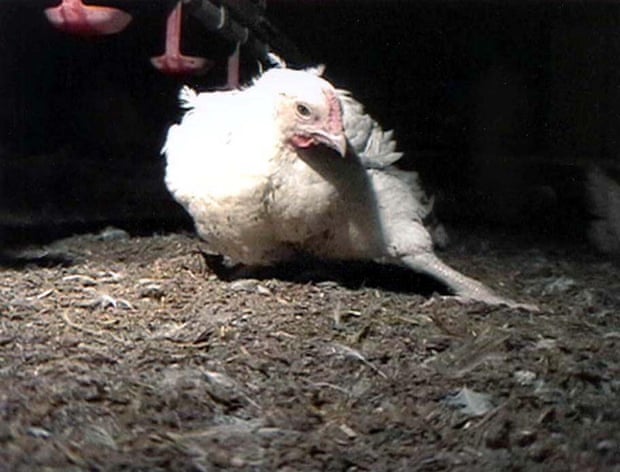
Broiler chickens, which are reared specifically for their meat, often suffer lameness due to overcrowding. Photograph: PA
Doesn’t that contradict the most basic principles of Darwinian evolution? The theory of evolution maintains that all instincts and drives have evolved in the interest of survival and reproduction. If so, doesn’t the continuous reproduction of farm animals prove that all their real needs are met? How can a cow have a “need” that is not really essential for survival and reproduction?
It is certainly true that all instincts and drives evolved in order to meet the evolutionary pressures of survival and reproduction. When these pressures disappear, however, the instincts and drives they had shaped do not evaporate instantly. Even if they are no longer instrumental for survival and reproduction, they continue to mould the subjective experiences of the animal. The physical, emotional and social needs of present-day cows, dogs and humans don’t reflect their current conditions but rather the evolutionary pressures their ancestors encountered tens of thousands of years ago. Why do modern people love sweets so much? Not because in the early 21st century we must gorge on ice cream and chocolate in order to survive. Rather, it is because if our stone age ancestors came across sweet, ripened fruits, the most sensible thing to do was to eat as many of them as they could as quickly as possible. Why do young men drive recklessly, get involved in violent rows, and hack confidential internet sites? Because they are obeying ancient genetic decrees. Seventy thousand years ago, a young hunter who risked his life chasing a mammoth outshone all his competitors and won the hand of the local beauty – and we are now stuck with his macho genes.
Exactly the same evolutionary logic shapes the life of cows and calves in our industrial farms. Ancient wild cattle were social animals. In order to survive and reproduce, they needed to communicate, cooperate and compete effectively. Like all social mammals, wild cattle learned the necessary social skills through play. Puppies, kittens, calves and children all love to play because evolution implanted this urge in them. In the wild, they needed to play. If they didn’t, they would not learn the social skills vital for survival and reproduction. If a kitten or calf was born with some rare mutation that made them indifferent to play, they were unlikely to survive or reproduce, just as they would not exist in the first place if their ancestors hadn’t acquired those skills. Similarly, evolution implanted in puppies, kittens, calves and children an overwhelming desire to bond with their mothers. A chance mutation weakening the mother-infant bond was a death sentence.
What happens when farmers now take a young calf, separate her from her mother, put her in a tiny cage, vaccinate her against various diseases, provide her with food and water, and then, when she is old enough, artificially inseminate her with bull sperm? From an objective perspective, this calf no longer needs either maternal bonding or playmates in order to survive and reproduce. All her needs are being taken care of by her human masters. But from a subjective perspective, the calf still feels a strong urge to bond with her mother and to play with other calves. If these urges are not fulfilled, the calf suffers greatly.
This is the basic lesson of evolutionary psychology: a need shaped thousands of generations ago continues to be felt subjectively even if it is no longer necessary for survival and reproduction in the present. Tragically, the agricultural revolution gave humans the power to ensure the survival and reproduction of domesticated animals while ignoring their subjective needs. In consequence, domesticated animals are collectively the most successful animals in the world, and at the same time they are individually the most miserable animals that have ever existed.
The situation has only worsened over the last few centuries, during which time traditional agriculture gave way to industrial farming. In traditional societies such as ancient Egypt, the Roman empire or medieval China, humans had a very partial understanding of biochemistry, genetics, zoology and epidemiology. Consequently, their manipulative powers were limited. In medieval villages, chickens ran free between the houses, pecked seeds and worms from the garbage heap, and built nests in the barn. If an ambitious peasant tried to lock 1,000 chickens inside a crowded coop, a deadly bird-flu epidemic would probably have resulted, wiping out all the chickens, as well as many villagers. No priest, shaman or witch doctor could have prevented it. But once modern science had deciphered the secrets of birds, viruses and antibiotics, humans could begin to subject animals to extreme living conditions. With the help of vaccinations, medications, hormones, pesticides, central air-conditioning systems and automatic feeders, it is now possible to cram tens of thousands of chickens into tiny coops, and produce meat and eggs with unprecedented efficiency.
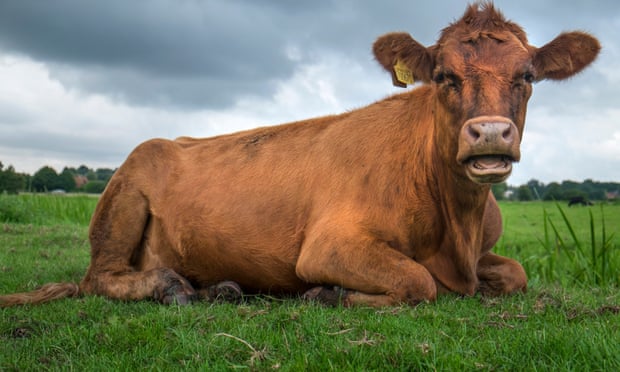
Science shows that animals are sentient beings that can feel pain and loneliness. Photograph: Graham Turner/Guardian
The fate of animals in such industrial installations has become one of the most pressing ethical issues of our time, certainly in terms of the numbers involved. These days, most big animals live on industrial farms. We imagine that our planet is populated by lions, elephants, whales and penguins. That may be true of the National Geographic channel, Disney movies and children’s fairytales, but it is no longer true of the real world. The world contains 40,000 lions but, by way of contrast, there are around 1 billion domesticated pigs; 500,000 elephants and 1.5 billion domesticated cows; 50 million penguins and 20 billion chickens.
In 2009, there were 1.6 billion wild birds in Europe, counting all species together. That same year, the European meat and egg industry raised 1.9 billion chickens. Altogether, the domesticated animals of the world weigh about 700m tonnes, compared with 300m tonnes for humans, and fewer than 100m tonnes for large wild animals.
This is why the fate of farm animals is not an ethical side issue. It concerns the majority of Earth’s large creatures: tens of billions of sentient beings, each with a complex world of sensations and emotions, but which live and die on an industrial production line. Forty years ago, the moral philosopher Peter Singerpublished his canonical book Animal Liberation, which has done much to change people’s minds on this issue. Singer claimed that industrial farming is responsible for more pain and misery than all the wars of history put together.
The scientific study of animals has played a dismal role in this tragedy. The scientific community has used its growing knowledge of animals mainly to manipulate their lives more efficiently in the service of human industry. Yet this same knowledge has demonstrated beyond reasonable doubt that farm animals are sentient beings, with intricate social relations and sophisticated psychological patterns. They may not be as intelligent as us, but they certainly know pain, fear and loneliness. They too can suffer, and they too can be happy.
It is high time we take these scientific findings to heart, because as human power keeps growing, our ability to harm or benefit other animals grows with it. For 4bn years, life on Earth was governed by natural selection. Now it is governed increasingly by human intelligent design. Biotechnology, nanotechnology and artificial intelligence will soon enable humans to reshape living beings in radical new ways, which will redefine the very meaning of life. When we come to design this brave new world, we should take into account the welfare of all sentient beings, and not just of Homo sapiens.
The story of Woodstock Farm Sanctuary in two minutes.
Woodstock Farm Sanctuary is driven by the simple philosophy that kindness and respect to animals is our duty and that all the creatures that share this earth are here with us and not for us. Farm animals are feeling individuals who deserve to be treated with compassion.
My friend Andy who made this said:
"We have a schizophrenic relationship with animals in that we love some
...and eat others"
I am a fourth-generation dairy farmer and cattle rancher. I grew up on a dairy farm in Montana, and I ran a feedlot operation there for twenty years. I know firsthand how cattle are raised and how meat is produced in this country.
Today I am president of Earth Save International, an organization promoting organic farming and the vegetarian diet.
Sure, I used to enjoy my steaks as much as the next guy. But if you knew what I know about what goes into them and what they can to do you, youd probably be a vegetarian like me. And, believe it or not, as a pure vegetarian now who consumes no animal products at all, I can tell you these days I enjoy eating more than ever.
If youre a meat-eater in America, you have a right to know that you have something in common with most of the cows youve eaten. Theyve eaten meat, too.
When a cow is slaughtered, about half of it by weight is not eaten by humans: the intestines and their contents, the head, hooves, and horns, as well as bones and blood. These are dumped into giant grinders at rendering plants, as are the entire bodies of cows and other farm animals known to be diseased. Rendering is a $2.4 billion-a-year industry, processing forty billion pounds of dead animals a year. There is simply no such thing in America as an animal too ravaged by disease, too cancerous, or too putrid to be welcomed by the all-embracing arms of the renderer. Another staple of the renderers diet, in addition to farm animals, is euthanized pets - the six or seven million dogs and cats that are killed in animal shelters every year. The city of Los Angeles alone, for example, sends some two hundred tons of euthanized cats and dogs to a rendering plant every month. Added to the blend are the euthanized catch of animal control agencies, and road kill. (Road kill is not collected daily, and in the summer, the better road kill collection crews can generally smell it before they can see it.) When this gruesome mix is ground and steam-cooked, the lighter, fatty material floating to the top gets refined for use in such products as cosmetics, lubricants, soaps, candles, and waxes. The heavier protein material is dried and pulverized into a brown powder-about a quarter of which consists of fecal material. The power is used as an additive to almost all pet food as well as to livestock feed. Farmers call it protein concentrates. In 1995, five million tons of processed slaughterhouse leftovers were sold for animal feed in the United States. I used to feed tons of the stuff to my own livestock. It never concerned me that I was feeding cattle to cattle.
The modern meat industry has some good reasons to fear the public finding out that Old MacDonald's farm isn't so happy these days.
Amy Meyer wanted to see for herself where her food was coming from. But in the state of Utah, she discovered, that was against the law.
On February 8, Meyer drove [3] to Dale Smith Meatpacking Company in Draper City, Utah, and took a look from the side of the road. She gasped as she peered through the barbed wire fence and saw what appeared to be a sick cow being treated like rubble as it was carried in a tractor. So she did what many people would do in this day and age. She got out her smartphone to begin recording.
For this, Meyer was arrested and prosecuted under Utah's new "ag-gag" law.
It turns out that similar laws are now in place not just in Utah, but also in Kansas, Arkansas, Iowa, and Missouri. And many other states are considering similar legislation.
The goal of these laws, it would appear, is to keep consumers from seeing where modern meat really comes from. Considering that 94 percent of the American public [4] believes that animals raised for food should be free from abuse and cruelty, the modern meat industry has some good reasons to fear the public finding out that Old MacDonald's farm isn't so happy these days.
Charges against Meyer were subsequently dropped [5], but Utah's law is still on the books. And now Amy Meyer is joining with award-winning author Will Potter and a team of organizations in filing a lawsuit [6] challenging her state's controversial law in the courts.
Soon thereafter, in Kansas on June 28th, a photographer working for a publication not generally seen as promoting a radical agenda, National Geographic, was arrested and briefly jailed [7] after taking aerial pictures of a feedlot for a series on food issues to be published some time next year.
George Steinmetz has taken award-winning photos in many dangerous situations, including a series depicting post-Gaddafi Libya. But it was his photographs of U.S. feedlots, taken from a paraglider in an area with hundreds of thousands of cattle [8], that got him put behind bars.
Kansas has its own "ag-gag bill," called the "Farm Animal and Field Crop and Research Facilities Protection Act [9]." This law makes it illegal to "enter an animal facility to take pictures by photograph, video camera or by any other means."
Apparently, the feedlot executives may have considered paragliding [7] to be a form of illegal entry, and they wanted Steinmetz to feel the force of the law. Industry officials said they believe his actions represent a "food security issue." Steinmetz had also parked and taken off from private property, so "trespassing" is central to the charge he now faces. But do you really think he'd have been arrested for parking there had he merely stopped to read a book?
The spread of ag-gag bills is alarming for many reasons. Aside from exposing specific incidents of animal abuse, undercover videos have also drawn attention [10] to industry practices such as housing chickens in cramped battery cages that hasten the sickening of birds and the spread of salmonella.
Elizabeth Holmes, an attorney with the nonprofit Center for Food Safety, comments: "The reason these are public health issues, and not just animal rights issues, is that those unsanitary conditions provide breeding grounds (for disease)."
Holmes has a point. Keeping animals alive in wretched conditions requires the use of massive amounts of pharmaceutical drugs. Nearly 80 percent [11] of the antibiotics used in the United States are given to animals, not people. The antibiotic overuse that allows meat producers to keep animals in filth and misery is spawning drug-resistant superbugs.
Earlier this year, an Environmental Working Group study [12] found antibiotic resistant "super bugs" on 81 percent of the ground turkey and 55 percent of the ground beef in America's supermarkets.
With antibiotic resistant bacteria costing us more than $55 billion [13] and killing tens of thousands [14] of people each year, you could even argue that today's factory farms have become a form of biological weapons factory.
But don't we have meat inspectors who monitor animal treatment? Isn't it their job to insure that the laws against excessive animal cruelty to animals, however weak they may be, are enforced? Aren't they being paid to look out for the public interest?
Unfortunately, thanks to the weight of agribusiness interests, even USDA meat inspectors don't always feel free to protect animals or public health.
After 29 years as a USDA meat inspector, Jim Schrier was recently stationed [15] at a Tyson Foods slaughter facility in Iowa where he reported clear humane handling violations to his supervisor. That's what he was supposed to do -- report the violations to his superior in the chain of command. But when Schrier presented his concerns, the supervisor reportedly became very angry [16], and a week later required Jim to work at another facility 120 miles away. Then the USDA reassigned Jim permanently to a plant in another state.
In what looks an awful lot like a form of whistleblower retaliation, after 29 years of service, Schrier must now choose between his job, and his family.
When Jim's wife, Tammy, launched a petition on change.org [17] exposing this story and calling for Jim Schrier to get his old job back, some of the first signers were other employees who had worked at the same plant and who corroborated Schrier's findings. Instead of being punished, they said, he should be rewarded and the whole plant should be inspected.
The significance of all this is huge. The first amendment [18] to the United States constitution states: "Congress shall make no law... abridging the freedom of speech, or of the press." There are serious questions about whether ag-gag bills, and retaliation against whistleblowers like Jim Schrier, are even constitutional. But whatever the courts decide, we are already paying a terrible price for the climate of repression they institutionalize.
Shutting up people like Amy Meyer, George Steinmetz, and Jim Schrier makes it hard for any of us to know where our food comes from. Shutting them up also allows the meat industry to get away with treating animals terribly, and with jeopardizing public health by breeding antibiotic resistant bacteria. But there's more.
Tyrants of all stripes thrive in the darkness. As Thomas Jefferson once said, "A properly functioning democracy depends on an informed electorate."
If journalists and whistleblowers aren't allowed to speak the truth, we're going to have an awfully hard time retaining any semblance of a functioning democracy.
This story [19] first appeared on the Huffington Post.
A stop-motion animated film about farming commissioned by "Chipotle Mexican Grill". It shows the life of a farmer as he slowly turns his family farm into an industrial animal factory, before seeing the errors of his ways and opting for a more sustainable future. Willie Nelson was commissioned to record a cover version of Coldplay's song, 'The Scientist', for the film's soundtrack.
I gotta admit I eat at Chipotle, just one taco at any of my local spots hooked up vegan style (grilled peppers and onions, brown rice, black beans, no cheese or sour cream, tomatoes, corn, heavy on the guacamole without an extra charge) $3 - they see me a few times a week.
from AlterNet: By Alexis Baden-Mayer and Ronnie Cummins Here's a partial lineup of hired guns and organizations behind the anti-labeling advertising blitz soon to hit the California airwaves.
What do a former mouthpiece for tobacco and big oil, a corporate-interest PR flack, and the regional director of a Monsanto-funded tort reform group have in common?
They’re all part of the anti-labeling PR team that will soon unleash a massive advertising and PR campaign in California, designed to scare voters into rejecting the California Right to Know Genetically Engineered Food Act.
In November, California voters will vote ‘yes’ or ‘no’ on a law to require mandatory labeling of all GMO ingredients in processed foods, and ban the routine industry practice of mislabeling foods containing GMO ingredients as ‘natural.’
Polls show that nearly 90% of the state’s voters plan to vote ‘yes.’ But when November rolls around, will voter support still be strong? Not if the biotech, agribusiness, and food manufacturers industries can help it.
It’s estimated that the opposition will spend $60 million - $100 million to convince voters that GMOs are perfectly safe. They’ll try to scare voters into believing that labeling will make food more expensive, that it will spark hundreds of lawsuits against small farmers and small businesses, and that it will contribute to world hunger. None of this is true. On the contrary, studies suggest just the opposite.
Here’s what is true: The opposition has lined up some heavy-hitters and industry-funded front groups -- masquerading as “grassroots” organizations -- to help spin their anti-labeling propaganda machine.
You have the right to know what’s in your food. You also have the right to know who is working tirelessly to prevent you from ever having that right – and who is signing their paychecks. Here’s a partial lineup of hired guns and organizations behind the anti-labeling advertising blitz soon to hit the California airwaves:
Tom Hiltachk: Monsanto’s Man in California
Tom Hiltachk is the PR gunslinger behind the Coalition Against the Costly Food Labeling Proposition (CACFLP), an anti-labeling front group. A partner at the Sacramento-based lobbying firm Bell, McAndrews & Hiltachk, Hiltachk is no stranger to front groups. With a little help from his friends at Philip Morris and R.J. Reynolds, he helped organize the Californians for Smokers’ Rights group to fight anti-smoking initiatives in the 1980s and 1990s. He also helped form the Californians for Fair Business Policy – a so-called “grassroots” organization, but actually a front group to mobilize business opposition to anti-smoking initiatives. That organization was funded by an “academic” front group – the Claremont Institute – which was in turn funded by tobacco companies.
Hitachk also has ties to Big Oil, including a colorful history with California’s Proposition 23, a conservative-backed ballot initiative launched – and defeated – in 2010. The initiative, supported by Big Oil, would have repealed California’s clean energy and climate laws. Hiltachk was initially an ally of Ted Costa, a veteran right-wing activist behind many conservative initiatives, including Prop 23, and head of the group People’s Advocate. But that relationship soured, according to ThinkProgress.org, when Costa realized that Hiltachk’s main motivation was to funnel the $50 million that he hoped would be raised from oil companies and the Chamber of Commerce to himself and his friends.
Coalition Against Costly Food Labeling Proposition: Looking out for consumers’ financial well being?
The Coalition Against Costly Food Labeling Proposition (CACFLP) runs a website called stopcostlyfoodlabeling.com, giving the impression that this is a group concerned about protecting consumers’ wallets. But the website lists only one consumer group in its coalition – Consumers Coalition of California. A search of the IRS.gov site turns up nothing on this group. According to the coalitions’ 2009 990-Form published on Guidestar.org, this Torrance, Calif.-based coalition describes itself as “Research and oriented community education studies and info for residential and small businesses advocating on issues affecting major legislation.” The group has no website. No other national or California-based consumer groups are listed on the CACFLP site.
CACFLP’s website does list some powerhouse coalition members, however, including the Grocery Manufacturers Association (GMA), whose members also include Monsanto, BASF, Bayer, Dow and Syngenta as well as many large food processors and supermarket chains, and the Council for Biotechnology Information (CBI) , whose members include Monsanto, BASF, Bayer, Dow and Syngenta. Both groups are based in Washington DC. As of March, the GMA and the CBI had contributed a combined $625,000 to the CACFLP – presumably to “protect” consumers from GMO labeling. Both groups have publicly opposed this initiative.
Monsanto recently made the following statement in support of CACFLP:
Monsanto is part of a growing coalition of California farmers, food producers, grocers, retailers, and others which has been formed to oppose the California measure. As a member of both GMA (Grocery Manufacturers Association) and BIO (Biotechnology Industry Organization), we support the organizations' involvement in the California campaign to oppose the costly and extreme measure.
Kathy Fairbanks: Voice of the people?
Kathy Fairbanks wants consumers to believe she’s on their side when she warns them that requiring labels on GMO foods will raise their grocery bills. Yet since when has she fought for the little guy? A glance at her resume reveals a long list of pro-corporate gigs, including some involving illegal donations and questionable practices.
In 2010, Fairbanks worked for the Californians for Fair Auto Insurance Rates - C-FAIR - an insurance industry front group set up by billionaire Mercury Insurance executive George Joseph. C-FAIR launched a California ballot initiative, Prop 17, to raise rates on consumers who had been without coverage - despite a voter-approved law banning the practice. Fairbanks' work on the 2010 ballot initiative was investigated in a San Francisco Bay Guardian piece called "Buying Power: How PG&E and Mercury Insurance Are Spending Millions to Try to Trick Californians into Voting for Corporate Interests," and a San Diego Union Tribune article, "Insurer Veils Its Funding of Measure: Literature for Prop. 17 Omits Mercury's Millions."
During the initiative battle, the state Department of Insurance accused Mercury of illegal practices, including unfairly denying coverage and charging discriminatory rates to motorists who were not at fault in accidents, were members of the armed forces or worked in certain professions. It found Mercury had a "lengthy history of serious misconduct" and an attitude of "contempt toward and/or abuse of its customers, the [insurance] commissioner, its competition and the Superior Court." Mercury paid $300,000 to settle the allegations.
Fairbanks also worked on the wrong side of consumers on the following pro-big business campaigns:
In 2008: spokesperson for the opposition to Prop 7, a California ballot measure to require half the state's electricity to come from renewable sources by 2025.
In 2006: helped defeat Proposition 82 which would have provided credentialed teachers to 150,000 4-year-olds living in the city, funded through tax increases on individuals earning more than $400,000 a year, and on couples making more than $800,000 a year.
In 2005: spokesperson for Steve Poizner's Campaign for State Insurance Commissioner , whose funding was controlled by Poizner, a wealthy Silicon Valley Republican. The fund was required to return $1.75 million in illegal donations made by Gov. Arnold Schwarzenegger and his campaign committee.
Fairbanks also worked for the California Chamber of Commerce, in 1999, when the Chamber was spending $2.4 million per legislative session on lobbying. The list of bills she urged Gov. Davis to veto included a bill that would have increased workers compensation benefits, and one that would have allowed employees to use up to half of their annual sick leave to stay home and care for sick family members. She also opposed limiting the expansion of Big Box stores and barring businesses from using revenues from state contracts for anti-union activities.
Maryann Marino and the California Citizens Against Lawsuit Abuse (CALA): Defending small farmers?
Maryann Marino is the Southern California regional director of California Citizens Against Lawsuit Abuse (CALA), which according to Public Citizen is one of many so-called "lawsuit abuse" groups throughout the country that are part of a national, corporate-backed network of front groups that receive substantial financial and strategic assistance from the tobacco industry and some of America's biggest corporations.
According to Public Citizen, “These groups masquerade as grassroots citizens groups spontaneously manifesting citizen anger against so-called ‘lawsuit abuse.’ The groups aim to incite public scorn for the civil justice system, juries and judges, and to pave the way for enactment of laws immunizing corporations from liability for actions that harm consumers.”
Sure enough, Marino recently told KABC-TV, Los Angeles, the GMO labeling initiative is “not really about the right to know, but rather the right to sue.”
In 2000, the Center for Justice and Democracy issued a report on CALA which unmasked "funding by self-serving mega-corporations that secretly spawned a national network of fake citizens’ organizations," said Public Citizen President Joan Claybrook. "These so-called citizens groups are doing the bidding of the corporate funders and are pushing at all levels to deny Americans access to the courtroom and to create a legal environment that shields corporate wrongdoers from accountability."
American Tort Reform Association (ATRA): Champion of food safety?
Maryann Marino’s organization, CALA, is a state chapter of the American Tort Reform Association (ATRA) – which receives substantial financial and strategic assistance from the tobacco industry and America's biggest corporations, including Philip Morris, Dow Chemical (currently seeking approval for Agent Orange Corn), Exxon, General Electric, Aetna, Geico and Nationwide.
ATRA now keeps its membership secret, but according to a 1993 American University Law Review article by P.R. Sugarman, Monsanto Chemical Company, RJR/Nabisco, E.I. DuPont de Nemours & Company were among just a few of the companies and industry trade association members. According to "Justice For Sale: Shortchanging the Public Interest for Private Gain," a 1993 report by the Alliance for Justice, "The ATRA is made up of corporation trade groups such as the National Association of Manufacturers, the Chemical Manufacturers Association, the Pharmaceutical Manufacturers Association -- thus giving corporations a decoy and accomplice group two full steps removed from their board rooms."
In 2008, the last time they made the names of any of their members public, a list of "sample members" included Kraft Foods Inc., the 3rd largest packaged food company in the U.S. Kraft opposes GMO labels, but defends its use of GMOs.
In return for Monsanto's support, ATRA has been a relentless cheerleader for the company's lawlessness.
ATRA applauded Monsanto for skirting plaintiffs' claims for medical monitoring after Monsanto was found to have been knowingly polluting the small town of Anniston, Alabama, with dangerous levels of Polychlorinated Biphenyls (PCBs). (The residents surrounding the Monsanto plant were predominantly minorities. The first lawsuit, brought in state court, went to trial and the jury found Monsanto guilty of a variety of torts, including negligence, nuisance and trespass. This case was eventually folded into a similar federal case, concluding in a global settlement fining Monsanto $700 million for its egregious behavior toward the Anniston residents.)
ATRA's publication, Judicial Hellholes, in a post titled, "Food Eaters 1, Uncompetitive Organics Industry 0," calls atrazine, the infamous endocrine-disrupting pesticide, "a safe and widely used weed killer."
Neither CALA nor ATRA have voiced concern about Monsanto suing farmers in 143 different patent infringement lawsuits when their crops were unintentionally contaminated with Monsanto's GMOs. Marino does, however, have a problem with farmers getting together to bring one lawsuit against Monsanto to stop the harassment.
Find our Common Ground: Advocating for moms and regular folks?
The newly launched website, Find Our Common Ground, may not fit in the heavy-hitter category, but it’s another example of a thinly veiled attempt by a group to look as if it’s working for small farmers, gardeners, and health-conscious folks. The group also has a facebook page, to help spread its folksy message.
The message? Direct from the group’s website:
Consumers aren’t getting the real story about American agriculture and all that goes into growing and raising their food. We’re a group of volunteer farm women and we plan to change that by doing something extraordinary. Our program is called CommonGround and it’s all about starting a conversation between women who grow food, and the women who buy it. It’s a conversation based on our personal experience as farmers, but also on science and research. Our first goal is to help consumers understand that their food is not grown by a factory. It’s grown by people and it’s important to us that you understand and trust the process. We hope you’ll join in the conversation.
The message maker? A quick search on Wois.com reveals that Osborn Barr Communications, a PR company with ties to - who else? - Monsanto – owns the domain name. Osborn Barr specializes in agriculture and rural communities and is used to create front groups for their clients. In 2006, Monsanto hired Osborn Barr to work on the controversial recombinant Bovine Growth Hormone issue, so Osborn Barr set up American Farmers for Advancement and Conservation of Technology (AFACT), a pro-rbGH farmer front group.
There will be no lack of creativity and certainly no lack of money spent to defeat the California Right to Know Genetically Engineered Food Act. There should also be no lack of scrutiny when it comes to who is spreading the anti-GMO labeling message.
Ronnie Cummins is founder and director of the Organic Consumers Association. Cummins is author of numerous articles and books, including "Genetically Engineered Food: A Self-Defense Guide for Consumers" (Second Revised Edition Marlowe & Company 2004).
nice post on BoingBoing to wet your appetite in case you never watched the must see movie "Earthlings".
above Visual treat of the day: mechanically-seperated chicken paste.
Someone figured out in the 1960’s that meat processors can eek out a few more percent of profit from chickens, turkeys, pigs, and cows by scraping the bones 100% clean of meat. This is done by machines, not humans, by passing bones leftover after the initial cutting through a high pressure sieve. The paste you see in the picture above is the result.
This paste goes on to become the main ingredient in many a hot dog, bologna, chicken nuggets, pepperoni, salami, jerky etc…
The industry calls this method AMR – Advanced Meat Recovery.