Showing posts with label internet. Show all posts
Showing posts with label internet. Show all posts
Monday, January 28, 2019


Monday, October 8, 2018
SCHOOL OF LIFE MONDAY:
The Secret to Leaving Comments Online
Reading the Comments sections beneath films and articles can leave one feeling certain that humanity must have gone mad - or is inherently vicious and unkind. The truth is a good deal less tragic: it's just that we've never been taught how to comment or how to spot the connection between our own unhappiness and alienation - and our desire to take vengeance in the anonymous digital world.
Wednesday, September 20, 2017
Wednesday, January 4, 2017
[Web] Traffic Is Fake, Audience Numbers Are Garbage, And Nobody Knows How Many People See Anything
from Tech Dirt:
thanks Sean Bonner
from the stabs-in-the-dark dept
by Leigh Beadon
How many living, breathing human beings really read Techdirt? The truth — the most basic, rarely-spoken truth — is that we have no earthly idea. With very few exceptions, no media property big or small, new or old, online or off, can truly tell you how big its audience is. They may have never thought about it that way — after all, we all get as close as we can to what we think is a reasonably accurate estimation, though we have no way of confirming that — but all these numbers are actually good for (maybe) is relative comparisons. What does it really mean when someone says "a million people" saw something? Or ten or a hundred million? I don't know, and neither do you. (Netflix might, but we'll get to that later.)
Where should we start? How about this: internet traffic is half-fake and everyone's known it for years, but there's no incentive to actually acknowledge it. The situation is technically improving: 2015 was hailed (quietly, among people who aren't in charge of selling advertising) as a banner year because humans took back the majority with a stunning 51.5% share of online traffic, so hurray for that I guess. All the analytics suites, the ad networks and the tracking pixels can try as they might to filter the rest out, and there's plenty of advice on the endless Sisyphean task of helping them do so, but considering at least half of all that bot traffic comes from bots that fall into the "malicious" or at least "unauthorized" category, and thus have every incentive to subvert the mostly-voluntary systems that are our first line of defence against bots... Well, good luck. We already know that Alexa rankings are garbage, but what does this say about even the internal numbers that sites use to sell ad space? Could they even be off by a factor of 10? I don't know, and neither do you. Hell, we don't even know how accurate the 51.5% figure is — it could be way off... in either direction.
Okay, so what about TV ratings? Well, there's a reason they've been made fun of on the shows themselves for as long as our culture has been able to handle "meta" jokes without getting a headache. Nielsen ratings in their classic form are built on monitoring such a tiny sample of households that the whole country's viewing profile can probably be swayed because someone forgot to turn off the TV before going on vacation. They sucked before DVRs and digital distribution began transforming the single household television into a quaint anachronism, and now it's just chaos. Nielsen was slow to catch up with DVRs, and now the TV industry juggles scattered measurements including three or seven days of viewing beyond live air, and constantly complains that the ratings are off — specifically, that they're too low. And they might be right, in the sense that they are too low by comparison to the garbage ratings from the pre-digital age that everyone eventually embraced as a standard for relative rankings. How big are these audiences really, in terms of real living breathing human beings? I don't know, and neither do you.
YouTube view counts? Subject to all the same fake internet traffic problems, plus the fact that there's an opaque system for supposedly ignoring too-short incomplete views according to the genre and nature of the video, but good luck finding out how accurate that is. Channel operators know their length-of-view statistics, but you don't see them bandying them about much. Plus, how often have you heard public view counts casually referred to as the number of "people" who watched something, even though (especially when it comes to short-and-cute viral animal hits and their ilk) the bulk of them probably come from obsessive re-watching? Yeah.
So what about Facebook stats? Everything from impressions to simultaneous live video viewers is padded out by the most transient of idly-scrolling-through-the-newsfeed interactions. Twitter followings and tweet stats? Dig into the bowels of any list of followers, or any trending link, and see how much of it is mindless bots. Print readerships? Don't even get me started. Did you know it's common practice for newspapers to calculate their readership by applying a multiplier to their actual circulation, to account for an imaginary surplus of "readers per copy"? Yes, that soggy "local" paper that's been sitting out in the rain on your porch for two days, and that only exists to give them an excuse to deliver flyers to your door, is not only being counted — it's probably being counted five times. So are all the free/cheap copies that big national papers give to hotels. Oh, and when these companies distribute multiple publications in different channels — with newspapers, magazines and paywalled websites all being given away with each other as free cross-subscriptions, in order to pad out all three subscriber numbers — they add them all up and then try to determine the actual number of individual people they are reaching. How? By applying an opaque "deduplication" formula. I once pressed a newspaper's stats person about what this formula could possibly entail, but details were not forthcoming — because I suspect they just knock off 20% and call it a day, despite the fact that the magazine is distributed inside the newspaper whose audience they are supposedly "deduplicating" it from, and half the website subscriptions were free add-ons with print delivery. That's awfully generous when the truth is they don't know, and neither do I, and neither do you.
So who does know how big of an audience they really have? Well, maybe Netflix, Amazon and other digital subscription services. Their paywalls insulate them from the bulk of random bot traffic, and their proprietary ecosystems give them the ability to closely monitor all activity. Netflix, of course, is famously secretive about viewer numbers and insists on the inaccuracy of those who claim to have worked them out. The most common assumption is that they do this to avoid giving content creators too much leverage, and because the data can be seen as a valuable commodity — but I propose another reason: Netflix's likely-more-accurate statistics, if made public, would have zero context in the topsy-turvy world of nonsense TV ratings. They would probably look exceptionally low, giving the legacy bosses who would like nothing more than to downplay the importance of digital distribution (and there are as many of those as there are record execs who can't spell mp3) a chance to project whatever narrative they wanted onto the numbers.
So why does any of this matter? Because advertising is a multibillion dollar industry, and whenever an industry is worth that much, you have to ask: is that because there are billions of dollars of worthwhile transactions happening, or because every bloodsucker in a ten-industry radius wanted in on the action? So, so much of the advertising industry is pure waste. How much exactly is as impossible to determine as the audience sizes themselves. This is hardly a new idea (in fact it's a century-old quote) but it's probably more true now than ever, despite the fact that in theory technology could have delivered us from uncertainty.
Finally, what can be done about this? There's no simple answer, and maybe no answer at all. Here at Techdirt, we've been working to come up with good advertising solutions by focusing almost entirely on what we know our community likes and might be interested in (as in, our real community of people who talk in our comments and we can say, with confidence, exist) and paying less attention to raw numbers — both a luxury and a necessity for a smaller publication, depending on how you look at it. That's not always easy though, as we face an advertising industry ruled by metrics, where there are often ten spreadsheet-wielding interns between us and someone who might actually care about our creativity. In our experiments with more traditional algorithmic display advertising to monetize the raw traffic numbers we do have, we keep running up against what appears to be a universal truth: the bulk of the global internet ad ecosystem runs on trash. Gigantic prestigious online media brands can sell display campaigns straight to the same people who buy Superbowl ads — everyone else receives a hundred pitches a week from new ad networks that claim to deliver great, relevant content but in fact litter your site with ads for fad diets and ambulance-chasers (at best). And this lowest-common-denominator filler appears to be the only reliably successful form of internet advertising! At least, it never goes away when the good stuff does, and the proud quality networks eventually embrace their roles as crap-peddlers. "Good" internet advertising is a rickety ship navigating an endless roiling ocean of spam, clickbait and outright fraud — but it couldn't float at all without it.
I realize I've painted a grim picture, but these are (more or less) the facts. I'm surely wrong in some of my guesses, but like everything discussed here, nobody knows how wrong or in which direction. We'll never even really know how many people read this — we'll just have a vague estimate that can be compared to other posts on Techdirt. But for now that's the reality, so maybe more people should stop worrying about the supposed size of their audience, and focus on making the content they want to make.
thanks Sean Bonner
Saturday, May 28, 2016
This dark side of the Internet is costing young people their jobs and social lives
from The Washington Post:
FALL CITY, WASH. — It was group discussion time at reSTART, a woodsy rehabilitation center about 30 miles outside Seattle. Four residents sat around the living room and talked about their struggles with addiction, anxiously drumming their fingers on their legs and fidgeting with their shoelaces. One young man described dropping out of college to seek treatment for the crippling problem that brought them all here: compulsive Internet use.It is easy to scoff at the idea of Internet addiction, which is not officially recognized as a disorder in the United States. Medical science has yet to diagnose precisely what is going on in the brains of the addicted, and there is no clear definition of what entails an Internet addiction. Yet a growing number of parents and experts say addiction to screens is becoming a major problem for many young Americans, causing them to drop out of school, withdraw from their families and friends, and complain of deep anxieties in social settings.A recent study by Common Sense Media, a parent advocacy group, found that 59 percent of parents think their teens are addicted to mobile devices. Meanwhile, 50 percent of teenagers feel the same way. The study surveyed nearly 1,300 parents and children this year.It is evident from the demand for centers such as reSTART — which will soon launch an adolescent program after fielding hundreds of pleading calls from parents — that many struggle with a dark side of tech use, even if our data-obsessed world can’t yet quantify it. Some parents think the condition is serious enough that they are willing to pay tens of thousands of dollars to send their children to get treatment, because insurance won’t cover it.“It’s not as obvious as substance addiction, but it’s very, very real,” said Alex, a 22-year-old who had been at reSTART for five days with a familiar story: He withdrew from college because he put playing games or using the Internet ahead of going to class or work. (Like the other patients, he declined to reveal his full name, for fear he would be stigmatized as an addict.)His parents, he said, had always encouraged him to use technology, without realizing the harm it could do. They were just trying to raise their son in a world soaked in technology that didn’t exist when they were his age.“We are a guinea pig generation,” he said.
Anthony, left, and Nikhil, who did not want to reveal their last names, wait for Dakota, the house dog, at reSTART, a rehabilitation center for digital media addiction, in Fall City, Wash., this month. (David Ryder/For The Washington Post)‘I was totally dependent’Those who say they suffer from Internet addiction share many symptoms with other types of addicts, in terms of which chemicals are released into the brain, experts say. The pleasure centers of the brain light up when introduced to the stimulus. Addicts lose interest in other hobbies or, sometimes, never develop any. When not allowed to go online, they experience withdrawal symptoms such as irritability, depression or even physical shaking. They retreat into corners of the Internet where they can find quick success — a dominant ranking in a game or a well-liked Facebook post — that they don’t have in the real world, experts say.Peter, 30, knows. Before he began the reSTART program, he was homeless and unemployed. He also struggled with alcoholism but believes that his compulsive tech use led him to some of the darkest moments of his life.“I was totally dependent. It cost me relationships,” he said.Peter’s tech dependence started when he was 13, after his father died. He retreated into gaming to cope, playing from sunup until sundown, sometimes without taking breaks to eat or even to use the bathroom.Gaming offered him a euphoric escape from reality. He spent more and more time playing games, watching online videos, and getting into arguments on social media and forums. He withdrew from the rest of the world, avoiding the pain and feelings of total worthlessness that hit him when he tried to address his problems. His schoolwork suffered. His physical health declined because he never learned to cook, to clean, to exercise — or, as he put it, “to live in an adult way.” That helped push his relationship with his mother to its breaking point, he said.Hilarie Cash, co-founder of reSTART and its chief clinical officer, knows these behaviors all too well. She first treated someone for Internet addiction in 1994: a man whose addiction to text-based online gaming cost him his marriage. Many of her young clients have poor impulse control and an inability to plan for the future. Even the thought of having to plan a meal, Cash said, can lock some of her patients up with fear.
Notes written by residents at reSTART, where patients learn about goal-setting and balance. Compulsive tech users often withdraw from their friends and families and have deep anxiety in social settings. (David Ryder/For The Washington Post)‘Flying blind’Some experts are less sure that these problems add up to a specific condition. In the United States, there is no definition of Internet addiction. It is not recognized in the Diagnostic and Statistical Manual of Mental Disorders (DSM), which sets the official standards for disorders in the United States. A draft definition covering video-game addiction is included in an appendix for further research review, but there is no entry for general tech use.It’s difficult to tease out from existing research what exactly an addiction to the Internet entails, said Nancy Petry, a doctor and professor at the University of Connecticut’s medical school. She was on the American Psychiatric Association’s committee that evaluated behavioral addictions for the DSM’s fifth edition. Is an addiction to online pornography, for example, an indication of an Internet addiction or of a sexual disorder? Or could it be both? Even when looking at something like an addiction to video games, Petry said, researchers have yet to define what aspects of gameplay are uniquely addictive.“I think that’s part of the issue with this particular condition,” Petry said. “It shouldn’t be technology-specific. You don’t have a medical disorder based on a technology per se; that’s led to inconsistencies about what are people assessing. And when you open it up to [broader] Internet addiction, it gets messier and messier.”Petry said that there is a strong suggestion that gaming addiction, at least, is its own unique condition — and that there could be further conditions related to Internet use. But, she said, more research is required to determine which behaviors are unique and deserving of their own recognition.Other countries, however, do officially recognize some forms of Internet addiction as serious conditions. In South Korea, Internet addiction has a formal definition; there, students are diagnosed and sent to government treatment centers. In China, militaristic government “boot camps” have treated millions of children. Japan, too, has tested an Internet “fasting camp” for young people.But researchers say the problem in America needs more study. “We’re largely flying blind because we’ve done so little research about this,” said Jim Steyer, the executive director of Common Sense Media, whose study found that no one can agree on a definition — meaning that it’s hard to know how many of us in this perpetually plugged-in society have a serious problem.
Hilarie Cash, chief clinical officer at reSTART, and Ryan Duncan, a counselor at the facility. The program costs $25,000 for 45 days at the center. (David Ryder/For The Washington Post)Reluctant insurersWithout a definition of what Internet-related addiction is, it is hard to get insurance coverage to help pay for intensive rehabilitation programs such as reSTART. The program costs $25,000 for 45 days at the center, on par with high-end drug recovery clinics.Cash said that while insurance won’t pay for any of that treatment, some clinics can get payment if addicts have another disorder, such as alcoholism, that is recognized by the DSM.Kimberly Young, a physician who founded the first-of-its-kind Center for Internet Addiction in 1995, has had little luck getting her patients financial support for their treatment. “Insurance companies are so tough that even when we have a drug addict that needs work, they don’t really want to pay,” she said. “We live in a tough world when it comes to health insurance, mental health and addiction — especially to something new like the Internet.”
From left, counselor Ryan Duncan plays bocce with Nikhil and Anthony at reSTART. The center is situated on a five-acre lot with trails and a flock of chickens — but no smartphones or video games. (David Ryder/For The Washington Post)Chickens instead of screensThere is also debate about what kind of treatment works best.At reSTART, which has treated roughly 150 patients between the ages of 18 and 30, the mission is to help detox residents and teach them the basic life skills they need to properly balance their tech use. The center is a converted house on a five-acre lot with plenty of trails and a small brood of chickens. There is little tech in the house — certainly no smartphones or game consoles. Even fantasy books are confiscated at the door to keep patients from withdrawing into their own worlds. A music room off the foyer has an old phone booth for private calls.Residents — generally young men, mostly sent by their parents — sleep in twin beds. They exercise, and they learn about goal-setting and balance, and how to handle the anxiety and depression that can feed addictive behavior. Residents learn to shop for groceries or do laundry; many come not even knowing how to clean a bathroom. Once they’re done with their stay, they can go home or live in apartments with other former residents.Young runs her northern Pennsylvania clinic more like a traditional treatment program, sometimes easing symptoms with psychiatric medication. Retreat houses like reSTART can be effective, she said, but she wondered if it was difficult for some patients to reenter the real world.“It’s easier for someone to be in a house and a structured environment, where you can have a lot of support if you relapse,” she said. “But how practical is that later?”Everyone agrees, though, that parents play a significant role in establishing healthy habits, since technology use is unavoidable.“I tell them, you’re the drug dealer,” Young said. “You need to understand what you’re modeling to this child.”


If you're looking to cut your Internet time, here's how to do it, according to science. (Gillian Brockell/The Washington Post)
Common Sense Media’s director of research, Michael Robb, said all parents should have conversations with their kids about balanced technology use. Heavy use doesn’t necessarily signal a problem, Robb said; parents have to know their own kids.“Not everything is pathological; things can be problematic but below that threshold,” he said.Delaney Ruston, a physician and filmmaker, explored a wide range of issues surrounding everyday tech use in her film “Screenagers.” The film followed her own struggle with her young daughter over how to monitor and moderate tech use.Ruston thinks we should be careful about how we use the word “addiction” in casual conversation about tech use. For serious cases, she agrees that Internet addiction is a real problem. But for the kid who just won’t put her phone down during dinner? Calling her an addict may do more harm than good.“We should be careful to stop using the word ‘addiction’ so kids can have an internal sense of control,” she said. “They have to know that the device does not control them.”
Friday, September 5, 2014
The Internet of Things
(video from NYTimes)
very interesting thoughts on simple uses of complicated technology.
Tuesday, June 24, 2014
By composing pieces from photos find online, Jim Kazanjian creates “hyper-collages”
from Domus:





By composing pieces from photos find online, Jim Kazanjian creates “hyper-collages” inspired by classic horror literature, disputing the idea that photography has a sort of built-in objectivity.

My images are digitally manipulated composites built from photographs I find online.(Must click on images to see larger with incredible details and go to original article for more)
The technique I use could be considered "hyper-collage". I cobble together pieces from photos I find interesting and feed them into Photoshop. Through a palimpsest-like layering process of adding and subtracting, I gradually blend the various parts together. I am basically manipulating and assembling a disparate array of multiple photographic elements (sometimes more than 50) to produce a single homogenized image. I do not use a camera at any stage in the process.
My method of construction has an improvisational and random quality to it, since it is largely driven by the source material I have available. I wade through my archive constantly and search for interesting combinations and relationships. Each new piece I bring to the composition informs the image's potential direction. It is an iterative and organic process where the end result is many times removed from its origin. I think of the work as a type of mutation which can haphazardly spawn in numerous and unpredictable directions.
I’ve chosen photography as a medium because of the cultural misunderstanding that it has a sort of built-in objectivity. This allows me to set up a visual tension within the work, to make it resonate and lure the viewer further inside. My current series is inspired by the classic horror literature of H.P. Lovecraft, Algernon Blackwood and similar authors. I am intrigued with the narrative archetypes these writers utilize to transform the commonplace into something sinister and foreboding. In my work, I prefer to use these devices as a means to generate entry points for the viewer. I'm interested in occupying a space where the mundane intersects the strange, and the familiar becomes alien. In a sense, I am attempting to render the sublime.


Monday, June 2, 2014
Friday, March 28, 2014
Spring Cleaning Who Has Access to Your Data
from the New York Times by Nick Bolton:
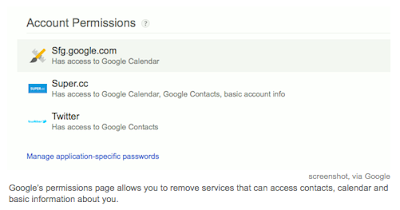
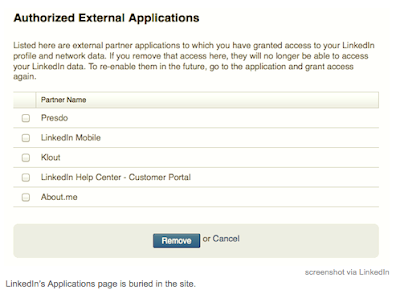

It’s almost that time of year again. Wash off the car. Take the cover off the grill. And figure out who has access to your social accounts.
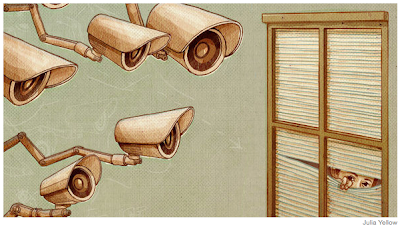
Whether you realize it or not, dozens — if not hundreds — of apps and services have access to your social accounts and can see everything you’re doing online. Tweets, Likes, your location, are all there for the taking. What’s worse, there’s a pretty good chance you unwittingly gave them permission.
On Thursday, this happened to me. I looked at Twitter and noticed that a start-up was tweeting from my account. I immediately deleted the Twitter message and revoked access to the service. But in doing so I noticed that hundreds of old apps have access to my Twitter, Facebook, Google and LinkedIn accounts.
It was time to do a little cleanup.
Just like the spring cleaning rule that says, “If you haven’t worn it in six months, throw it out,” you should use the same edict with your online data: “If you haven’t logged in to an app or site in six months, revoke its access.”
Here are some tips to clean up who has access to all your personal data:

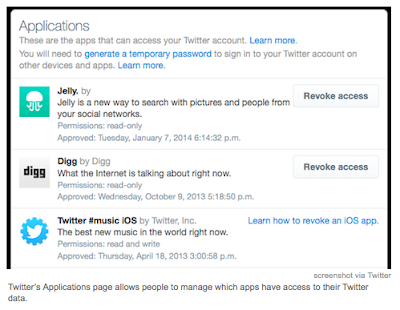
If you venture over to Twitter’s “Applications” page you will be able to see a long list of all the apps and services that currently have access to your Twitter profile. If you’re like me, you’ve probably forgotten about many of these apps — or, as I discovered, some of these companies have since been acquired by other companies. While many of these services use this access only to know who you are on another site, many are also collecting data about you.
To be safe hit the “Revoke Access” button for any apps that you haven’t visited in the last few months. Or any that look a little sketchy.
You will want to be especially careful of applications that have the ability to tweet on your behalf. These apps will have a line of text below their logo that say “Permissions: read and write.” My advice: Limit these to only sites you absolutely trust.

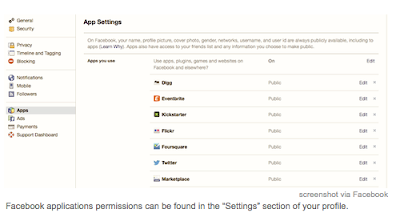
When I opened up my Facebook account to look at the apps I’ve given permission to, I thought there was a typo on the page because the number was so high. I’ve given 148 apps access to my Facebook profile, which is a whole lot of information about me floating around on the Internet. It’s clearly time for me to do some cleaning here.
To fix who has access to your Facebook profile you will want to log into your account and then click here. The page you will land on is a list of apps that you have used with Facebook before, but this isn’t the full list. To see all of the apps and services, click the link at the bottom that says “Show all apps.”
Now it’s time to start deleting.

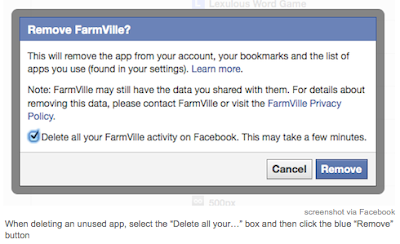
This might take a while, but go through and hit the “x” button at the far right next to every single app or service you no longer use. After you click the “x,” a popup will ask if you’re sure you want to remove the app and then it will give you the option to delete any posts by this service that have appeared in your news feed. If you want to remove this data or content, select the check mark and then click the blue “Remove” button. Voila, you’re done.
Now go through those steps again and again until you’ve removed all your unwanted services.

Your list of apps using Google is most likely pretty small, but just to be safe you should take a look at which services are getting access to your data. To see this list, go to Google’s Account Permission page under its security settings.
If you want to remove access to a service, click on the name of the company and then click the “Revoke Access,” button.

Just like Google, you probably haven’t granted access to too many apps from LinkedIn, but you should still take the time to investigate.from the New York Times by Nick Bolton
LinkedIn doesn’t make it easy to find this privacy section. You have to start on the website by clicking on your own personal avatar in the top right corner. Then select “Privacy and Settings.” Once on this page, click on the tab at the bottom of the page that says “Groups, Companies and Applications.” (Hang in there, you’re almost done.) Finally, you will want to click “View your applications.”
Deleting an app is easier than finding this section. To do this, you simply check the box next to the app you want to delete and then select the blue “Remove” button at the bottom of the page.
And that’s it. Spring cleaning of your social sites is complete. That is, until next spring.
Thursday, March 27, 2014
Tuesday, February 11, 2014
Tuesday, December 3, 2013
DRONES for Amazon.com?
This is some crazy shit . . .
Amazon Prime Air: drone-based 30 minute delivery
from Boing Boing:
Amazon Prime Air: drone-based 30 minute delivery
from Boing Boing:
Jeff Bezos took to 60 Minutes to announce Prime Air, a drone-based 30-minute delivery system for densely populated areas that comes with its own video design-fiction illustrating how it might work. The vision is an exciting one, but the designfic elides some important questions like the regulatory framework under which thousands (millions?) of drones might share the sky as businesses compete to do airborne delivery; whether that framework would be sufficient to actually maintain public safety (hello midair drone collision over a busy highway with attendant plummeting shrapnel into the path of speeding cars!); and what the energy and carbon footprint of drones would be, especially with comparison to conventional delivery logistics.
On the last point, I'm somewhat optimistic. One big problem with renewables is storing excess power generated during peak periods (tidal inflows/outflows, high wind events, strong sun), and having fleets of independent, battery-powered systems handy presents a solution: use their batteries as storage for this excess capacity. So if you imagine networks of drone-depots topped with solar arrays and/or windmills (or near to tidal generators on the coast), these could use drone batteries to both store energy for the drones, and as a storage medium to draw upon for internal power usage (pick-and-pull robots, etc) during the troughs in renewable output.
Tuesday, October 15, 2013
Piracy isn't killing big content; government needs to be skeptical of entertainment industry claims,
according to London School of Economics

Copyright and Creation, a policy brief from a collection of respected scholars at the rock-ribbed London School of Economics, argues that the evidence shows that piracy isn't causing any grave harm to the entertainment industry, and that anti-piracy measures like the three-strikes provision in Britain's Digital Economy Act don't work. They call on lawmakers to take an evidence-led approach to Internet and copyright law, and to consider the interests of the public and not just big entertainment companies looking for legal backstops to their profit-maximisation strategies.
“Contrary to the industry claims, the music industry is not in terminal decline, but still holding ground and showing healthy profits. Revenues from digital sales, subscription services, streaming and live performances compensate for the decline in revenues from the sale of CDs or records,” says Bart Cammaerts, LSE Senior Lecturer and one of the report’s authors.
The report shows that the entertainment industries are actually doing quite well. The digital gaming industry is thriving, the publishing sector is stable, and the U.S. film industry is breaking record after record.
“Despite the Motion Picture Association of America’s (MPAA) claim that online piracy is devastating the movie industry, Hollywood achieved record-breaking global box office revenues of $35 billion in 2012, a 6% increase over 2011,” the report reads.
Even the music industry is doing relatively well. Revenue from concerts, publishing and digital sales has increased significantly since the early 2000s and while recorded music revenues show a decline, there is little evidence that piracy is the lead cause.
“The music industry may be stagnating, but the drastic decline in revenues warned of by the lobby associations of record labels is not in evidence,” the report concludes.
Piracy Isn’t Killing The Entertainment Industry, Scholars Show
Tuesday, February 12, 2013
Capitalist conundrum: Free WiFi for EVERYONE or protecting profit margins of the 1%?
from our friend Richard Metzger over at Dangerous Minds:
With the news that a five-member panel of the FCC are considering creating a series of super powerful free WiFi network across America, it’s to be expected that the corporate lobbyists for the $178 billion wireless industry are already working overtime to scuttle these plans.
Conversely, according to The Washington Post, there has been an equally aggressive push coming from tech giants like Google and Microsoft for free WiFi networks “who say a free-for-all WiFi service would spark an explosion of innovations and devices that would benefit most Americans, especially the poor”:
The airwaves that FCC officials want to hand over to the public would be much more powerful than existing WiFi networks that have become common in households. They could penetrate thick concrete walls and travel over hills and around trees. If all goes as planned, free access to the Web would be available in just about every metropolitan area and in many rural areas.
The new WiFi networks would also have much farther reach, allowing for a driverless car to communicate with another vehicle a mile away or a patient’s heart monitor to connect to a hospital on the other side of town.
If approved by the FCC, the free networks would still take several years to set up. And, with no one actively managing them, connections could easily become jammed in major cities. But public WiFi could allow many consumers to make free calls from their mobile phones via the Internet. The frugal-minded could even use the service in their homes, allowing them to cut off expensive Internet bills.
In a country where Wal-Mart is the nation’s largest employer and doesn’t really even pay a living wage, this sort of monthly savings for what has become a necessity of modern life would seen quite attractive for the common man. The costs are surprisingly minimal, too.
But what of the poor, put-upon media barons who won’t be able to continue sticking the masses with a monthly cell phone bill? Should the management and stockholders of AT&T, T-Mobile, Verizon Wireless, Intel and Qualcomm be disallowed from skimming around a hundred bucks a month from the bank accounts of the average American?
Of course, the wireless telecom and cable providers are determined not to let this happen. In a January letter to FCC Chairman Julius Genachowski, the architect of this ambitious plan, and a powerful member of the Obama inner circle, several major companies argued that the government should concentrate on selling the public airwaves to private business, and raising money for the US Treasury that way, rather than going with the free WiFi for all, option.
They would feel that way, wouldn’t that??? LOL.
Naturally, the Republicans are lining up behind this ridiculously blinkered, backwards “free market” approach. Who can forget watching the Tea party dolts who were against net neutrality—because someone on Fox News told them it was something “socialist,” I guess—and braying like buffoons for the privilege of being able to give more power to the telecoms, even if it would mean seeing their own monthly bills rise... because, um, THEIR FREEDUMBS were apparently at stake.
This is a different kind of free market entirely that we’re talking about, one that could alter American lives in profound ways, spurring great innovation and perhaps even unprecedented high tech job creation. The saying goes that there’s no such thing as a free lunch, but free WiFi is already occurring in New York City and parts of Silicon Valley. In January, Google announced that it was providing free WiFi for NYC’s Chelsea neighborhood (where Google is headquartered in Manhattan). Soon that will extend to indoor fiber optic wiring as well. Google also rolled out high-speed fiber-optic Internet coverage recently in the Kansas City area, with download speeds up to 1 Gigabit per second. That’s pretty good. In fact it’s approximately 200 times faster than your home broadband connection. It’s not five times faster, it’s 200 times faster. (So much for innovation among the cable companies themselves, eh?)
Google’s blazing fast fiber optic service is beginning to draw hi-tech start-ups to Kansas City. Who would have thought that would happen a few years ago?
Furthermore, the major wireless carriers own far more spectrum than would even be necessary to provide public WiFi, and it would also improve their existing wireless networks for their own consumers. The only downside for this is for a relatively tiny group of stockholders. The benefits for Americans overall? Well, they seem limitless in terms of what can be imagined from 2013.
Designed by FCC Chairman Julius Genachowski, the plan would be a global first. When the U.S. government made a limited amount of unlicensed airwaves available in 1985, an unexpected explosion in innovation followed. Baby monitors, garage door openers and wireless stage microphones were created. Millions of homes now run their own wireless networks, connecting tablets, game consoles, kitchen appliances and security systems to the Internet.
“Freeing up unlicensed spectrum is a vibrantly free-market approach that offers low barriers to entry to innovators developing the technologies of the future and benefits consumers,” Genachowski said in a an e-mailed statement.
He’s 1000% right. Although not seeing the economic benefits flowing upwards at first may discombobulate their tiny brains, how idiotic would even Republicans have to be not to see the logic of this decidedly free market approach? If they balk, they need to be reminded of what the earlier—but far more technologically limited, pre-PC, iPad and smartphone, of course—Reagan-era changes in the management of the public airways wrought for the economy.
This is a real us vs.against them situation. The fattest cats versus EVERYBODY ELSE. It’ll be interesting to see how this shakes out. It’s an idea that’s time has come—IF NOT, WHY NOT—and I don’t think it’s going to go away until there’s free Wifi for all. The cat’s out of the bag and it ain’t going back in.

Sunday, June 17, 2012
The Fucking Internet, how does it work?
Sunday Sermon
from Maggie Koerth-Baker at BoingBoing
For the next 60 years or so—basically, until everyone roughly my age has died off—former Alaskan senator Ted Stevens will be widely remembered (and mocked) for once describing the Internet as "a series of tubes".
But here's the thing. It's easy to make fun of Ted Stevens. It's harder (much harder) to explain quickly and at a relatively simple level—for lay people with no tech background—what actually happens when they call up a web page.
That's why Greg Boustead and the nice folks at the World Science Festival put together this short video, explaining the basics of the Internet, specifically the basics of packet switching. The video should help the average person understand the Internet just a little better and it has been run by several experts for accuracy, Boustead says.I have to admit that when I had to screen it for "father of the Internet" Vint Cerf, who invented this process, I was more than a little nervous, certain he would pick it apart. When he replied with "This is so good - can I please use it to explain the concept of packets at public lectures," needless to say, I was over the moon.So, the Internet. It's not a big truck. It's not a series of tubes. It's more like a bus full of tourists.
Friday, February 17, 2012
Mike D for Net Neutrality In A Big Way

The Beastie Boys' Michael "Mike D" Diamond is part of an AT&T investor group seeking to put a net neutrality question on the shareholder ballot: "The shareholder resolution would recommend each company 'publicly commit to operate its wireless broadband network consistent with network neutrality principles,' the letter said. The companies should not discriminate based on the “source, ownership or destination” of data sent over their wireless infrastructure." (from BoingBoing via Consumerist)
Wednesday, January 18, 2012
PROTEST OF SOPA & PIPA - NO SCHEDULED BLOG POST TODAY IN SUPPORT OF THE ACTION

Call your elected officials.
Tell them you are their constituent, and you oppose SOPA and PIPA.
Why?
SOPA and PIPA cripple the free and open internet. They put the onus on website owners to police user-contributed material and call for the blocking of entire sites, even if the links are not to infringing material. Small sites will not have the sufficient resources to mount a legal challenge. Without opposition, large media companies may seek to cut off funding sources for small competing foreign sites, even if big media are wrong. Foreign sites will be blacklisted, which means they won't show up in major search engines.
In a post SOPA/PIPA world, Wikipedia --and many other useful informational sites-- cannot survive in a world where politicians regulate the Internet based on the influence of big money in Washington. It represents a framework for future restrictions and suppression. Congress says it's trying to protect the rights of copyright owners, but the "cure" that SOPA and PIPA represent is much more destructive than the disease they are trying to fix.
If you'd like to learn even more about SOPA/PIPA, click here.
and click here for even more info!
Friday, October 8, 2010
What Internet activism looks like.
 from BoingBoing:
 Anil Dash hits one so far out of the park it attains orbit in this response to a silly Malcolm Gladwell column that decried Internet activism as incapable of achieving meaningful change. It's all must-read stuff, but here's the bit that made me want to stand up and salute:Today, Dale Dougherty and the dozens of others who have led Maker Faire, and the culture of "making", are in front of a movement of millions who are proactive about challenging the constrictions that law and corporations are trying to place on how they communicate, create and live. The lesson that simply making things is a radical political act has enormous precedence in political history; I learned it well as a child when my own family's conversation after a screening of Gandhi turned to the salt protests in India, which were first catalyzed in my family's home state of Orissa, and led to my great-grandfather walking alongside Gandhi and others in the salt marches to come. Today's American Tea Partiers see even the original "tea party" largely as a metaphor, but the salt marches were a declaration of self-determination as expressed through manufacturing that took the symbolism of the Boston Tea Party and made it part of everyday life.Make The Revolution
To his last day, my great-grandfather wore khadi, the handspun clothing that didn't just represent independence from the British Raj in an abstract way, but made defiance of onerous British regulation as plain as the clothes on one's back. At Maker Faire this weekend, there were numerous examples of clothing that were made to defy laws about everything from spectrum to encryption law. It would have been only an afternoon's work to construct a t-shirt that broadcast CSS-descrambling code over unauthorized spectrum in defiance of the DMCA.
And if we put the making movement in the context of other social and political movements, it's had amazing success. In city after city, year after year, tens of thousands of people pay money to show up and learn about taking control of their media, learning, consumption and communications. In contrast to groups like the Tea Party, the crowd at Maker Faire is diverse, includes children and adults of all ages, and never finds itself in conflict with other groups based on identity or politics. More importantly, the jobs that many of us have in 2030 will be determined by young people who attended a Maker Faire, in industries that they've created. There is no other political movement in America today with a credible claim at creating the jobs of the future.
Thursday, September 30, 2010
Just How Massive Is Google, Anyway?

With all the controversy of all the private information google is getting on all of us every day, note the google alarm system i recently read about. Here's another cool graphic explaining what the fuck is going on with them.
Monday, May 3, 2010
Choose Privacy: video from the American Library Association
from Cory Doctrow at Boing Boing
Choose Privacy Week Video from 20K Films on Vimeo.
The American Library Association's "Choose Privacy" week kicks off with a ~20 minute video featuring writers and thinkers talking about the value of privacy in simple, accessible, thought-provoking terms. Included are me, Neil Gaiman, and many others. Produced by Laura Zinger and 20K films, it's a really fine little introduction to subject from the towering heroes of the information revolution: the librarians.
Subscribe to:
Posts (Atom)


