Showing posts with label liberal. Show all posts

Sunday, November 20, 2016

Sunday Sermon:
Michael Moore’s to do list for a Revolution:
An Intervention for Liberals

from Boing Boing
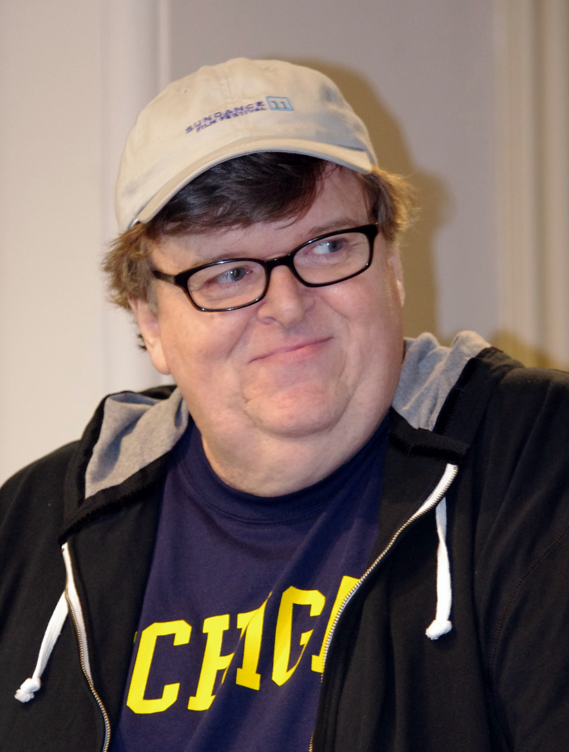
Photo by David Shankbone
We have a new leader in America. Known for his distinct regional accent and often seen wearing a baseball cap at rallies, he starred in a show on NBC, and holds strong opinions about guns and the NRA. He may not be the leader you saw coming, but you're going to see a lot more of him: Michael Moore. The documentary filmmaker shuns the activist label he is often given. In a recent LA Times interview Moore asserted, "I'm not an activist, I'm a citizen. It's redundant to say I'm an activist. We all should be active." Moore has been very active, and has made films that take on some of America's most complex and controversial topics -- globalization, gun violence, 9/11, our healthcare system, the economy, war, and most recently, Donald Trump, someone he did see coming. Unlike the Democrats. 
Moore tried to warn the left in July, when he wrote a piece titled simply "5 Reasons Why Trump Will Win. In it, he did not mince words: "Go ahead and say the words, 'cause you'll be saying them for the next four years: 'PRESIDENT TRUMP.' Never in my life have I wanted to be proven wrong more than I do right now." With his midwestern directness and efficiency, Moore then proceeded to list how and why Donald Trump was going to win. 
Liberals feel aimless and powerless, falling all over each other trying to figure out what happened. Like teenagers at a party that went off the rails, some are locked in the bathroom crying, some are fighting amongst themselves, others are telling everyone it's going to be fine, and some are standing on the kitchen table yelling, trying to restore order in futility. The left needs a designated driver, and Michael Moore is already in the driveway with the car warmed up, waiting for Democrats to pull themselves together and get in. 
After the election, Moore posted another 5-point list, this time, a" Morning After To-Do List." Item number one? "Take over the Democratic Party and return it to the people. They have failed us miserably." It might sound like pointing fingers, or running for office, but it's not. It was statement of tough love telling us what was necessary to lay the groundwork for an effective movement against Trump. Two days later, in an interview with LA Times reporter Steven Zeitchik, he said he that he wanted to head that movement: 
You live in a country where a majority of its citizens have said they believe there's climate change, they believe women should be paid the same as men, they want a debt-free college education, the don't want us invading countries, they want a raise in the minimum wage, and they want a single-payer true universal health care system. None of that has changed. We live in a country where the majority agree with the "liberal" position. We just lack the liberal leadership to make that happen. 
Hillary Clinton won the widest margin of the popular vote in the history of presidential election defeats, but lost in electoral votes -- and her supporters are still losing their minds. Also, on the 100th anniversary of a woman's right to vote, electing the first female president seemed like it was meant to be. Now, Twitter reads like a manic-depressive's drunken journal, riddled with earnest hashtags desperately trying to unify the bloodied left, and gloating trolls on the right who were all absent from gym class the day the other kids learned what sportsmanship was. 
After appearing on CNN's "State of the Union" along with Rudy Giuliani and Paul Ryan yesterday morning, the in-demand Moore took time to answer questions from Boing Boing: 
***
Maureen Herman: Do you see yourself as a leader or what role do you see yourself in now?
Michael Moore: I am doing my part to help lead the opposition, and will work with others to do so. Less meetings, more action. I tried to warn people about Trump winning -- I now have a responsibility to stop him from doing any harm. At least now people are listening to me.
***
He was right when he said Trump would win, but his article did not go particularly viral at the time, considering Moore's general popularity. It didn't get re-posted, re-tweeted, or shared the way the left, myself included, spread around self-soothing articles on our preferred candidate or editorials painting Trump as an impossible joke. Maybe Moore's perspective was not taken seriously, or it was ignored out of fear of facing the reality we are in now. Maybe we thought that embracing the possibility of a Trump presidency would jinx the election. Whatever the reason, we didn't listen, and we also didn't listen when he said back in 2015 that Trump was going to be the Republican Party's nominee. 
"That doesn't make me feel good, the fact that I was right. I never wanted to be more wrong," the outspoken liberal director said in an LA Times interview. "I just don't live in the bubble of New York and L.A. and I was worried with what I was witnessing in the Midwest, the Rust Belt, what I call the 'Brexit' states." 
Moore does not make his predictions based on algorithms, polls, and self-satisfied soothsaying. He pays attention to the root causes, he sees how systemic problems play out in individual lives -- it's what he has always done in his films. Michael Moore is as woke as they get. He kept his eye on the ball while the rest of us looked away, assuming it would land in our glove. Well, it got dropped and we lost the game. 
There's no Red Cross for losing an election, but that's the kind of thing people are looking for. Sure, there are existing Democratic organizations, and nonprofits that work for liberal concerns, like the ACLU, Planned Parenthood, and NAACP, and donations are coming in. People want to do something. But they need to do something different. Well, yesterday, Michael Moore posted a handy to do list on Twitter: 

#1. A massive nationwide opposition movement has exploded. It must continue. I am part of this. You are, too.

Must quickly and decisively form an opposition movement, the likes of which hasn't been seen since the 1960s. I will do my part to help lead this, as I'm sure many others (Bernie, Elizabeth Warren, MoveOn, the hip-hop community, DFA, etc.) will, too. The core of this opposition force will be fueled by young people who, as with Occupy Wall Street and Black Lives Matter, don't tolerate B.S. and are relentless in their resistance to authority. They have no interest in compromising with racists and misogynists. 

#2. Prepare for Trump's Impeachment now. Narcissism and greed and the fact he's a sociopath will lead to him breaking the law. 

Prepare to impeach Trump. Just as the Republicans were already planning to do with President Hillary from Day One, we must organize the apparatus that will bring charges against him when he violates his oath and breaks the law -- and then we must remove him from office. 

#3. Plan now to join millions in civil disobedience when Trump nominates his first Supreme Court Justice.

Must commit right now to a vigorous fight (including civil disobedience, if necessary) which will block any and all Donald Trump Supreme Court nominees who do not meet our approval. We demand the Democrats in the Senate aggressively filibuster any nominees who support Citizens United or who oppose the rights of women, immigrants and the poor. This is non-negotiable. 

#4. The DNC must apologize to Bernie Sanders for trying to rig the fight against him, for defaming him, for cheating.

Demand the DNC apologize to Bernie Sanders for trying to fix the primaries against him, for spinning the press to ignore his historic campaign, for giving Clinton the questions in advance at the Flint debate, for its latent ageism and anti-Semitism in trying to turn voters against him because of his age or religious beliefs, and for its anti-democracy system of "super-delegates" who are elected by no one. We all know now had Bernie been given a fair shot, he probably would have been the nominee and he -- as the true outsider and "change" candidate -- would have inspired and fired up the base and soundly defeated Donald Trump. If no apology is soon forthcoming from the DNC, that's ok -- when we take over the Democratic Party (see yesterday's To-Do List, #1), we will issue the apology in person. 

#5. Obama must appoint a special prosecutor to investigate the FBI Director's illegal interference in the election.

Demand that President Obama establish a Special Prosecutor to investigate who and what was behind FBI Director James Comey's illegal interference into the Presidential election 11 days before the vote was held. 

#6. Abolish electoral college and electronic voting; Election Day held on the weekend, restore voting rights of former prisoners

Begin a national push while it's fresh in everyone's mind for a constitutional amendment to fix our broken electoral system: 1. Eliminate the Electoral College -- popular vote only. 2. Paper ballots only -- no electronic voting. 3. Election Day must be made a holiday for all -- or held on a weekend so more people vote. 4. All citizens, regardless of any run-ins with the criminal "justice" system, must have the right to vote. (In swing states like Florida and Virginia, 30-40% of all Black men are prohibited by law from voting.) 
#7. President Obama: send the Army Corps of Engineers to Flint to replace the water pipes. The water is still unusable.
Convince President Obama to immediately do what he should have done a year ago: Send in the Army Corps of Engineers to Flint to dig up and replace all the poisoned pipes. NOTHING HAS CHANGED; the water in Flint is still unusable. 
Will try to get these done by sundown. More To-Do tomorrow... 
--Michael Moore 
It is not just Moore's accurate political predictions or successful films that make him the right person to lead the left out of the darkness, and it's not his common presence on major talk shows that inspired me to write this article. It was my personal experience with Michael Moore during the 2000 presidential campaign that revealed the kind of guy he was, his core values, and what he thought was possible for America. Sustained, passionate and authentic concern for the welfare of others is hard to find, and even harder to fake. That is what I learned that Michael was all about. 
We met the night of the 2000 MTV Video Awards, when a video he directed for Rage Against the Machine was nominated for Best Video. I became friendly with him and his wife, was invited to see him speak at a Ralph Nader for President rally, and a few weeks later, out to dinner. It was at dinner that he spoke eloquently and personally about his hopes and dreams for America, always peppering his points with the stories and struggles of real people. He was so full of belief in the promise of real change, and most importantly, in the ability of everyday people to come together to make it happen. He was supporting Nader's campaign with gusto, and in fact, that nights, he inspired me to vote third party for the first time. Moore left New York not long afterwards to work on what would become the Oscar-winning documentary, Bowling for Columbine. We all know what happened in the 2000 election, when votes for Ralph Nader ate up Al Gore's margin and won George Bush the presidency. I plead guilty. 
For as right as he's been, Moore is just as able to admit past mistakes, which he demonstrated famously on Bill Maher's Real Time, when he and Maher literally begged Ralph Nader not to run for president again in 2004. It was not a stunt. He learned the hard way something very profound and critical from the 2000 election: that real change only happens from the bottom up. In a 2010 interview with Amy Goodman for Democracy Now, Moore reflected on his changed stance about third parties: 
I have this basic position about Ralph. I've known him for many, many years. He has done so much good for this country. I also believe that he doesn't really have a handle on what the proper strategy is to get this country in our hands. I don't see him ever working with the grassroots or with the people or being in touch with the people in any way, shape or form. if we really want to try and get this power in our hands, in the people's hands, in the hands of the working people of this country, then we should, on a very grassroots level, from the bottom up, be doing things -- whether it's running for local office, or taking over the local Democratic Party." 
The game is rigged in America when it comes to third parties. There's no way that that's ever going to work. And so, then how, instead of letting the game, I guess, rig us, what can we do to the game itself? And if the game is, well, we have these two political parties which are really very much like one party, why don't we make sure that one of those parties actually is a second party and start locally and do that? And that's what I encourage people to do. That's my approach." 
If earnest optimism and the belief in significant change were Moore's greatest flaws in 2000, they are now an asset that over a half of the country desperately needs. What he learned from that election and every one since, is reflected in his to do list. This is not just wild revolutionary posturing. This came from being in the trenches. It came from losing and understanding what it takes to win. It came from seeing the impact of an election on the working folks who have inspired his life's work, and wanting sincerely to stop the suffering. 
So the morning after the 2016 election, when MSNBC's Rachel Maddow very accurately posted the very real impact of third party votes, it echoed the frustration of 2000. So if anyone was wondering why Moore and others who initially supported Bernie Sanders didn't go "Bernie or Bust," like our younger counterparts, it comes from what voters like myself experienced firsthand, having lived through eight years of a Bush presidency. 


Moore is not afraid to call the Democratic party out on its mistake with Bernie Sanders, and the role that played in the election, and he makes that clear on his to do list. He doesn't blame third party voters for Trump -- He holds the Democratic party responsible for leading them there. He knows there are other factors, like the impact of prisoners without voting rights -- people who are subject to punishment under the law, but not allowed to participate in the system of government. He recognizes that even if Hillary had won, things are still very broken, just by virtue of what happened to Sanders. Moore's razor sharp focus is on changing, the Democratic party from the inside. 

Moore is also careful not to blame racism for the election results. He is very aware of and concerned about the racial tension in the country, but he stresses that it should not keep us from looking at the very real economic issues that put Trump in the White House, as he told the LA Times: 
The Democratic Party doesn't seem to get it. Working people that are both African American and white -- don't make it a racial thing -- have suffered at the hands of both Republicans and Democrats," Moore said. He grew more fiery. "The DNC has to resign. They all have to resign." 
***
Maureen Herman: People would love to see Trump ousted from office, but most think it's unrealistic. What do you say to that?
Michael Moore: We must work every path that leads to stopping Trump -- legal, popular opinion, mass protest, forcing elected officials to obstruct his every negative move. 
***
In his "Morning After" list, Moore warned that Democrats in Congress who were not ready to fight "must step out of the way and let those of us who know the score lead the way in stopping the meanness and the madness that's about to begin." In the LA Times interview, Moore doubled down on the goal of removing Trump. "I don't believe anyone in the media who says we're going to have four years of Trump. This is a man who doesn't have any ideology; the only thing he believes in is Donald Trump. And that's usually a one-way ticket out of office." 

***
Maureen Herman: What can people do immediately to get involved with this movement? 
Michael Moore: Find the protests in your area and show up. If there are none, start one. Post photos and video on social media. Stay aware of other things going on and get involved! 
***
Another documentary filmmaker, comedian Bobcat Goldthwait, posted a text message to his daughter, in answer to her asking how he was doing after the election. It sums up where a lot of us are, or need to be right now: 
Numb, but it's just put the fire back in me. It's time for me to make a big noise. Protect your rights, protect the gays, protect minorities. This will wake up the strength and good people. I know it sounds crazy, but a lot of good will come from this. Too many good people just got a huge wake up call. It's OK to be sad and scared, but love, the real beautiful kind of love, comes out of times like these. We're the new 60s. Time to love and kick ass, and stand up to sexism and racism.
So all hands on deck. Get in the car with Uncle Mike. And yes, we can stop at Denny's on the way home. You're going to need your energy. 
With additional reporting by Katie Schwartz


Sunday, June 14, 2015

Liberals Make Big Comeback in 2015
Poll Analysis Finds

from The Wall Street Journal - Washington Wire

There are signs that liberals are making a comeback — and not just because a socialist is running for president, gay marriage is spreading like wildfire and pot legalization is gaining acceptance.

A new analysis of Wall Street Journal/NBC News poll data finds a marked increase in the share of registered voters identifying themselves as liberals, and an even bigger drop in the share saying they are conservatives.

In three national polls conducted so far in 2015, the analysis found that 26% of registered voters identified themselves as liberals — up from 23% in 2014. At the same time, the share of voters identifying as conservatives dropped to 33% from 37% in 2014.

The analysis by GOP pollster Bill McInturff, who looked at survey data from 2010 to 2015, found that the biggest ideological shifts came among women, young people, Latinos and well-educated voters, as well as people in the West and in cities.

From 2010 through 2014, there was little overall variation in the share of people identifying themselves as conservative, moderate and liberal, with conservatives either a plurality or tied with moderates. But that stability seems to be ending this year. For the first time since 2010, conservatives are no longer a plurality: 38% identify as moderates, compared with the 33% who identify as conservative and 26% as liberal.

Mr. McInturff said it wasn’t immediately clear what accounts for the shift. Another poll analysis by Gallup also suggests there has been a leftward movement on social issues: 31% of adults in a May 6-10 poll identified themselves as liberal on social issues — the largest share since Gallup started asking the question in 1999, and the first time social liberals matched the share who said they were socially conservative. On economic issues, by contrast, conservatives continued to dominate by a 39%-19% margin.

These signs of an ideological shift come at a time when public opinion is rapidly changing in favor of gay marriage — a social view long regarded as liberal that is gaining wider acceptance among members of both parties. On the broader political landscape this year, liberal populism is gaining prominence in the anti-Wall Street rhetoric of presidential candidate Sen. Bernie Sanders, a self-described socialist, and of liberal icon Sen. Elizabeth Warren.

“Americans’ growing social liberalism is evident not only in how they describe their views on social issues but also in changes in specific attitudes, such as increased support for same-sex marriage and legalizing marijuana,” the Gallup report said.

Mr. McInturff’s analysis of WSJ/NBC data found that the demographic group that now has the most liberals – and that has seen the most dramatic swing to the left since 2010 — is women aged 18-49. Among those voters in 2015 polls, 37% said they were liberal, 23% said they were conservative — a 20 point swing since 2010 when 27% said they were liberal and 33% said they were conservative.

Younger voters also saw a notable swing to the left, with 35% of 18-34-year-olds saying they are liberal and 26% saying the are conservative. In 2010, that age group split 28% liberal-32% conservative.


Tuesday, December 24, 2013

The Great American Class War: Plutocracy Versus Democracy

By Bill Moyers

Crossposted from TomDispatch via Michael Moore

I met Supreme Court Justice William Brennan in 1987 when I was creating a series for public television called In Search of the Constitution, celebrating the bicentennial of our founding document. By then, he had served on the court longer than any of his colleagues and had written close to 500 majority opinions, many of them addressing fundamental questions of equality, voting rights, school segregation, and -- in New York Times v. Sullivan in particular -- the defense of a free press.

Those decisions brought a storm of protest from across the country. He claimed that he never took personally the resentment and anger directed at him. He did, however, subsequently reveal that his own mother told him she had always liked his opinions when he was on the New Jersey court, but wondered now that he was on the Supreme Court, “Why can’t you do it the same way?” His answer: “We have to discharge our responsibility to enforce the rights in favor of minorities, whatever the majority reaction may be.”

Although a liberal, he worried about the looming size of government. When he mentioned that modern science might be creating “a Frankenstein,” I asked, “How so?” He looked around his chambers and replied, “The very conversation we’re now having can be overheard. Science has done things that, as I understand it, makes it possible through these drapes and those windows to get something in here that takes down what we’re talking about.”

That was long before the era of cyberspace and the maximum surveillance state that grows topsy-turvy with every administration. How I wish he were here now -- and still on the Court!

My interview with him was one of 12 episodes in that series on the Constitution. Another concerned a case he had heard back in 1967. It involved a teacher named Harry Keyishian who had been fired because he would not sign a New York State loyalty oath. Justice Brennan ruled that the loyalty oath and other anti-subversive state statutes of that era violated First Amendment protections of academic freedom.

I tracked Keyishian down and interviewed him. Justice Brennan watched that program and was fascinated to see the actual person behind the name on his decision. The journalist Nat Hentoff, who followed Brennan’s work closely, wrote, “He may have seen hardly any of the litigants before him, but he searched for a sense of them in the cases that reached him.” Watching the interview with Keyishian, he said, “It was the first time I had seen him. Until then, I had no idea that he and the other teachers would have lost everything if the case had gone the other way.”

Toward the end of his tenure, when he was writing an increasing number of dissents on the Rehnquist Court, Brennan was asked if he was getting discouraged. He smiled and said, “Look, pal, we’ve always known -- the Framers knew -- that liberty is a fragile thing. You can’t give up.” And he didn’t.

The Donor Class and Streams of Dark Money

The historian Plutarch warned us long ago of what happens when there is no brake on the power of great wealth to subvert the electorate. “The abuse of buying and selling votes,” he wrote of Rome, “crept in and money began to play an important part in determining elections. Later on, this process of corruption spread in the law courts and to the army, and finally, when even the sword became enslaved by the power of gold, the republic was subjected to the rule of emperors.”

We don’t have emperors yet, but we do have the Roberts Court that consistently privileges the donor class.

We don’t have emperors yet, but we do have a Senate in which, as a study by the political scientist Larry Bartels reveals, “Senators appear to be considerably more responsive to the opinions of affluent constituents than to the opinions of middle-class constituents, while the opinions of constituents in the bottom third of the income distribution have no apparent statistical effect on their senators’ roll call votes.”

We don’t have emperors yet, but we have a House of Representatives controlled by the far right that is now nourished by streams of “dark money” unleashed thanks to the gift bestowed on the rich by the Supreme Court in the Citizens United case.

We don’t have emperors yet, but one of our two major parties is now dominated by radicals engaged in a crusade of voter suppression aimed at the elderly, the young, minorities, and the poor; while the other party, once the champion of everyday working people, has been so enfeebled by its own collaboration with the donor class that it offers only token resistance to the forces that have demoralized everyday Americans.

Writing in the Guardian recently, the social critic George Monbiot commented,
“So I don’t blame people for giving up on politics... When a state-corporate nexus of power has bypassed democracy and made a mockery of the voting process, when an unreformed political system ensures that parties can be bought and sold, when politicians [of the main parties] stand and watch as public services are divvied up by a grubby cabal of privateers, what is left of this system that inspires us to participate?”
Why are record numbers of Americans on food stamps? Because record numbers of Americans are in poverty. Why are people falling through the cracks? Because there are cracks to fall through. It is simply astonishing that in this rich nation more than 21 million Americans are still in need of full-time work, many of them running out of jobless benefits, while our financial class pockets record profits, spends lavishly on campaigns to secure a political order that serves its own interests, and demands that our political class push for further austerity. Meanwhile, roughly 46 million Americans live at or below the poverty line and, with the exception of Romania, no developed country has a higher percent of kids in poverty than we do. Yet a study by scholars at Northwestern University and Vanderbilt finds little support among the wealthiest Americans for policy reforms to reduce income inequality.

Class Prerogatives

Listen! That sound you hear is the shredding of the social contract.

Ten years ago the Economist magazine -- no friend of Marxism -- warned: “The United States risks calcifying into a European-style class-based society.” And as a recent headline in the Columbia Journalism Review put it: “The line between democracy and a darker social order is thinner than you think.”

We are this close -- this close! -- to losing our democracy to the mercenary class. So close it’s as if we’re leaning way over the rim of the Grand Canyon waiting for a swift kick in the pants.

When Justice Brennan and I talked privately in his chambers before that interview almost 20 years ago, I asked him how he had come to his liberal sentiments. “It was my neighborhood,” he said. Born to Irish immigrants in 1906, as the harsh indignities of the Gilded Age brought hardship and deprivation to his kinfolk and neighbors, he saw “all kinds of suffering -- people had to struggle.” He never forgot those people or their struggles, and he believed it to be our collective responsibility to create a country where they would have a fair chance to a decent life. “If you doubt it,” he said, “read the Preamble [to the Constitution].”

He then asked me how I had come to my philosophy about government (knowing that I had been in both the Kennedy and Johnson administrations). I don’t remember my exact words, but I reminded him that I had been born in the midst of the Great Depression to parents, one of whom had to drop out of school in the fourth grade, the other in the eighth, because they were needed in the fields to pick cotton to help support their families.

Franklin Roosevelt, I recalled, had been president during the first 11 years of my life. My father had listened to his radio “fireside chats” as if they were gospel; my brother went to college on the G.I. Bill; and I had been the beneficiary of public schools, public libraries, public parks, public roads, and two public universities. How could I not think that what had been so good for me would be good for others, too?

That was the essence of what I told Justice Brennan. Now, I wish that I could talk to him again, because I failed to mention perhaps the most important lesson about democracy I ever learned.

On my 16th birthday in 1950, I went to work for the daily newspaper in the small East Texas town where I grew up. It was a racially divided town -- about 20,000 people, half of them white, half of them black -- a place where you could grow up well-loved, well-taught, and well-churched, and still be unaware of the lives of others merely blocks away. It was nonetheless a good place to be a cub reporter: small enough to navigate but big enough to keep me busy and learning something new every day. I soon had a stroke of luck. Some of the old-timers in the newsroom were on vacation or out sick, and I got assigned to report on what came to be known as the “Housewives’ Rebellion.” Fifteen women in town (all white) decided not to pay the Social Security withholding tax for their domestic workers (all black).

They argued that Social Security was unconstitutional, that imposing it was taxation without representation, and that -- here’s my favorite part -- “requiring us to collect [the tax] is no different from requiring us to collect the garbage.” They hired themselves a lawyer -- none other than Martin Dies, Jr., the former congressman best known, or worst known, for his work as head of the House Committee on Un-American Activities in the witch-hunting days of the 1930s and 1940s. They went to court -- and lost. Social Security was constitutional, after all. They held their noses and paid the tax.

The stories I helped report were picked up by the Associated Press and circulated nationwide. One day, the managing editor, Spencer Jones, called me over and pointed to the AP ticker beside his desk. Moving across the wire was a notice citing the reporters on our paper for the reporting we had done on the “rebellion.” I spotted my name and was hooked. In one way or another, after a detour through seminary and then into politics and government, I’ve been covering the class war ever since.

Those women in Marshall, Texas, were among its advance guard. Not bad people, they were regulars at church, their children were my classmates, many of them were active in community affairs, and their husbands were pillars of the business and professional class in town. They were respectable and upstanding citizens all, so it took me a while to figure out what had brought on that spasm of reactionary defiance. It came to me one day, much later: they simply couldn’t see beyond their own prerogatives.

Fiercely loyal to their families, to their clubs, charities, and congregations -- fiercely loyal, in other words, to their own kind -- they narrowly defined membership in democracy to include only people like themselves. The black women who washed and ironed their laundry, cooked their families’ meals, cleaned their bathrooms, wiped their children’s bottoms, and made their husbands’ beds, these women, too, would grow old and frail, sick and decrepit, lose their husbands and face the ravages of time alone, with nothing to show for their years of labor but the creases on their brows and the knots on their knuckles. There would be nothing for them to live on but the modest return on their toil secured by the collaborative guarantee of a safety net.

The Unfinished Work of America

In one way or another, this is the oldest story in America: the struggle to determine whether “we, the people” is a moral compact embedded in a political contract or merely a charade masquerading as piety and manipulated by the powerful and privileged to sustain their own way of life at the expense of others.

I should make it clear that I don’t harbor any idealized notion of politics and democracy. Remember, I worked for Lyndon Johnson. Nor do I romanticize “the people.” You should read my mail and posts on right-wing websites. I understand the politician in Texas who said of the state legislature, “If you think these guys are bad, you should see their constituents.”

But there is nothing idealized or romantic about the difference between a society whose arrangements roughly serve all its citizens (something otherwise known as social justice) and one whose institutions have been converted into a stupendous fraud. That can be the difference between democracy and plutocracy.

Toward the end of Justice Brennan’s tenure on the Supreme Court, he made a speech that went to the heart of the matter. He said:
“We do not yet have justice, equal and practical, for the poor, for the members of minority groups, for the criminally accused, for the displaced persons of the technological revolution, for alienated youth, for the urban masses... Ugly inequities continue to mar the face of the nation. We are surely nearer the beginning than the end of the struggle.”
And so we are. One hundred and fifty years ago, Abraham Lincoln stood on the blood-soaked battlefield of Gettysburg and called Americans to “the great task remaining.” That “unfinished work,” as he named it, remained the same then as it was when America’s founding generation began it. And it remains the same today: to breathe new life into the promise of the Declaration of Independence and to assure that the Union so many have sacrificed to save is a union worth saving.

-----------------

Bill Moyers has received 35 Emmy awards, nine Peabody Awards, the National Academy of Television’s Lifetime Achievement Award, and an honorary doctor of fine arts from the American Film Institute over his 40 years in broadcast journalism. He is currently host of the weekly public television series Moyers & Company and president of the Schumann Media Center, a non-profit organization which supports independent journalism. He delivered these remarks (slightly adapted here) at the annual Legacy Awards dinner of the Brennan Center for Justice, a non-partisan public policy institute in New York City that focuses on voting rights, money in politics, equal justice, and other seminal issues of democracy. This is his first TomDispatch piece.

Monday, October 22, 2012

George McGovern | 1922-2012
A Prairie Liberal, Trounced but Never Silenced


He was the first candidate I ever supported for anything, I was around 10 years old and remember making a huge leather badge that said McGovern '72 on it.

Here's a good piece from the New York Times By DAVID E. ROSENBAUM
George McGovern, the United States senator who won the Democratic Party’s presidential nomination in 1972 as an opponent of the war in Vietnam and a champion of liberal causes, and who was then trounced by President Richard M. Nixon in the general election, died early Sunday in Sioux Falls, S.D. He was 90.

His death was announced in a statement by his family. He had been moved to hospice care in recent days after being treated for several health problems in the last year. He had a home in Mitchell, S.D., where he had spent his formative years.

In a statement, President Obama called Mr. McGovern “a champion for peace” who was a “statesman of great conscience and conviction.”

To the liberal Democratic faithful, Mr. McGovern remained a standard-bearer well into his old age, writing and lecturing even as his name was routinely invoked by conservatives as synonymous with what they considered the failures of liberal politics.

He never retreated from those ideals, however, insisting on a strong, “progressive” federal government to protect the vulnerable and expand economic opportunity, while asserting that history would prove him correct in his opposing not only what he called “the tragically mistaken American war in Vietnam” but also the American invasions of Iraq and Afghanistan.

A slender, soft-spoken minister’s son newly elected to Congress — his father was a Republican — Mr. McGovern went to Washington as a 34-year-old former college history teacher and decorated bomber pilot in World War II. He thought of himself as a son of the prairie as well, with a fittingly flat, somewhat nasal voice and a brand of politics traceable to the Midwestern progressivism of the late 19th century.

Elected to the Senate in 1962, Mr. McGovern left no special mark in his three terms, but he voted consistently in favor of civil rights and antipoverty bills, was instrumental in developing and expanding food stamp and nutrition programs, and helped lead opposition to the Vietnam War in the Senate.

The war was the cause he took into the 1972 election, one of the most lopsided in American history. Mr. McGovern carried only Massachusetts and the District of Columbia and won just 17 electoral votes to Nixon’s 520.

The campaign was the backdrop to the burglary at the Democratic Party headquarters in the Watergate Hotel in Washington and to the Nixon organization’s shady fund-raising practices and sabotage operations, later known as “dirty tricks,” which were not disclosed until after the election.

The Republicans portrayed Mr. McGovern as a cowardly left-winger, a threat to the military and the free-market economy and someone outside the mainstream of American thought. Whether those charges were fair or not, Mr. McGovern never lived down the image of a liberal loser, and many Democrats long accused him of leading the party astray.

Mr. McGovern resented that characterization mightily. “I always thought of myself as a good old South Dakota boy who grew up here on the prairie,” he said in an interview for this obituary in 2005 in his home in Mitchell. “My dad was a Methodist minister. I went off to war. I have been married to the same woman forever. I’m what a normal, healthy, ideal American should be like.

“But we probably didn’t work enough on cultivating that image,” he added, referring to his presidential campaign organization. “We were more interested in ending the war in Vietnam and getting people out of poverty and being fair to women and minorities and saving the environment.

“It was an issue-oriented campaign, and we should have paid more attention to image.”

The 1972 Nomination

Mr. McGovern was 49 years old and in his second Senate term when he won the 1972 Democratic nomination, outdistancing a dozen or so other aspirants, including Senator Edmund S. Muskie of Maine, the early front-runner; former Vice President Hubert H. Humphrey, the nominee in 1968; and Gov. George C. Wallace of Alabama, a populist with a segregationist past who was gravely wounded in an assassination attempt in Maryland during the primaries.

Mr. McGovern benefited from new party rules that he had been largely responsible for writing, and from a corps of devoted young volunteers, including Bill Clinton and Hillary Rodham, who took time off from Yale Law School to work on the campaign in Texas.

The nominating convention in Miami was a disastrous start to the general election campaign. There were divisive platform battles over Vietnam, abortion, welfare and court-ordered busing to end racial discrimination. The eventual platform was probably the most liberal one ever adopted by a major party in the United States. It advocated an immediate withdrawal from Vietnam, amnesty for war resisters, the abolition of the draft, a guaranteed job for all Americans and a guaranteed family income well above the poverty line.

Several prominent Democrats declined Mr. McGovern’s offer to be his running mate before he chose Senator Thomas F. Eagleton of Missouri.

Mr. McGovern’s organization was so disorganized that by the time he went to the convention rostrum for his acceptance speech, it was nearly 3 a.m. He delivered perhaps the best speech of his life. “We reject the view of those who say, ‘America, love it or leave it,’ ” he declared. “We reply, ‘Let us change it so we can love it more.’ ”

The delegates loved it, but most television viewers had long since gone to bed.

The convention was barely over when word got out that Mr. Eagleton had been hospitalized three times in the 1960s for what was called nervous exhaustion, and that he had undergone electroshock therapy.

Mr. McGovern said he was behind his running mate “a thousand percent.” But less than two weeks after the nomination, Mr. Eagleton was dropped from the ticket and replaced by R. Sargent Shriver, a Kennedy in-law and former director of the Peace Corps.

The campaign never recovered from the Eagleton debacle. Republicans taunted Mr. McGovern for backing everything a thousand percent. Commentators said his treatment of Mr. Eagleton had shown a lack of spine.

In the 2005 Times interview, Mr. McGovern said he had handled the matter badly. “I didn’t know a damn thing about mental illness,” he said, “and neither did anyone around me.”

With a well-oiled campaign operation and a big financial advantage, Nixon began far ahead and kept increasing his lead. When Mr. McGovern proposed deep cuts in military programs and a $1,000 grant to every American, Nixon jeered, calling the ideas liberalism run amok. Nixon, meanwhile, cited accomplishments like the Paris peace talks on Vietnam, an arms limitation treaty with the Soviet Union, a prosperous economy and a diplomatic opening to China.

On election night, Mr. McGovern did not bother to call Nixon. He simply sent a telegram offering congratulations. Then, he said, he sat on his bed at the Holiday Inn in Sioux Falls and wrote his concession speech on hotel stationery.

In his book on the campaign, “The Making of the President 1972,” Theodore H. White wrote that the changes Mr. McGovern had sought abroad and at home had “frightened too many Americans.”

“Richard M. Nixon,” Mr. White wrote, “convinced the Americans, by more than 3 to 2, that he could use power better than George McGovern.”

Mr. McGovern offered his own assessment of the campaign. “I don’t think the American people had a clear picture of either Nixon or me,” he said in the 2005 interview. “I think they thought that Nixon was a strong, decisive, tough-minded guy, and that I was an idealist and antiwar guy who might not attach enough significance to the security of the country.

“The truth is, I was the guy with the war record, and my opposition to Vietnam was because I was interested in the nation’s well-being.”

His staff, he said, urged him to talk more about his war experience, but like many World War II veterans at the time, he was reluctant to do so.

How long, he was asked, did it take to get over the disappointment of losing? “You never fully get over it,” he replied. “But I’ve had a good life. I’ve enjoyed myself 90 percent of the time.”

Humble Beginnings

George Stanley McGovern was born on July 19, 1922, in a parsonage in Avon, S.D., a town of about 600 people where his father, Joseph, was the pastor of the Wesleyan Methodist Church. A disciplinarian, his father, who was born in 1868, tried to keep his four children from going to the movies and playing sports. His mother, the former Frances McLean, was a homemaker about 20 years her husband’s junior.

The family moved to Mitchell, in southeastern South Dakota, when George was 6. He went to high school and college there, enrolling at Dakota Wesleyan University in 1940. After Pearl Harbor, Mr. McGovern joined the Army Air Corps. In 1943 he married Eleanor Stageberg, who had grown up with an identical twin on a South Dakota farm. They had met at Dakota Wesleyan.

Mr. McGovern was trained to fly the B-24 Liberator, a four-engine heavy bomber, and he flew dozens of missions over Austria, Germany and Italy.

On his 30th mission, his plane was struck by enemy fire and his navigator was killed. Lieutenant McGovern crash-landed the plane on an island in the Adriatic. He earned a Distinguished Flying Cross for the exploit.

After his discharge, Mr. McGovern returned to Mitchell — his father had recently died — and resumed his studies at Dakota Wesleyan. He graduated in 1946 and went to Northwestern University for graduate studies in history.

With a master’s degree, he returned to Dakota Wesleyan, a small university, to teach history and political science. “I was the best historian in a one-historian department,” he said in an interview in 2003. During summers and in his free time, he continued his graduate work and received a Ph.D. in history from Northwestern in 1953.

Mr. McGovern left teaching to become executive secretary of the South Dakota Democratic Party, and almost single-handedly revived a moribund operation in a heavily Republican state.

Month after month, he drove across South Dakota in a beat-up sedan, making friends and setting up county organizations. In 1956, gaining the support of farmers who had become New Deal Democrats during the Depression, he was elected to Congress himself, defeating an overconfident incumbent Republican. He became the first Democratic congressman from his state in more than 20 years.

Mr. McGovern left the House after two terms to run for the Senate and was soundly beaten by the sitting Republican, Karl E. Mundt. He then became a special assistant to the newly elected president, John F. Kennedy, and the director of Kennedy’s Food for Peace program, an effort to provide food for the hungry in poor countries.

In 1962, Mr. McGovern ran for the Senate again, and this time he won, by 597 votes. He defeated Joseph H. Bottum, a Republican serving out the term of Senator Francis H. Case, who had died in office.

In the Senate, Mr. McGovern became a reliable vote for Democratic initiatives and a leader on food and hunger issues as a member of the Agriculture Committee. But he was more interested in national politics than in legislation.

After Robert F. Kennedy, fresh from his victory in the California presidential primary, was assassinated in Los Angeles in June 1968, the Kennedy camp encouraged Mr. McGovern to enter the race as an alternative to Humphrey and Senator Eugene J. McCarthy of Minnesota. Mr. McGovern did so but was unable to catch up to Humphrey.

Almost from the moment the 1968 campaign ended, Mr. McGovern began running for the 1972 nomination. He traveled the country, recording on index cards the names of potential supporters he met. He also became the chairman of a Democratic Party commission on delegate selection, created after the fractious 1968 national convention to give the rank and file more say in picking a presidential nominee.

What became known as the McGovern commission rewrote party rules to ensure that more women, young people and members of minorities were included in delegations. The influence of party leaders was curtailed. More states began choosing delegates on the basis of primary elections. And the party’s center of gravity shifted decidedly leftward.

Though the rules were not written specifically to help Mr. McGovern win the nomination, they had that effect.

After he was crushed by Nixon in the 1972 election, Mr. McGovern returned to the Senate and began campaigning for re-election in 1974. At the Gridiron Club’s annual dinner in 1973, he told the assembled Washington elite, “Ever since I was a young man, I wanted to run for the presidency in the worst possible way — and I did.”

Mr. McGovern was re-elected to the Senate in 1974, a landslide year for Democrats after Watergate. He defeated Leo K. Thorsness, a novice politician.

It proved to be Mr. McGovern’s last success in elective politics. As the conservative movement gained force, Mr. McGovern’s popularity dropped.

In 1980, he was defeated by James Abdnor, a plain-spoken Republican congressman who had clung to Ronald Reagan’s coattails and was helped by anti-McGovern advertisements broadcast by the National Conservative Political Action Committee.

Mr. McGovern ran for the Democratic presidential nomination again in 1984, but withdrew after winning only 23 convention delegates, most of them in Massachusetts.

Unlike some of his peers, Mr. McGovern did not become wealthy in office, and he said he had no interest in lobbying afterward. Instead, he earned a living teaching, lecturing and writing. He briefly owned a motor inn in Stratford, Conn., and a bookstore in Montana, where he owned a summer home. But neither investment proved profitable.

What he called “the big tragedy of my life” occurred in 1994. His daughter Teresa J. McGovern, who had suffered from alcoholism and mental illness, froze to death, acutely intoxicated, in a parking lot snowbank in Madison, Wis., at the age of 45.

His eyes welled up as he talked about it 11 years later. “That just about killed me,” he said. “I had always had a very demanding schedule. I didn’t do everything I could as a father.”

As therapy, Mr. McGovern researched and wrote a book, “Terry: My Daughter’s Life-and-Death Struggle With Alcoholism,” published in 1997. (An addiction-treatment center named after her was established in Madison.)

That year, President Bill Clinton appointed Mr. McGovern ambassador to the United Nations’ Food and Agriculture Organization. He moved to Rome, and he worked on plans for delivering food to malnourished people around the world. In 2000, Mr. Clinton awarded him the Presidential Medal of Freedom, the nation’s highest civilian honor.

Returning Home

After four years in Rome, Mr. McGovern and his wife moved back to Mitchell, where they lived in a ranch-style house owned by Dakota Wesleyan and helped raise money for a university library that was named after them. The university is also home to the McGovern Center for Leadership and Public Service, a research and educational institution founded in 2006. The McGoverns also had a home in St. Augustine, Fla.

Eleanor McGovern died in 2007 at 85. A son, Steven, who had also struggled with alcoholism, died in July at 60.

Mr. McGovern’s survivors include three daughters, Ann, Susan and Mary; 10 grandchildren; and one great-grandchild.

Mr. McGovern remained robust in old age. To celebrate his 88th birthday, he sky-dived in Florida. Last fall, he was hospitalized twice, once after falling and hitting his head outside the Dakota Wesleyan library before a scheduled C-Span interview, and another time for fatigue after completing a lecture tour. But he rebounded and resumed making public appearances this year.

Mr. McGovern remained a voice in public affairs, notably in 2008, when, in an op-ed article in The Washington Post, he called for the impeachment of President George W. Bush and Vice President Dick Cheney for their prosecution of the war in Iraq.

He published books regularly, on history, the environment and other subjects. In “Out of Iraq” (2006), written with William R. Polk, he argued for a phased withdrawal from Iraq, to end in 2007. In his final book, “What It Means to Be a Democrat,” released last November, he despairs of an “insidious” political atmosphere in Washington while trying to rally Democrats against “extremism” in the Republican ranks.

“We are the party that believes we can’t let the strong kick aside the weak,” Mr. McGovern wrote. “Our party believes that poor children should be as well educated as those from wealthy families. We believe that everyone should pay their fair share of taxes and that everyone should have access to health care.”

With the country burdened economically, he added, there has “never been a more critical time in our nation’s history” to rely on those principles.

“We are at a crossroads,” he wrote, “over how the federal government in Washington and state legislatures and city councils across the land allocate their financial resources. Which fork we take will say a lot about Americans and our values.”

David E. Rosenbaum, a Washington correspondent for The New York Times, died in 2006. William McDonald contributed reporting.
(with Fidel for a Jeep ride in 1975)

Tuesday, September 20, 2011

RALPH NADER: USA IS A TWO-PARTY DICTATORSHIP

Last week Ralph Nader appeared on Fox News to discuss a democratic primary challenge he’s helping to organize against Barack Obama to “hold his feet to the fire.” I think what Nader means by this is that Obama needs to start doing some liberal stuff.
“The important thing here is if he’s not challenged from the progressive-liberal wing of his party, that elected him, it’ll be a very dull campaign, people will not be very enthusiastic, more and more people will stay home, it’s not good for him,. If he’s a good debater, if he knows his facts, he’ll want to be challenged because he’ll come out much sharper.”
It’s surprising how little Neil Cavuto challenged Nader in this segment. To his credit, he hardly even tried and let Nader say some things you wouldn’t normally hear on Fox News without someone else trying to shout over it.

Or maybe it’s just that Nader isn’t exactly saying anything too positive about Obama… Either way, I’m glad Cavuto’s audience got to hear this.


from Richard Metzger at DangerousMinds