Maslow's Hierarchy, (or Pyramid), of Needs is one of the central ideas in modern economics and sociology. The work of a once little-known American psychologist, it has grown into an indispensable guide to understanding the modern world. This film explains who Maslow was, what his pyramid is, and why it matters so much.
Showing posts with label psychology. Show all posts
Showing posts with label psychology. Show all posts
Monday, April 22, 2019
School of Life Monday:
Why Maslow's Hierarchy Of Needs Matters


Monday, February 25, 2019
School of Life Monday:
The Problem of Fame
It sounds so nice to be famous - from afar. But from closer up, there might be a range of problems that make anonymity preferable. This is a film for recovering fame addicts (there are quite a few of us out there...).
Monday, May 28, 2018
School of Life Monday:
How the Modern World Makes Us Mentally Ill
It's easy to blame ourselves for not feeling 100% in our minds, but some of the causes of mental unwellness have to do with large systemic problems in our societies, among these, an emphasis on individualism, a manic faith in Romantic love and a cult of meritocracy.
Monday, May 7, 2018
School of Life Monday:
Why You Will Marry the Wrong Person
This video sees Alain de Botton, Creator of The School of Life and narrator on the majority of our videos, talking at a Google event in London in 2017.
Monday, April 23, 2018
School of Life Monday:
The True and the False Self
A good life is one in which we can dare to show our True Self and do not mind too much occasionally having to wear the mask of a False Self. But for this to be possible, we need a certain sort of childhood - as the masterful British psychoanalyst Donald Winnicott helped to explain in his theory of the true and the false self, outlined here.
“One of the most surprising but powerful explanations for why we may, as adults, be in trouble mentally is that we were, in our earliest years, denied the opportunity to be fully ourselves, that is, we were not allowed to be wilful and difficult, we could not be as demanding, aggressive, intolerant, and unrestrictedly selfish as we needed to be. Because our caregivers were preoccupied or fragile, we had to be preternaturally attuned to their demands, sensing that we had to comply in order to be loved and tolerated; we had to be false before we had the chance to feel properly alive. And as a result, many years later, without quite understanding the process, we risk feeling unanchored, inwardly dead and somehow not entirely present…”
Monday, February 19, 2018
School of Life Monday:
How Our Past Influences Our Present
A lot of the way we see reality has been influenced, and often distorted, by our past. Our childhoods, which went on a long time, have shaped how we assess other people, ourselves and our prospects. Knowing about our innate biases allows us to liberate ourselves from certain settled but unhelpful habits of the mind.
Monday, February 12, 2018
School Life Monday:
What Your Home Says About You...
One of our most basic psychological needs is to create a home, that is a space that is decorated in such a way as to reflect our values back to us. That's why we can legitimately get so excited (or distressed) by matters of home decoration - and why, after too long on the road, we long to get back to our own place.
FURTHER READING
“One of the most meaningful activities we are ever engaged in is the creation of a home. Over a number of years, typically with a lot of thought and considerable dedication, we assemble furniture, crockery, pictures, rugs, cushions, vases, sideboards, taps, door handles and so on into a distinctive constellation we anoint with the word home. As we create our rooms, we engage passionately with culture in a way we seldom do in the supposedly higher realms of museums or galleries. We reflect profoundly on the atmosphere of a picture, we ponder the relationship between colours on a wall, we notice how consequential the shape of the back of a sofa can be and ask with care what books really deserve our ongoing attention…”
Wednesday, January 24, 2018
The secret history of Facebook depression
from PHYS.ORG:


To early users, the internet held such promise for people and communities. Now, on the eve of Facebook's 15th birthday, social media is making people depressed. What happened?
Since it launched in 2004, Facebook has been working to "give people the power to share and make the world more open and connected."
This sounds great. But is it, actually?
Does connecting with everyone you've ever met ever on Facebook make you happy? Does sharing everything with them on Facebook make you jump out of your seat with joy? Probably not.
In fact, if the research is any indication, you may actually be finding Facebook and other social media sites aren't so great for your mental health. Instead of feeling blissfully open and connected with your friends, you feel inadequate or maybe even a bit depressed.
Is social media making us sad because technology is inherently alienating? Is Facebook actually just evil?
We've been asking questions about technology like this for a rather long time. But the answer is a bit more complicated.
Ye olde internet
If you were an internet researcher in the 1990s (when the internet was first going mainstream), you would have been aware of two key ways of imagining the future: utopian and dystopian.
In their 1998 review of the literature, British researchers Debra Howcroft and Brian Fitzgerald summarised these two strands and the internet's predicted impact on the world.
In the utopian vision, the internet was not only "the gateway to a new era of democracy, equity, plenitude and knowledge" but would also "liberate interpersonal relationships from the confines of physical locality and create opportunities for new personal relationships and communities".
Sound familiar? It sure sounds like a fancy version of Facebook's mission statement: to bring the world closer together.
In the dystopian vision, on the other hand, "technology exacerbates human misery as individuals become increasingly controlled by what they fail to understand."
Fake news anyone?
And, as they go on, online relationships could be described as "shallow, impersonal, and often hostile."
This may also seem familiar and perhaps more in line with today's lived experience of social media.
So is that it? Were the techno-dystopians right and the reason Facebook makes us depressed is simply because it's the nature of the internet to cause misery?
It depends. Let's look at some more clues.
Context collapse
If you were using Facebook back then, you may remember the drama created as the site's design started making people share more and be less private.
Once a largely locked-down site only for college and university kids (and thus populated with large numbers of photos featuring drunken antics), Facebook became open to everyone in 2006.
The trouble it caused went like this.
In everyday life, we tend to have different sides of ourselves that come out in different contexts. For example, the way you are at work is probably different from the way you might be at a bar or at a church or temple.
Sociologist Erving Goffman used concepts of theatre to explain these different aspects of our identities, for example, front stage and back stage.
But on Facebook, all these stages or contexts were mashed together. The result was what internet researchers called context collapse. People were even getting fired when one aspect of their lives was discovered by another (i.e. their boss!).
Meeting Mark Zuckerberg
In 2008, I found myself speaking with the big boss himself, Facebook CEO Mark Zuckerberg. I was in the second year of my Ph.D. research on Facebook at Curtin University. And I had questions.
Why did Facebook make everyone be the same for all of their contacts? Was Facebook going to add features that would make managing this easier?
To my surprise, Zuckerberg told me that he had designed the site to be that way on purpose. And, he added, it was "lying" to behave differently in different social situations.
Up until this point, I had assumed Facebook's socially awkward design was unintentional. It was simply the result of computer nerds designing for the rest of humanity, without realising it was not how people actually want to interact.
The realisation that Facebook's context collapse was intentional not only changed the whole direction of my research but provides the key to understanding why Facebook may not be so great for your mental health.
Your perfect self
The key to understanding social media depression lies in the social norm that has emerged around how we manage Facebook's context collapse in a way that is acceptable in all contexts. That social norm is being your perfect self. And the consequence of that is we are all performing our perfect selves, thus all making each other feel depressed and inadequate.
It didn't have to be this way
Before Facebook, there were many other sites that did similar things but in a different way. My favourite was LiveJournal (which still exists in a different incarnation, but that's a whole other story).
In its heyday in the early 2000s, LiveJournal had a strong privacy culture. People used pseudonyms and avatars rather than their 'real selves', which was the norm on the internet before Facebook came along.
Before I began research on Facebook, LiveJournal was the focus of my research. I found that the site culture fostered vulnerability, authenticity and mutual support. People would share the highs and the lows of their lives with each other.
LiveJournal was also run as an open source community project rather than a for-profit venture—users were the customers rather than eyeballs to sell to advertisers.
This alternate social media culture shows that social media can be (and was) different. It can support mental wellness rather than harm it.
Peak social media depression?
BJ Novak (who fans of the American version of The Office will recognise) just launched an app called Kiyo, whose tag line is "let's just be ourselves again."
The app's mission sits in stark contrast to Facebook's goal of connecting everyone, always. As the app's description on ProductHunt reads:
Perhaps we've reached peak toxic social media culture, and we're about to turn a corner.
Wednesday, December 13, 2017
Former Facebook exec says network is 'destroying how society works'
from Mashable:
He's an interesting guy, but can't say I agree with all of his philosophies and tactics discussed in the interview below... but some interesting stuff...
"You don't get to 500 million friends without making a few enemies."-----------------
That was the tagline for The Social Network, the film about creating Facebook, and it's only become more relevant as the social network has grown to more than 2 billion people. Those "few enemies" are former Facebook executives, people who helped build the tech giant.
“The short-term, dopamine-driven feedback loops we’ve created are destroying how society works," said Chamath Palihapitiya, who joined Facebook in 2007 and served as its vice president for user growth. He was referring to the iconic "like" button and other reactions we have while browsing News Feed.
The video, first surfaced by The Verge on Monday, is of Palihapitiya speaking at Stanford Graduate School of Business on Nov. 13. Four days prior, Facebook's founding president Sean Parker echoed similar concerns about Facebook "exploiting a vulnerability in human psychology."
Facebook has received a lot of attention for helping manipulate the 2016 presidential election via Russian trolls and propaganda, but Palihapitiya noted other bad events that have transpired over Facebook's networks. He described how a lynching in India occurred via hoax messages sent over WhatsApp.
"Imagine taking that to the extreme, where bad actors can now manipulate large swathes of people to do anything you want," Palihapitiya said.
Of course, it's not all bad. Facebook “overwhelmingly does good in the world," he said.
And, of course, Facebook helped make people like Palihapitiya rich. His net worth was rumored to be close to $1 billion, according to Business Insider in 2015. He spent some of his wealth on owning a part of Silicon Valley's favorite basketball team, the Golden State Warriors.
Since leaving Facebook, Palihapitiya entered the venture capital industry in 2011. He runs his own VC firm called Social Capital that focuses on investing in technology, healthcare, and education. Social Capital is also an investor in Slack, a platform that causes anxiety like Facebook.
Palihapitiya critiqued not only Facebook and social networks but also the state of venture capital in Silicon Valley.
“Everybody’s bullshitting,” he said of the venture capital community. "Over time you get one of the 20 [successful investments] and you look like a genius."
He's an interesting guy, but can't say I agree with all of his philosophies and tactics discussed in the interview below... but some interesting stuff...
Friday, April 28, 2017
20 Diversion Tactics Highly Manipulative Narcissists, Sociopaths And Psychopaths Use To Silence You
from ThoughtCatalog.com
Toxic people such as malignant narcissists, psychopaths and those with antisocial traits engage in maladaptive behaviors in relationships that ultimately exploit, demean and hurt their intimate partners, family members and friends. They use a plethora of diversionary tactics that distort the reality of their victims and deflect responsibility. Although those who are not narcissistic can employ these tactics as well, abusive narcissists use these to an excessive extent in an effort to escape accountability for their actions.
Here are the 20 diversionary tactics toxic people use to silence and degrade you.
1. Gaslighting.
Gaslighting is a manipulative tactic that can be described in different variations of three words: “That didn’t happen,” “You imagined it,” and “Are you crazy?” Gaslighting is perhaps one of the most insidious manipulative tactics out there because it works to distort and erode your sense of reality; it eats away at your ability to trust yourself and inevitably disables you from feeling justified in calling out abuse and mistreatment.
When a narcissist, sociopath or psychopath gaslights you, you may be prone to gaslighting yourself as a way to reconcile the cognitive dissonance that might arise. Two conflicting beliefs battle it out: is this person right or can I trust what I experienced? A manipulative person will convince you that the former is an inevitable truth while the latter is a sign of dysfunction on your end.
In order to resist gaslighting, it’s important to ground yourself in your own reality – sometimes writing things down as they happened, telling a friend or reiterating your experience to a support network can help to counteract the gaslighting effect. The power of having a validating community is that it can redirect you from the distorted reality of a malignant person and back to your own inner guidance.
2. Projection.
One sure sign of toxicity is when a person is chronically unwilling to see his or her own shortcomings and uses everything in their power to avoid being held accountable for them. This is known as projection. Projection is a defense mechanism used to displace responsibility of one’s negative behavior and traits by attributing them to someone else. It ultimately acts as a digression that avoids ownership and accountability.
While we all engage in projection to some extent, according to Narcissistic Personality clinical expert Dr. Martinez-Lewi, the projections of a narcissist are often psychologically abusive. Rather than acknowledge their own flaws, imperfections and wrongdoings, malignant narcissists and sociopaths opt to dump their own traits on their unsuspecting suspects in a way that is painful and excessively cruel. Instead of admitting that self-improvement may be in order, they would prefer that their victims take responsibility for their behavior and feel ashamed of themselves. This is a way for a narcissist to project any toxic shame they have about themselves onto another.
For example, a person who engages in pathological lying may accuse their partner of fibbing; a needy spouse may call their husband “clingy” in an attempt to depict them as the one who is dependent; a rude employee may call their boss ineffective in an effort to escape the truth about their own productivity.
Narcissistic abusers love to play the “blameshifting game.” Objectives of the game: they win, you lose, and you or the world at large is blamed for everything that’s wrong with them. This way, you get to babysit their fragile ego while you’re thrust into a sea of self-doubt. Fun, right?
Solution? Don’t “project” your own sense of compassion or empathy onto a toxic person and don’t own any of the toxic person’s projections either. As manipulation expert and author Dr. George Simon (2010) notes in his book In Sheep’s Clothing, projecting our own conscience and value system onto others has the potential consequence of being met with further exploitation.
Narcissists on the extreme end of the spectrum usually have no interest in self-insight or change. It’s important to cut ties and end interactions with toxic people as soon as possible so you can get centered in your own reality and validate your own identity. You don’t have to live in someone else’s cesspool of dysfunction.
3. Nonsensical conversations from hell.
If you think you’re going to have a thoughtful discussion with someone who is toxic, be prepared for epic mindfuckery rather than conversational mindfulness.
Malignant narcissists and sociopaths use word salad, circular conversations, ad hominem arguments, projection and gaslighting to disorient you and get you off track should you ever disagree with them or challenge them in any way. They do this in order to discredit, confuse and frustrate you, distract you from the main problem and make you feel guilty for being a human being with actual thoughts and feelings that might differ from their own. In their eyes, you are the problem if you happen to exist.
Spend even ten minutes arguing with a toxic narcissist and you’ll find yourself wondering how the argument even began at all. You simply disagreed with them about their absurd claim that the sky is red and now your entire childhood, family, friends, career and lifestyle choices have come under attack. That is because your disagreement picked at their false belief that they are omnipotent and omniscient, resulting in a narcissistic injury.
Remember: toxic people don’t argue with you, they essentially argue with themselves and you become privy to their long, draining monologues. They thrive off the drama and they live for it. Each and every time you attempt to provide a point that counters their ridiculous assertions, you feed them supply. Don’t feed the narcissists supply – rather, supply yourself with the confirmation that their abusive behavior is the problem, not you. Cut the interaction short as soon as you anticipate it escalating and use your energy on some decadent self-care instead.
4. Blanket statements and generalizations.
Malignant narcissists aren’t always intellectual masterminds – many of them are intellectually lazy. Rather than taking the time to carefully consider a different perspective, they generalize anything and everything you say, making blanket statements that don’t acknowledge the nuances in your argument or take into account the multiple perspectives you’ve paid homage to. Better yet, why not put a label on you that dismisses your perspective altogether?
On a larger scale, generalizations and blanket statements invalidate experiences that don’t fit in the unsupported assumptions, schemas and stereotypes of society; they are also used to maintain the status quo. This form of digression exaggerates one perspective to the point where a social justice issue can become completely obscured. For example, rape accusations against well-liked figures are often met with the reminder that there are false reports of rape that occur. While those do occur, they are rare, and in this case, the actions of one become labeled the behavior of the majority while the specific report itself remains unaddressed.
These everyday microaggressions also happen in toxic relationships. If you bring up to a narcissistic abuser that their behavior is unacceptable for example, they will often make blanket generalizations about your hypersensitivity or make a generalization such as, “You are never satisfied,” or “You’re always too sensitive” rather than addressing the real issues at hand. It’s possible that you are oversensitive at times, but it is also possible that the abuser is also insensitive and cruel the majority of the time.
Hold onto your truth and resist generalizing statements by realizing that they are in fact forms of black and white illogical thinking. Toxic people wielding blanket statements do not represent the full richness of experience – they represent the limited one of their singular experience and overinflated sense of self.
5. Deliberately misrepresenting your thoughts and feelings to the point of absurdity.
In the hands of a malignant narcissist or sociopath, your differing opinions, legitimate emotions and lived experiences get translated into character flaws and evidence of your irrationality.
Narcissists weave tall tales to reframe what you’re actually saying as a way to make your opinions look absurd or heinous. Let’s say you bring up the fact that you’re unhappy with the way a toxic friend is speaking to you. In response, he or she may put words in your mouth, saying, “Oh, so now you’re perfect?” or “So I am a bad person, huh?” when you’ve done nothing but express your feelings. This enables them to invalidate your right to have thoughts and emotions about their inappropriate behavior and instills in you a sense of guilt when you attempt to establish boundaries.
This is also a popular form of diversion and cognitive distortion that is known as “mind reading.” Toxic people often presume they know what you’re thinking and feeling. They chronically jump to conclusions based on their own triggers rather than stepping back to evaluate the situation mindfully. They act accordingly based on their own delusions and fallacies and make no apologies for the harm they cause as a result. Notorious for putting words in your mouth, they depict you as having an intention or outlandish viewpoint you didn’t possess. They accuse you of thinking of them as toxic – even before you’ve gotten the chance to call them out on their behavior – and this also serves as a form of preemptive defense.
Simply stating, “I never said that,” and walking away should the person continue to accuse you of doing or saying something you didn’t can help to set a firm boundary in this type of interaction. So long as the toxic person can blameshift and digress from their own behavior, they have succeeded in convincing you that you should be “shamed” for giving them any sort of realistic feedback.
6. Nitpicking and moving the goal posts.
The difference between constructive criticism and destructive criticism is the presence of a personal attack and impossible standards. These so-called “critics” often don’t want to help you improve, they just want to nitpick, pull you down and scapegoat you in any way they can. Abusive narcissists and sociopaths employ a logical fallacy known as “moving the goalposts” in order to ensure that they have every reason to be perpetually dissatisfied with you. This is when, even after you’ve provided all the evidence in the world to validate your argument or taken an action to meet their request, they set up another expectation of you or demand more proof.
Do you have a successful career? The narcissist will then start to pick on why you aren’t a multi-millionaire yet. Did you already fulfill their need to be excessively catered to? Now it’s time to prove that you can also remain “independent.” The goal posts will perpetually change and may not even be related to each other; they don’t have any other point besides making you vie for the narcissist’s approval and validation.
By raising the expectations higher and higher each time or switching them completely, highly manipulative and toxic people are able to instill in you a pervasive sense of unworthiness and of never feeling quite “enough.” By pointing out one irrelevant fact or one thing you did wrong and developing a hyperfocus on it, narcissists get to divert from your strengths and pull you into obsessing over any flaws or weaknesses instead. They get you thinking about the next expectation of theirs you’re going to have to meet – until eventually you’ve bent over backwards trying to fulfill their every need – only to realize it didn’t change the horrific way they treated you.
Don’t get sucked into nitpicking and changing goal posts – if someone chooses to rehash an irrelevant point over and over again to the point where they aren’t acknowledging the work you’ve done to validate your point or satisfy them, their motive isn’t to better understand. It’s to further provoke you into feeling as if you have to constantly prove yourself. Validate and approve of yourself. Know that you are enough and you don’t have to be made to feel constantly deficient or unworthy in some way.
7. Changing the subject to evade accountability.
This type of tactic is what I like to call the “What about me?” syndrome. It is a literal digression from the actual topic that works to redirect attention to a different issue altogether. Narcissists don’t want you to be on the topic of holding them accountable for anything, so they will reroute discussions to benefit them. Complaining about their neglectful parenting? They’ll point out a mistake you committed seven years ago. This type of diversion has no limits in terms of time or subject content, and often begins with a sentence like “What about the time when…”
On a macrolevel, these diversions work to derail discussions that challenge the status quo. A discussion about gay rights, for example, may be derailed quickly by someone who brings in another social justice issue just to distract people from the main argument.
As Tara Moss, author of Speaking Out: A 21st Century Handbook for Women and Girls, notes, specificity is needed in order to resolve and address issues appropriately – that doesn’t mean that the issues that are being brought up don’t matter, it just means that the specific time and place may not be the best context to discuss them.
Don’t be derailed – if someone pulls a switcheroo on you, you can exercise what I call the “broken record” method and continue stating the facts without giving in to their distractions. Redirect their redirection by saying, “That’s not what I am talking about. Let’s stay focused on the real issue.” If they’re not interested, disengage and spend your energy on something more constructive – like not having a debate with someone who has the mental age of a toddler.
8. Covert and overt threats.
Narcissistic abusers and otherwise toxic people feel very threatened when their excessive sense of entitlement, false sense of superiority and grandiose sense of self are challenged in any way. They are prone to making unreasonable demands on others – while punishing you for not living up to their impossible to reach expectations.
Rather than tackle disagreements or compromises maturely, they set out to divert you from your right to have your own identity and perspective by attempting to instill fear in you about the consequences of disagreeing or complying with their demands. To them, any challenge results in an ultimatum and “do this or I’ll do that” becomes their daily mantra.
If someone’s reaction to you setting boundaries or having a differing opinion from your own is to threaten you into submission, whether it’s a thinly veiled threat or an overt admission of what they plan to do, this is a red flag of someone who has a high degree of entitlement and has no plans of compromising. Take threats seriously and show the narcissist you mean business; document threats and report them whenever possible and legally feasible.
9. Name-calling.
Narcissists preemptively blow anything they perceive as a threat to their superiority out of proportion. In their world, only they can ever be right and anyone who dares to say otherwise creates a narcissistic injury that results in narcissistic rage. As Mark Goulston, M.D. asserts, narcissistic rage does not result from low self-esteem but rather a high sense of entitlement and false sense of superiority.
The lowest of the low resort to narcissistic rage in the form of name-calling when they can’t think of a better way to manipulate your opinion or micromanage your emotions. Name-calling is a quick and easy way to put you down, degrade you and insult your intelligence, appearance or behavior while invalidating your right to be a separate person with a right to his or her perspective.
Name-calling can also be used to criticize your beliefs, opinions and insights. A well-researched perspective or informed opinion suddenly becomes “silly” or “idiotic” in the hands of a malignant narcissist or sociopath who feels threatened by it and cannot make a respectful, convincing rebuttal. Rather than target your argument, they target you as a person and seek to undermine your credibility and intelligence in any way they possibly can. It’s important to end any interaction that consists of name-calling and communicate that you won’t tolerate it. Don’t internalize it: realize that they are resorting to name-calling because they are deficient in higher level methods.
10. Destructive conditioning.
Toxic people condition you to associate your strengths, talents, and happy memories with abuse, frustration and disrespect. They do this by sneaking in covert and overt put-downs about the qualities and traits they once idealized as well as sabotaging your goals, ruining celebrations, vacations and holidays. They may even isolate you from your friends and family and make you financially dependent upon them. Like Pavlov’s dogs, you’re essentially “trained” over time to become afraid of doing the very things that once made your life fulfilling.
Narcissists, sociopaths, psychopaths and otherwise toxic people do this because they wish to divert attention back to themselves and how you’re going to please them. If there is anything outside of them that may threaten their control over your life, they seek to destroy it. They need to be the center of attention at all times. In the idealization phase, you were once the center of a narcissist’s world – now the narcissist becomes the center of yours.
Narcissists are also naturally pathologically envious and don’t want anything to come in between them and their influence over you. Your happiness represents everything they feel they cannot have in their emotionally shallow lives. After all, if you learn that you can get validation, respect and love from other sources besides the toxic person, what’s to keep you from leaving them? To toxic people, a little conditioning can go a long way to keep you walking on eggshells and falling just short of your big dreams.
11. Smear campaigns and stalking.
When toxic types can’t control the way you see yourself, they start to control how others see you; they play the martyr while you’re labeled the toxic one. A smear campaign is a preemptive strike to sabotage your reputation and slander your name so that you won’t have a support network to fall back on lest you decide to detach and cut ties with this toxic person. They may even stalk and harass you or the people you know as a way to supposedly “expose” the truth about you; this exposure acts as a way to hide their own abusive behavior while projecting it onto you.
Some smear campaigns can even work to pit two people or two groups against each other. A victim in an abusive relationship with a narcissist often doesn’t know what’s being said about them during the relationship, but they eventually find out the falsehoods shortly after they’ve been discarded.
Toxic people will gossip behind your back (and in front of your face), slander you to your loved ones or their loved ones, create stories that depict you as the aggressor while they play the victim, and claim that you engaged in the same behaviors that they are afraid you will accuse them of engaging in. They will also methodically, covertly and deliberately abuse you so they can use your reactions as a way to prove that they are the so-called “victims” of your abuse.
The best way to handle a smear campaign is to stay mindful of your reactions and stick to the facts. This is especially pertinent for high-conflict divorces with narcissists who may use your reactions to their provocations against you. Document any form of harassment, cyberbullying or stalking incidents and always speak to your narcissist through a lawyer whenever possible. You may wish to take legal action if you feel the stalking and harassment is getting out of control; finding a lawyer who is well-versed in Narcissistic Personality Disorder is crucial if that’s the case. Your character and integrity will speak for itself when the narcissist’s false mask begins to slip.
12. Love-bombing and devaluation.
Toxic people put you through an idealization phase until you’re sufficiently hooked and invested in beginning a friendship or relationship with you. Then, they begin to devalue you while insulting the very things they admired in the first place. Another variation of this is when a toxic individual puts you on a pedestal while aggressively devaluing and attacking someone else who threatens their sense of superiority.
Narcissistic abusers do this all the time – they devalue their exes to their new partners, and eventually the new partner starts to receive the same sort of mistreatment as the narcissist’s ex-partner. Ultimately what will happen is that you will also be on the receiving end of the same abuse. You will one day be the ex-partner they degrade to their new source of supply. You just don’t know it yet. That’s why it’s important to stay mindful of the love-bombing technique whenever you witness behavior that doesn’t align with the saccharine sweetness a narcissist subjects you to.
As life coach Wendy Powell suggests, slowing things down with people you suspect may be toxic is an important way of combating the love-bombing technique. Be wary of the fact that how a person treats or speaks about someone else could potentially translate into the way they will treat you in the future.
13. Preemptive defense.
When someone stresses the fact that they are a “nice guy” or girl, that you should “trust them” right away or emphasizes their credibility without any provocation from you whatsoever, be wary.
Toxic and abusive people overstate their ability to be kind and compassionate. They often tell you that you should “trust” them without first building a solid foundation of trust. They may “perform” a high level of sympathy and empathy at the beginning of your relationship to dupe you, only to unveil their false mask later on. When you see their false mask begins to slip periodically during the devaluation phase of the abuse cycle, the true self is revealed to be terrifyingly cold, callous and contemptuous.
Genuinely nice people rarely have to persistently show off their positive qualities – they exude their warmth more than they talk about it and they know that actions speak volumes more than mere words. They know that trust and respect is a two-way street that requires reciprocity, not repetition.
To counter a preemptive defense, reevaluate why a person may be emphasizing their good qualities. Is it because they think you don’t trust them, or because they know you shouldn’t? Trust actions more than empty words and see how someone’s actions communicate who they are, not who they say they are.
14. Triangulation.
Bringing in the opinion, perspective or suggested threat of another person into the dynamic of an interaction is known as “triangulation.” Often used to validate the toxic person’s abuse while invalidating the victim’s reactions to abuse, triangulation can also work to manufacture love triangles that leave you feeling unhinged and insecure.
Malignant narcissists love to triangulate their significant other with strangers, co-workers, ex-partners, friends and even family members in order to evoke jealousy and uncertainty in you. They also use the opinions of others to validate their point of view.
This is a diversionary tactic meant to pull your attention away from their abusive behavior and into a false image of them as a desirable, sought after person. It also leaves you questioning yourself – if Mary did agree with Tom, doesn’t that mean that you must be wrong? The truth is, narcissists love to “report back” falsehoods about others say about you, when in fact, they are the ones smearing you.
To resist triangulation tactics, realize that whoever the narcissist is triangulating with is also being triangulated by your relationship with the narcissist as well. Everyone is essentially being played by this one person. Reverse “triangulate” the narcissist by gaining support from a third party that is not under the narcissist’s influence – and also by seeking your own validation.
15. Bait and feign innocence.
Toxic individuals lure you into a false sense of security simply to have a platform to showcase their cruelty. Baiting you into a mindless, chaotic argument can escalate into a showdown rather quickly with someone who doesn’t know the meaning of respect. A simple disagreement may bait you into responding politely initially, until it becomes clear that the person has a malicious motive of tearing you down.
By “baiting” you with a seemingly innocuous comment disguised as a rational one, they can then begin to play with you. Remember: narcissistic abusers have learned about your insecurities, the unsettling catchphrases that interrupt your confidence, and the disturbing topics that reenact your wounds – and they use this knowledge maliciously to provoke you. After you’ve fallen for it, hook line and sinker, they’ll stand back and innocently ask whether you’re “okay” and talk about how they didn’t “mean” to agitate you. This faux innocence works to catch you off guard and make you believe that they truly didn’t intend to hurt you, until it happens so often you can’t deny the reality of their malice any longer.
It helps to realize when you’re being baited so you can avoid engaging altogether. Provocative statements, name-calling, hurtful accusations or unsupported generalizations, for example, are common baiting tactics. Your gut instinct can also tell you when you’re being baited – if you feel “off” about a certain comment and continue to feel this way even after it has been expanded on, that’s a sign you may need to take some space to reevaluate the situation before choosing to respond.
16. Boundary testing and hoovering.
Narcissists, sociopaths and otherwise toxic people continually try and test your boundaries to see which ones they can trespass. The more violations they’re able to commit without consequences, the more they’ll push the envelope.
That’s why survivors of emotional as well as physical abuse often experience even more severe incidents of abuse each and every time they go back to their abusers.
Abusers tend to “hoover” their victims back in with sweet promises, fake remorse and empty words of how they are going to change, only to abuse their victims even more horrifically. In the abuser’s sick mind, this boundary testing serves as a punishment for standing up to the abuse and also for being going back to it. When narcissists try to press the emotional reset button, reinforce your boundaries even more strongly rather than backtracking on them.
Remember – highly manipulative people don’t respond to empathy or compassion. They respond to consequences.
17. Aggressive jabs disguised as jokes.
Covert narcissists enjoy making malicious remarks at your expense. These are usually dressed up as “just jokes” so that they can get away with saying appalling things while still maintaining an innocent, cool demeanor. Yet any time you are outraged at an insensitive, harsh remark, you are accused of having no sense of humor. This is a tactic frequently used in verbal abuse.
The contemptuous smirk and sadistic gleam in their eyes gives it away, however – like a predator that plays with its food, a toxic person gains pleasure from hurting you and being able to get away with it. After all, it’s just a joke, right? Wrong. It’s a way to gaslight you into thinking their abuse is a joke – a way to divert from their cruelty and onto your perceived sensitivity. It is important that when this happens, you stand up for yourself and make it clear that you won’t tolerate this type of behavior.
Calling out manipulative people on their covert put-downs may result in further gaslighting from the abuser but maintain your stance that their behavior is not okay and end the interaction immediately if you have to.
18. Condescending sarcasm and patronizing tone.
Belittling and degrading a person is a toxic person’s forte and their tone of voice is only one tool in their toolbox. Sarcasm can be a fun mode of communication when both parties are engaged, but narcissists use it chronically as a way to manipulate you and degrade you. If you in any way react to it, you must be “too sensitive.”
Forget that the toxic person constantly has temper tantrums every time their big bad ego is faced with realistic feedback – the victim is the hypersensitive one, apparently. So long as you’re treated like a child and constantly challenged for expressing yourself, you’ll start to develop a sense of hypervigilance about voicing your thoughts and opinions without reprimand. This self-censorship enables the abuser to put in less work in silencing you, because you begin to silence yourself.
Whenever you are met with a condescending demeanor or tone, call it out firmly and assertively. You don’t deserve to be spoken down to like a child – nor should you ever silence yourself to meet the expectation of someone else’s superiority complex.
19. Shaming.
“You should be ashamed of yourself” is a favorite saying of toxic people. Though it can be used by someone who is non-toxic, in the realm of the narcissist or sociopath, shaming is an effective method that targets any behavior or belief that might challenge a toxic person’s power. It can also be used to destroy and whittle away at a victim’s self-esteem: if a victim dares to be proud of something, shaming the victim for that specific trait, quality or accomplishment can serve to diminish their sense of self and stifle any pride they may have.
Malignant narcissists, sociopaths and psychopaths enjoy using your own wounds against you – so they will even shame you about any abuse or injustice you’ve suffered in your lifetime as a way to retraumatize you. Were you a childhood abuse survivor? A malignant narcissist or sociopath will claim that you must’ve done something to deserve it, or brag about their own happy childhood as a way to make you feel deficient and unworthy. What better way to injure you, after all, than to pick at the original wound? As surgeons of madness, they seek to exacerbate wounds, not help heal them.
If you suspect you’re dealing with a toxic person, avoid revealing any of your vulnerabilities or past traumas. Until they’ve proven their character to you, there is no point disclosing information that could be potentially used against you.
20. Control.
Most importantly, toxic abusers love to maintain control in whatever way they can. They isolate you, maintain control over your finances and social networks, and micromanage every facet of your life. Yet the most powerful mechanism they have for control is toying with your emotions.
That’s why abusive narcissists and sociopaths manufacture situations of conflict out of thin air to keep you feeling off center and off balanced. That’s why they chronically engage in disagreements about irrelevant things and rage over perceived slights. That’s why they emotionally withdraw, only to re-idealize you once they start to lose control. That’s why they vacillate between their false self and their true self, so you never get a sense of psychological safety or certainty about who your partner truly is.
The more power they have over your emotions, the less likely you’ll trust your own reality and the truth about the abuse you’re enduring. Knowing the manipulative tactics and how they work to erode your sense of self can arm you with the knowledge of what you’re facing and at the very least, develop a plan to regain control over your own life and away from toxic people. TC mark
Tuesday, February 7, 2017
Paul ‘H.R.’ Hudson (BAD BRAINS)
and the Enduring Power of P.M.A.
from Psychology Today
from Psychology Today:
Bad Brains singer shares spiritual path
“Some people look at me, and talk about me like a clown.
They just don’t realize it’s just my simple way to get down.
I’ve got that supertouch. Chances are, I’ve got too much.
I’ve come to let you see that you also can be free.”
— from “Supertouch/Shitfit” by Bad Brains
It’s no exaggeration to say that people worship Bad Brains.
Bad Brains’ legendary front man, Paul “H.R.” (“Human Rights”) Hudson, commands an almost supernatural reverence. For example, in the book Finding Joseph I: An Oral History of H.R. From Bad Brains, co-author Howie Abrams refers to H.R.’s voice as “otherworldly.” Norwood Fisher of Fishbone described H.R. as a “genius madman musical prophet.” Ian MacKaye of Minor Threat and Fugazi described H.R. as “a visionary.” And Mark Anderson of Positive Force D.C. called H.R. “an absolute shaman.”

Source: Photo credit: Jeff Schmale
The admiration that H.R. commands is perhaps best summed up by John Joseph of Cro-Mags: “Still to this day, I bow down.”
At the same time that H.R. is so highly revered, there are few figures in music history who are as enigmatic. Far from an exercise in abject hero worship, the portrayal of H.R. in Finding Joseph I is one of a complex man who has defied convention at every turn, perhaps to his own detriment.
Bad Brains’ music and live shows still set the bar for excellence in heavy-metal music. And H.R. is admired for his tremendous insight and strong ability to build bonds and command loyalty. However, the book also describes erratic, violent and self-destructive behavior by a man struggling with mental and physical illness making commercial success less viable and at times leading him to incarceration or homelessness.
In spite of the various struggles that H.R. has experienced in his life, there is one incontrovertible fact: Through it all, he has maintained an unyielding and unflinching spiritual approach to his life; specifically, Positive Mental Attitude. P.M.A. can perhaps best be defined as a deep sense of optimism. And the theory of P.M.A. is that this optimism attracts positive people and situations, helping one to achieve life goals and personal fulfillment.
So when I spoke with H.R. about his life and career, my goal was to deconstruct how H.R. approached P.M.A., not only as a way of celebrating his consistent ability to maintain this mindset, but also to learn from his example. In doing so, I became aware that P.M.A. is not a mindset or attitude per se, but a holistic and active spiritual, mental and behavioral practice. And while not everyone will embrace every aspect of H.R.’s approach, his story serves as an inspiration for each of us as we navigate our own struggles.
At the core of H.R.’s approach to P.M.A. is a deep spirituality – particularly a connection to God and Jesus Christ. H.R. described himself as initially a Jehovah’s Witness, but then eventually embracing Rastafarianism. He explained how reading Napoleon Hill’s 1937 book Think and Grow Rich introduced him to the concept of how faith can drive one to success.
“I was doing more drugs and living wild. At that time, I knew in my heart that I wanted a better way. Just in the nick of time, God taught me how to relate to him. It was in 1979. My father introduced me to a book called Think and Grow Rich,” H.R. told me. “So I read the book and found the connection to God … it introduced a new philosophy to me.
“The new philosophy was P.M.A. Anything the mind can conceive and believe, the mind can achieve.”
That spiritual connection serves as the engine for H.R.’s approach to P.M.A. “I think the way is better when you can believe in yourself and believe that you are a true son of God and a true daughter of God,” he explained. “And there will be a better way of living for those that want to know…that can help them and save them from tragedy.”
Connecting with God is not a passive endeavor for H.R. in which he hopes to find divine revelation, but rather an active process in which he engages in activities specifically designed to enhance his connection with God.
“Love thy neighbor as one loves thyself. Using these ideals and using the formula that one can have through a labor of love. So they would grow up and learn to do the things that they love,” H.R. explained..
Also, for H.R., one needs to have an open mind to embrace P.M.A. and to always be simultaneously learning and teaching. “A good leader is someone who would lead people to the new way, the new lifestyle of God,” H.R. said. “But it is very important to also be a good follower still.”
In theory, when one is focused on their connection with God and having a loving path, different activities can help facilitate P.M.A. “It’s not in one particular formula except for love,” he explained.
As an example, H.R. embraces going to church and reading the Bible. “I think that the way we can do it is by studying the word … and then we will learn for ourselves,” H.R. said. He recalled going to a local church “and the pastor there came to visit us, and he said I was very familiar with the Bible. And he wanted to know how I was so into the Bible.
“And it made him feel happy and glad that I was.”
Another form of exploring P.M.A. is through music or other creative outlets. “When someone keeps the faith, they’re able to become a better person and also do things better. These things that I’m talking about are like playing guitar or playing the bass or singing. Music has a lot to do with the new person they’re transforming to be,” he said. “I knew I’d have to continue on in music, but I’d have to do a new kind of music to help me be a new person.”
And while there are several things that can enhance one’s P.M.A., H.R. points to racism and discrimination as obstacles to having a loving relationship with oneself and others.
“It was easy coming to know the new way of God and this attitude or this way of living does not interfere with one who is not a racist,” H.R. described. “I think some people make it hard because of racism … I think that it does interfere with their quest of life… They know what they’re doing is wrong. But they still want to get away with it and try another way of living.”
Over time, science seems to have caught up to H.R.’s approach. Though P.M.A. as a construct still has not been formally studied, we now know that different aspects of P.M.A. predict health and well-being. For example, research suggests that optimism, as well as spirituality and religion, predicts improved health and well-being. And there is consistent evidence that music can be a form of medicine, improving conditions including Parkinson’s disease and depression.
And while H.R. has faced many ups and downs, things seem to be headed in the right direction. In addition to the recent book about his life, Finding Joseph I co-author James Lathos completed a documentary about H.R.’s life as well. And there is talk of Bad Brains making new music together this fall.
Perhaps most importantly, however, H.R. is on a path to recovery from the mental and physical health issues that he’s faced. In contrast to many people whose religious beliefs result in lower adherence to medication regimens, H.R.’s approach to P.M.A. dictates that difficulties can often be temporary and that medication is one way to help people through a difficult time in life.
H.R. describes how he has been willing to take medication to manage his mental health issues, which his wife, Lori Carns Hudson, has described as schizophrenia. “I think that some people … they let the medicine pass them by. Or they may object to a certain kind of medicine. But one should know that they are going through a phase in life,” he described.
H.R. has also embraced healthier dietary habits that become a form of self-love. “I think by eating and drinking new things that we’re supposed to eat and drink … So, here’s this wonder drug called spirulina. Also, another good source of eating is the wheatgrass. These can definitely assist mankind in taking care of oneself,” he explained.
And to continue on his path of health, H.R. heads into surgery on Feb. 21 to relieve him of a rare form of headache — short-lasting, unilateral neuralgiform headache with conjunctival injection and tearing (SUNCT).
And after years of being his followers, we can perhaps show that we are also leaders by sending support through a GoFundMe campaign to help raise money for H.R.’s medical costs.
As we continue to understand his message and learn from his life, we can learn to find the path that works for us.
Because, hey, we’ve got that P.M.A.
Michael A. Friedman, Ph.D., is a clinical psychologist in Manhattan and a member of EHE International’s Medical Advisory Board. Follow Dr. Friedman on Twitter @DrMikeFriedman and EHE @EHEintl.

Thursday, September 29, 2016
TRADING CARDS OF SOME DANGEROUS MINDS, DEEP THINKERS & RADICAL INTELLECTUALS
from Dangerous Minds


For those with an interest in big ideas, these trading cards from Theory.org should fire up your neurotransmitters.
Between 2000-2001, a set of twelve trading cards was released monthly via David Gauntlett’s website Theory.org. This original set of cards featured theorists (and their concepts) from the world of social and cultural theory, gender and identity, and media studies. The first out of the pack was British social theorist Anthony Giddens who devised the theory of structuration and wrote the book on The Third Way. This was followed by theorist Judith Butler whose book Gender Trouble argued that “biological” sexes were just as much as a social construct as gender. Then came the great controversial French thinker Michel Foucault with his ideas about sexuality, gender and power structures. The deck included some interesting choices like artists Tracey Emin, Gilbert & George and concepts like Postmodernity and Psychoanalysis.
This official set of twelve trading cards was thought by some to lack a few key players and its release inspired various academics, students and alike to produce their own cards. These additions included Karl Marx, Carl Jung, Simone de Beauvoir, Edward Said, Germaine Greer, Walter Benjamin and Marcel Duchamp.
Described as “Creative knowledge you can put your pocket™” these cards can be used to play a game of trumps—in which players can match strengths, weaknesses and special skills. For example, Foucault’s special skill of happily rejecting old models and creating new ones, might not quite beat Duchamp’s ability to confuse the hell out of everyone.
The full set is below—but if you want to own a set of these super brainy trading cards (and who wouldn’t?) then deal yourself in by clicking here.

#1 Anthony Giddens—British social theorist.

#2 Judith Butler—American philosopher and gender theorist.
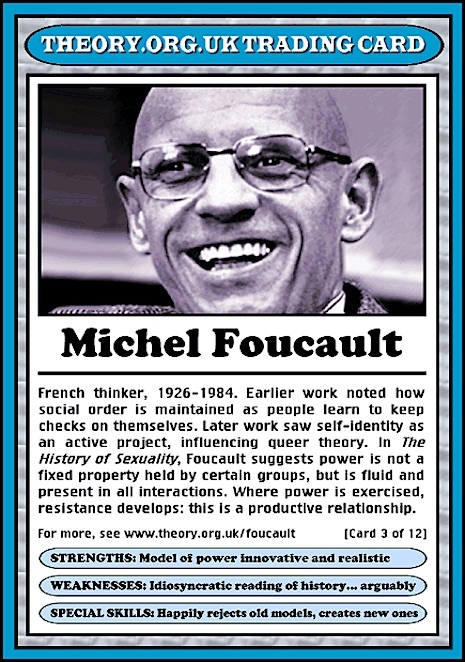
#3 Michel Foucault—French philosopher, theorist, philologist and literary critic.
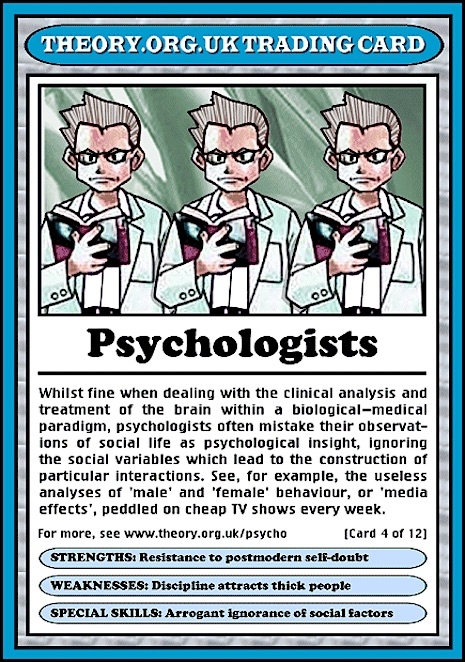
#4 Psychologists.

#5 Postmodernity.
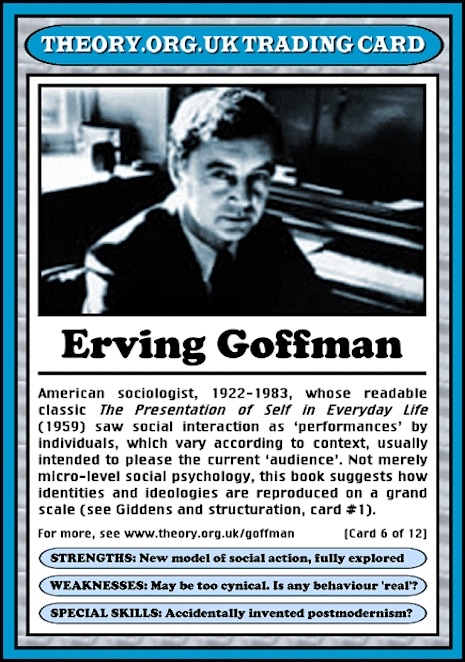
#6 Erving Gofffman—American/Canadian sociologist and writer.

#7 Theodor Ardorno—German philosopher, sociologist and composer.
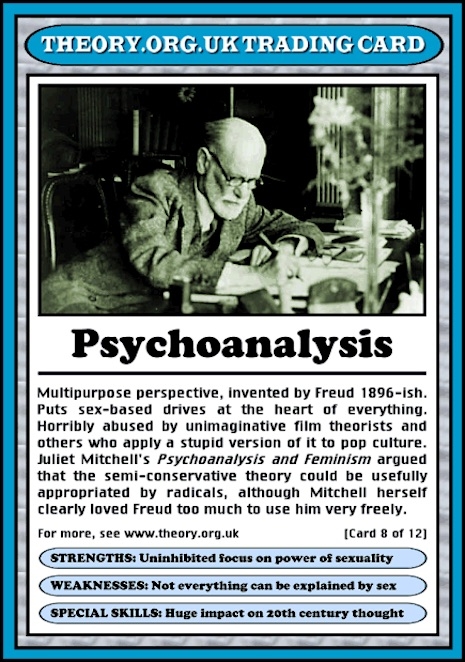
#8 Psychoanalysis.
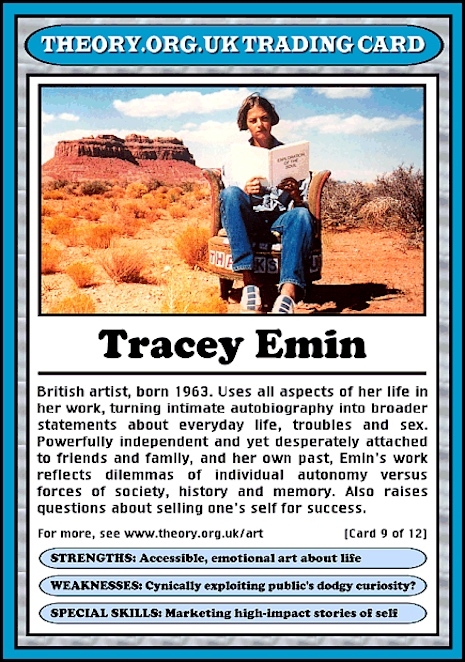
#9 Tracey Emin—British artist.

#10 Gilbert & George—Italian/British artists.
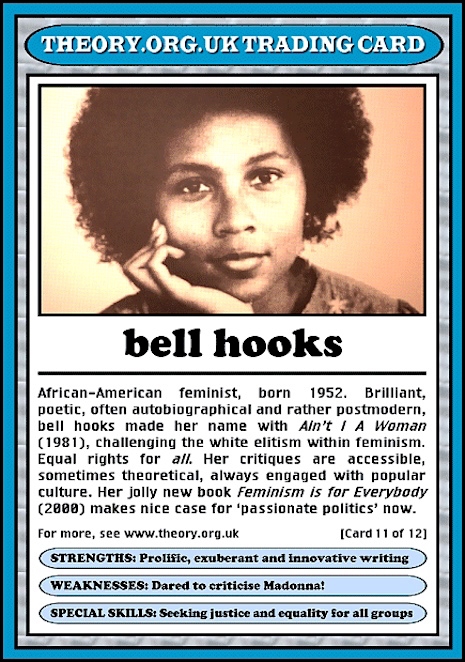
#11—bell hooks (aka Gloria Jean Watkins)—African-American author, feminist and social activist.
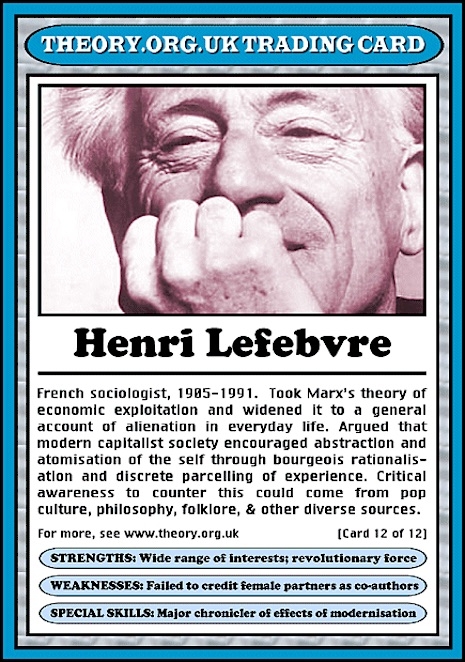
#13 Henri Lefebvre—Marxist philosopher and sociologist.

Unofficial Card #13: Edward Said—philosopher and writer. (Made by Jacob Ramsay of Australian National University to illustrate a lecture on Said.)
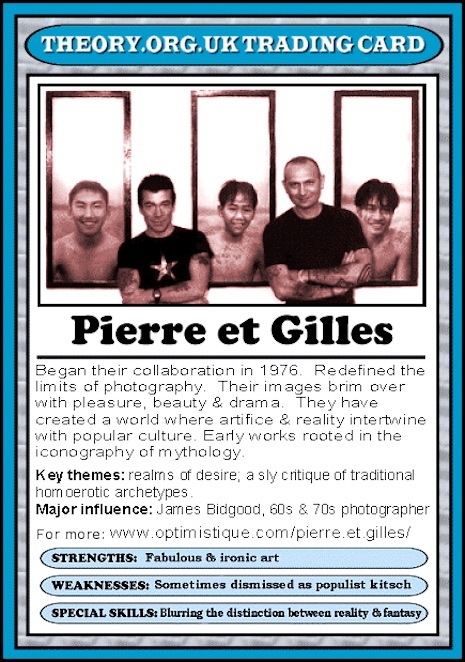
Unofficial Card #14: Pierre et Gilles—French artists/photographers. (Made by Yvonne Aburrow of the University of Bath.)
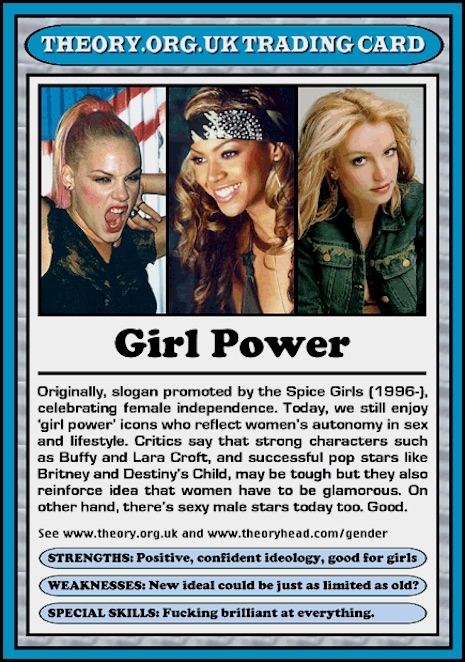
Unofficial Card #15: Girl Power. (Made by Sophie of Amsterdam.)
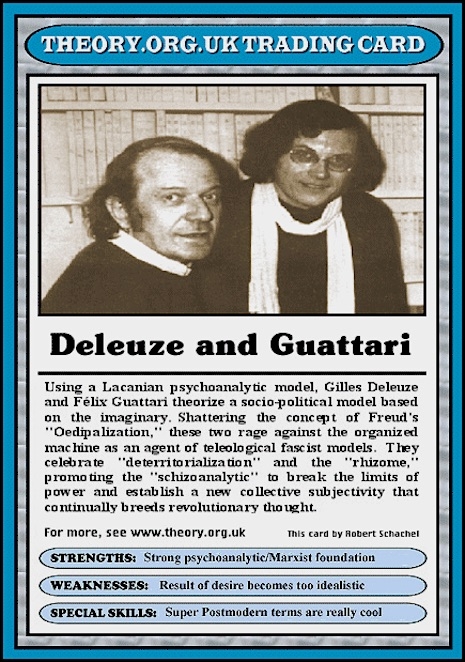
Unofficial Card #16: Deleuze and Guattari.—French philosopher and psychiatrist and social activist. (Made by Robert Schachel of University of Florida.)
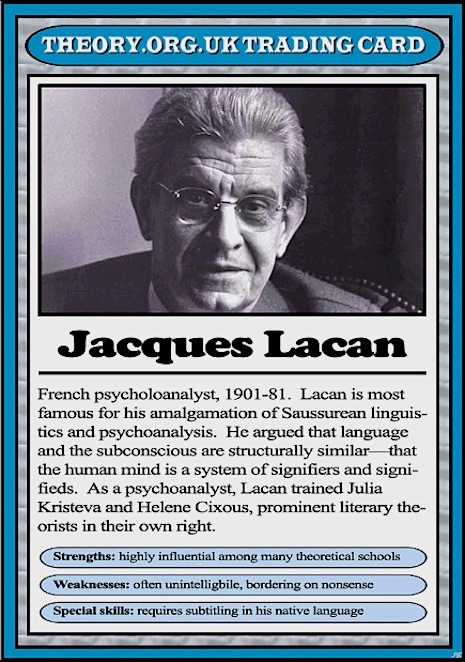
Unofficial Card #17: Jacques Lacan—French psychoanalyst and psychiatrist. (Made by Josh G in Providence, Rhode Island.)
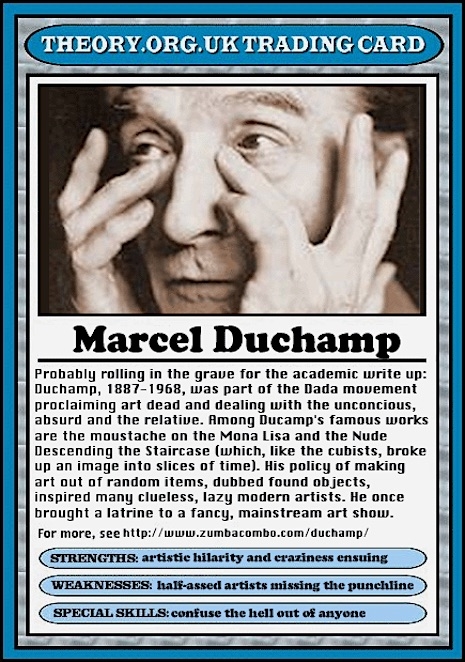
Unofficial Card #18: Marcel Duchamp—French-American artist. (Made by John Gehron.)
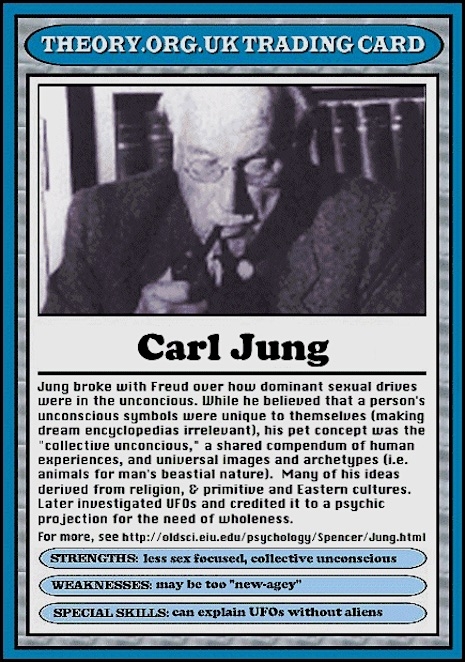
Unofficial Card #19: Carl Jung—Swiss psychiatrist and psychoanalyst. (Made by John Gehron.)

Unofficial Card #20: Simone de Beauvoir—French writer, existentialist philosopher, political activist, feminist and social theorist. Made by John Gehron.
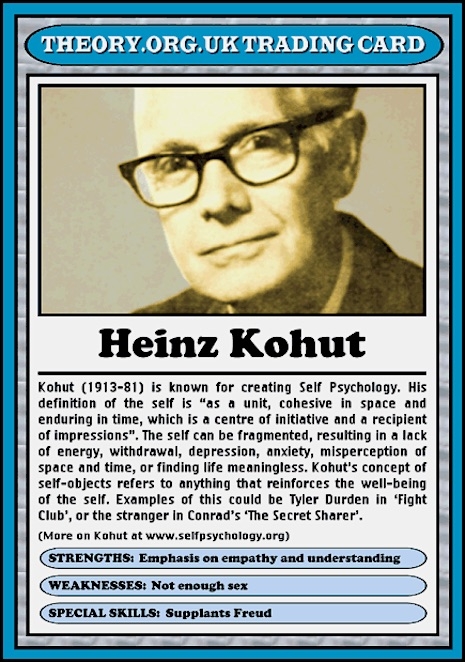
Unofficial Card #21: Heinz Kohut—Austrian-American psychoanalyst. (Made by John Gehron and Theory.org.)
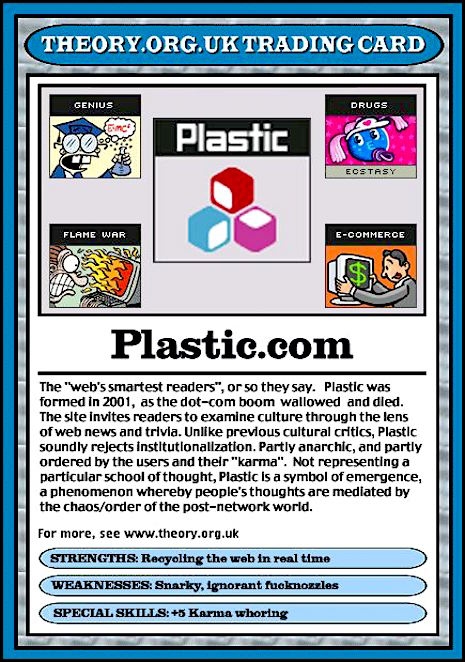
Unofficial Card #22: Plastic. (Made by ‘Snarkism’, Australia.)
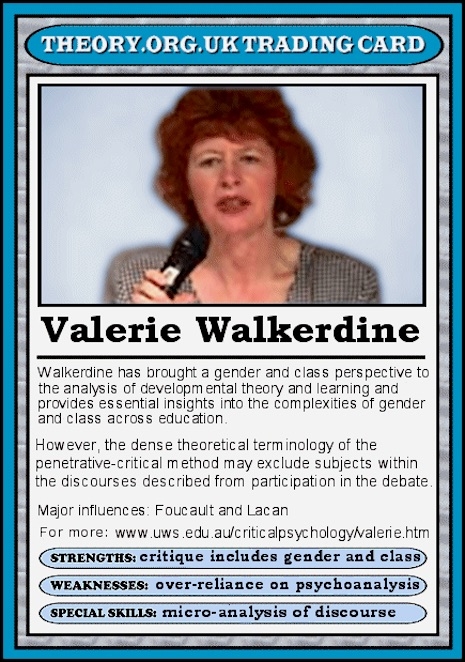
Unofficial Card #23: Valerie Walkerdine—gender theorist, social psychologist and writer. (Made by Yvonne Aburrow of the University of Bath.)

Unofficial Card #24: Ulrich Beck—German sociologist. (Made by Sophie of Amsterdam.)
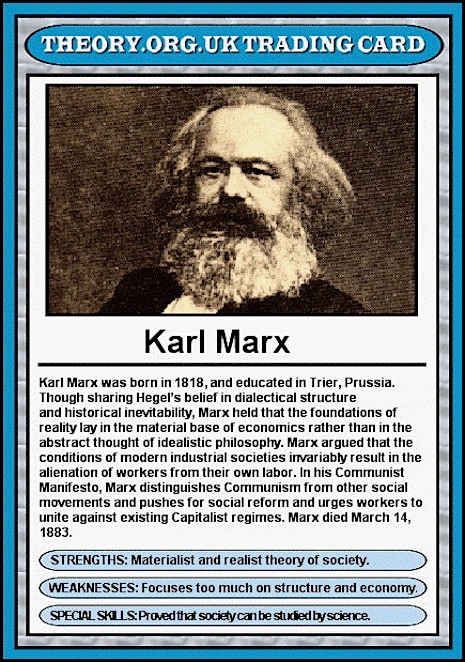
Unofficial Card #25: Karl Marx—German philosopher, economist, sociologist, journalist, and revolutionary socialist. (Made by Kevin Lande.)
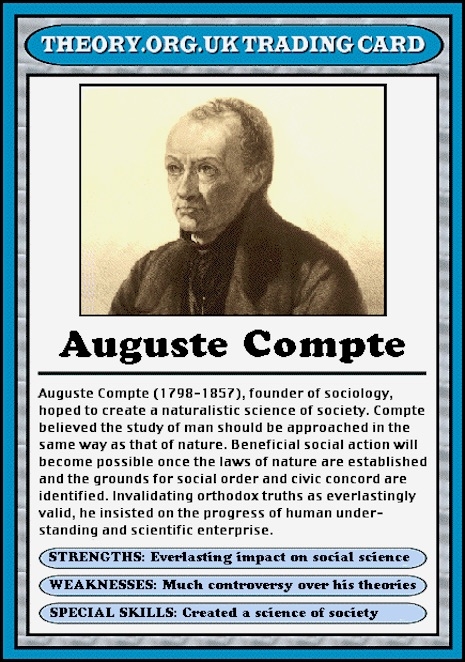
Unofficial Card #26: Auguste Comte—French philosopher and founder of sociology. (Made by Kevin Lande.)
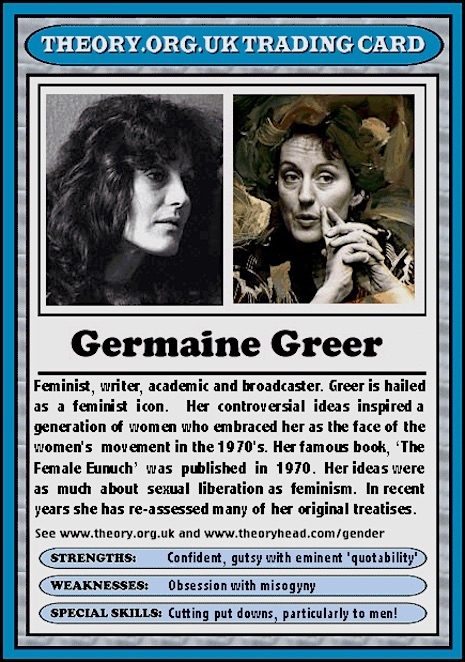
Unofficial Card #27: Germaine Greer—Australian writer and feminist. (Made by Kylie Robinson of Leeds, UK.)
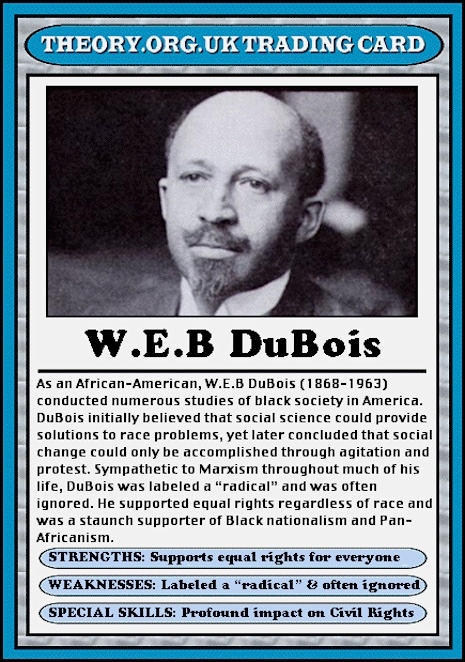
Unofficial Card #28: W. E. B. DuBois--American sociologist, historian, civil rights activist, Pan-Africanist, author, and editor. (Made by Kevin Lande.)
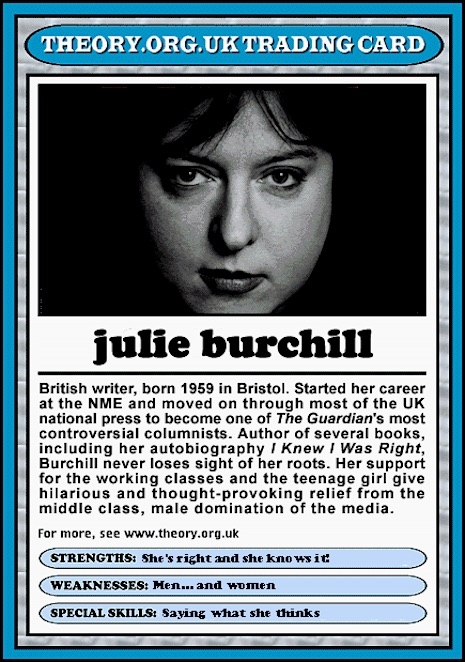
Unofficial Card #29: Julie Burchill—English writer and journalist. (Made by Tara Moneytooth.)
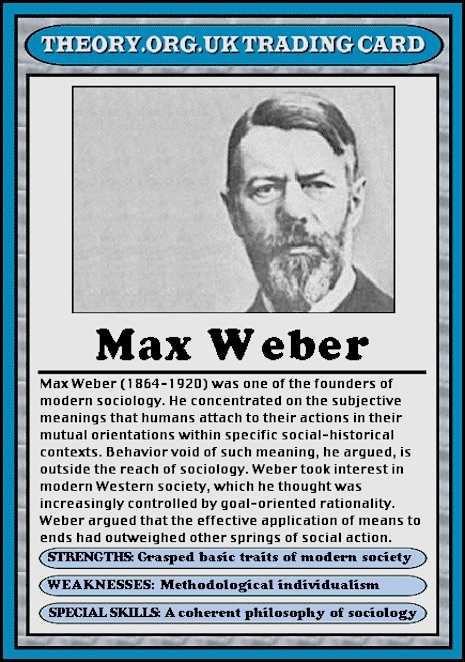
Unofficial Card #30: Max Weber—German sociologist, philosopher, jurist, and political economist. (Made by Kevin Lande.)

Unofficial Card #31: Walter Benjamin—German Jewish philosopher and cultural critic. (Made by Fabian Thomas.)
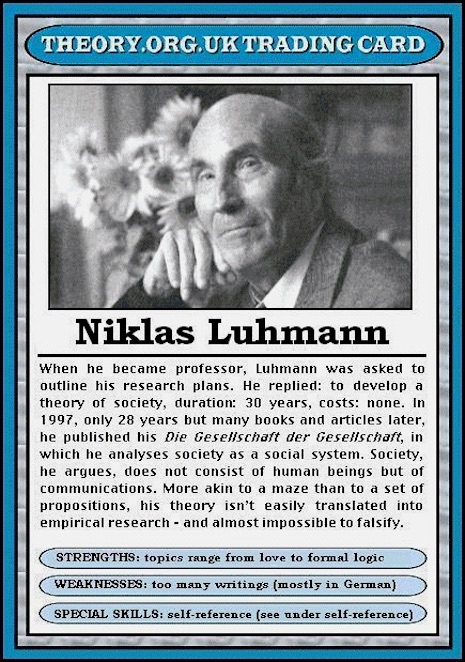
Unofficial Card #32: Niklas Luhmann—German sociologist and writer. (Made by Ludwig-Maximilians-Universität, München.)
Via Theory.org.
#1 Anthony Giddens—British social theorist.
#2 Judith Butler—American philosopher and gender theorist.
#3 Michel Foucault—French philosopher, theorist, philologist and literary critic.
#4 Psychologists.
#5 Postmodernity.
#6 Erving Gofffman—American/Canadian sociologist and writer.
#7 Theodor Ardorno—German philosopher, sociologist and composer.
#8 Psychoanalysis.
#9 Tracey Emin—British artist.
#10 Gilbert & George—Italian/British artists.
#11—bell hooks (aka Gloria Jean Watkins)—African-American author, feminist and social activist.
#13 Henri Lefebvre—Marxist philosopher and sociologist.
Unofficial Card #13: Edward Said—philosopher and writer. (Made by Jacob Ramsay of Australian National University to illustrate a lecture on Said.)
Unofficial Card #14: Pierre et Gilles—French artists/photographers. (Made by Yvonne Aburrow of the University of Bath.)
Unofficial Card #15: Girl Power. (Made by Sophie of Amsterdam.)
Unofficial Card #16: Deleuze and Guattari.—French philosopher and psychiatrist and social activist. (Made by Robert Schachel of University of Florida.)
Unofficial Card #17: Jacques Lacan—French psychoanalyst and psychiatrist. (Made by Josh G in Providence, Rhode Island.)
Unofficial Card #18: Marcel Duchamp—French-American artist. (Made by John Gehron.)
Unofficial Card #19: Carl Jung—Swiss psychiatrist and psychoanalyst. (Made by John Gehron.)
Unofficial Card #20: Simone de Beauvoir—French writer, existentialist philosopher, political activist, feminist and social theorist. Made by John Gehron.
Unofficial Card #21: Heinz Kohut—Austrian-American psychoanalyst. (Made by John Gehron and Theory.org.)
Unofficial Card #22: Plastic. (Made by ‘Snarkism’, Australia.)
Unofficial Card #23: Valerie Walkerdine—gender theorist, social psychologist and writer. (Made by Yvonne Aburrow of the University of Bath.)
Unofficial Card #24: Ulrich Beck—German sociologist. (Made by Sophie of Amsterdam.)
Unofficial Card #25: Karl Marx—German philosopher, economist, sociologist, journalist, and revolutionary socialist. (Made by Kevin Lande.)
Unofficial Card #26: Auguste Comte—French philosopher and founder of sociology. (Made by Kevin Lande.)
Unofficial Card #27: Germaine Greer—Australian writer and feminist. (Made by Kylie Robinson of Leeds, UK.)
Unofficial Card #28: W. E. B. DuBois--American sociologist, historian, civil rights activist, Pan-Africanist, author, and editor. (Made by Kevin Lande.)
Unofficial Card #29: Julie Burchill—English writer and journalist. (Made by Tara Moneytooth.)
Unofficial Card #30: Max Weber—German sociologist, philosopher, jurist, and political economist. (Made by Kevin Lande.)
Unofficial Card #31: Walter Benjamin—German Jewish philosopher and cultural critic. (Made by Fabian Thomas.)
Unofficial Card #32: Niklas Luhmann—German sociologist and writer. (Made by Ludwig-Maximilians-Universität, München.)
Via Theory.org.
Wednesday, December 9, 2015
How search engines make us feel smarter
than we really are.
from BoingBoing:


You’ve likely wondered if the internet is having a negative effect on your brain. Perhaps you’ve thought this after realizing the world wide web now serves as a trusty resource when gaps in your knowledge appear, and over time it, you’ve thought, maybe it might be making you less knowledgeable overall because you habitually head to Google if you don’t know the answers to something, search, click, read a few lines, and then promptly forget the factoid until the next time you need it.
Fearing that new technology will lead to lazy thinking is an old concern, one that goes back at least as far as Socrates who was certain that scrolls would make people dumb because they would grow to depend on “external written characters” instead of memorization. Just about every new technology and medium has been vilified at some point by that era’s luddites as finally being the end of deep thinking and the beginning of idiocracy. It never happens, of course, and I doubt it ever will.
The latest research suggest that though technology probably doesn’t make us stupid, it can, however, cause us to believe that we are smarter than we really are. Knowing you can search the internet is similar to knowing that you can consult a dictionary or a home encyclopedia or make a visit to the library when truly puzzled – but it’s different in that your brain, and the brains of every other cybercitizen, has become accustomed to the power to almost effortlessly reach into the internet and in a second or two bring back the info previously missing from your head, and you can do that mid-conversation, or while driving, or in the subway or on the couch or in line for a concert. That effortlessness and in-our-pockets availability seems to deeply affect how we categorize what is in our heads and what is not. When we consider all there is to know about a given subject, the convenience of search engines seems to blur the way we think about what we do and do not personally know about the world.
Matthew Fisher YaleAccording to the early studies of researcher Matthew Fisher, the side effect of a familiarity with search engines is an inflated sense of internal knowledge. Habitual googling leads us to mistakenly believe we know more than we actually do about any given subject – and here is the crazy part – that intuition persists even in moments in which we no longer have access to the internet. The more you use Google, it seems, the smarter you feel without it.
In this episode we explore what happens when a human mind becomes aware that it can instantly, on-command, at any time, search for an answer to any question, and then, most of time, find it.
After the interview, I discuss a new study that suggests having a Facebook account raises your cortisol levels way higher than normal, but interacting with Facebook in a positive way then lowers those levels to normal. Basically, it’s like smoking. It introduces a stressor that it then reduces. It’s the sickness AND the cure.
In every episode, after I read a bit of self delusion news, I taste a cookie baked from a recipe sent in by a listener/reader. That listener/reader wins a signed copy of my new book, “You Are Now Less Dumb,” and I post the recipe on the YANSS Pinterest page. This episode’s winner is Jon Edwards who submitted a recipe for metacookies, or cookies inside of cookies. Send your own recipes to david {at} youarenotsosmart.com.
Monday, June 1, 2015
Top 10 Common Faults In Human Thought
From The idealist Revolution:
The human mind is a wonderful thing. Cognition, the act or process of thinking, enables us to process vast amounts of information quickly. For example, every time your eyes are open, you brain is constantly being bombarded with stimuli. You may be consciously thinking about one specific thing, but you brain is processing thousands of subconscious ideas. Unfortunately, our cognition is not perfect, and there are certain judgment errors that we are prone to making, known in the field of psychology as cognitive biases. They happen to everybody regardless of age, gender, education, intelligence, or other factors. Some of them are well known, others not, but all of them are interesting. I am sure everyone will find that one has happened to them, (I myself have been prone to several) and now will recognize when they are making an error in the future.
10: Gambler’s Fallacy

The Gambler’s fallacy is the tendency to think that future probabilities are altered by past events, when in reality, they are not. Certain probabilities, such as getting a heads when you flip a (fair) coin, are always the same. The probability of getting a heads is 50%, it does not matter if you’ve gotten tails the last 10 flips. Thinking that the probabilities have changed is a common bias, especially when gambling. For example, I am playing roulette. The last four spins have landed on black, it has to be red this time right? Wrong! The probability of landing on red is still 47.37% (18 red spots divided by 38 total spots). This may sound obvious, but this bias has caused many a gambler to lose money thinking the probabilities have changed.
9: Reactivity

Reactivity is the tendency of people to act or appear differently when they know that they are being observed. In the 1920s, Hawthorne Works (a manufacturing facility) commissioned a study to see if different levels of light influenced worker productivity. What they found was incredible, changing the light caused productivity to soar! Unfortunately, when the study was finished, productivity levels decreased to their regular levels. This was because the change in productivity was not due to the light levels, but to the workers being watched. This demonstrated a form of reactivity; when individuals know they are being watched, they are motivated to change their behavior, generally to make themselves look better. Reactivity is a serious problem in research, and has to be controlled in blind experiments (“Blind” is when individuals involved in a research study are purposely withheld information so as not to influence the outcomes).
8: Pareidolia

Pareidolia is when random images or sounds are perceived as significant. Seeing clouds in the shapes of dinosaurs, Jesus on a hot pocket, or hearing messages when a record is played backward are common examples of pareidolia. The common element is that the stimulus is neutral, it does not have intentional meaning; the meaning is in the viewer’s perception.Interesting Fact: the Rorschach Inkblot test was developed to use pareidolia to tap into people’s mental states. Testees are shown images of ambiguous pictures, and asked to describe what they see. Responses are analyzed to discover the testee’s hidden thoughts.
7: Self-fulfilling Prophecy

Self-fulfilling prophecy is engaging in behaviors that obtain results that confirm existing attitudes. A self-fulfilling prophecy is a prediction that causes itself to become true. For example, I believe that I am going to do poorly in school, so I decrease the effort I put into my assignments and studying, and I end up doing poorly, just as I thought. Another common example is relationships; I think my relationship with my significant other is going to fail, so I start acting differently, pulling away emotionally. Because of my actions, I actually cause the relationship to fail. This is a powerful tool used by “psychics” – they implant an idea in your mind, and you eventually make it happen because you think it will.Interesting Fact: Economic Recessions are self-fulfilling prophecies. Because a recession is 2 quarters of Gross Domestic Product (GDP) decline, you cannot know you are in a recession until you are at least 6 months into one. Unfortunately, at the first sign of decreasing GDP, the media reports a possible recession, people panic and start a chain of events that actually cause a recession.
6: Halo effect

The Halo effect is the tendency for an individual’s positive or negative trait to “spill over” to other areas of their personality in others’ perceptions of them. This bias happens a lot in employee performance appraisals. For example: my employee, Biff, has been late to work the past three days; I notice this and conclude that Biff is lazy and does not care about his job. There are many possible reasons why Biff was late, perhaps his car broke down, his babysitter did not show up, or there has been bad weather. The problem is, because of one negative aspect that may be out of Biff’s control, I assume that he is a bad worker.Interesting Fact: The Physical Attractiveness Stereotype is when people assume that attractive individuals possess other socially desirable qualities, such as happiness, success and intelligence. This becomes a self-fulfilling prophecy when attractive people are given privileged treatment such as better job opportunities and higher salaries.
5: Herd Mentality

Herd mentality is the tendency to adopt the opinions and follow the behaviors of the majority to feel safer and to avoid conflict. Also known as “Mob Mentality,” this is, at its most common form, peer pressure. Herd mentality explains why fads get so popular. Clothes, cars, hobbies, styles, all it takes is a group of people who think something is cool, and it catches on.Interesting Fact: things that are unattractive, or that would never seem cool or popular now have had huge followings due to herd mentality. Examples include parachute pants, pet rocks, mullets, cone bras, tie-dye, sea monkeys, and the 1980s (by the way, that is an ’80s guy in the picture above).
4: Reactance

Reactance is the urge to do the opposite of what someone wants you to do out of a need to resist a perceived attempt to constrain your freedom of choice. This is common with rebellious teenagers, but any attempt to resist authority due to perceived threats to freedom and/or choice is reactance. The individual may not have a need to do the specific behavior, however the fact that they cannot do it makes them want to.Interesting Fact: “reverse psychology” is an attempt to influence people using reactance. Tell someone (particularly children) to do the opposite of what you really want, and they will rebel and actually end up doing what you want.
3: Hyperbolic Discounting

Hyperbolic discounting is the tendency for people to prefer a smaller, immediate payoff over a larger, delayed payoff. Much research has been done on decision-making, and many factors contribute to the individual decision making process. Interestingly, delay time is a big factor in choosing an alternative. Put simply, most people would choose to get 20 dollars today instead of getting 100 dollars one year from today. Normally it makes sense to choose a greater amount of money immediately than less in the future, as the value of a dollar is worth more today than it is tomorrow. Assume that the interest rate is 9%, at this interest rate, a rational person would be indifferent to taking $91.74 now, or $100 a year from now. However, it is interesting how much less we are willing to take immediately rather than wait, would you rather have $100 a year from now, or $50 immediately? How about $40 immediately? Where do you draw the line?
2: Escalation of Commitment

Escalation of commitment is the tendency for people to continue to support previously unsuccessful endeavors. With all the decisions people have to make, it is unavoidable that some will be unsuccessful. Of course, the logical thing to do in these instances is to change that decision or try to reverse it. However, sometimes individuals feel compelled not only to stick with their decision, but also to further invest in that decision because they have sunk costs. For example, say you use half of your life savings to start a business. After 6 months, it is evident that the business is going to be unsuccessful. The logical thing to do would be to “cut your losses” and drop the business. However, due to the sunk costs of your life savings, you feel committed to the business and invest even more money into the project hoping that the additional cash will turn the business around.
1: Placebo Effect

The Placebo effect is when an ineffectual substance that is believed to have healing properties produces the desired effect. Especially common with medications, the placebo effect has been observed when individuals given a sugar pill for a real ailment report improvement. Placebos are still a scientific mystery. It is theorized that placebos cause an “Expectancy Effect”, (In cases of uncertainty, expectation is what is most likely to happen) individuals expect the pills to cure their ailments, so they feel cured. However, this does not explain how the ineffectual pills actually cause a reduction in symptoms.
Interesting Fact: The term “Placebo” is used when the outcomes are considered favorable, when the outcomes are negative or harmful; the term is “Nocebo”
Subscribe to:
Posts (Atom)


