Showing posts with label 1960's. Show all posts

Saturday, February 18, 2017

GROOVY KIDS’ RECORD SET NURSERY RHYMES TO THE TUNES OF ‘60S TEEN DANCE CRAZES

from Dangerous Minds:


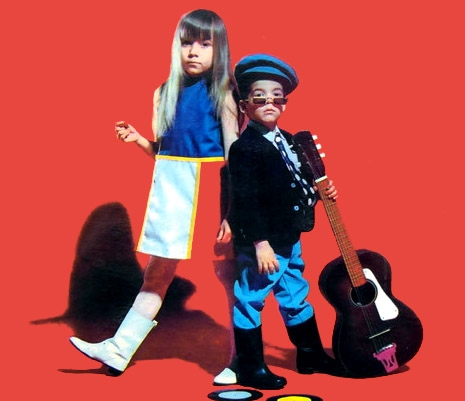
I have a feeling this album was approved for production based on the cover design alone, but it’s an amusing listen, too—in 1966, Happy Time Records (motto: “Hi-Fi for Small Fry”) released Kiddie Au Go-Go, an LP’s worth of “Nursery rhymes with the teen dance beat of today!”, boasting textbook greeting-card psych bubble lettering and a fabulous photo of a little girl in Mondrianesque mod-wear and a toddler boy dressed like his mom thought it’d be “darling” to send him out on Halloween as Quentin Crisp.
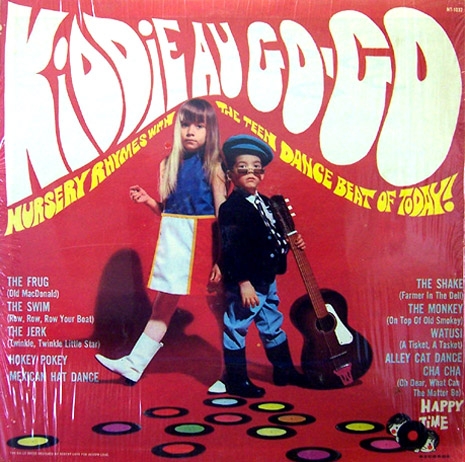

The U.S. Happy Time release, 1966
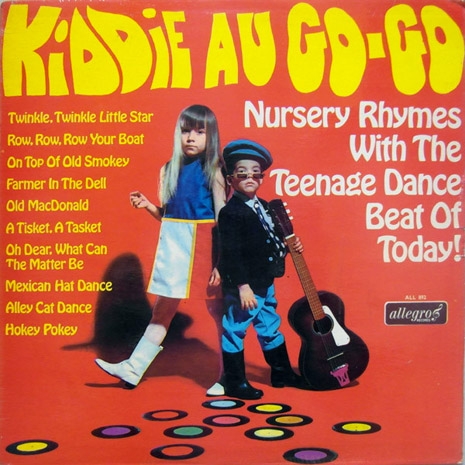

The UK Allegro Records version, also 1966


No damn clue whatsoever, International Award Series Records. This image comes from the Way Out Junk blog, which offers this commentary: “For kids in the sixties that wanted to be cool and parents who wanted to keep them tied to the children’s classics, here’s an album that probably didn’t make either group happy!”
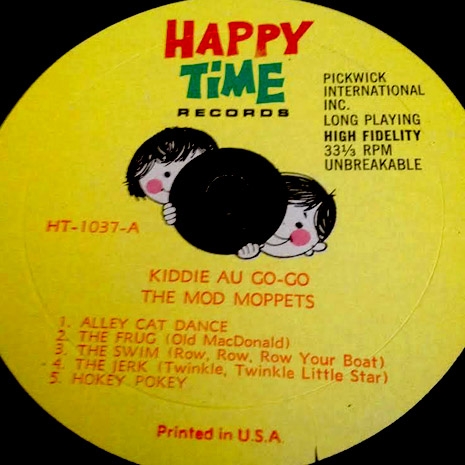

”33 1/3 RPM UNBREAKABLE.” This is my own copy, so we won’t be testing that claim.
As advertised, the album features nursery rhymes (some of them more like children’s folk songs, but that’s probably a petty quibble) set to music associated with the Frug, the Jerk, the Watusi, the Monkey… which is to say that they all sound pretty much like teenage garage bands playing “Twist and Shout” to me. Notably, Happy Time was a subsidiary of Pickwick Records, which really good weirdos will recognize as the label that gave Lou Reed a day job as a session guitarist and songwriter before the Velvet Underground made him notorious. The 1966 release date makes it entirely possible that this was in production during Reed’s two-year tenure at the label, but oh, dear reader, I hunted high and low for any evidence—even the merest suggestion—that Reed might have played on this album, but a lengthy rabbit-hole dive that ate up too much of a nice afternoon turned up zilch. The LP label itself names the band as “The Mod Moppets,” but no session information is forthcoming anywhere, and Discogs lists this as the only release by the anonymous “band.”
Someone really ought to steal that band name.


Monday, February 23, 2015

MAD magazine's most vicious advertising parodies, circa 1960

from Dangerous Minds


From 1957 to 2001, Mad magazine ran no outside ads—a highly noteworthy feat. Ideally, advertising income should finance 100% of a magazine’s operating costs, materials, payroll, profit, everything, leaving actual newsstand and subscription revenues as mere icing on the cake (that’s how alt weeklies can pull off free-of-charge distribution—well, that and criminally underpaying their art directors BUT I’M NOT BITTER). Mad‘s model was such a drastic inversion of the usual magazine industry business template that, off the top of my head, I can think of few other long-running rags to pull that off—Cooks Illustrated and Consumer Reports, both of which, if I recall correctly, survive on at least some institutional support, and the horrifying Reader’s Digest, which finally began taking ads in the ‘70s, probably realizing via the success of the era’s televangelists what a goldmine of suckers their elderly right-wing audience could be.

Mad‘s late founding publisher and giant among beautiful freaks William Gaines refused ads for so long because he felt it would compromise the publication’s satirical bent. In this amusing TV segment, Gaines spelled out his rejection of advertising bluntly and succinctly:

We don’t believe in merchandising. We make FUN of people who suck every last dime out of a product, and so we won’t do it.

It made sense—if for example Marlboro was paying the bills, writers might feel abashed to target Marlboro, and as it happens, Mad absolutely savaged the cigarette industry, even going so far, as you’ll see below, as to compare its death toll to Hitler’s. But so if all the revenue came from the readers alone, it was the readers alone who’d be served by the publication, and the writers and artists could freely satirize any entity they wanted to. And so they did—their advertising parodies are legendary, and a Flickr user by the handle of Jasperdo has amassed an excellent collection of them. Most of them are from the late ‘50s to mid-‘60s, coinciding with the advertising industry’s so-called “creative revolution,” so naturally they all appropriate the distinctive feel of that era.


Wednesday, November 19, 2014

Awesome woman performs bike tricks 20 years before BMX flatland-style, 1965

from Tara at Dangerous Minds:


Meet Japanese ballerina Lilly Yokoi. Here she is performing some amazing bike tricks on TV variety show The Hollywood Palace in 1965. The ABC program used a different host each week. Joan Crawford was the host on this show which aired on October 9, 1965.


Throughout the sixties and seventies Yokoi was considered the world’s greatest acrobat on a bicycle. She was known as “The Ballerina On The Golden Bicycle.”


I can’t find any information on Yokoi’s whereabouts today, but I believe she’s still alive. In any case, she’d give a lot of X Games competitors a run for their money. And mind you, she’s doing this in heels. Go Lilly!


via reddit

Friday, April 4, 2014

The Lost Art of Surf Movie Tickets

from Dangerous Minds:


Movie tickets are not something to which we give a lot of thought from an aesthetic point of view, and really why should we?  They exist to be torn in half within minutes of purchase. The generic, bluish, thermally printed and perfectly utilitarian stubs we’re used to today were preceded in my youth by the classic red “ADMIT ONE” tabs that did the job just fine in the days when most cinemas had only one or two theaters.


So it was a truly pleasant surprise to find The Gallery of Surf Classics’ trove of 1960s surf movie ticket stubs. Many are very plain, but some of the graphic tickets are marvelous. Now, apart from breakouts like Bruce Brown’s classic The Endless Summer, surf movies weren’t nearly as mainstream as the Frankie & Annette beach party movies that simplified the culture for America’s landlocked. (As a Cleveland kid and a great indoorsman who doesn’t doesn’t tend to much get hung up on the whole So-Cal vibe, movies formed the basis of my knowledge of surf culture, to which I’m a consummate outsider.) These were essentially niche sports documentaries that screened in high school auditoria and civic rec centers, so I find it pretty amazing that anyone would have taken the time and expense to craft such elaborate tickets for these films.


The Endless Summer, 1964


Walt Phillips’ Once Upon a Wave, 1963


Grant Rohloff’s Too Hot To Handle, 1963


Peter Clifton/DES Films’ A Fluid Journey, 1969


MacGillivray Freeman Films moved on from surfer flicks in the ‘60s and ‘70s to retool as an IMax production company, whose body of work includes the massive success Everest, but their Five Summer Stories is a surf genre classic.


Five Summer Stories, 1972


Free and Easy, 1967


The Sunshine Sea, 1970


A Cool Wave of Color, 1964


The following stubs are quite special—they’re designed by director/artist/surfer John Severson. Severson began filming surf documentaries in 1957, founded Surfer magazine in 1959, and remains to this day a gifted graphic artist celebrating surf. His block prints are especially awesome, but all his artwork is worth a peek.


Surf Fever, 1960


Big Wednesday, 1961, related only by title to the 1978 Jan-Michael Vincent/Gary Busey surf film.


Going My Wave, 1962


The Angry Sea, 1963


I could hardly show you surf movie ticket art without showing you a surf movie, right? Here’s a fantastic looking and sounding upload of the Citizen Kane of surf movies, The Endless Summer. The premise is tantalizingly wishful—if one had the time and resources, one could continually travel the globe so as to always be in a part of the world where it’s summertime, and thus live a life of neverending surfing. It’s all at once a helpful primer about surf culture basics (as of 1964), a fantastic travelogue, and a collection of beautiful footage.


Sunday, January 26, 2014

EYES ON THE PRIZE,
famed civil rights documentary series, is finally back!
HERE, and on DVD!

Eyes on the Prize is a famed documentary series on the civil rights movement that all but disappeared because of trouble clearing the copyrights to clips of leaders like Martin Luther King for the reissue. Nearly ten years ago, a civil disobedience campaign brought attention to society's loss as a result of this series no longer being available for home and classroom use, and the resulting furore brought the intransigent rightsholders back to the bargaining table, and this indispensable video back from the dead -- you can even buy it on DVD now.
Episode 1 (of 14)

This will be an ongoing Sunday series here on this blog - Thank You PBS!


I WILL POST A NEW EPISODE EVERY SUNDAY ...

This episode description:
Awakenings focuses on the catalytic events of 1954-1956. The Mississippi lynching of 14-year-old Emmett Till led to a widely publicized trial where a courageous black man took the stand and accused two white men of murder. In Montgomery, Alabama, Rosa Parks refused to yield her bus seat to a white man and triggered a yearlong boycott that resulted in the desegregation of public buses. Ordinary citizens and local leaders joined the black struggle for freedom. The Southern Christian Leadership Conference was formed. In response, may white southerners closed ranks in opposition to the burgeoning black rights movement. Racial discrimination finally became a political issue.

Heads up from Boing Boing, Thank You.

Thursday, July 25, 2013

THE MONKEES: Complete Un-Aired TV Pilot from 1965

from DangerousMinds
When series creators Bob Rafelson and Bert Schneider shot the un-aired 16mm pilot (something that would now probably be called a “sizzle reel” in show biz lingo) for The Monkees, the Pre-Fab Four weren’t even miming along to their own voices.

It starts off with some charming B&W screen test footage from Davy Jones and Michael Nesmith, then still going by his stage name “Michael Blessing” but credited here as Nesmith. (Micky Dolenz, however was called “Micky Braddock” then, as you can see above)

At 6:14, you can hear Boyce and Hart’s demo version of the show’s theme and a decidedly less colorful opening credit sequence. At 9:23, Boyce and Hart’s demo of “I Wanna Be Free” is heard while the group mime along. At 22:06 you see them and hear Boyce and Hart’s “Let’s Dance On” demo.

It’s (mildly, of course) jarring, to say nothing of the Monkeemobile being a broke-ass old station wagon…


In terms of the plot, it’s one of their typical, Davy with (literally) stars in his eyes over a girl story-lines. The pilot episode was remade properly for the NBC series (with the same pretty blonde actress for Davy to moon over) the following year as “Here Comes The Monkees,” episode #10. Again they used the B&W screen test footage, but at the end this time, and by then the group was at least miming along to their own voices.

Thursday, May 10, 2012

Skater Dater & The Devil's Toy
60's Classics!

In Honor of The Skateboarding Hall Of Fame Induction Ceremony This Evening:
Skaterdater is a short film that was released in 1965. It was Produced by Marshal Backlar, and written and directed by Noel Black and was the winner of the Palme d’Or for Best Short Film at the 1966 Cannes Film Festival. It was also nominated for an Academy Award in the Best Short Subject category. First prizes in international film festivals including Moscow and Venice.

The film tells a story with no dialogue. The surf rock-esque soundtrack was composed by Mike Curb and Nick Venet with Davie Allan and the Arrows playing “Skaterdater Rock” .
It was the first film on skateboarding. It was distributed theatrically, both domestically and internationally, by United Artists. It was reviewed extensively, including “Time Magazine”.

The skateboarders were members of the neighborhood Imperial Skateboard Club from Torrance, California. Their names are Gary Hill, Gregg Carrol, Mike Mel, Bill McKaig, Gary Jennings, Bruce McKaig and Rick Anderson. Most of the action shots were taken in Torrance, Redondo Beach, Palos Verdes Estates. The final shot was Averill Park in San Pedro.” Wikipedia.


and the Canadian classic,
The Devil's Toy
"dedicated to all victims of intolerance"

Sunday, April 8, 2012

Yellow Submarine Restoration +
Review for Your Sunday


From Richard Metzger over at DangerousMinds:

“Once upon a time…or maybe twice…there was an unearthly paradise called Pepperland…”

The Beatles’ classic 1968 animated feature film, Yellow Submarine, has been restored in 4K digital resolution for the first time by Paul Rutan Jr. and his team at Triage Motion Picture Services. No automated software was used in the clean-up of the film’s restored photochemical elements. This was a job painstakingly done by hand, a single frame at a time. The absolutely stunning Yellow Submarine restoration premiered last weekend at the SXSW festival and will be coming on Blu-Ray DVD at the end of May with a new 5.1 multi-channel audio soundtrack. Seeing the film unspool on the big screen of Austin’s historic Paramount Theatre was like watching a series of moving stained glass windows.

Directed by George Dunning, and written by Lee Minoff, Al Brodax, Jack Mendelsohn and future best-selling Love Story novelist Erich Segal, Yellow Submarine, based upon the song by John Lennon and Paul McCartney, is a basically incomprehensible series of musical vignettes, groan-worthy puns and lysergically-inspired kaleidoscopic eye-candy that sees John, Paul, George and Ringo saving the world from the evil Blue Meanies.

When Yellow Submarine originally premiered in 1968, the film was regarded as an artistic marvel. With its innovative animation techniques, it represented the most technologically advanced animation work since Disney’s masterpiece, Fantasia. Inspired by the Pop Art of Andy Warhol, Peter Max and Peter Blake, art director Heinz Edelmann’s work on Yellow Submarine is now considered among the classics of animated cinema. Yellow Submarine also showcases the creative work of animation directors Robert Balser and Jack Stokes along with a team of the best animators and technical artists that money could hire. The ground-breaking animation styles included 3-D sequences and the highly detailed “rotoscoping” (tracing film frame by frame) of the celebrated “Eleanor Rigby” sequence. The production process took nearly two years and employed 40 animators and 140 technical artists.

I must say, though, as happy as I was to be one of the first people to see the restored Yellow Submarine, I couldn’t help be to think that—with all of its merits—the film is just a little bit boring. If you responded negatively to the news of the (now shelved) Yellow Submarine 3-D remake, consider that not only did the Fab Four have precious little to do with the actual making of the original film (it’s not even their own voices) but that today’s kids—your kids—won’t have the patience to sit through it. Nor will they even understand what’s being said onscreen. Yellow Submarine, I hate to say it, was ripe for a remake. Sacrilege, I know, but it’s not like I’m suggesting that they remake A Hard Day’s Night or anything!

Below, a decidedly low res version of Yellow Submarine in its entirety. This isn’t really the way to watch it, of course…


Now fact is I disagree with Richard on the point of " today’s kids—your kids—won’t have the patience to sit through it." because in fact my four and a half year old was fascinated by it! And of course loves all the music. But Richard doesn't have kids yet so you can't really blame him for assuming, or maybe my boy really is a genius ;-)

Now here's another angle from another Dangerous Minds contributor:
PREVIEW OF THE BEAUTIFULLY RESTORED ‘YELLOW SUBMARINE"

Here’s the trailer for the newly restored Yellow Submarine.

The digital clean-up of the film’s photochemical elements was lovingly done entirely by hand, frame by frame. Having seen the world premiere of the restored version at this year’s SXSW, I can attest to its eye-searing intensity and lysergic beauty. While the story obviously remains the same, rather thin with a script comprised of surreal non sequiturs and bad puns, the overall experience of watching the film in a pristine digital format overwhelms the narrative with colors and artwork so you rich you can practically taste it. And the stereo soundtrack sounded wonderful.

Coming out on Blu-Ray and DVD on May 29 with 5.1 surround sound. Expect to be astonished.


Mod Odyssey is a groovy short documentary on the creation of Yellow Submarine. Enjoy.


Saturday, December 11, 2010

'The Jungle': Philadelphia's Mean Streets (1967)

from DangerousMinds

Directed, written and acted by teenagers Charlie Davis, David Williams and Jimmy Robinson, 1967’s The Jungle chronicles the exploits of Philadelphia’s 12th and Oxford street gang. It is amateur film making that transcends its limitations and achieves a certain rough artfulness.

With its starkly poetic black and white cinematography, urban rhythm and streetwise jargon The Jungle recalls Shirley Clarke’s The Cool World and the Beat-era improvs of Cassavetes’ Shadows. The fact that theThe Jungle holds its own against some of the sixties more legendary indie films makes it somewhat disappointing that none of the people involved with the production of the film went on to make more movies.

There’s little info on the internet regarding The Jungle, but the I found the following comment from Youtube compelling:
This film (The Jungle) was shown along with slide shows of dead teens on slabs in the 70’s in schools around Philly to try to stop the gang violence at that time. In the early ‘70s, Philly led the nation in gang-related deaths at around 40 a year.
Death Row inmate, Philly gang member and writer Reginald S. Lewis recalls the Oxford Street gangs:
I saw the 70’s usher in the era of blackploitation flicks such as Superfly, The Mack, Come Back, Charleston Blue, and even slickly packaged Hollywood gangster movies like The Godfather. This was also an era that bred hustlers-turned-authors IceBerg Slim and Donald Goines, and some of the most ruthless true-life gangsters this country has ever seen.

In my hometown, Philadelphia, Pennsylvania, vicious black street gangs seemingly ruled every inch of the black community, and it was a dangerous time to be a young black teenager living in the treacherous terrain of the urban wilds. My parents did all they could to keep my two older brothers and me from being drafted into the notorious “12th & Oxford Street Gang,” one of the largest, fiercest black youth gangs in the history of Philadelphia.

The Oxford Street gang had well over 500 members, divided into gradations and ranks, according to age. There were the “Pee Wees,” “The Midgets,” “The Juniors,” and “The Seniors,” and “The Old Heads.” There was also 8th & Oxford, 15 & Oxford, and “Uptown Oxford Street,” which was 20th Street, and beyond. These divisions boosted the ranks into thousands.”
Teenage wasteland, Philly-style.


Wednesday, August 4, 2010

"A Whole Scene Going"
Incredible rare TV show from 1965

This is a super rare pilot of A Whole Scene Going, a show for teens that aired on British tv in 1965. This episode features fashion predictions for 1966, advice for young lovers from Lulu, a segment on the up and coming skateboard craze, footage of The Who, and an interview with a very cynical, sarcastic and witty Pete Townshend, pretty heavy actually.


thanks, Mark Campbell, via Dangerous Minds