Greatest Hip-Hop Album of All Time


In both music and manner, Quincy Jones has always registered — from afar, anyway — as smooth, sophisticated, and impeccably well-connected. (That’s what earning 28 Grammy awards and co-producing Michael Jackson’s biggest-selling albums will do.) But in person, the 84-year-old music-industry macher is far spikier and more complicated. “All I’ve ever done is tell the truth,” says Jones, seated on a couch in his palatial Bel Air home, and about to dish some outrageous gossip. “I’ve got nothing to be scared of, man.”
Currently in the midst of an extended victory lap ahead of his turning 85 in March — a Netflix documentary and a CBS special hosted by Oprah Winfrey are on the horizon — Jones, dressed in a loose sweater, dark slacks, and a jaunty scarf, talks like he has nothing to lose. He name-drops, he scolds, he praises, and he tells (and retells) stories about his very famous friends. Even when his words are harsh, he says them with an enveloping charm, frequently leaning over for fist bumps and to tap me on the knee. “The experiences I’ve had!” he says, shaking his head in wonder. “You almost can’t believe it.”
You worked with Michael Jackson more than anyone he wasn’t related to. What’s something people don’t understand about him?
I hate to get into this publicly, but Michael stole a lot of stuff. He stole a lot of songs. [Donna Summer’s] “State of IndependenceOriginally written by Vangelis and longtime Yes front man Jon Anderson, “State of Independence” was recorded by Donna Summer in 1982. Jones produced Summer’s version, Michael Jackson helped out on backing vocals, and the song’s central riff does sound awfully similar (albeit faster) to the iconic bass riff on Jackson’s hit single “Billie Jean.” It should also be noted that, last year, Jones won a lawsuit over a royalties dispute against Jackson’s estate. ” and “Billie Jean.” The notes don’t lie, man. He was as Machiavellian as they come.
How so?
Greedy, man. Greedy. “Don’t Stop ’Til You Get Enough” — Greg Phillinganes wrote the c sectionPhillinganes, an in-demand studio keyboardist, played on a handful of Jackson-Jones collaborations, including the 1979 album Off the Wall, from which “Don’t Stop ‘Til You Get Enough” comes. . Michael should’ve given him 10 percent of the song. Wouldn’t do it.
What about outside of music? What’s misunderstood about Michael?
I used to kill him about the plastic surgery, man. He’d always justify it and say it was because of some disease he had. Bullshit.
How much were his problems wrapped up with fame?
You mean with the way he looked? He had a problem with his looks because his father told him he was ugly and abused himJackson described being abused by his father Joe in a 1993 interview with Oprah, as well as in a 2003 interview with Martin Bashir. “It was really bad,” he recalled during the latter. . What do you expect?
It’s such a strange juxtaposition — how Michael’s music was so joyous, but his life just seems sadder and more odd as time goes by.
Yes, but at the end Michael’s problem was PropofolIn 2009, not long after Jackson’s death, the Los Angeles County coroner announced that the singer’s death was caused by “acute propofol intoxication.” Jackson’s doctor, Conrad Murray, had been prescribing the powerful sedative, which Jackson called his “milk,” to help with the singer’s insomnia. In 2011, Murray was found guilty of involuntary manslaughter in Jackson’s death. , and that problem affects everyone — doesn’t matter if you’re famous. Big Pharma making OxyContin and all that shit is a serious thing. I was around the White House for eight years with the Clintons, and I’d learn about how much influence Big Pharma has. It’s no joke. What’s your sign, man?
Pisces.
Me too. It’s a great sign.
You just mentioned the Clintons, who are friends of yours. Why is there still such visceral dislike of them? What are other people not seeing in Hillary, for example, that you see?
It’s because there’s a side of her — when you keep secrets, they backfire.
Like what secrets?
This is something else I shouldn’t be talking about.
You sure seem to know a lot.
I know too much, man.
What’s something you wish you didn’t know?
Who killed Kennedy.
Who did it?
[Chicago mobster Sam] GiancanaChicago gangster Sam Giancana is a well-known name among Kennedy conspiracists, both for his alleged help in delivering Illinois votes for Kennedy in the 1960 presidential election and the 1963 assassination of the president. The latter theory largely stems from Giancana’s murder in 1975, not long before he was supposed to testify before a Senate committee investigating collusion between the mob and the CIA. . The connection was there between Sinatra and the Mafia and Kennedy. Joe Kennedy — he was a bad man — he came to Frank to have him talk to Giancana about getting votes.
I’ve heard this theory before, that the mob helped win Illinois for Kennedy in 1960.
We shouldn’t talk about this publicly. Where you from?
Toronto.
I was at the Massey Hall showIn May 1953, jazz geniuses Charlie Parker, Bud Powell, Charles Mingus, Max Roach, and Dizzy Gillespie were recorded — for the first and last time — together in concert at Toronto’s Massey Hall. The resulting live album, Jazz at Massey Hall, is rightly considered a classic. .
Really? The Charlie Parker concert with Mingus and those guys?
Yeah, man. I saw the contract after. The whole band made $1,100. I’ll never forget that. At the time it was just another gig. It wasn’t historical. Like with Woodstock, Tito Puente told me he wanted to go out to that gig. Those festivals ain’t my thing. Elon Musk keeps trying to get me to go to Burning Man. No thank you. But who knew what Woodstock would turn out to be? Jimi Hendrix was out there fucking up the national anthem.
Wasn’t Hendrix supposed to play on Gula Matari?
He was supposed to play on my albumApparently, Hendrix was supposed to lend guitar work to Jones’s 1970 album Gula Matari, which arrived at a time when the guitarist was expanding his musical vocabulary beyond rock and blues and into jazz and funk. Sadly, he didn’t get far, dying of asphyxiation in September of that same year. and he chickened out. He was nervous to play with Toots Thielemans, Herbie Hancock, Hubert Laws, Roland Kirk — those are some scary motherfuckers. Toots was one of the greatest soloists that ever fucking lived. The cats on my records were the baddest cats in the world and Hendrix didn’t want to play with them.
What’d you think when you first heard rock music?
Rock ain’t nothing but a white version of rhythm and blues, motherfucker. You know, I met Paul McCartney when he was 21.
What were your first impressions of the Beatles?
That they were the worst musicians in the world. They were no-playing motherfuckers. Paul was the worst bass player I ever heard. And Ringo? Don’t even talk about it. I remember once we were in the studio with George Martin, and RingoJones arranged a version of “Love Is a Many-Splendored Thing” for Starr’s 1970 solo debut album Sentimental Journey, which was produced by the Beatles’ frequent collaborator George Martin. The song, and album, are more than a bit gloopy. had taken three hours for a four-bar thing he was trying to fix on a song. He couldn’t get it. We said, “Mate, why don’t you get some lager and lime, some shepherd’s pie, and take an hour-and-a-half and relax a little bit.” So he did, and we called Ronnie Verrell, a jazz drummer. Ronnie came in for 15 minutes and tore it up. Ringo comes back and says, “George, can you play it back for me one more time?” So George did, and Ringo says, “That didn’t sound so bad.” And I said, “Yeah, motherfucker because it ain’t you.” Great guy, though.
Were there any rock musicians you thought were good?
I used to like Clapton’s band. What were they called?
Cream.
Yeah, they could play. But you know who sings and plays just like Hendrix?
Who?
Paul AllenThe Microsoft co-founder and multibillionaire has a collection of yachts and guitars to rival the world’s finest, both of which he apparently makes good use of. .
Stop it. The Microsoft guy?
Yeah, man. I went on a trip on his yacht, and he had David Crosby, Joe Walsh, Sean Lennon — all those crazy motherfuckers. Then on the last two days, Stevie Wonder came on with his band and made Paul come up and play with him — he’s good, man.
You hang out in these elite social circles and doing good has always been important to you, but are you seeing as much concern for the poor as you’d like from the ultrarich?
No. The rich aren’t doing enough. They don’t fucking care. I came from the street, and I care about these kids who don’t have enough because I feel I’m one of ’em. These other people don’t know what it feels like to be poor, so they don’t care.
Are we in a better place as a country than we were when you started doing humanitarian work 50 years ago?
No. We’re the worst we’ve ever been, but that’s why we’re seeing people try and fix it. Feminism: Women are saying they’re not going to take it anymore. Racism: People are fighting it. God is pushing the bad in our face to make people fight back.
We’ve obviously been learning more lately about just how corrosive the entertainment industry can be for women. As someone who’s worked in that business at the highest levels for so many years, do all the recent revelations come as a surprise?
No, man. Women had to put up with fucked-up shit. Women and brothers — we’re both dealing with the glass ceiling.
But what about the alleged behavior of a friend of yours like Bill Cosby? Is it hard to square what he’s been accused of with the person you know?
It was all of them. Brett Ratner. [Harvey] Weinstein. Weinstein — he’s a jive motherfucker. Wouldn’t return my five calls. A bully.
What about Cosby, though?
What about it?
Were the allegations a surprise to you?
We can’t talk about this in public, man.
I’m sorry to jump around —
Be a Pisces. Jam.
If you could snap your fingers and fix one problem in the country, what would it be?
Racism. I’ve been watching it a long time — the ’30s to now. We’ve come a long way but we’ve got a long way to go. The South has always been fucked up, but you know where you stand. The racism in the North is disguised. You never know where you stand. That’s why what’s happening now is good, because people are saying they are racists who didn’t used to say it. Now we know.
What’s stirred everything up? Is it all about Trumpism?
It’s Trump and uneducated rednecks. Trump is just telling them what they want to hear. I used to hang out with him. He’s a crazy motherfucker. Limited mentally — a megalomaniac, narcissistic. I can’t stand him. I used to date Ivanka, you know.
Wait, really?
Yes, sir. Twelve years ago. Tommy Hilfiger, who was working with my daughter KidadaA former model and current designer, Kidada is the daughter of Jones and his ex-wife Peggy Lipton. Jones’s other daughter with Lipton is the actress Rashida Jones. Jones has five other children, with four other women. , said, “Ivanka wants to have dinner with you.” I said, “No problem. She’s a fine motherfucker.” She had the most beautiful legs I ever saw in my life. Wrong father, though.
Would your friend Oprah be a good president?
I don’t think she should run. She doesn’t have the chops for it. If you haven’t been governor of a state or the CEO of a company or a military general, you don’t know how to lead people.
She is the CEO of a company.
A symphony conductor knows more about how to lead than most businesspeople — more than Trump does. He doesn’t know shit. Someone who knows about real leadership wouldn’t have as many people against him as he does. He’s a fucking idiot.
Is Hollywood as bad with race as the rest of the country? I know that when you started scoring films, you’d hear producers say things like they didn’t want a “bluesy” score, which was clearly code-speak. Are you still encountering that kind of racism?
It’s still fucked up. 1964, when I was in Vegas, there were places I wasn’t supposed to go because I was black, but Frank [Sinatra] fixed that for me. It takes individual efforts like that to change things. It takes white people to say to other white people, “Do you really want to live as a racist? Is that really what you believe?” But every place is different. When I go to Dublin, Bono makes me stay at his castle because Ireland is so racist. Bono’s my brother, man. He named his son after me.
Is U2 still making good music?
[Shakes head.]
Why not?
I don’t know. I love Bono with all my heart, but there’s too much pressure on the band. He’s doing good work all over the world. Working with him and Bob Geldof on debt reliefJones has a truly admirable record of humanitarian and philanthropic work, going back to his support of Dr. Martin Luther King in the early 1960s. In 1999, Jones, U2 lead singer Bono, and musician-activist Bob Geldof (who spearheaded 1985’s Live Aid charity concerts), traveled to the Vatican to meet with Pope John Paul II, hoping to gain his support in their effort to reduce third-world debt. was one of the greatest things I ever did. It’s up there with “We Are the WorldA charity single written by Lionel Richie and Michael Jackson and co-produced by Quincy Jones, “We Are the World” featured a who’s who of 1980s American pop and rock stars, a collection dubbed USA for Africa. .”
There’s a small anecdote in your memoir about how the rock musicians who’d been asked to sing on “We Are the World” were griping about the song. Is there more to that story?
It wasn’t the rockers. It was Cyndi Lauper. She had a manager come over to me and say, “The rockers don’t like the song.” I know how that shit works. We went to see Springsteen, Hall & Oates, Billy Joel, and all those cats and they said, “We love the song.” So I said [to Lauper], “Okay, you can just get your shit over with and leave.” And she was fucking up every take because her necklace or bracelet was rattling in the microphone. It was just her that had a problem.
What’s something you’ve worked on that should’ve been bigger?
What the fuck are you talking about? I’ve never had that problem. They were all big.
How about a musician who deserved more acclaim?
Come on, man. The Brothers Johnson. James Ingram. Tevin Campbell. Every one of them went straight through the roof.
From a strictly musical perspective, what have you done that you’re most proud of?
That anything I can feel, I can notate musically. Not many people can do that. I can make a band play like a singer sings. That’s what arranging is, and it’s a great gift. I wouldn’t trade it for shit.
A few years back there was a quote you supposedly gave — I couldn’t find the source of it, so maybe it’s apocryphal — where you dismissed rap as being a bunch of four-bar loops. Is that an opinion you stand by?
That’s true about rap, that it’s the same phrase over and over and over again. The ear has to have the melody groomed for it; you have to keep the ear candy going because the mind turns off when the music doesn’t change. Music is strange that way. You’ve got to keep the ear busy.
Is there an example from the work you did, maybe with Michael, which illustrates what you’re talking about?
Yeah, the best example of me trying to feed the musical principles of the past — I’m talking about bebop — is “Baby Be Mine.” [Hums the song’s melody.] That’s Coltrane done in a pop song. Getting the young kids to hear bebop is what I’m talking about. Jazz is at the top of the hierarchy of music because the musicians learned everything they could about music. Every time I used to see Coltrane he’d have Nicolas Slonimsky’s book.
Yeah, he was famously obsessed with the Thesaurus of Scales and Melodic Patterns. That’s the one you’re talking about, right?
That’s right. You’re bringing up all the good subjects now! Everything that Coltrane ever played was in that thesaurus. In fact, right near the front of that book, there’s a 12-tone example — it’s “Giant Steps.” Everyone thinks Coltrane wrote that, he didn’t. It’s Slonimsky. That book started all the jazz guys improvising in 12-tone. Coltrane carried that book around till the pages fell off.
When Coltrane started to go far out with the music —
“Giant Steps.”
Even further out, though, like on Ascension —
You can’t get further out than 12-tone, and “Giant Steps” is 12-tone.
But when he was playing atonally —
No, no, no. Even that was heavily influenced by Alban Berg — that’s as far out as you can get.
Do you hear the spirit of jazz in pop today?
No. People gave it up to chase money. When you go after Cîroc vodka and Phat FarmCîroc is the alcohol brand owned by Diddy. Phat Farm was the fashion label founded by hip-hop impresario Russell Simmons in 1992. Simmons sold the company in 2004. and all that shit, God walks out of the room. I have never in my life made music for money or fame. Not even ThrillerJones may not have worked on Thriller for money, but co-producing the album (with Jackson) presumably made him a ton of it: The 1982 album is widely reported to be the biggest-selling LP of all time, having sold somewhere north of 66 million copies. . No way. God walks out of the room when you’re thinking about money. You could spend a million dollars on a piano part and it won’t make you a million dollars back. That’s just not how it works.
Is there innovation happening in modern pop music?
Hell no. It’s just loops, beats, rhymes and hooks. What is there for me to learn from that? There ain’t no fucking songs. The song is the power; the singer is the messenger. The greatest singer in the world cannot save a bad song. I learned that 50 years ago, and it’s the single greatest lesson I ever learned as a producer. If you don’t have a great song, it doesn’t matter what else you put around it.
What was your greatest musical innovation?
Everything I’ve done.
Everything you’ve done was innovative?
Everything was something to be proud of — absolutely. It’s been an amazing contrast of genres. Since I was very young, I’ve played all kinds of music: bar mitzvah music, Sousa marches, strip-club music, jazz, pop. Everything. I didn’t have to learn a thing to do Michael Jackson.
What would account for the songs being less good than they used to be?
The mentality of the people making the music. Producers now are ignoring all the musical principles of the previous generations. It’s a joke. That’s not the way it works: You’re supposed to use everything from the past. If you know where you come from, it’s easier to get where you’re going. You need to understand music to touch people and become the soundtrack to their lives. Can I tell you one of the greatest moments in my life?
Of course.
It was the first time they celebrated Dr. King’s birthday in Washington, D.C., and Stevie Wonder was in charge and asked me to be musical director. After the performance, we went to a reception, and three ladies came over: The older lady had Sinatra at the Sands, I arranged that; her daughter had my album The Dude; and then that lady’s daughter had Thriller. Three generations of women said those were their favorite records. That touched me so much.
How Stevie Wonder Helped Make MLK Day A National Holiday
I’m trying to isolate what you specifically believe the problem with modern pop is. It’s the lack of formal musical knowledge on the part of the musicians?
Yes! And they don’t even care they don’t have it.
Well, who’s doing good work?
Bruno Mars. Chance the Rapper. Kendrick Lamar. I like where Kendrick’s mind is. He’s grounded. Chance, too. And the Ed Sheeran record is great. Sam Smith — he’s so open about being gay. I love it. Mark Ronson is someone who knows how to produce.
Putting aside the quality of contemporary songs, are there any technical or sonic production techniques that feel fresh?
No. There ain’t nothing new. The producers are lazy and greedy.
How does that laziness manifest itself?
Listen to the music — these guys don’t know what they’re doing. You’ve got to respect the gift God gave you by learning your craft.
Are you as down on the state of film scoring as you are on pop?
It’s not good. Everybody’s lazy. Alexandre DesplatThe French film composer won an Oscar for his score for 2015’s The Grand Budapest Hotel and his been nominated an additional eight times. — he’s good. He’s my brother. He was influenced by my scores.
Again, when you say film composers are lazy, what does that mean, exactly, in this context?
It means they’re not going back and listening to what Bernard Herrmann did.
Do you see a future for the music business?
There isn’t a music business anymore! If these people had paid attention to Shawn Fanning 20 years ago, we wouldn’t be in this mess. But the music business is still too full of these old-school bean counters. You can’t be like that. You can’t be one of these back-in-my-day people.
You’re talking about business not music, but, and I mean this respectfully, don’t some of your thoughts about music fall under the category of “back in my day”?
Musical principles exist, man. Musicians today can’t go all the way with the music because they haven’t done their homework with the left brain. Music is emotion and science. You don’t have to practice emotion because that comes naturally. Technique is different. If you can’t get your finger between three and four and seven and eight on a piano, you can’t play. You can only get so far without technique. People limit themselves musically, man. Do these musicians know tango? Macumba? Yoruba music? Samba? Bossa nova? Salsa? Cha-cha?
Maybe not the cha-cha.
[Marlon] BrandoThe actor and Jones were longtime friends. During a down period in Jones’s life, he spent time on the island in Tahiti which Brando owned. The two called each other Leroy, owing to a story recounted extremely well (one among many) in this recent GQ profile. used to go cha-cha dancing with us. He could dance his ass off. He was the most charming motherfucker you ever met. He’d fuck anything. Anything! He’d fuck a mailbox. James Baldwin. Richard Pryor. Marvin Gaye.
He slept with them? How do you know that?
[Frowns.] Come on, man. He did not give a fuck! You like Brazilian music?
Yeah, but I don’t know much beyond Jorge Ben and Gilberto Gil.
Gilberto Gil and Caetano Veloso are the kings! You know, I visit the favelas every year. Those motherfuckers have a hard life. They’re tough, though. You think our shit in America’s bad? It’s worse there.
I read that as a young man you used to carry around a .32.
Yeah.
Did you ever fire it?
Yeah.
At what?
[Grins.] Just practicin’.
Okay, let me ask you a left-field question. In your memoir, there’s a section where you talk about —
Being a dog?
That’s not what I was thinking of, but yeah, that’s in there. I was thinking of a section where you describe having a nervous breakdown not long after Thriller. You talk so often about your ups — I’m wondering if maybe you can talk about one of your downs.
What happened was that I was a producer on The Color Purple. Spielberg and me are still great friends, man. He’s a great fucking guy. I loved working with him.
Yep, but what happened on The Color Purple that caused your breakdown?
What happened was that I was a producer on that movie and everybody went on vacation after we finished filming — everybody except me. I had to stay home and write an hour and 55 minutes of music for the movie. I was so fucking tired from doing that, I couldn’t see. I put too much on my plate and it took its toll. You learn from your mistakes and I learned I couldn’t do that again.
What’s the last mistake you learned from?
My last record [2010’s Q: Soul Bossa Nostra]. I was not in favor of doing it, but the rappers wanted to record something as a tribute to me, where they’d do versions of songs that I’d done over my career. I said to them, “Look, you got to make the music better than we did on the originals.” That didn’t happen. T-Pain, man, he didn’t pay attention to the details.
What’s something positive you’ve been feeling about music lately?
Understanding where it comes from. It’s fascinating. I was on a trip with Paul Allen a few years ago, and I went to the bathroom and there were maps on the wall of how the Earth looked a million-and-a-half years ago. Off the coast of South Africa, where Durban is, was the coast of China. The people had to be mixing, and you hear it in the music — in the drums from both places. There are African qualities to Chinese music, Japanese music, too, with the Kodo drumming. It all comes from Africa. It’s a heavy thing to think about.
You’re about to turn 85. Are you afraid of the end?
No.
What do you think happens when you pass?
You’re just gone.
Are you religious?
No, man. I know too much about it. I knew Romano Mussolini, the jazz piano player, the son of Benito Mussolini. We used to jam all night. And he’d tell me about where the Catholics were coming from. The Catholics have a religion based on fear, smoke, and murder. And the biggest gimmick in the world is confession: “You tell me what you did wrong and it’ll be okay.” Come on. And almost everywhere you go in the world, the biggest structures are the Catholic churches. It’s money, man. It’s fucked up.
On the subject of money, I have a crass question. You spent the first half of your career working in jazz, which isn’t especially lucrative. When did you start to make serious money?
When I started producing after Lesley Gore. I was the first black vice-president at a record label [Mercury], which was great — except that meant they didn’t pay me for producing herJones had his first major pop successes — including 1963’s “It’s My Party” — producing a teenaged Lesley Gore for the Mercury label, where Jones was named a vice-president in 1964. . You know how they do; you know your country. But after that, in the ’70s, when I started producing for other artists, and then with Michael of course, that made me a lot of money. And big money came from TV producing — The Fresh Prince of Bel-Air, that was huge for me. Mad TV was on for 14 years. That syndication money is great, man.
How much did your upbringing — the difficulties with your mother and growing up in real povertyAs recounted in his 2002 autobiography, Q, Jones’s youth in Chicago and Seattle was one of almost unimaginable physical and emotional trauma. In addition to facing poverty, he was stabbed in the hand by a gang member as a child, and frequently witnessed his mother’s extreme and frightening mental instability. — affect how you perceive success?
Of course it affected it. I appreciate the shit I have because I know what it’s like to have nothing.
What about having a fractured family? How did that change you?
Same as with money, man. I appreciate what I got.
How often do you think about your mother?
All the time. She died in a mental home. Brilliant lady, but she never got the help she needed. Her dementia praecox could’ve been cured with vitamin B, but she couldn’t get it because she was black.
When you think about her now, what comes to mind?
That I wish I could’ve been closer to her. What happened to her — for kids, that’s a bitch.
What’s the most ambitious thing you have left to do?
Qwest TVQwest TV is a subscription streaming service mostly dedicated to footage of jazz performances and documentaries. It’s still in beta. . Everybody is excited about it. It’s going to be a musical Netflix. It’s the best music from every genre around the world. So if kids want to hear something great, it’ll be right there for them. I can’t believe I still get to be involved in things like this. I stopped drinking two years ago and I feel like I’m 19 years old. I’ve never been so creative. I can’t tell you, man — what a life!
This interview has been edited and condensed from two conversations.
It took us a few seasons to get this episode going but it’s worth the wait. Clocking in at just under 25 minutes it’s a mini documentary about the relationship between skateboarders and the music they listen to and create. Like Jake Phelps says: “We’re skateboarders, the music exudes from our bodies”.
Posted by Izzi Krombholz
Photo by Conor Collins
Allison Wolfe, iconic 90s riot grrrl and Bratmobile member hasn’t stopped playing music since their break up in the early 2000s. In fact, she has gone on to be in several other bands such as Cold Cold Hearts, Partyline, Deep Lust, Cool Moms and most recently Sex Stains (whose debut album comes out September 2nd.)I chatted with Wolfe about her new band as well as zines, Bratmobile, being a 90s female musician and an inspirational feminist.
Before Allison Wolfe and Molly Neuman started Bratmobile, they had a riot grrrl fanzine called Girl Germs:“Molly and I met in the dorms at the University of Oregon. We weren’t in the same room but we shared a wall and we would knock on the walls. We became best friends and started plotting to do all of these things. We were fairly young girls who were getting politicized who wanted to have a voice and participate. We really wanted to have a girl programmed radio show but it turned out that the University of Oregon didn’t have a college radio so I think Tobi Vail encouraged us to do a fanzine. We started the fanzine before we started playing music or did the band. It was a good way to have a voice when we didn’t have any other means at the time. We didn’t really know what we were doing but it was fun. Our first issue had an interview with Calamity Jane. It had scene reports and a lot of it was a reaction to grunge which had completely taken over the Northwest and was too male dominated. We wanted to have a girly voice.”
Photo by Pat Graham
From there they began travelling to Olympia often to hang out. “We were a band in theory. We had been travelling up to Olympia on weekends and telling everyone we were in a band called Bratmobile.”Calvin Johnson called them and told them he had set up a show for Valentine’s Day 1991 and wanted them to play with Bikini Kill. At this point they were not truly a band so they had to scramble to get songs together. “We went to our friend Robert Christie and were like ‘What do we do?’ He loaned us his practice space and let us use their equipment and but we didn’t know how to write songs. He said to listen to a bunch of Ramones records but I thought if all bands listen to the Ramones in order to start bands then I wouldn’t and I vowed to never listen to them which isn’t exactly accurate but I never owned any Ramones records or listened to them that much.”
Allison said she listen to a lot of female rap and hip hop before the band started such as Salt n’ Pepa, Yo Yo, Bytches with Problems, TLC and others. “That was a big influence on us, all these really awesome, kinda goofy but politicized women in rap and hip hop that weren’t commercialized yet. It was more politicized. They had messages that were pretty important. Also, the first Batman movie had come out and Prince did the soundtrack and the Batmobile was an influence on us naming the band Bratmobile.” Their first show, which was just her and Molly at the time, was pretty much a capella. “There was a little bit of guitar and drums going on but not much… We jumped off stage and Kurt Cobain walked in right then and I walked up to him and said ‘You missed us!’ and handed him one of our fanzines.”
At the time, most female bands were lumped into the category of riot grrrl while only a select few actually were. For example, true riot grrrls were Bikini Kill, Huggy Bear, Bratmobile and Heavens to Betsy while L7, Babes in Toyland, 7 Year Bitch and Hole were not. “Their music was different and they were doing a different thing and they certainly never called themselves riot grrrls. This was pre-internet and everything was so much more regional then. The riot grrrl network was based on who knew who and who hung out with who, which was based in Olympia or in DC whereas those bands didn’t live in any of those places. That whole division was really mostly created by the media. People listen to the public record and the public record is a bunch of lazy journalists who couldn’t think of anything else than to throw all women into riot grrrl. It was irresponsible and lazy and inaccurate and it turned us against each other when in fact each mixtape I made had a song by one of those bands on it. We all respected and like each other. I was pen pals a bit with Kat (Bjelland) and went to 7 Year Bitch shows when I could.”In the late 90s a lot of the riot grrrl bands were breaking up. Wolfe that was hard because “it felt like it left a big hole.” However, she says “A lot of young women in punk and indie music were inspired by riot grrrl or awesome 90s musicians like 7 Year Bitch, Babes in Toyland, PJ Harvey and L7. That moved things forward a bit.”
Wolfe is also responsible for the creation of Ladyfest (a music festival that is still very popular today and happens in many different cities) which first occurred in Olympia in 2000.
“It stemmed from this riot grrrl gathering that had been organized by the EMP (Experience Music Project) who were about to start their museum in Seattle. They had approached me and asked if I would help them get former riot grrrls together to do an oral history. That was the first time a lot of us formal riot grrrls had been together in the same room and we just talked about riot grrrls. There was such a backlash at the end, everyone was trying to separate themselves from it or move beyond it. It was the first time we felt we could be together and talked about what had happened, but also feel validated. Out of that gathering I started talking with Corin Tucker a bit about how we were all still doing cool things separately and if there was somehow we could harness those old riot grrrl energies and do something together. I thought Olympia in 2000 would be the perfect place and statement.”
Photo by Debi del Grande
Today Wolfe is focusing her attention on Sex Stains. The band formed in LA when Allison kept getting asked to play in tribute nights. “I met various members of Sex Stains through those tribute nights. For each one, they were the person at those tribute nights that really stood out to me.” The band is made up of five members including Mecca Vazie Andrews, Sharif Dumani, Pachy Garcia and David Orlando. “I really wanted to be in a band with two lead singers.” Their record release show is September 4th at The Echo in LA. The album is being released by Don Giovanni Records. “They were the only label we approached. It just seemed like a good fit. We love the other bands on the label especially Downtown Boys, Screaming Females and Priests and we wanted to be aligned with other bands we believe in and that were slightly politicized.”
This September, Sex Stains hit the road. Tour dates include:8/26: Los Angeles, CA @ The Echoplex (FYF Pre-Party show w/ Sheer Mag + Girlpool)
9/4: Los Angeles, CA @ The Echo (ALBUM RELEASE SHOW)
9/13: Brooklyn, NY @ Silent Barn
9/14: Baltimore, MD @ The Windup Space
9/15: Washington, DC @ Comet Ping Pong (w/ Coup Savage & the Snips, Governess)
9/16: Manhattan, NY @ Webster Hall (w/ Downtown Boys)
9/17: Asbury Park, NJ @ The New Alternative Music Festival (Don Giovanni Records)
9/24: Santa Monica, CA @ 18th Street Arts Center Beer and Art Festival
9/27: Los Angeles, CA @ American Legion Hall
10/23: Los Angeles, CA @ The EchoBonus video: Bratmobile’s “Eating Toothpaste”
WHAT IS A GROUP? A Film By IAN F SVENONIUS
"The first Sci Fi Documentary Rock 'N' Roll Exploitation Film"
Starring KID CONGO POWERS, KATIE GREER, DANIELE YANDEL, MICHELLE MAE, ALEX MINOFF, MARY TIMONY, FRANCY Z GRAHAM, ALYSSA BELL, ERICK JACKSON, IAN F SVENONIUS
With the voices of MADIE MCCORMICK & FRANCY Z GRAHAM
Produced, Directed, Written, and Edited By IAN F SVENONIUS
Camera & Lights by ERIC CHEEVERS & BRAD BAKER
Theme song By ALEX MINOFF
"Free Will" By CHAIN & The GANG
Sound & Noise by IAN F SVENONIUS
A STRAWBERRY CITY PRODUCTION
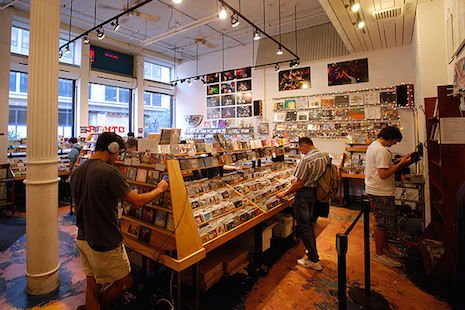
Other Music opened its doors on East 4th Street in 1995, right across the street from the gargantuan downtown branch of Tower Records.After it opened, for a few weeks I obscurely thought that it must be an adjunct of Tower Records. It seemed perfectly plausible that Tower might open an annex called ‘Other Music’ across the street from one of its major locations. Plus the Internet wouldn’t have had good information on something like that back then, so I just didn’t know.
After a couple of visits, however, it became clear that something entirely else was going on at Other Music. They would always have the hip, newer stuff that was making the rounds online, like Clinic or Enon or Les Savy Fav, and would also focus on older material that wasn’t as prominent in the larger chain stores, like Neu! or Henry Cow. They did a pretty good job of making Tower look safe and provincial.
Of course, the 2000s weren’t kind to big-box retailers of music, and even though such an idea would have seemed absurd when it was starting out, Other Music outlasted Tower Records by a decade.
Today Other Music tweeted the sad news that it will be closing in a few weeks:
It's with heavy hearts that we announce that Other Music will be closing its doors on June 25. More details shortly. pic.twitter.com/u05bun8QY0
— Other Music (@othermusic) May 9, 2016
A week ago, Josh Madell, one of the owners of the store, commented, “We still do a ton of business—probably more than most stores in the country. It’s just the economics of it actually supporting us—we don’t see a future in it. We’re trying to step back before it becomes a nightmare.”Rather than assume a snobby attitude about the music you should have been up on before you entered the store (ahem—Kim’s Underground), Other Music always went the other way, eager to bring you new stuff you hadn’t heard before. Its shelves always had enthusiastic and informative note cards written by staff members explaining why this or that obscure album was worth your fifteen bucks.
Few establishments have enhanced the East Village like Other Music. For a good while there—certainly through the 2000s—they always had the best used CD racks. I’m very sorry to see it go.
In 1999 Other Music paid the Scottish musician Momus to write a song about the store. So he did. This is how it came out:
The outpouring of grief for Prince and David Bowie was justified – but another rock and funk pioneer languishes ignored by pop culture. Let’s give him his due
Sly Stone: his music still sounds startlingly current. Photograph: David Warner Ellis/Redferns
If you’d had to guess which rock/funk legend was going to die in 2016, Sly Stone would have been much higher up on the list than Prince. Stone, at 73, is 16 years older than Prince, and besides that has been ill for decades. Sly’s career was derailed by addiction in the 1970s, and he never recovered. Comeback effort after comeback effort fizzled, royalty disputes festered, and for a time he was living in a recreational vehicle. Given his lack of public profile and his history of addiction, many people have assumed he died years ago.
Even when Stone does pass on (hopefully many years from now), there’s unlikely to be a Prince or Bowie sized outpouring of grief – and think-pieces. Though Sly’s widely acknowledged as a rock legend, after 40 years out of the spotlight he barely figures in pop culture. You can gauge the extent of Stone’s marginalization by the reaction to the death last year of his collaborator and the mother of one of his children, legendary funk trumpeter and singer Cynthia Robinson. She received brief obituaries, but people on social media hardly noticed.
Stone may not be much thought about, but his music still sounds startlingly current. More than George Clinton, more than James Brown, more even perhaps than Prince, Sly and the Family Stone’s hits foreshadow the bricolage construction and magpie eclecticism of hip-hop. The first track on Sly Stone’s first album, 1967’s A Whole New Thing, opens with what is effectively a proto-sample: a horn riff from, of all things, Frère Jacques.
He continued to use quotations throughout his career – Thank You (Falettinme Be Mice Elf Agin) name-drops his own earlier hits; I Don’t Know (Satisfaction) is a stoned, stunned remix of the Stones hit. But even when he was writing entirely new material, his songs sound like they’re built out of bits and pieces glued together; Dylan’s harmonica, Motown grooves, rock guitar sting, Stax horns – everything went into mix, not blended together but turned into a single psychedelic explosion. Sing a Simple Song, perhaps the funkiest track ever recorded, has been sampled hundreds of times, which makes sense since it sounds as though it’s built out of samples. Vocals, horn beats and bass burps zip in and out of the staggering beat, while Sly’s own shouted disembodied cry of ecstasy pans from channel to channel, foreshadowing generations of funk studio trickery to come. You can hear everyone from George Clinton to Public Enemy to De La Soul to Timbaland to FKA twigs to Kendrick Lamar to, of course, Prince taking notes at each “try a little Do! Re! Me!” Sly is the place you go if you want to learn how to smash a song apart and reassemble the broken pieces into something weirder, funkier and better.
Stone’s message also continues to resonate. It’s a cliche by now to talk about the transition from his earlier, optimistic flower power hits to his later downer mumbled grooves. There certainly is a contrast between Everyday People, and 1971’s There’s a Riot Goin’ On, which starts with Sly muttering: “Feel so good, don’t wanna move.” But the truth is Sly always mixed irony, hope and despair, balancing the sunny dynamics of his (pre-Prince) multi-gendered and racially integrated band with his studio play-every-instrument-himself control freak insularity. Thank You For Talking to Me Africa, his ominous, slowed-down, screwed-and-chopped-before-there-was-screwed-and-chopped remix of Thank You (Falettinme Be Mice Elf Agin) can be heard either as a statement of black pride and resistance or as a bitter comment on the end of the civil rights movement’s racial idealism, or as both. In any case, “Lookin’ at the devil / grinnin’ at his gun / fingers start shakin’ / I begin to run” could have been written yesterday for the Black Lives Matter movement – as could “If I could do it all over again / I’d be in the same skin I’m in”, from his last classic, 1973’s Fresh.
And then there’s the early, cheerful-sounding Run, Run, Run, where the bright chimes and doo-wop Beach Boy harmonies provide a backdrop for a bleak, blunt assessment of white America. “Don’t try to figure out what’s happenin’ inside their heads / Ain’t too much goin’ on inside the head of the dead.” When Robinson shouts, “People, listen!” it’s part call to party, part warning – the ambivalence only underlined when the rest of the band takes it up in sweet harmonizing. Stone’s mixture of joy and paranoia doesn’t seem too dated for 2016; if anything, it seems too pointed. Prince and Bowie both in their ways took the 60s as a touchstone for eccentric, and erotic, transcendence. Stone, even at his happiest, had an eye on the broken shards lying around on the asphalt after the spaceship cracked.
Maybe Stone would be a little more discussed or acknowledged if his message wasn’t so insistently political and uncomfortable. Still, the real reason there aren’t a bazillion Sly Stone think-pieces whooshing through the net isn’t because of that. It’s just a marketing failure. “Ain’t nobody got the thing I can hear / But if I have to I will yell in your ear,” he sang in one of his 70s tracks, Time for Livin’, but he’s been singularly bad at shouting in anyone’s ear for decades. The media needs a news peg, and when an artist isn’t releasing music, or performing, or maintaining the brand, it’s difficult to generate interest.
Sly & The Family Stone in the early 70s: mixing irony, hope and despair. Photograph: GAB Archives/Redferns
The one exception, of course, is that final news peg, death. If you’re not in the spotlight, nobody looks at you – until you die, at which point think piece writers are all given one last chance to consider your legacy. “You only funky as your last cut / You focus on the past your ass’ll be a has-what”, as Sly-and-Prince-disciple Andre 3000 said, back when he was still relevant and people wrote think pieces about him. Time and the media chug ahead, and Stevie Wonder’s career is less important at the moment than whatever Justin Bieber happened to say yesterday on Twitter. That’s pop, and there’s not much point in being bitter about it. Still, it’s worthwhile to take a moment now and then to think about the legends while they’re here, rather than waiting for that arbitrary online instant when everybody all at once will be allowed to remember, after Sly’s left, how important it was for him to have been here all along.