‘Skateboarding In Pine Ridge’ chronicles a skatepark build and the life of the Lakota youth in Pine Ridge, South Dakota. After watching it, we hope you are moved by the incredible work of the Stronghold Society - an organization dedicated to empowering youth through skateboarding, art and music. #skateboardingsaveslives
Showing posts with label Native American. Show all posts
Showing posts with label Native American. Show all posts
Wednesday, April 5, 2017
Skateboarding is incredible always.
Skateboarding Saves!


Saturday, November 19, 2016
Native American Council offers amnesty to 220 million undocumented whites
from Native News:


A council of Native American leaders has offered partial amnesty to the estimated 220 million illegal white immigrants living in the United States.
The “white” problem has been a topic of much debate in the Native American community for centuries, and community leaders have decided the time has come to properly address it.*
Daily Currant reports, “At a meeting of the Native Peoples Council (NPC) in Albuquerque, New Mexico yesterday, Native American leaders considered several proposals on the future of this continent’s large, unauthorized European population.
The elders ultimately decided to extend a pathway to citizenship for those without criminal backgrounds.”

“We are prepared to offer White people the option of staying on this continent legally and applying for citizenship,” explains Chief Wamsutta of the Wampanoag nation.
“In return, they must pay any outstanding taxes and give back the land stolen from our ancestors.
“Any white person with a criminal record, however, will be deported in the next 90 days back to their ancestral homeland.
Rush Limbaugh will be going to Germany. Justin Bieber will depart for Canada.
And the entire cast of Jersey Shore will be returning to Italy.”
Illegal white immigration has been rapidly increasing for nearly 400 years from the European countries of France, Spain and England.
These illegals have ravished the land and colonized areas occupied by the natives.
Some white supporters claim the immigrants are a blessing, arguing that they take all of the menial white-collar jobs that the natives don’t even want.
‘What native would want to have a cushy salary and a corner office as an accountant, or the excess of power as senator or fortune-500 CEO,?’ they claim.
Others are not so forgiving. “Why can’t we just deport all of the Whites back to Europe?” asks Ité Omácau of the Lakota people.
“They’re just a drain on our economy anyway. They came over here to steal our resources because they’re too lazy to develop their own back home…
I can’t believe we’re just going to let them pay a fine. They should get to the back of the line like everybody else — behind the Mexicans.”
*For the offended… this is satire.
Thursday, December 17, 2015
John Trudell, Outspoken Advocate for American Indians,
Is Dead at 69
from the New York Times


John Trudell, whose outspokenness and charisma made him a leading advocate of Native American rights, and who channeled his message of righteous defiance into poetry and songwriting, died on Tuesday at his home in Santa Clara County, Calif. He was 69.
The cause was cancer, said Cree Miller, the trustee of Mr. Trudell’s estate.
Mr. Trudell, a Santee Dakota, was national chairman of the American Indian Movement during much of the 1970s, a turbulent stretch in the relationship between Native American activists and the federal government.
His tenure began after the episode at Wounded Knee, S.D., where, in February 1973, Oglala Lakota from the Pine Ridge reservation, incensed by tribal corruption, and American Indian Movement activists, protesting the government’s treatment of their people, occupied the town in a 71-day standoff with federal marshals and F.B.I. agents.
Three men — Bob Robideau, Darelle Butler and Leonard Peltier — were tried in the killing of two agents during a confrontation in Oglala, S.D., two years later.
Mr. Trudell — “the most eloquent speaker in the Movement,” as Peter Matthiessen wrote in “In the Spirit of Crazy Horse,” his 1983 book about the siege — held community meetings in Cedar Rapids, Iowa, where the trial of Mr. Robideau and Mr. Butler was held, and he testified for the defense. The two men were acquitted. Mr. Peltier, tried later, was convicted and remains in prison.
But well before that, Mr. Trudell had already made a name for himself as an effective champion of his people, decrying the indignities they had suffered for more than a century at the hands of the American government.
In November 1972, he was among the leaders of a group that occupied the Bureau of Indian Affairs in Washington, demanding the enforcement of historical treaties that granted Native Americans sovereignty over their land.
Perhaps most famously, in 1969, he joined an occupation of Alcatraz Island, home of the former prison in San Francisco Bay, arguing that the terms of an old treaty gave American Indians the right to unused federal land.
The occupiers, calling themselves Indians of All Tribes, held the island for 19 months, demanding that they be given the right to develop it as a cultural and education center. Mr. Trudell, then in his 20s, emerged as the group’s spokesman, frequently delivering a broadcast called “Radio Free Alcatraz” and speaking at news conferences.
Rejecting a government proposal that the island be turned into a park with “maximum Indian qualities,” Mr. Trudell said: “We will no longer be museum pieces, tourist attractions and politicians’ playthings. There will be no park on this island because it changes the whole meaning of what we are here for.”
The F.B.I. compiled a substantial file on him.
In 1979, Mr. Trudell burned an American flag on the steps of the F.B.I. building in Washington, saying that the flag had been desecrated by the government’s behavior toward American Indians and other minorities, and that burning was the appropriate way to dispose of a desecrated flag.
The next day, his home in Nevada burned to the ground. The fire killed his pregnant wife, Tina Manning, who was also an activist, as well as their three children and Ms. Manning’s mother.
An investigation by the Bureau of Indian Affairs found that the fire was an accident. But some viewed the inquiry as perfunctory, and its findings were questioned by an investigator hired by Mr. Trudell, who suspected the fire had been deliberately set.
“I don’t want to say that the F.B.I. kills innocent kids and children,” Lindsey Manning, a cousin of Tina Manning, said in “Trudell,” an acclaimed 2005 documentary film by Heather Rae. “I just don’t want to say that. But you never know. You never know.”
The film asserted that the cause of the fire had never been established.
John Francis Trudell was born in Omaha on Feb. 15, 1946, and grew up partly there and partly on a reservation near the South Dakota border. His father, Clifford Trudell, was a Santee Dakota; his mother, the former Ricarda Almanza, was of Mexican-Indian descent. She died when John was a boy.
Mr. Trudell dropped out of high school and served in the Navy during the Vietnam War. Afterward, he moved to Southern California, where he studied radio and communications at a community college before joining the Indians of All Tribes group on Alcatraz.
Mr. Trudell began to distance himself from the American Indian Movement after the fire at his house, and in the 1980s, he turned to writing. He published several volumes of poetry, including “Stickman” and “Lines From a Mined Mind,” often writing in protest of corporate power and government oppression. He also recorded spoken-word albums accompanied by traditional Native American music as well as contemporary pop. His latest album, “Wazi’s Dream,” was released this year.
The recordings earned him admirers in the music world, including Bob Dylan, Jackson Browne and Kris Kristofferson.
Mr. Trudell also acted in feature films, including “Thunderheart” (1992), with Sam Shepard and Val Kilmer, in which he played a character drawn from a crucial figure in the events leading to Wounded Knee; and “Smoke Signals” (1998), based on a collection of short stories by Sherman Alexie.
Mr. Trudell’s first marriage, to Fenicia Ordonez, ended in divorce. He is survived by a brother, Roger, and several children and grandchildren. Ms. Miller, his estate’s trustee, declined to say specifically where Mr. Trudell lived in Santa Clara County.
“If this is the land of the free,” Mr. Trudell said during the occupation of Alcatraz, summarizing the issue that would propel his life and work from then on, “we want to know why we don’t have the respect and dignity that all free men are accorded by other free men.”
Correction: December 11, 2015
Because of an editing error, an obituary on Thursday about the Native American activist John Trudell referred incorrectly to the trials of his fellow activists Bob Robideau, Darelle Butler and Leonard Peltier. They were tried in the killing of two F.B.I. agents during a confrontation in Oglala, S.D., in 1975 — not during the occupation of Wounded Knee, S.D., in 1973.
Correction: December 14, 2015
An obituary on Thursday about John Trudell, a leading advocate of Native American rights, misstated the source material for the movie “Smoke Signals” in which Mr. Trudell had a role. It was based on a collection of short stories by Sherman Alexie, not on a novel by Mr. Alexie.

Thursday, May 2, 2013
Native Americans: Portraits From A Century Ago
from The Presurfer:
click here to see more


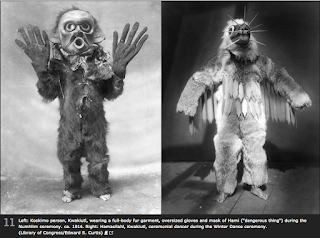

In the early 1900s, Seattle-based photographer Edward S. Curtis embarked on a project of epic scale, to travel the western United States and document the lives of Native Americans still untouched by Western society. Curtis visited more than 80 tribes over the next 20 years, taking more than 40,000 photographs.
The end result was a 20-volume set of books. In the hundred-plus years since the first volume was published, Curtis's depictions have been both praised and criticized. The sheer documentary value of such a huge and thorough project has been celebrated, while critics of the photography have objected to a perpetuation of the myth of the 'noble savage' in stage-managed portraits.
click here to see more


Subscribe to:
Posts (Atom)


