Showing posts with label images. Show all posts

Tuesday, February 3, 2015

AWE some perspective


(click on the full screen option)


Watch Earth roll by through the perspective of ESA astronaut Alexander Gerst in this six-minute timelapse video from space. Combining 12 500 images taken by Alexander during his six-month Blue Dot mission on the International Space Station this Ultra High Definition video shows the best our beautiful planet has to offer.

Marvel at the auroras, sunrises, clouds, stars, oceans, the Milky Way, the International Space Station, lightning, cities at night, spacecraft and the thin band of atmosphere that protects us from space.

Often while conducting scientific experiments or docking spacecraft Alexander would set cameras to automatically take pictures at regular intervals. Combining these images gives the timelapse effect seen in this video.

Watch the video in 4K resolution for the best effect and find out more about Alexander Gerst’s Blue Dot mission here: http://www.esa.int/BlueDot

Follow Alexander Gerst via http://alexandergerst.esa.int

Thursday, July 5, 2012

Seeing Beyond the Human Eye: Video of beautiful scientific and artistic photography

The latest installment of the "Off Book" series from PBS and Kornhaber Brown is called Seeing Beyond the Human Eye and features microphotography, astrophotography, slow-motion video, and time-lapse video.


This piece explores the beautiful imagery that has been uncovered thanks to modern technology. Because of advancements made in photomicrography, astrophotography, high-speed and stop-motion photography, we’re now able to see the world (and galaxy) as we never have before.

It’s our curiosity and thirst for the unknown that has driven us to uncover the beauty of the universe. Technology has allowed us to overcome the boundaries of human perception and explore beyond the limits of the naked eye. Told through the voices of scientists and artists, this video illustrates how size and distance are no longer barriers, and how through innovation we see the universe, time, and humanity in a new light.
Thanks, BoingBoing

Wednesday, July 4, 2012

Monday, May 7, 2012

Beautiful photos from the Hubble Space Telescope

from Maggie Koerth-Baker at BoingBoing:

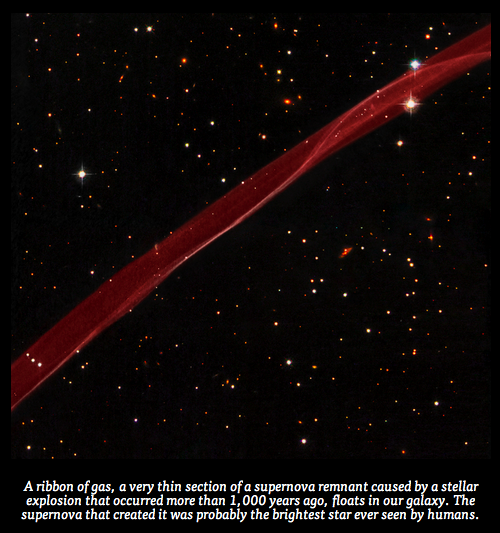
At the Brain Pickings blog, Maria Popova has some amazing images, taken by the Hubble Space Telescope during its 22 years of operation. I love this one. It's such a great reminder of the time scales of space—the remnants of things that happened 1000 years ago are still moving through the cosmos, even while humans have died and been born and moved on to other obsessions.

One other thing to keep in mind as you're looking at these photos—what you see does not always represent exactly what outer space looks like. An astronaut wouldn't see a red ribbon undulating among the stars. One of these Hubble photographs are put together from multiple images taken by different parts of the telescope. Humans colorize the images to make details stand out. In this case, making the stream of gas red allows us to see it and understand its meaning. In that way, a colorized Hubble image is actually more useful and more educational than a 100% accurate photo would have been.

See the rest of the photos at Brain Pickings

Learn more about how Hubble images are made.

Learn about the process of colorizing Hubble images, including why specific colors are chosen.

Tuesday, February 7, 2012

What happens if you ask Google Images what's most similar, starting with a blank image, repeating the process 2951 times?

Sebastian Schmieg of the Netherlands created this video by feeding a transparent image to Google Image Search and asking it to find similar images, and then taking the top result and feeding it back into the similarity algorithm, 2951 times. It's a wonderful look at an evolutionary process.


Search by Image, Recursively, Transparent PNG, #1

Thanks, BoingBoing