Showing posts with label Space. Show all posts

Sunday, April 15, 2018

FCC approves SpaceX’s ambitious satellite internet plans

Starlink is well on its way to serving customers on Earth
from TheeLeverage.com


The Federal Communications Commission today granted SpaceX a license to operate an array of broadband internet satellites, marking the first time the government agency has given the green light for a US-licensed low-Earth orbit broadband service. SpaceX co-founder and CEO Elon Musk has been discussing a micro-satellite constellation for providing broadband internet for years, and in 2017 the company began accelerating its efforts by meeting regularly with the FCC and applying for a license that would allow it to operate in an unused portion of the FCC-regulated broadband spectrum. The company plans to call the service Starlink.

Earlier this year, SpaceX launched the first two of its planned 12,000-satellite constellation. It appears that the company is starting out with a 4,425-satellite array, with the FCC requiring it launch at least half of those units within the next six years. “With this action, the Commission takes another step to increase high-speed broadband availability and competition in the United States,” the FCC said in a statement to CNBC. SpaceX is slated to start launching operational satellites for the network starting next year, when it will be going head to head with competing space internet provider OneWeb.

”We appreciate the FCC’s thorough review and approval of SpaceX’s constellation license. Although we still have much to do with this complex undertaking, this is an important step toward SpaceX building a next-generation satellite network that can link the globe with reliable and affordable broadband service, especially reaching those who are not yet connected,” Gwynne Shotwell, SpaceX’s president and chief operating officer, said in a statement given to The Verge. SpaceX hopes Starlink may become a big revenue generator that can help offset R&D and operations costs for the rocket company. Financial projections, disclosed by The Wall Street Journal last year, show SpaceX expects more than 40 million subscribers for Starlink by 2025, equaling roughly $30 billion in revenue.

Monday, October 30, 2017

School of Life Monday :
Earthrise

Earthrise is the most famous photograph in the history of the world. It was taken by astronaut Bill Anders on the 24th December 1968, during the Apollo 8 mission and for the first time showed us what our planet looks like from space. Its vulnerability and beauty gave rise to a new global consciousness. We should take care to pin it to the fridge and apply its lessons to our lives.

Sunday, July 31, 2016

One man's incredible plan for humanity to migrate into space

from Boing Boing


AC75-2621f

In the early 1970s, Princeton University physicist Gerard O’Neill became a space activist touting plans to build human colonies in outer space. He argued that humans could escape (while helping alleviate) the environmental damage we are causing on Earth by migrating to space habitats housed in cylinders that would be suspended 250,000 miles from Earth at LaGrange Point 5, a spot where the gravitational forces enable objects to just hang there. O'Neill's ideas, while controversial, were mostly sound from a scientific and engineering perspective.

After the New York Times published a front page article about O'Neill, he became a media sensation and quickly developed a very vocal following of space geeks, (some) environmentalists, heads, and future-minded scientists. NASA even jumped in, supporting studies based on O'Neill's research and commissioning the incredible illustrations seen here. O'Neill's specific concepts influenced countless science fiction books and movies and were the seed of bOING bOING patron saint Timothy Leary's plan for humanity's future, SMI2LE (Space Migration, Intelligence Increase, Life Extension.)

His book The High Frontier: Human Colonies in Space is still in-print and captures the wonder and sense of possibility that permeated our culture after the first moon landing and into the 1970s. It's my hope that today's myriad private efforts to make space accessible will re-ignite that desire in everyone to explore and experience what lies beyond our home planet.

The fantastic podcast 99% Invisible told O'Neill's story in an episode titled "Home on Lagrange":


untitled

AC76-0525f

gerry-oneil-and-wife-600x400

AC75-1086f


Monday, February 1, 2016

"School of Life" Monday's Watch and Listen This Week:
The Wisdom of Space

A series of images provided by NASA (and music by J.S.Bach) help to restore perspective and a sense of peace to our frazzled lives.

Tuesday, February 3, 2015

AWE some perspective


(click on the full screen option)


Watch Earth roll by through the perspective of ESA astronaut Alexander Gerst in this six-minute timelapse video from space. Combining 12 500 images taken by Alexander during his six-month Blue Dot mission on the International Space Station this Ultra High Definition video shows the best our beautiful planet has to offer.

Marvel at the auroras, sunrises, clouds, stars, oceans, the Milky Way, the International Space Station, lightning, cities at night, spacecraft and the thin band of atmosphere that protects us from space.

Often while conducting scientific experiments or docking spacecraft Alexander would set cameras to automatically take pictures at regular intervals. Combining these images gives the timelapse effect seen in this video.

Watch the video in 4K resolution for the best effect and find out more about Alexander Gerst’s Blue Dot mission here: http://www.esa.int/BlueDot

Follow Alexander Gerst via http://alexandergerst.esa.int

Sunday, June 22, 2014

Space Colonies: A look via the 1970's

from BoingBoing:
In the 1970s, NASA's Ames Research Center gathered artists and tasked them with designing space colonies able to accommodate 10,000 people. Some forty years later, the dream of suburbs in space remains just that—but their influence on science fiction and the public imagination only grows.

Wednesday, November 20, 2013

Two billion planets in our galaxy may be suitable for life

Data from Kepler space observatory suggests planets capable of supporting life are far more common than previously thought

from The Guardian


One in five sun-like stars may host planets in their habitable zone where liquid water could sustain life. Illustration: Reuters

Our galaxy probably contains at least two billion planets that, like Earth, have liquid water on their surfaces and orbit around their parent stars in the "habitable zone" for life. The nearest, according to astronomers, could be a mere 12 light years away.

A new study, published on Monday [November 4th] in the Proceedings of the National Academy of Sciences, suggests that Earth-like planets capable of supporting life are far more common than previously thought. Using measurements from Nasa's Kepler space observatory, scientists led by Erik Petigura at the University of California, Berkeley, estimated that 22% of our galaxy's sun-like stars have rocky planets circling them in the zone where they get roughly the same amount of light energy as Earth receives from the sun. There are around 100bn stars in our galaxy, of which 10% are like the sun.

So far Kepler has studied more than 150,000 stars and identified more than 3,000 candidate planets, but many of these are "gas giants", similar to Jupiter, that orbit close to their parent stars. If there is life out there, it is far more likely to have evolved on rocky planets with liquid water on their surfaces, similar to Earth.

To get their results, Petigura's team looked for planets in Kepler data that had a radius up to double that of Earth. They searched for planets that orbited far enough from their star that liquid water would not evaporate, but not so far that the water would all freeze.

Subhanjoy Mohanty, an astrophysicist at Imperial College London who was not involved with the study, said: "This is the first estimate of the frequency of Earth-like planets around sun-like stars, in orbits large enough to lie in the habitable zone of their stars. The finding that roughly one in five sun-like stars may host such planets is an incredibly important one, probably exceeding the expectations of most cautious astronomers."

He added that the latest analysis increased the chances that there might be life somewhere among the stars. "Previous analyses of Kepler data had shown that red dwarfs – the most common type of star in the galaxy, making up about 80% of the stellar population – very frequently harbour Earth-size planets, including in their habitable zones. This new study shows that the same is true around stars more like our own sun. This is certainly an added impetus for planned future missions which will study the atmospheres of these potentially habitable planets, enabling us to investigate whether they are in fact habitable or not, and also whether their atmospheres show actual biosignatures of existing life."

Nasa also announced on Monday that the Kepler probe would be given a new lease of life, following fears that it would have to end its mission after only four years in space. In May 2013, scientists discovered that one of the gyroscopic wheels – known as "reaction wheels" – that kept the probe pointing in the right direction had stopped working and, try as they might, Nasa engineers could not restart it. Unable to point itself at the stars with any accuracy, the probe could no longer be used to collect data about the position of new exoplanets.

But it looks as though there could be a solution that involves reorienting the probe to look along the plane of the galaxy, which will allow it to remain stable with only two of its reaction wheels working. "The old saying 'necessity is the mother of invention' has rung true here, with engineers and scientists from Nasa and the spacecraft manufacturers having figured out this way to – we hope – recover much of the performance we thought we had lost. We are very excited," said Bill Chaplin, an astrophysicist at the University of Birmingham in the UK.

If all goes well, the new Kepler mission – dubbed "K2" – will look for planets around smaller stars than the sun, and will also study the stars themselves. "There are a wealth of fantastically interesting targets for astrophysics that can be observed in the ecliptic plane, which were not accessible in the original Kepler field, notably brighter clusters of stars – where the common origins and distances to these stars make the clusters excellent laboratories for testing our understanding of stars – and young, star-forming regions," said Chaplin.

Sunday, September 29, 2013

This is the Space Age


from Boing Boing:

Annalee Newitz's Stop pretending we aren't living in the Space Age is a magnificent rant on the incredibly achievements of modern space programs, and a savage indictment of the lack of imagination underpinning complaints about the failure of humans to return to the moon in force.
More importantly, humans have continued the project that our grandparents and great-grandparents started in the 1950s when the Space Age began. Remember how that project got off the ground with remote-controlled satellites? Want to know why? Because that is how smart explorers do it. Believe it or not, we are actually clever enough monkeys that we are carefully doing a little reconnaissance in distant, dangerous places before we send people there. Which is why we have sent probes to Mars, the asteroid belt, Jupiter, Saturn, Neptune, Uranus, Pluto, and even to several moons and comets.

We currently have two robots on the surface of Mars that we are actually driving around. They are equipped with instruments that can do pretty sophisticated science experiments. We also have a satellite orbiting Mars, the MRO, which can take incredibly granular images of the planet's surface and do climate analysis. Using these robots and the MRO, we have discovered important things like the fact that Mars has underground ice, and once had seas on its surface. This is precisely the kind of information we need to know before we get to the planet ourselves.

Stop pretending we aren't living in the Space Age (via Making Light)

Tuesday, September 17, 2013

In a Breathtaking First, NASA’s Voyager 1 Exits the Solar System

from The New York Times:


By BROOKS BARNES
PASADENA, Calif. — By today’s standards, the spacecraft’s technology is laughable: it carries an 8-track tape recorder and computers with one-240,000th the memory of a low-end iPhone. When it left Earth 36 years ago, it was designed as a four-year mission to Saturn, and everything after that was gravy.

But Voyager 1 has become — thrillingly — the Little Spacecraft That Could. On Thursday, scientists declared that it had become the first probe to exit the solar system, a breathtaking achievement that NASA could only fantasize about back when Voyager was launched in 1977, the same year “Star Wars” was released.

“I don’t know if it’s in the same league as landing on the moon, but it’s right up there — ‘Star Trek’ stuff, for sure,” said Donald A. Gurnett, a physics professor at the University of Iowa and the co-author of a paper published Thursday in the journal Science about Voyager’s feat. “I mean, consider the distance. It’s hard even for scientists to comprehend.”

Even among planetary scientists, who tend to dream large, the idea that something they built could travel beyond the Sun’s empire and keep grinding away is impressive. Plenty of telescopes gaze at the far parts of the Milky Way, but Voyager 1 can now touch and feel the cold, unexplored region in between the stars and send back detailed dispatches about conditions there. It takes 17 hours and 22 minutes for Voyager’s signals to reach NASA’s Jet Propulsion Laboratory here.


“This is historic stuff, a bit like the first exploration of Earth, and we had to look at the data very, very carefully,” said Edward C. Stone, 77, NASA’s top Voyager expert, who has been working on the project since 1972. He said he was excited about what comes next. “It’s now the start of a whole new mission,” he said.

The lonely probe, which is 11.7 billion miles from Earth and hurtling away at 38,000 miles per hour, has long been on the cusp, treading a boundary between the bubble of hot, energetic particles around the solar system and the dark region beyond. There, in interstellar space, the plasma, or ionized gas, is noticeably denser.

Dr. Gurnett and his team have spent the past few months analyzing their data, trying to nail down whether what they were seeing was solar plasma or the plasma of interstellar space. Now they are certain it was the latter, and have even pinpointed a date for the crossing: Aug. 25, 2012.

At a news conference on Thursday, NASA scientists were a bit vague about what they hope to get from Voyager 1 from now on. The answer, to some extent, depends on what instruments continue to function as the power supply dwindles. Dr. Stone expects Voyager 1 to keep sending back data — with a 23-watt transmitter, about the equivalent of a refrigerator light bulb — until roughly 2025.

One hope is that Voyager 1’s position will allow scientists to more accurately study galactic cosmic rays, which are high-energy particles that originate outside the solar system. They would use the information to make judgments about what interstellar space is like at even greater distances from Earth.

In its heyday, Voyager 1 pumped out never-before-seen images of Jupiter and Saturn. But it stopped sending home pictures in 1990, to conserve energy and because there was no longer much to see. A companion spacecraft, Voyager 2, also launched in 1977, has stopped sending back images as well. Voyager 2 is moving in a different direction but is also expected to exit the solar system.

Eventually, NASA said, the Voyagers will pass other stars, coasting and drifting and being pulled by gravity. The next big encounter for Voyager 1, in around 40,000 years, is expected to be a dwarf star dispassionately known as AC+793888 in the constellation of Camelopardalis.

But already, Voyager 1 has achieved what Dr. Gurnett called “the holy grail of heliosphere research.”

Voyager 1 left the solar system the same month that Curiosity, NASA’s state-of-the-art rover, landed on Mars and started sending home gorgeous snapshots. Curiosity’s exploration team, some 400 strong, promptly dazzled the world by driving the $2.5 billion robot across a patch of Martian terrain, a feat that turned the Red Bull-chugging engineers and scientists of Building 264 of the Jet Propulsion Laboratory campus into rock stars. By comparison, the Voyager mission looked like a Betamax in the era of Bluetooth.

The 12-person Voyager staff was long ago moved from the Jet Propulsion Laboratory campus to cramped quarters down the street, next to a McDonald’s. In an interview last month at Voyager’s offices, Suzanne R. Dodd, the Voyager project manager, said that when she attended meetings in Building 264, she kept a low profile in deference to the Mars team.

“I try to stay out of the elevator and take the stairs,” Ms. Dodd said. “They’re doing important work there, and I’ll only slow them down.”

At 52, Ms. Dodd is a relative newcomer to Voyager, first working on the mission in 1984. Now she and her team seem poised to return to the spotlight.

As the solar system’s edge grew tantalizingly close, NASA asked the Voyager scientists to increase the amount of data collection. The problem: the 8-track data recorders from 1977 were not exactly bursting with extra space. Could Ms. Dodd even find anyone who specialized in that piece of technology and could coax it to record more?

“These younger engineers can write a lot of sloppy code, and it doesn’t matter, but here, with very limited capacity, you have to be extremely precise and have a real strategy,” she said.

She was able to find her man: Lawrence J. Zottarelli, 77, a retired NASA engineer. He came up with a solution. But would it work?

Mr. Zottarelli waited at Voyager mission control one afternoon last month to find out. The first of the newly programmed data dumps was set to come down. Ms. Dodd, Dr. Stone and Mr. Zottarelli watched two old Sun Microsystems computers like children watching for a chick to peck through an egg. “Nine, eight, seven,” Dr. Stone counted down.

“Everything’s fine,” said Mr. Zottarelli, flashing a thumbs up. “You’re on your own now.”

The relief was written all over Ms. Dodd’s face. “It’s not easy flying an old spacecraft,” she said.

Her eyes moved to Dr. Stone, who was peering at a computer through his trifocals.

“There are lots of old missions,” he responded with a sly smile. “But not many are doing exciting new things.”


Check out this VIDEO


Monday, July 29, 2013

Incredible Online Gallery of High-Res Film Scans from Every Apollo Mission


The title sort of gives it away, but did you know that there is an online archive that contains high-resolution film scans from every Apollo mission? The gallery contains all of the incredible photos taken during each of the missions — from Apollo 1 all the way through Apollo 17 — with some 1,000+ photos from Apollo 11 alone. 
 The archive, officially the Apollo Image Gallery, was put together by the Project Apollo Archive by scanning photographs provided by the NASA History Office, Kennedy Space Center and Johnson Space Center.
 Since all of these images were taken by NASA astronauts in the course of duty, they’re all Public Domain and free for you to browse through, download, share and use to your heart’s content.

Incredible Online Gallery of High Res Film Scans from Every Apollo Mission apollo7 2
Unfortunately, the website can be a bit of a hassle to navigate through — there’s no way to browse image after image in any sort of slide show format — but it’s a relatively small con when you consider the work it took to scan and bring all of these photos under one roof.
 
From photos taken on the moon and in space, to press release photos and training exercises it’s all there in glorious high-resolution. Here’s a selection of images taken from all of the Apollo missions, complete with descriptions in the captions: 
Incredible Online Gallery of High Res Film Scans from Every Apollo Mission apollo1 1
Incredible Online Gallery of High Res Film Scans from Every Apollo Mission apollo7 1
Incredible Online Gallery of High Res Film Scans from Every Apollo Mission apollo8 1
Incredible Online Gallery of High Res Film Scans from Every Apollo Mission apollo9 1
Incredible Online Gallery of High Res Film Scans from Every Apollo Mission apollo10 1
Incredible Online Gallery of High Res Film Scans from Every Apollo Mission apollo11 1
Incredible Online Gallery of High Res Film Scans from Every Apollo Mission apollo11 2
Incredible Online Gallery of High Res Film Scans from Every Apollo Mission apollo11 3
Incredible Online Gallery of High Res Film Scans from Every Apollo Mission apollo12 1
Incredible Online Gallery of High Res Film Scans from Every Apollo Mission apollo13 1
Incredible Online Gallery of High Res Film Scans from Every Apollo Mission apollo14 1
Incredible Online Gallery of High Res Film Scans from Every Apollo Mission apollo15 1
Incredible Online Gallery of High Res Film Scans from Every Apollo Mission apollo16 1
Incredible Online Gallery of High Res Film Scans from Every Apollo Mission apollo17 1
 flight to travel beyond low Earth orbit.
These are just some of our favorites that we found while browsing the massive archive. There are literally thousands more where these came from. 
To check out the full gallery for yourself — or if you’d like to see any of the photos we shared above in beautiful high-resolution — head over to the Project Apollo Archive’s image gallery by clicking HERE.

Saturday, April 20, 2013

What happens when you wring out a washcloth in space?


from BoingBoing:
For hand towels, astronauts get those little vacuum-packed pucks that you kind of have to unravel into a towel. But what happens when you actually put the towels to use?

Two Nova Scotia high school students, Kendra Lemke and Meredith Faulkner, submitted this experiment to Canadian Space Agency and got to see astronaut Chris Hadfield actually test it out on the ISS. The results are seriously extraordinary and you need to see them.

Sunday, January 6, 2013

We have the technology to look for life on Mars


from Boing Boing
The Curiosity rover can do a lot of things, but nobody is expecting her to find direct evidence of life on Mars. In fact, the hunt for life on the Red Planet has been a pretty stunted one. The last time we really looked was during the Viking missions, which tried to find chemical "footprints" that would exist if there had once been life on Mars, but that could end up on that planet for other reasons, as well. What we got back was a less-than-enthralling "Outlook Hazy. Try Again Later."

Ever since, we've contented ourselves with searching for indirect evidence — assessing the planet for signs that it might once have had the conditions necessary for life to happen. That's important, and it will make direct evidence of life more believable if we ever do find it, but it's not quite the same thing.

But now, DNA sequencing tools have become portable enough (and drilling technology has become powerful enough) that some scientists and Craig Ventner think we could send a probe to Mars which could find buried traces of actual DNA protected in the dirt and sequence that DNA on site.
It's also possible that life hitched a ride between Earth and Mars in their early days. Asteroid impacts have sent about a billion tonnes of rock careering between the two planets, potentially carrying DNA or its building blocks. That could mean that any genetic material on Mars is similar enough to DNA that we have a chance of finding it using standard tests.

Even if we don't, we can set up future sequencers to look for molecules that use alternative sugars or chemical letters in the genetic code. "We're not there yet, but it's not a fundamental limitation," says Chris Carr of the Massachusetts Institute of Technology, who works on the NASA-backed Search for Extraterrestrial Genomes.
Read the rest of the story at New Scientist

Friday, December 14, 2012

40th anniversary of the Blue Marble photo


Last week was the 40th anniversary of the "Blue Marble," the iconic photo taken by the crew of the Apollo 17. More on the photo and its impact at LIFE.com and Wikipedia. Here's NASA's original caption:
View of the Earth as seen by the Apollo 17 crew traveling toward the moon. This translunar coast photograph extends from the Mediterranean Sea area to the Antarctica south polar ice cap. This is the first time the Apollo trajectory made it possible to photograph the south polar ice cap. Note the heavy cloud cover in the Southern Hemisphere. Almost the entire coastline of Africa is clearly visible. The Arabian Peninsula can be seen at the northeastern edge of Africa. The large island off the coast of Africa is Madagascar. The Asian mainland is on the horizon toward the northeast."
Thanks, Boing Boing

Monday, December 10, 2012

Thursday, September 6, 2012

The profound beauty of the night sky


“At the dead hour of the night, when the world is hushed in sleep and all is still; when there is not a sound to be heard save the dead beat escapement of the clock, counting with hollow voice the footsteps of time in ceaseless round, I turn to the Ephemeris and find there, by calculations made years ago, that when that clock tells a certain hour, a star which I never saw will be in the field of the telescope for a moment, flit through and then disappear. The instrument is set; the moment approaches and is intently awaited—I look—the star mute with eloquence that gathers sublimity from the silence of the night, comes smiling and dancing into the field, and at the instant predicted even to the fraction of a second, it makes its transit and is gone. With emotions too deep for the organs of speech, the heart swells out with unutterable anthems; we then see that there is harmony in the heavens above; and though we cannot hear, we feel the ‘music of the spheres.’” — Matthew Fontaine Maury, in an 1849 presentation to the Virginia Historical Society. Maury was superintendent of the U.S. Naval Observatory.

Read more about Maury and other retro scientists in Caren Cooper's guest posts at the Scientific American blogs.
Thanks, BoingBoing

Saturday, July 28, 2012

Views from the International Space Station

Every frame in this video is a photograph taken from the International Space Station. All credit goes to the crews on board the ISS.
I removed noise and edited some shots in photoshop. Compiled and arranged in Sony Vegas.

Music by John Murphy - Sunshine (Adagio In D Minor)
itunes.apple.com/us/album/sunshine-music-from-motion/id297702863

Image Courtesy of the Image Science & Analysis Laboratory,
NASA Johnson Space Center, The Gateway to Astronaut Photography of Earth
eol.jsc.nasa.gov


thanks, presurfer

Friday, June 15, 2012

This is real life. Not Tron.

from Maggie Koerth-Baker at DangerousMinds


This amazing photo was taken by astronaut Don Pettit on board the International Space Stations—of which you can see a chunk at the top of the frame. It's part of a whole series of absolutely stunning photos that you need to go check out as soon as you have a free 20 minutes to spend staring at your monitor and going, "Woah," to yourself over and over.

Here's what Pettit had to say about the process.

“My star trail images are made by taking a time exposure of about 10 to 15 minutes. However, with modern digital cameras, 30 seconds is about the longest exposure possible, due to electronic detector noise effectively snowing out the image. To achieve the longer exposures I do what many amateur astronomers do. I take multiple 30-second exposures, the ‘stack’ them using imaging software, thus producing the longer exposure.”

Via Smithsonian, which is where you can find the rest of Don Pettit's photos.

Monday, May 7, 2012

Beautiful photos from the Hubble Space Telescope

from Maggie Koerth-Baker at BoingBoing:

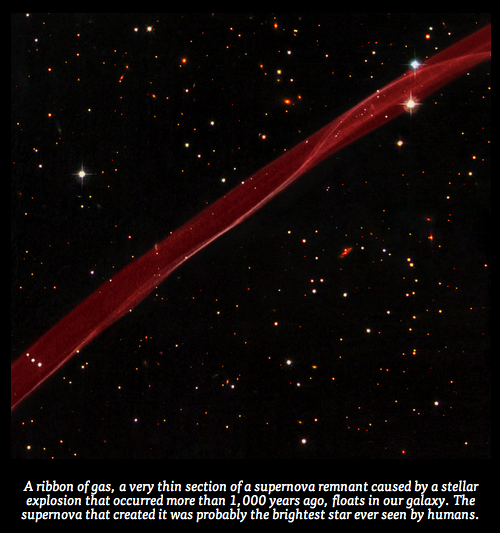
At the Brain Pickings blog, Maria Popova has some amazing images, taken by the Hubble Space Telescope during its 22 years of operation. I love this one. It's such a great reminder of the time scales of space—the remnants of things that happened 1000 years ago are still moving through the cosmos, even while humans have died and been born and moved on to other obsessions.

One other thing to keep in mind as you're looking at these photos—what you see does not always represent exactly what outer space looks like. An astronaut wouldn't see a red ribbon undulating among the stars. One of these Hubble photographs are put together from multiple images taken by different parts of the telescope. Humans colorize the images to make details stand out. In this case, making the stream of gas red allows us to see it and understand its meaning. In that way, a colorized Hubble image is actually more useful and more educational than a 100% accurate photo would have been.

See the rest of the photos at Brain Pickings

Learn more about how Hubble images are made.

Learn about the process of colorizing Hubble images, including why specific colors are chosen.

Monday, November 14, 2011

Probably The Most Beautiful Images I've Ever Seen Of Our Planet

Earth | Time Lapse View from Space | Fly Over | Nasa, ISS


Notes from the Vimeo page where the video was found:
Note: Still couldn't find any appropriate, reliable source describing
the technical setting for this footage. The same applies to any specific
information about the responsible person in charge of the photographs.
Please let me know, if you have any information, links or the like.

Time lapse sequences of photographs taken with a special low-light 4K-camera
by the crew of expedition 28 & 29 onboard the International Space Station from
August to October, 2011. All credit goes to them.

HD, refurbished, smoothed, retimed, denoised, deflickered, cut, etc.

Music: Jan Jelinek | Do Dekor, faitiche back2001
w+p by Jan Jelinek, published by Betke Edition
janjelinek.com | faitiche.de

Editing: Michael König | koenigm.com

Image Courtesy of the Image Science & Analysis Laboratory,
NASA Johnson Space Center, The Gateway to Astronaut Photography of Earth
eol.jsc.nasa.gov

Shooting locations in order of appearance:

1. Aurora Borealis Pass over the United States at Night
2. Aurora Borealis and eastern United States at Night
3. Aurora Australis from Madagascar to southwest of Australia
4. Aurora Australis south of Australia
5. Northwest coast of United States to Central South America at Night
6. Aurora Australis from the Southern to the Northern Pacific Ocean
7. Halfway around the World
8. Night Pass over Central Africa and the Middle East
9. Evening Pass over the Sahara Desert and the Middle East
10. Pass over Canada and Central United States at Night
11. Pass over Southern California to Hudson Bay
12. Islands in the Philippine Sea at Night
13. Pass over Eastern Asia to Philippine Sea and Guam
14. Views of the Mideast at Night
15. Night Pass over Mediterranean Sea
16. Aurora Borealis and the United States at Night
17. Aurora Australis over Indian Ocean
18. Eastern Europe to Southeastern Asia at Night

Thursday, September 1, 2011

PETA Wants Mars to Be an All-Vegan Planet


from Eccorazzi:
PETA isn’t just looking to make Earth a vegan planet, they have their sights set on Mars too.

PETA recently sent out a press release about rocket producer SpaceX and their plans to send flights to Mars to create a colony. According to the animal rights organization, “the Martian colony is an opportunity to make a kind civilization in which humans don’t exploit other beings. And since the animal agriculture industry is toxic to human health and to the environment, an all-vegan civilization would ensure that the new Martian citizens would have long and healthy futures.”

The letter from PETA president Ingrid Newkirk to SpaceX founder and CEO Elon Musk was also included. Newkirk said, “We can get off on the right foot on our new biosphere by ensuring that SpaceX crafts traveling to Mars are stocked only with vegan food and that Mars’ colonists commit to enjoying an animal-free diet once they’ve arrived. Colonizing Mars can give us the opportunity to learn from our mistakes on one planet and create a just civilization on another. Ensuring that Mars is a vegan planet (rather than importing animal products from Earth or creating factory farms on our new home) would protect animals from the horrors that they endure in the meat, egg, and dairy industries.” She also pointed out the cruelty of factory farms, such as animals being “crammed by the thousands into filthy sheds and cages so small that many can’t even turn around or spread their limbs.”

Musk’s response to PETA’s letter was somewhat supportive of the idea. He told Space.com, “”I’m a big fan of free choice for any future Martian colony. That said, it is likely that early Mars colonists would have a mostly vegetable diet, because of the energy and space needed to raise farm animals.” Space.com also points out that feeding the Mars colony will be difficult, as food will either need to be transported from Earth or grown on Mars itself. Musk hopes to fly people to Mars within 10-20 years.

Meanwhile, Newkirk and PETA say going vegan is the best solution for people on Earth too. “If Elon Musk’s vision of a colony on Mars comes true, the last thing those people will need is the disease and destruction that results from eating animals…Whether you’re settling into your new Martian home or staying here on Earth, going vegan is the best way to ensure that you’ll be able to enjoy the world around you for as long as possible.”