Wednesday, December 10, 2014


Tuesday, December 9, 2014

Monday, December 8, 2014
In Conversation Chris Rock
New York magazine
What’s killing comedy. What’s saving America.
The interview of last week, everyone i know was talking 'bout...
from New York Magazine.
Chris Rock Talks to Frank Rich About Ferguson, Cosby, and What ‘Racial Progress’ Really Means

The last time Frank Rich had a conversation with Chris Rock was in early 1996, when they and the 1950s teen heartthrob Pat Boone were thrown together in a New York television studio as panelists on Bill Maher’s old show Politically Incorrect. This time they had two conversations in a New York hotel lounge as Rock prepared for the release of Top Five, a bittersweet film comedy in which he does triple duty as director, screenwriter, and star.
We’ve just come through an election that was a triumph for Fox News and a fiasco for Obama. What do you make of it?
Jon Stewart has said the reason Fox News works better than CNN is because the people at Fox News figured out how to make themselves into victims.
So will it now be harder for Republicans to play victims?
They have no problem playing victims.
Even in victory?
Even in victory. America — not black America, but America as a whole — started in England and was ruled by kings and queens and had a class system. I’m almost of the mind that that’s what America wants at the end of the day. Maybe America wants monopolies.
They always seem to want a Bush or a Clinton.
Maybe they just want a Bush. Maybe they want no regulations. It’s hard for me to figure out people voting against their own self-interests. At some point you go, Okay: Is that what they want?
Is it possible that they’re just angry, whether it’s anger at Obama or Washington in general, and they just want to lash out? If you’re angry, you don’t rationally consider what’s in your self-interest.
Maybe. But we had Bush for eight years. They saw what that was. Apparently a lot of people want to go back to that. A lot of people think rich people are smart.
For all the current conversation about income inequality, class is still sort of the elephant in the room.
Oh, people don’t even know. If poor people knew how rich rich people are, there would be riots in the streets. If the average person could see the Virgin Airlines first-class lounge1, they’d go, “What? What? This is food, and it’s free, and they … what? Massage? Are you kidding me?”
You recently hosted Saturday Night Live, and in the monologue, where you were talking about the opening of One World Trade, my wife and I both felt just like you: No way are we going into that building. But you look online the next morning, and some people were offended2and accused you of disparaging the 9/11 victims. The political correctness that was thought to be dead is now—
Oh, it’s back stronger than ever. I don’t pay that much attention to it. I mean, you don’t want to piss off the people that are paying you, obviously, but otherwise I’ve just been really good at ignoring it. Honestly, it’s not that people were offended by what I said. They get offended by how much fun I appear to be having while saying it. You could literally take everything I said on Saturday night and say it on Meet the Press, and it would be a general debate, and it would go away. But half of it’s because they think they can hurt comedians.
That they can hurt your career?
Yeah. They think you’re more accessible than Tom Brokaw saying the exact same thing.
What do you make of the attempt to bar Bill Maher from speaking at Berkeley for his riff on Muslims?
Well, I love Bill, but I stopped playing colleges, and the reason is because they’re way too conservative.
In their political views?
Not in their political views — not like they’re voting Republican — but in their social views and their willingness not to offend anybody. Kids raised on a culture of “We’re not going to keep score in the game because we don’t want anybody to lose.” Or just ignoring race to a fault. You can’t say “the black kid over there.” No, it’s “the guy with the red shoes.” You can’t even be offensive on your way to being inoffensive.
When did you start to notice this?
About eight years ago. Probably a couple of tours ago. It was just like, This is not as much fun as it used to be. I remember talking to George Carlin before he died and him saying the exact same thing.
A few days ago I was talking with Patton Oswalt, and he was exercised about the new reality that any comedian who is trying out material that’s a little out there can be fucked by someone who blasts it on Twitter or a social network.
I know Dave Chappelle bans everybody’s phone when he plays a club. I haven’t gone that far, but I may have to, to get an act together for a tour.
When Frank Rich asked Chris Rock about how he develops his comedy, he replied, “I’ve always said, ‘okay, what’s the angle no one’s talking about? And what if the thing that everybody’s talking about is wrong?’” Rich asked for an example. Rock responded: “Bullying.”
Does it force you into some sort of self-censorship?
It does. I swear I just had a conversation with the people at the Comedy Cellar about how we can make cell phones into cigarettes. If you would have told me years ago that they were going to get rid of smoking in comedy clubs, I would have thought you were crazy.
It is scary, because the thing about comedians is that you’re the only ones who practice in front of a crowd. Prince doesn’t run a demo on the radio. But in stand-up, the demo gets out. There are a few guys good enough to write a perfect act and get onstage, but everybody else workshops it and workshops it, and it can get real messy. It can get downright offensive. Before everyone had a recording device and was wired like fucking Sammy the Bull,4 you’d say something that went too far, and you’d go, “Oh, I went too far,” and you would just brush it off. But if you think you don’t have room to make mistakes, it’s going to lead to safer, gooier stand-up. You can’t think the thoughts you want to think if you think you’re being watched.
I assume you worked on the SNL material in the confines of the studio and that it never went before an audience?
Comedy Cellar all week. If I messed up a word here and there, which I did, it could really be get-him-out-of-here offensive. But you just watch to make sure nobody tapes it. You watch and you watch hard. And you make sure the doorman’s watching. What Patton’s trying to say is, like, comedians need a place where we can work on that stuff. And by the way: An audience that’s not laughing is the biggest indictment that something’s too far. No comedian’s ever done a joke that bombs all the time and kept doing it. Nobody in the history of stand-up. Not one guy.
What is the worst audience you’ve ever played to?
I had a really bad show in Biloxi, Mississippi. That sounds so cliché. Last tour, Obama was running, and I was doing all my stuff, and it was hostile.
Was the audience black, white, mixed?
Probably more white than black. A few thousand seats. Playing a casino.
Always a problem, I suppose.
Especially on a Friday night. Friday-night second show’s the worst because they’ve been drinking since they got off work. We definitely were like, “Wow. Let’s drive to another town. We should not sleep here.”
Do you use social media at all?
You know, I got my Hulu account. Is it the Hulu account? Wait, what is this thing? Not Hulu.
Hulu’s to watch TV.
Dude, I’m getting old. It’s WhoSay,5 which allows you to tweet, Facebook, and Instagram simultaneously. It’s perfect for someone that’s not 25.
Do you sit around and read other people’s Tumblr accounts, or their tweets, or follow them on Facebook?
A little. I follow a couple people on Instagram. You’ve got to follow all that stuff. You have to understand it, because if you don’t, then you’re going to sound like an old guy. You got to have the ability to use it as a reference. A lot of the time, the difference between hip and unhip is just reference. We did some sketch the other night on SNL, and in it I tell my wife — actually, we messed it up, but it was better in the dress — anyway, I tell my wife, “Hey, honey, the cab’s here.” Then I look at it again. I go, “You know what? We got to rewrite this.” “Hey, honey, the Uber’s here.” That little difference, it’s a big, big deal. I remember seeing Robin Williams at Town Hall. He did some Elmer Fudd bit, and I was like, dude, if you change that to SpongeBob—
You’ll get the laugh.
You’ll seem a lot hipper. I do not wish to become Alan King6 quite yet.
I haven’t thought about him in a long time. He had an incredible longevity.
He was amazing. But there’s a certain type of These kids today and the rock and roll, you know?
Whereas Joan Rivers …
Great person, underrated comedian. Who the hell’s funnier than Joan Rivers? That whole reference thing: Joan updated constantly.
Well, she was voracious.
Okay, these Liz Taylor jokes are gone, and they are now Lindsay Lohan jokes. The compliment you give of a comedian is: Who wants to follow them onstage? Nobody wanted to follow Joan Rivers, ever. Even in her 80s, nobody wanted to follow her.
You’ve always been incredibly respectful and a fan of great comedians ahead of you. Have any ever been disdainful of you?
I mean, maybe Cosby early on, but he turned pretty quick. Other than that, nobody.
What do you make of what’s happening to Cosby now?
I don’t know what to say. What do you say? I hope it’s not true. That’s all you can say. I really do. I grew up on Cosby. I love Cosby, and I just hope it’s not true. It’s a weird year for comedy. We lost Robin, we lost Joan, and we kind of lost Cosby.
What about conservative comedians? You and Dennis Miller were on SNL together. Is it just because I don’t share his politics that I find him less funny, or is there something about conservative stand-up that just doesn’t work?
Yeah, he was there my first year. He used to bust my balls. He’d come into my office and say, “Hey, Rock, how’s that ‘next Eddie’7 thing working out?” Oh, he’s definitely less funny. You know where he’s going. Smart as hell, but you know where he’s going. The middle’s where it’s at, comically. I mean, what do you got? Miller, Stewart, Maher.
Miller on the right, Stewart in the middle, Maher on the left?
And the most successful guy’s …
Stewart?
Stewart’s middle-to-left, but he’s still more in the middle.
In Miller’s case, do you think that identifying with those in power is an impediment to laughter?
I’ll say this. Poor people laugh harder than rich people. Especially black people, they laugh with their feet, too.
I know that it’s Miller who first introduced you to Robin Williams. What did you make of his tragic end?
Comedians kill themselves. Talk to 100 comedians this week, everybody knows somebody who killed themselves. I mean, we always say ignorance is bliss. Well, if so, what’s the opposite? Some form of misery. Being a comedian, 80 percent of the job is just you notice shit, which is a trait of schizophrenics too. You notice things people don’t notice.
And it either makes you crazy or it doesn’t. How do you defend against it yourself?
You try to give yourself other things to focus on. I always say, my children saved me from my miserable self.
Let’s talk about Obama a bit. You have been a fan. Have you ever met him?
Yeah, a couple times.
And what did you make of him?
Kind of cool. I always say, cooler than most politicians, not as cool as actual cool people. He’s not cool like Jay Z’s cool. He’s not Eddie Murphy. But in a world of politicians …
When he first came on the scene, we learned he listened to Jay Z. He watched The Wire. Do you think he has had any effect on pop culture?
I’m not sure. I mean, time will tell, and what I mean by “time will tell” is: We’ll see who gets into politics. That’s the real test. In a weird way, him saying he listens to Jay Z — it’s kind of revolutionary, because he’s of the age that he’s supposed to listen to that stuff. And so he’s a little more himself than most politicians. We’ll see if more politicians end up being just themselves.
What do you think of how he’s done? Here we are in the last two years of his presidency, and there’s a sense among his supporters of disappointment, that he’s disengaged.
I’m trying to figure out the right analogy. Everybody wanted Michael Jordan, right? We got Shaq. That’s not a disappointment. You know what I mean? We got Charles Barkley. It’s still a Hall of Fame career. The president should be graded on jobs and peace, and the other stuff is debatable. Do more people have jobs, and is there more peace? I guess there’s a little more peace. Not as much peace as we’d like, but I mean, that’s kind of the gig. I don’t recall anybody leaving on an up. It’s just that kind of job. I mean, the liberals that are against him feel let down because he’s not Bush. And the thing about George Bush is that the kid revolutionized the presidency. How? He was the first president who only served the people who voted for him. He literally operated like a cable network. You know what I mean?
He pandered to his target audience.
He’s the first cable-television president, and the thing liberals don’t like about Obama is that he’s a network guy. He’s kind of Les Moonves.8 He’s trying to get everybody. And I think he’s figured out, and maybe a little late, that there’s some people he’s never going to get.
When you mentioned Bush, I thought you were going to say something else, which is that he had this “good versus evil” manner of speaking — the Western sheriff who’s come to lay down the law. Obama’s been faulted for not showing anger in public, and for not speaking in simple, declarative Bushisms. Of course, the moment he does do that, he’s accused of being an angry black man.
There’s an advantage that Bush had that Obama doesn’t have. People thinking you’re dumb is an advantage. Obama started as a genius. It’s like, What? I’ve got to keep doing that? That’s hard to do! So it’s not that Obama’s disappointing. It’s just his best album might have been his first album.
What has Obama done wrong?
When Obama first got elected, he should have let it all just drop.
Let what drop?
Just let the country flatline. Let the auto industry die. Don’t bail anybody out. In sports, that’s what any new GM does. They make sure that the catastrophe is on the old management and then they clean up. They don’t try to save old management’s mistakes.
That’s clever. You let it all go to hell.
Let it all go to hell knowing good and well this is on them. That way you can implement. You hire your own coach. You get your own players. He could have got way more done. You know, we’ve all been on planes that had tremendous turbulence, but we forget all about it. Now, if you live through a plane crash, you’ll never forget that. Maybe Obama should have let the plane crash. You get credit for bringing somebody back from the dead. You don’t really get credit for helping a sick person by administering antibiotics.
One thing that was so exciting to many people, including you and me, when Obama got in was the hope, however delusional, that his election signaled some kind of racial progress in America. When, in fact, I don’t think there’s been much at all.
Grown people, people over 30, they’re not changing. But you’ve got kids growing up.
Your own kids are all girls, right?
All girls. I mean, I almost cry every day. I drop my kids off and watch them in the school with all these mostly white kids, and I got to tell you, I drill them every day: Did anything happen today? Did anybody say anything? They look at me like I am crazy.
And you think this change is generational? That maybe it has nothing to do with Obama?
It’s partly generational, but it’s also my kids grew up not only with a black president but with a black secretary of State, a black joint chief of staff, a black attorney general. My children are going to be the first black children in the history of America to actually have the benefit of the doubt of just being moral, intelligent people.
I hope you’re right.
But these things take a while. The Triborough Bridge has been called the Robert F. Kennedy for years now, and we’re still calling it the Triborough Bridge.
We still have some white people taking the Sarah Palin line about blacks and immigrants alike. They want to “take back the country” — and we know from whom. I find it depressing. The increments of change seem to be so much tinier than we wanted to believe when the Civil Rights Act passed 50 years ago, or when Obama was elected in 2008.
Yeah. The stuff you’re talking about is pockets though. There’s always going to be people that don’t know that the war’s over. I’m more optimistic than you, but maybe it’s because I live the way I do. I just have a great life, so it’s easier for me to say things are great. But not even me. My brothers drive trucks and stock shelves. They live in a much better world than my father did. My mother tells stories of growing up in Andrews, South Carolina, and the black people had to go to the vet to get their teeth pulled out. And you still had to go to the back door, because if the white people knew the vet had used his instruments on black people, they wouldn’t take their pets to the vet. This is not some person I read about. This is my mother.
What about the speed of change in gay rights? If, 20 years ago, someone told me that same-sex marriage would become more or less the law of the land, I would have thought it was preposterous.
Yeah. I mean, you got to remember, the women’s movement and the civil-rights movement, even getting rid of Prohibition — it all loosened up the country for the gay-rights movement. Anybody that’s old enough realizes none of these movements has ever been stopped.
Do you think gay-rights progress has more to do with the shaming of people or the education of people?
Both. I always call Ellen DeGeneres the gay Rosa Parks. If Rosa Parks had one of the most popular daytime TV shows, I’m sure the civil-rights movement would’ve moved a little bit faster too.
Tim Cook, the CEO of Apple, just came out as gay.
Which I think is actually bigger than the football player. Because the average person in that locker room is in his 20s. And it’s just not a big deal to be around a gay guy — if you’re in your 20s. Whereas Tim Cook is around these corporate guys. That is the epitome of a boys’ club. That is sexist, racist — the least inclusive group of people you’re ever going to find. Men who have no problem being called owners. Who actually wants to be called an owner, even if you owned a football team? Just the title owner is just so nasty and disgusting.
It does have a kind of antebellum ring.
So Tim Cook came out to those guys. He’s in that club. My God.
I remember when I was a kid and Jack Kennedy had little kids in the White House. Are your daughters taken by the fact that there are young girls in the White House?
Yeah, but you’ve got to remember, they’re so young. Zahra was 4 when Obama was nominated. So as far as they’re concerned, there have always been little black girls in the White House.
What do your kids think of the First Kids?
They think they’re cute. The Obama girls are older than them, which makes them want to play with them more. They look at their hair, the way they dress. They wanted that dog. You know, “Oh, can we get a dog like Bo?”
Did they?
No. There’s a stuffed Bo in the house. It’s a fake Bo.
Do your kids find you funny?
Sometimes. My daughter Lola was like, “Kevin Hart’s funnier than you.”
Has she seen your new movie?
No, it’s too risqué for her. I’ve got to watch a PG before I’ll let them see it.
Top Five is almost like an homage to Woody Allen — it’s like you are playing Alvy Singer.9
I’ve checked into hotels under Alvy Singer.
A star comedian is having a kind of midlife crisis, wanting to do more serious material, but everyone is always saying, “I liked your funnier stuff better.” It’s Stardust Memories, too.
I’m not going to do September.10 I promise you …
I don’t think people understand how hard it is to write comedy. The gestation period, the trying out of jokes, the whittling them down — a lot of people may not understand that, in some ways, drama may be easier.
It’s not may. It is easier.
Go on.
It just is. Hey, man, I loved Gone Girl. Loved it. But you could probably get other directors — I’m not saying they’d make it as good as Fincher, but you could get it from beginning to end and get a reaction out of it, where you can’t really do that with comedy.
“It’s been a weird year for comedy. We lost Robin, we lost Joan, and we kind of lost Cosby. ”
Every moment has to pay off.
In this sense, comedy’s really fair. It’s not like music, where you can hire Timbaland and he gives you a beat and a song, and even though you can’t sing it’s a hit. Comedy, especially stand-up comedy, it’s like: Who’s funny?
It’s a ruthless marketplace.
It’s the only thing that smacks Hollywood out of its inherent racism, sexism, anti-Semitism. It makes people hire people that they would never hire otherwise. Do they really want to do a show with Roseanne Barr? No, they want a thin blonde girl.
But she’s funny.
She’s just funnier than everybody. I’m not even sure they wanted to do a Seinfeld show, but he’s just funnier than everybody.
He’s not a matinee idol. He’s Jewish, nerdy. And recently he said publicly he was somewhere on the autism spectrum as a comedian.
He bores easily. I bore easily. Not because I’m on some spectrum, but because I hear so many conversations again and again. So many people come up to you, and not enough people try to take into account what you’ve heard already.
Let’s put it this way. Take Anchorman. Now switch the directors of Anchorman and Gone Girl and give them their movies to do. Adam McKay’s going to get closer to Gone Girl than Fincher is going to get to Anchorman.
Absolutely.
It’s not even close.
Okay, but Woody Allen—
I don’t even think Woody does comedy. I think he does dramas with jokes. They’re all sad at their core.
But what is drama without jokes? Even Death of a Salesman has jokes. Are there other stories you think you might want to tell that are dramatic but would have jokes?
Oh, yeah. The script I’m working on now is the same tone. I can’t go too much into it, but it’s based on a civil-rights icon. A radio guy with a talk show. Kind of an Al Sharpton guy who’s against Obama in the year Obama runs. It’s the life of a black guy going against the grain while this thing is happening around him.
That’d be a great role for you. Do you know people like that?
Oh, yeah. Tavis Smiley, Cornel West.11 They’re both intelligent, sincere guys. I think it’s an interesting thing to play.
Before Obama arrived, you were saying that there’d been Martin Luther King and Malcolm X, and then black leaders in America became like substitute teachers.
I mean, you got to realize, there’s not a need for it the way there was. Back then, we needed that guy for our day-to-day existence. Now you only feel the need in special cases. So, okay, Ferguson goes down. You’re like, Oh, it’d be great if we had a guy.
When Al Sharpton goes down to Ferguson, it feels like a media ritual rather than an actual civil-rights action.
It’s a revival, where King was doing an original play. It’s a good part. The lead is open.
When you made the movie Good Hair,12 it was almost a 60 Minutes kind of investigative piece.
I would love to be a 60 Minutes correspondent.
What would you want to cover?
I would cover anything. I mean, I’d be in Ferguson right now, and it would be in-depth, and it would be funny.
It’s hard to do funny in journalism.
No, it’s not. It’s all in the cut.
What would you do in Ferguson that a standard reporter wouldn’t?
I’d do a special on race, but I’d have no black people.
Well, that would be much more revealing.
Yes, that would be an event. Here’s the thing. When we talk about race relations in America or racial progress, it’s all nonsense. There are no race relations. White people were crazy. Now they’re not as crazy. To say that black people have made progress would be to say they deserve what happened to them before.
Right. It’s ridiculous.
So, to say Obama is progress is saying that he’s the first black person that is qualified to be president. That’s not black progress. That’s white progress. There’s been black people qualified to be president for hundreds of years. If you saw Tina Turner and Ike having a lovely breakfast over there, would you say their relationship’s improved? Some people would. But a smart person would go, “Oh, he stopped punching her in the face.” It’s not up to her. Ike and Tina Turner’s relationship has nothing to do with Tina Turner. Nothing. It just doesn’t. The question is, you know, my kids are smart, educated, beautiful, polite children. There have been smart, educated, beautiful, polite black children for hundreds of years. The advantage that my children have is that my children are encountering the nicest white people that America has ever produced. Let’s hope America keeps producing nicer white people.
It’s about white people adjusting to a new reality?
Owning their actions. Not even their actions. The actions of your dad. Yeah, it’s unfair that you can get judged by something you didn’t do, but it’s also unfair that you can inherit money that you didn’t work for.
Would you seek out someone to interview who might not normally be sought out?
I would get you to interview somebody, and I would put something in your ear, and I’d ask the questions through you.
You’d have a white guy.
And I would ask them questions that you would never come up with, and we’d have the most amazing interviews ever.
And we’d be asking white people and black people?
Just white people. We know how black people feel about Ferguson — outraged, upset, cheated by the system, all these things.
So you think people can be lulled into saying the outrageous shit they really feel?
Michael Moore has no problem getting it. Because he looks like them. But the problem is the press accepts racism. It has never dug into it.
When Obama was running for president, a certain kind of white person would routinely tell reporters, “He’s just not one of us.” Few reporters want to push that person to the wall and say, “What do you mean he’s not like you, unless you’re talking about the fact that he’s African-American?” Where else besides Ferguson would you hypothetically want to interview white people?
I’d love to do some liberal places, because you can be in the most liberal places and there’s no black people.
I assume one such place is Hollywood.
I don’t think I’ve had any meetings with black film execs. Maybe one. It is what it is. As I told Bill Murray, Lost in Translation is a black movie: That’s what it feels like to be black and rich. Not in the sense that people are being mean to you. Bill Murray’s in Tokyo, and it’s just weird. He seems kind of isolated. He’s always around Japanese people. Look at me right now.
We’re sitting on the 35th floor of the Mandarin Oriental Hotel overlooking Central Park.
And there’s only really one black person here who’s not working. Bill Murray in Lost in Translation is what Bryant Gumbel experiences every day. Or Al Roker. Rich black guys. It’s a little off.
But the thing is, we treat racism in this country like it’s a style that America went through. Like flared legs and lava lamps. Oh, that crazy thing we did. We were hanging black people. We treat it like a fad instead of a disease that eradicates millions of people. You’ve got to get it at a lab, and study it, and see its origins, and see what it’s immune to and what breaks it down.
Recently there’s been a spate of movies that have tried to look at the origins of the disease: 12 Years a Slave, The Butler, Lincoln.
42.
But do they make any difference, or do people just say, “Oh, that’s history, and slavery was bad,” and they don’t cause people
to reflect?
I think it causes some people to reflect. I mean, again, it’s the kids. It’ll help a little bit. Of the ones you just mentioned, the only one I really liked is 12 Years a Slave, because it just didn’t feel the need to make people feel comfortable.
Sarah Paulson was one of the most evil white people ever onscreen. She was brilliant.
I don’t know who won the Oscar, but it should’ve been hers. When they had slave revolts in the past, they would always kill Massa’s wife first.
Talk to me a little about the trajectory of Top Five. I gather there was wild enthusiasm at the premiere in Toronto and a bidding war — and now this very personal, independent movie is on a fast track. Has this been exciting?
There’s a humongous screening in Toronto. All the buyers are there. All the critics are there. I believe the bids were coming in before the movie was over.
That’s the ADD of the industry writ large.
They had a little after-party at the Soho House in Toronto. And you know, you’re just shaking hands. It’s the Lionsgate people, and it’s the Fox 2000 people and Paramount and Screen Gems. “I hope we’re doing it with you. I hope we’re doing it with you.” It’s like running for office.
They’re jockeying for distribution rights.
Yeah. Everybody’s on the phone all night, essentially. It’s like election returns. It’s at 6. It’s at 10. You know what I mean? A lot of money for a film at a festival is like $3 million, so for a movie to sell for $12.5 million is unheard of.
How are they opening the movie? In major cities first?
You know what? They’re getting greedy, which is scaring me a little bit. It was supposed to be New York and L.A. the 5th, and then the rest of the country on the 12th. Now they’re just going for the whole country on the 12th. It feels like they’re going to go for 2,000 screens. Every screening’s gone amazingly well, but something inside me keeps saying, This is a little movie.
So if the movie opens, and it’s disappointing, how do you think you’ll react? I mean you care, obviously, but …
I mean, you care, but suppose, what, the movie makes a billion dollars? It’s not going to affect my day with my kids. If it makes two cents, it’s not going to affect my day with my kids. Fine, the movie comes out Friday, Saturday I will take Zahra to gymnastics. I hope Annie’s out. We’ll go see Annie.
I’m always scared, though. I remember Sacha Cohen a week or two before Borat came out. I remember him being scared. He was like, “I don’t know if the tracking was right,” or whatever. It was supposed to open in about 2,000 screens, and they opened it in 800. It actually played better in 800, because it played to a packed house. I like the concept of every house packed. But who knows? The marketing costs are more than the movie. Some of that is them charging themselves. Paramount’s paying Viacom. Viacom owns MTV, BET, Comedy Central. So if you’re paying for a commercial on Comedy Central — it could be $20 million, it could be $5 million, it could be $50 million. Who the hell knows what the hell they’re really spending?
It’s bookkeeping. What’s your relationship with the Hollywood power structure? How do you deal with the failures you’ve had there?
I’m still on the table, which is good. No one’s yanked me off. You can be behind and on the table. I never take any of it personally. It’s all money, especially when you’re talking about playing a lead of anything. I guess if you’re a supporting character, friendships may come into play here and there — strings can be pulled in the lower echelons. But as far as being a leading man, there’s a printout, and there’s how much the movie made here, here, and here. How do you do in Budapest? How do you do in Calgary? Germany? And they make the decision.
Does all that make you want to release on your own?
I was talking to Steve McQueen a couple weeks ago about this. People come up to us and are like, “Get the funding yourself, and put it out yourself.” Dude, I can’t run a candy store.
Let’s say, for the sake of argument, Top Five is a hit. What would be the top career goal on your wish list?
I’ve been around a long time, and the thing not to chase is stardom. It’s like chasing hits. I would just do another little movie. But don’t get me wrong: If Marvel wants to throw me something—
Put you in a costume—
If they want to say, “Hey, that little movie you made? Well here’s a big movie” — like they did with Singer?14 Yeah, I’m open to that. If somebody wants to do something that crazy.
Do you like directing?
I do. I like the control. I like creating a world. It’s your world. If you want gravity in it, there’s gravity. If there’s not, things will float. And I like to create a tone. If there’s anything I’m proud of with this movie, it’s that we got a really good comedic tone that can be funny and real at the same time. I think parts of this movie feel like a Richard Linklater movie.
And at times, like at the end, it’s almost a romantic comedy.
There’s a sprinkle of Ephron in there. Just a sprinkle. I can’t pour on too much Ephron. She and I used to talk about making a movie all the time. She always used to say to me, “Are you ready to walk? That’s the only way we’re going to make a movie. We’re going to have to do a lot of walking and talking.”
Who would’ve directed it?
She would’ve directed it. I wanted her to direct me really bad. I’d love to do a Nancy Meyers movie.
As an actor?
Just an actor.
Who’s a leading lady you’d like to be up against?
I don’t know. Kerry Washington? It can be anybody though. Whoever she likes. I love her. It’s nice taking your mother to a Nancy Meyers movie. It’s tradition. They should have one every Thanksgiving or Christmas.
You live in New Jersey.
I’m in Alpine.15 That’s not Jersey. That’s like Beverly Hills with freaking snow.
And with Chris Christie. Were you caught on the G.W. Bridge?
I was caught on the bridge! He didn’t do it to mess up the bridge. He did it because it just messes up the whole town around the bridge. Just imagine: a whole town paralyzed.
How did you react when you found out it might be politically motivated?
You just want to choke somebody. If you live near the bridge, you know you’re going to have like seven bad days a year. But you hate to think one of them is on purpose.
Christie’s running for president. It could also be Jeb Bush versus Hillary.
It’s still not a done deal with Hillary. Remember, she was ahead last time. She had all the black people. And she lost to somebody she really shouldn’t have lost to.
Obama came out of nowhere, basically. At which point Bill Clinton started making public statements that often seemed one step away from knifing Obama.
He’s a dick, but you’re talking about a guy who’s embarrassed his wife. So he had a choice, and I couldn’t judge him. I had to choose between pissing off all the black people in the world or having my wife mad at me? Then the hell with the black people, because he doesn’t live with all the black people. He lives with his wife.
Even though he was the first black president.
Allegedly. Until a black guy showed up.
Who in the Democratic Party could go after Hillary, though? There doesn’t seem to be anyone like Barack Obama.
There was no Barack Obama until Barack Obama either. I mean, I would love to see Hillary, but there’s a part of Hillary that’s like the Democratic McCain at this point. As he showed, “It’s my time” is not really enough. But you know, I’m absolutely ready for a woman president. I’m ready for a woman nighttime-talk-show host, to tell you the truth. I wonder which will be first.
What about your future? We talked about the risks of being a comedian in an age when politically correct vigilantes can pillory you on social media. What’s the worst thing that can happen to you?
If you really got barred off of TV shows, that would hurt you a little bit. But comedians are like preachers, and they have congregations. As long as you’re good to your congregation, you’ll be fine.
The congregation sort of protects you unless you really spite them.
Unless you turn your back on them artistically. I’m going to say this about sitcoms. There might be one exception to this, but from what I can see right now, never in the history of television has television created a comedy star. The person was always rich and had a level of fame before they got there. Jerry Seinfeld. Bill Cosby was rich. Jay Leno was rich. Roseanne Barr was rich. Lucille Ball was big in vaudeville. Abbott & Costello were big in vaudeville.
That’s right, and a lot of them were big in radio: Jack Benny—
Redd Foxx. They all come with a congregation.
Right, and that’s distinguishing comics from, say, Carroll O’Connor, who was an actor.
That’s the advantage comedians have.
So in some sense you have protection. But how do you push the envelope in stand-up now?
You just do it. You do a movie for a lot of people. Hey, I’m doing a movie with Paramount, and so on some level that’s for the masses. When you do stand-up, you do it for your fans. I’d like to get new fans, don’t get me wrong, but I’m doing stand-up for the people that have come to see me throughout the years. They expect a little something. I’ve got to give them that thing. If I don’t, they’re going to be pissed.
When you’re looking for subjects, do you go with your gut?
You keep notes. You look for the recurring. What’s not going away? Boy, this police-brutality thing — it seems to be lingering. What’s going to happen here? You don’t even have the joke, you just say, “Okay, what’s the new angle that makes me not sound like a preacher?” Forget being a comedian, just act like a reporter. What’s the question that hasn’t been asked? How come white kids don’t get shot? Have you ever watched television and seen some white kid get shot by accident?
And out of that comes comedy.
Comes humor. You laughed right away. I just asked a question that no one had ever asked.
Where do you think this comes from?
When I started doing comedy at Catch a Rising Star,16 I used to get there at 7:45 and leave about two in the morning. That’s six hours a night watching comedians for a good six years straight. Just watching, watching, watching. What I learned more than what I wanted to be was what I didn’t want to be and what I didn’t want to say.
For instance?
There were just too many cliché jokes. I never wanted to do that horrible gay voice that everybody does. I didn’t want to be swishing and all that crap. I didn’t want to do impressions of each ethnic group. A lot of comedians are very, very similar. So I’ve always said, “Okay, what if the thing that everybody’s talking about is wrong?”
Is there a part of you that feels ready to go back on tour?
I don’t know. I think I’d rather be on tour right now.
The exhilaration of performing?
There’s the exhilaration of performing. There’s more money. It’s far more lucrative. And there’s a lot of compromise in movies. Whereas stand-up, you don’t even have a director. You literally make every decision. But kids, man. Kids, and schedules, and traveling.
There’s such a romance about the road.
Yeah, it’s a romance, but I’d still rather go to my daughter’s basketball game. Lola scored seven points on Sunday! Got a couple rebounds. Playing Radio City would not be as fun as watching my daughter hit a three. I’ll eventually get a James Taylor schedule.
James Taylor?
Some people just don’t play during the school year. They get that down, buff it. There’s the Memorial Day–to–Labor Day tour with James.
You sound like a guy who’s turning 50 next year. Do you ever feel that you can never be as edgy as you once were?
I probably can’t, but it’s okay. I didn’t recall a lack of edge in George Carlin. Joan didn’t seem to have calmed down at all. I don’t think they were thinking about edge. I think they were just thinking about, How am I going to be funny? It’s funny first.
*This article appears in the December 1, 2014 issue of New York Magazine.
Sunday, December 7, 2014
The Century of The Self
Part 3

An incredible
BBC documentary about the use of Freud's theories in the use of propaganda to control the masses. Excellent! Freud's nephew, Edward Bernays, and his "public relations" were instrumental in shaping the consumer mindset of the 20th century.
Part 1 HERE.
Saturday, December 6, 2014
Myopia: New art book by Mark Mothersbaugh of DEVO
from Dangerous Minds
Is there such a thing as a natural-born pop artist? I don’t really think there is, but the voluminous graphical art of Mark Mothersbaugh, well known to Dangerous Minds readers as the frontman and co-founder of DEVO, is enough to give me pause.
The Museum of Contemporary Art Denver on Thursday opened Myopia, a very large exhibition showcasing the art of Mark Mothersbaugh that runs through April. (If it rings a bell, it may be because we wrote about it last winter.) Adam Lerner, director of the museum and curator of the show, takes pains in the book accompanying the show published by Princeton Architectural Press, to emphasize Mothersbaugh’s almost preposterous productivity: “Mark Mothersbaugh is a fountain of creative energy. He creates postcard-size drawings and collages on a daily basis (more than 30,000 of them so far) and uses them as the basis for other works. ...”
It’s well known that the spark that led to DEVO’s formation was the tragic shooting at Kent State in May 1970, which Mothersbaugh and Jerry Casale witnessed. Mothersbaugh puts it well in the book: “For a lot of reasons, the shootings gave me a focus.” To flip through Myopia is to wonder just what button that event pushed in Mothersbaugh’s brain—there seems to be no cessation of the combinations of icons and slogan-like textual elements that Mothersbaugh can’t put together in an arresting image. Lerner wants to emphasize that DEVO is merely one channel for Mothersbaugh’s creativity, with the works featured in Myopia representing some of the others, and that’s perfectly true. It may not be “fair” that DEVO overshadows the entirety of Mothersbaugh’s other output, but that’s the nature of showbiz. A less curmudgeonly way of thinking about it is that Mothersbaugh has found success in the opposed worlds of pop culture and high art in ways that reinforce each other.
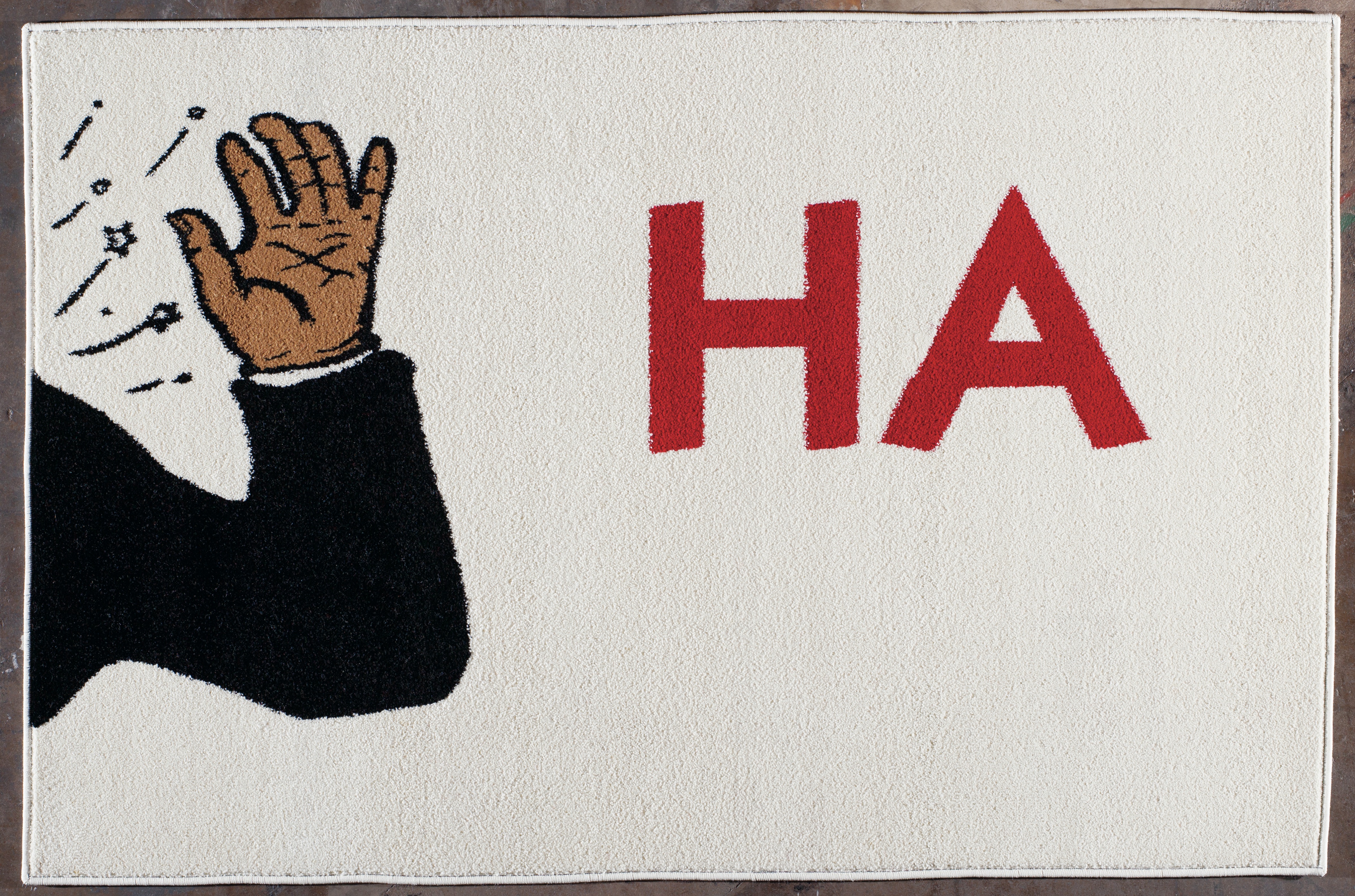
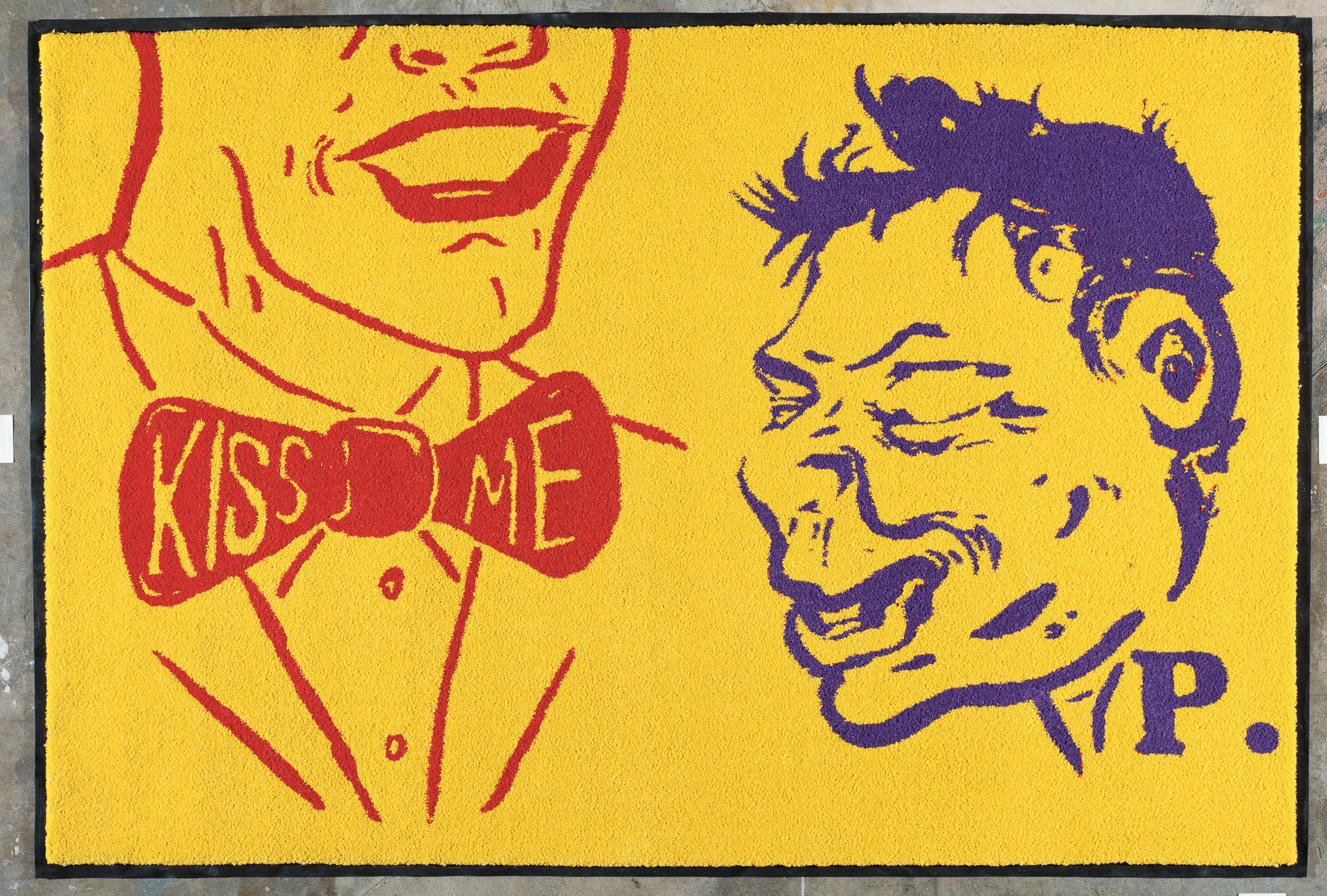
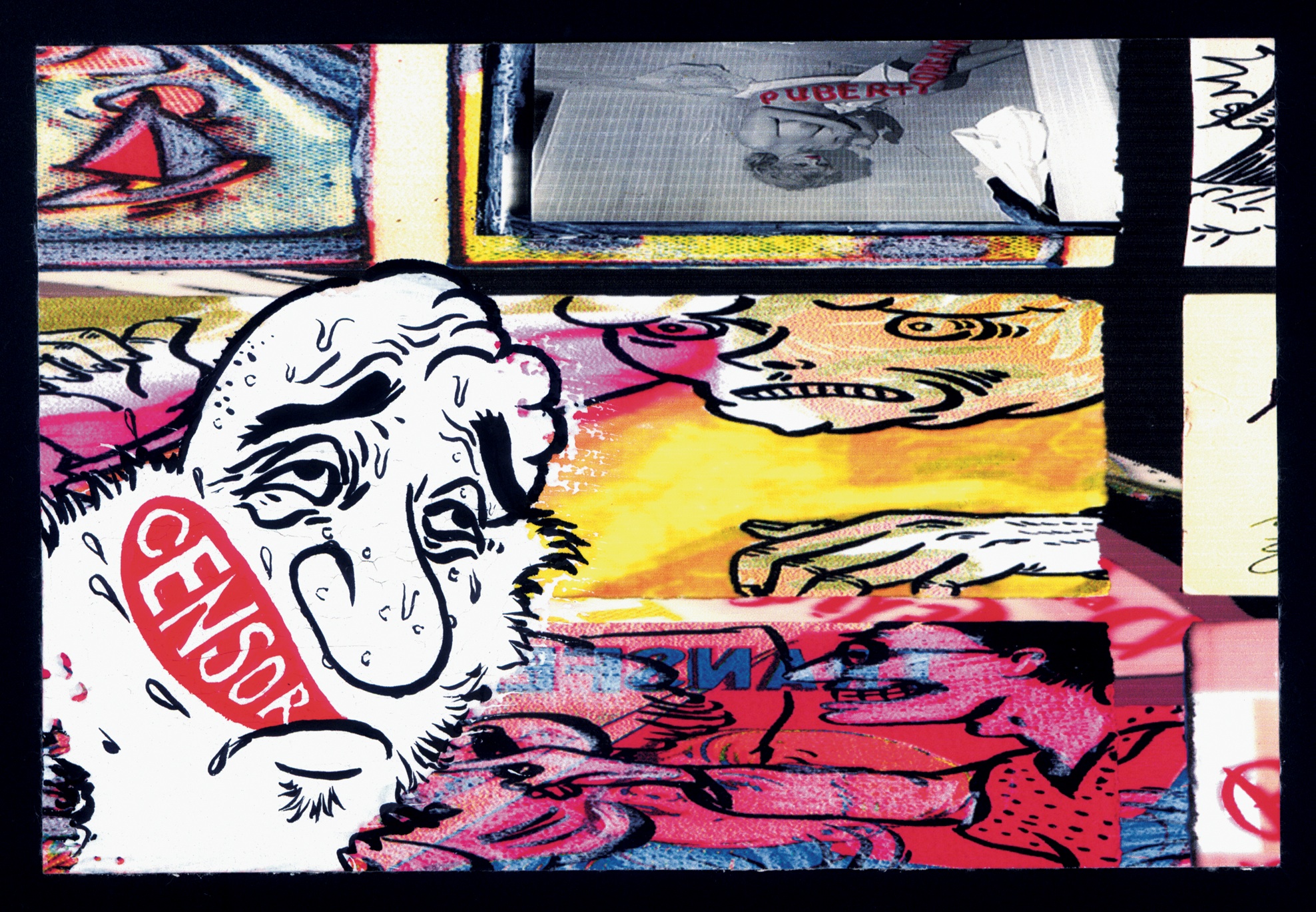
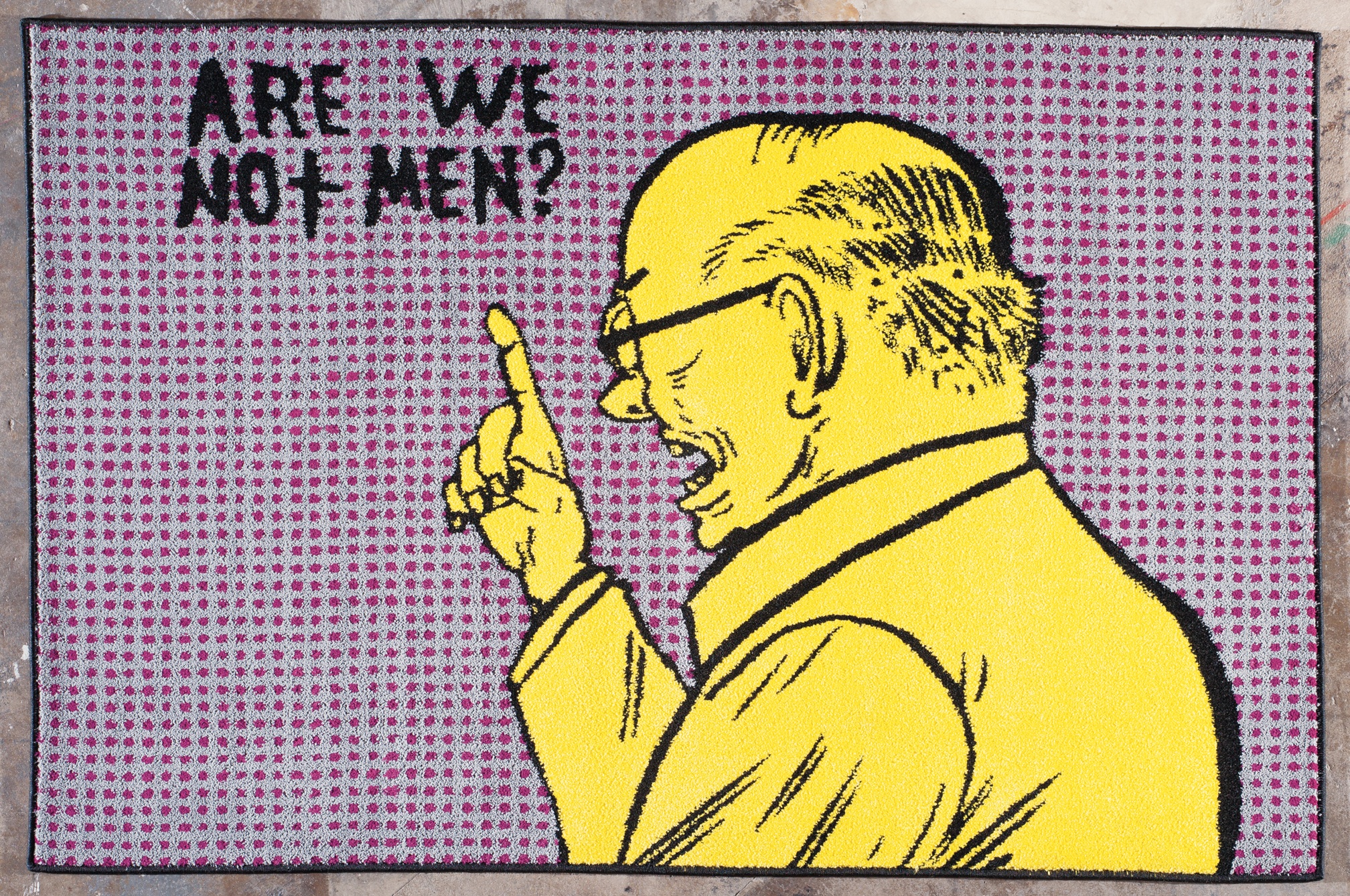
It kind of goes without saying for anyone who knows his or her DEVO, but Mothersbaugh’s sloganeering impulse is strongly influenced by advertising. Picking almost at random from the images, you can find phrases in Mothersbaugh’s pictures such as “Don’t Bullshit God, Padre!” “Press My Tummy, Buttwipe!” “I’m Keeping Score, You Fiend!” “Soiled Linen Pantaloons, Yakety Pants,” and on and on. The exclamation points aren’t incidental—there’s a hectoring quality that maybe prevents Mothersbaugh’s images from penetrating the upper echelons of art, but he’s awfully adept and they function really well below that threshold. Hell, even the ones without words are almost as emphatic—the man understands his icons. As for originality, obviously Mothersbaugh owes a huge debt to the pop art movement of the 1950s and after: The Ben-Day dots, visible on the cover, are obviously a nod to Roy Lichtenstein and through him to pop art in general.
My guess is that 90% of DEVO’s fans have no idea just how startling and accomplished an artist Mark Mothersbaugh is. If you take DEVO’s output and convert it to a collection of paintings, it would look a lot like the pieces in Myopia—possibly just because of the sheer number of postcard-style paintings and doodles Mothersbaugh has produced, the graphical art ranges a little wider and more freely than DEVO’s catalog, for reasons that should be mostly obvious. Also, the pretense of the Devolution schtick isn’t quite as present—the levels of pessimistic irony are a little flatter in the paintings, so you can apprehend it a little easier. It’s still about showing you the ugliest side of our noisy culture somehow, but you can admire it purely as an aesthetic thing without the oxytocin hit of DEVO’s spastic 4/4 beat.
Riggs’ Class Record No. 101 (No D) (pages 18 and 19), 1971
Untitled, 1984
LuAnn, ca. 1984
Untitled, 1991
Untitled, 2001
HA, 2004
Kiss Me, 2004
Untitled (Censor), 2004
Are We Not Men?, 2004
Untitled, 2010
(Most of the images in this post can be clicked on for a larger version.)
Here’s the first section of a roughly 75-minute interview conducted at the Museum Of Contemporary Art in Los Angeles a month ago:
(All images from Mark Mothersbaugh: Myopia edited by Adam Lerner, published by Princeton Architectural Press, 2014. The book goes on sale November 4 but you can pre-order it before then.)

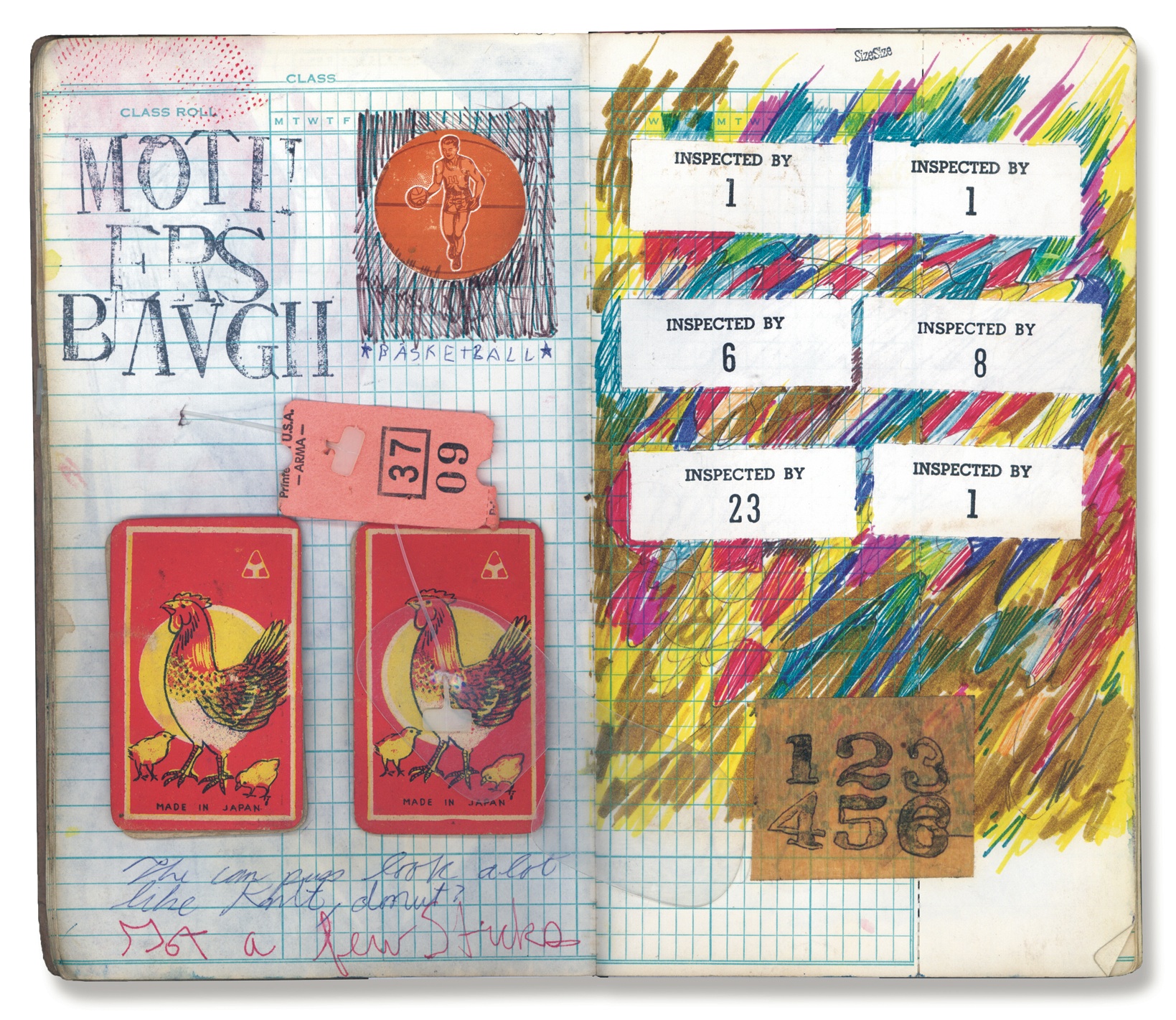

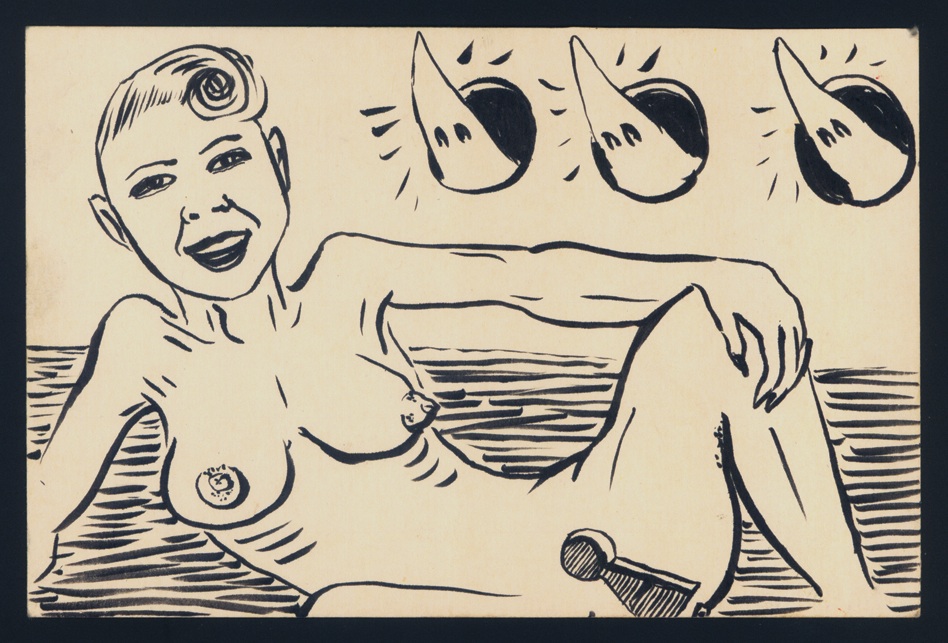
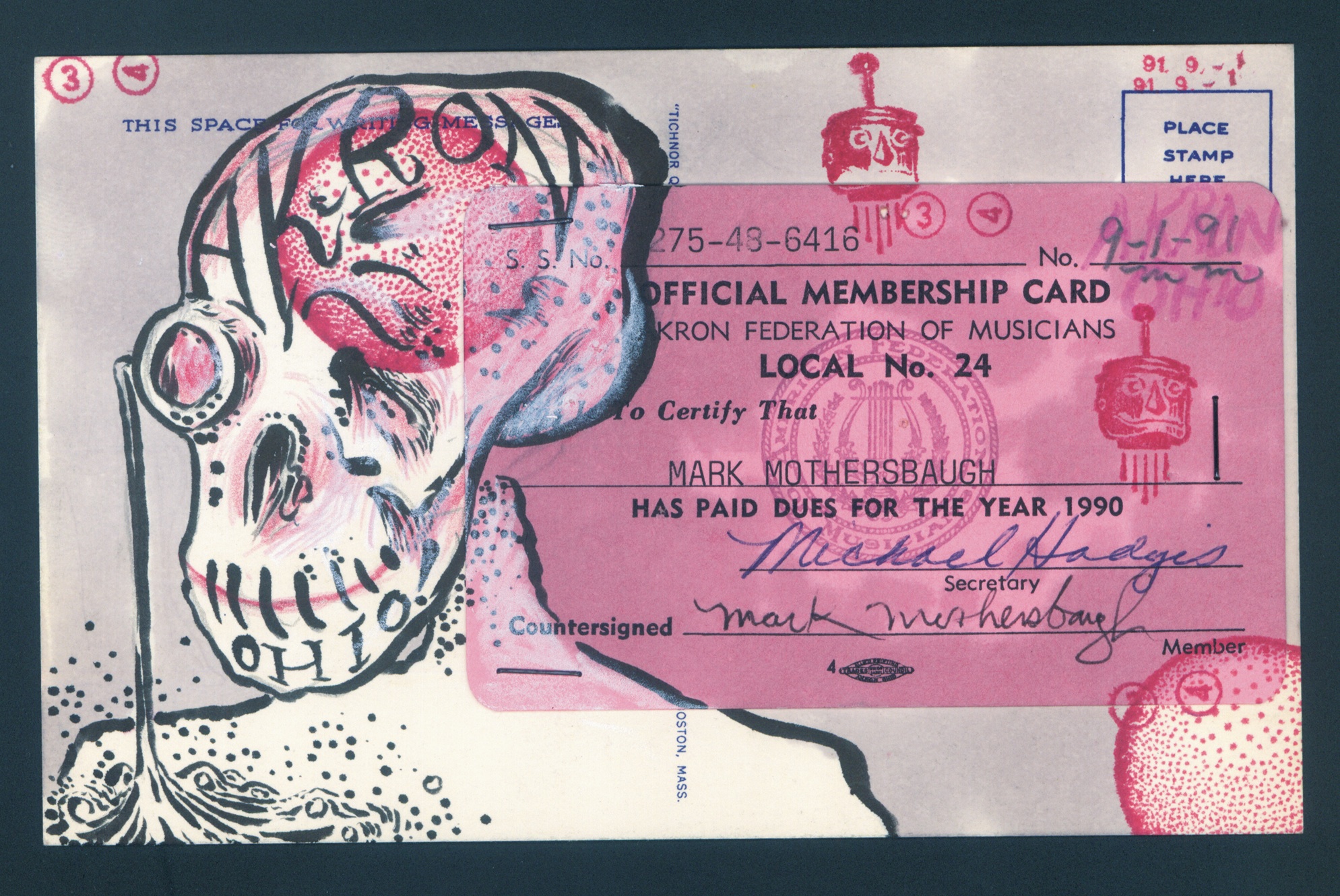
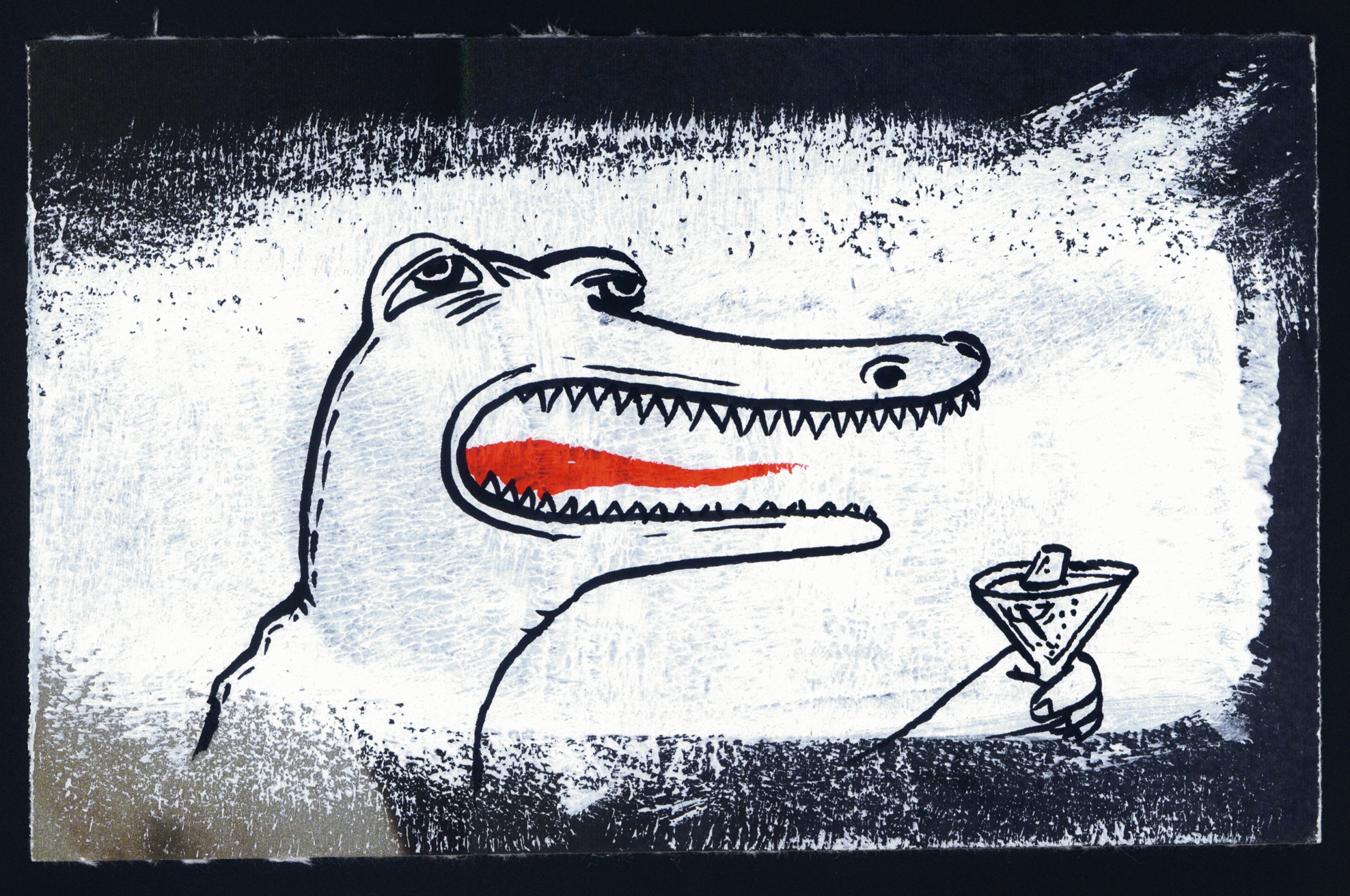
Friday, December 5, 2014
BLACK FLAG 1983
Playing a Suicidal party during the day in a garage.
(video)
Contrary to popular belief and the youTube caption, this is NOT in Mike Muir's garage, it was in the garage of the grandmother of Suicidal roadie Albert.
It turns out this was the last time Dez played in the band. The party was being thrown to get a bunch of Suicidal Tendencies fans together to shoot their hand drawn shirts for the debut album cover. I shot some great photos this day as well, although in this video i'm not taking pictures but can be seen slamming by the front.
These are just a few of the songs, about 14 minutes of video does exist, thanks to Al "FlipSide" but i could only find these two clips today.
here's a previously un published one that appears in the new MY RULES book.

Thursday, December 4, 2014
Wu-Tang Clan ALERT!
RZA Vegan Interview:
Do Good Today for ‘A Better Tomorrow’

A Better Tomorrow isn't simply the name of the latest Wu-Tang Clan album—it's also RZA's hope for the world. He encourages fans to follow in his footsteps and make the change and go vegan because, as he puts it, it doesn't make sense to put "dead flesh" into a "live body." The musician understands that the choices he makes in his own life can either contribute to or help alleviate the pain and suffering that animals experience at the hands of the meat industry. RZA, along with PETA friend Masta Killa and other Wu-Tang members, has chosen to live better today, knowing that it'll truly make for a better tomorrow. And he hopes others will be inspired to go vegan to help to save the lives of animals and for their own well-being.from PeTA
Watch his exclusive interview with PETA and see RZA explain his choice to help animals by not eating them.
Animals value their lives just as much as you value yours. Yet their lives are sacrificed for profit, and human health suffers because of it. RZA makes the point that we shouldn't be putting the product of such stress and death into our living bodies.It's never too soon (or too late) to make the kind, smart choice to adopt a plant-based diet, giving your health a boost and sparing animals unnecessary suffering. And it's never been easier to give up meat, eggs, and dairy products—today, there are numerous cruelty-free options available in grocery stores and restaurants across the country. PETA also has hundreds of free, delicious vegan recipes for you to try!
Wednesday, December 3, 2014
from Pee-wee Herman
"ONE OF MY ALL-TIME FAVORITE NECKTIES!"
from Pee-wee Herman's Log


To be safe, I’d buy at least TWO!! My eyes are up here!!!
LOOK: HERE


FYI, I’m not giving up my bow tie anytime soon…
Tuesday, December 2, 2014
Monday, December 1, 2014
Ian x the scream
instant classic

Based on one of my photos of Ian MacKaye during his Minor Threat days, and the famous painting known as "The Scream" by Edvard Munch


Mash-up by "King James" - thank you
Sunday, November 30, 2014
Tiny Homes for the Homeless an Occupy Madison Project
from Revolution News:


Madison Wisconsin: In a city with a homeless population that has risen by 7 percent over the last four years to about 3,370, Occupy Madison organizers decided to tell their local leaders to “put up or shut up” and developed a non profit organization Occupy Madison Inc. In June 2013 OM Build was born and Tiny Homes was decided on as a solution.
To achieve their goals of a Tiny Village complete with 9 tiny homes, permanent comprehensive day resource center, safer places to sleep at night, as well as access to restrooms, showers, laundry, community gardening space, and other basic needs for people experiencing homelessness, OM Build realized that they would need to work from within the system. The hard and relentless work paid off. Scheduled for November 15th 2014 is a Ribbon Cutting Event for The first Tiny Village for the Homeless in Madison.

Local organizers also state “Our approach to working within the system came only after we realized that without dotting every “i”, and crossing every “t”, the city and the county would never let us operate– they used every opportunity to enforce ordinances, regulations, and seemingly arbitrary whims against us. This paralleled precisely the persecution of everyday, unaffiliated, homeless individuals. When you are homeless, “the system” is rife with obstacles designed to prevent creative innovation or adaptation– we at Occupy Madison experienced the same headaches.” organizers also stated “In many ways, we have had much more success since we changed our approach. This was due not only to how we communicated with city and county offices (we never shirked from being open or transparent), but how we are perceived by Madison’s genteel liberal population. It’s stunning how a flowerbed on a windowsill can be so much better for PR than the window itself, or the house it’s attached to.”
At least six other cities nationwide are adopting Tiny Homes… others are installing Homeless Spikes. One OM Build organizer in Madison stated that Homeless pikes are “disgusting” and a “weak attempt to make even society’s most uninviting spaces– doorways, parks, etc– uninhabitable as well” He also states “People don’t choose to sleep in the gutter. Physically preventing people from getting whatever rest they can will not help them in any way, and nor do they help society. It’s tempting to say that for every spike a municipality erects, they should provide a warm, safe, clean, bed. But the truth is that we should be providing those beds anyway.”

Local organizers and volunteers state that “next is occupancy and fundraising. We’ve done a lot of work and spent a lot of money getting our site ready for people to move in. Now is a critical time for us financially– if we can’t raise enough funds to pay for making the site as wonderful as it is, there’s a real risk our whole project could go under.” Donations can be sent to paypay account http://bit.ly/1uSYGew Fundraiser in the past have been matched on a dollar per dollar basis and none of current progress would be possible without a 100% volunteer effort.
Local grass root groups that deserve a special shout out include: Friends of the State Street Family, The Bubbles program, (which provides free laundry services to the homeless), Occupy Madison, OM Build, Homeless Ministry at Bethel Lutheran Church, Madison Street Pulse (a cooperative homeless newspaper based In Madison WI).

Saturday, November 29, 2014
SALAD DAYS: A TALK WITH THE FORMER FANZINE KIDS BEHIND THE NEW 80S DC PUNK DOCUMENTARY
from Dangerous Minds:
During the ten-year timespan that encapsulated the Reagan presidency and the emergence of Washington, D.C. as the nation’s murder capital, the1980s DC punk underground became a hotbed of incendiary youth activism. The 1980s saw the birth of Dischord Records and DC bands like Minor Threat, Beefeater, Fire Party, Soulside, Rites of Spring, and Fugazi as the harDCore scene matured around community action groups like Positive Force that advocated for punk rock to take direct action against societal injustice.
The early scene was not without its critics, and was sometimes derided by music reviewers like Robert Christgau who, according to Positive Force founder, Mark Anderson, in his seminal history of DC punk, Dance of Days, once called the emerging aggressive breed of young punks “muscleheads.” As a counterpoint, according to Anderson, the comment lead to the title of Flex Your Head, a compilation of DC punk released on Dischord Records in 1982.
The DC underground’s fiercely D.I.Y and, often, cerebral take on traditional punk rock continues to resonate.
A new documentary about the era called Salad Days: The DC Punk Revolution, is set to make its debut in a few weeks. Created by Director Scott Crawford, a then very youthful fanzine chronicler of the 1980’s DC punk scene and Jim Saah (Director of Photography and Editor), a now professional photographer who taught himself the art in large part by shooting DC punk performances, the Kickstarter-funded film will begin seeing the light of day in November after being in the works for nearly four years. Salad Days features interviews with DC punk and post-punk luminaries Ian MacKaye, J. Robbins, Brian Baker, Kenny Inouye, Dante Ferrando and many others. DC post-punk outfit Soulside, three members of which went on to form Girls Against Boys, will reunite for a handful of shows in conjunction with the NYC and DC premiers.
I sent both Crawford and Saah a few questions via email recently and asked them to discuss the upcoming release of the film, their backgrounds as young fanzine creators, and what the 1980s DC hardcore scene meant to them.
DM: Scott, tell me about your years of making underground publications and what drew you to the Salad Days project.
Crawford: My love of magazines started as a kid when I published a fanzine called Metrozine that was focused on the DC punk scene. I did that for almost three years until I started playing in a band. Years later, I started two other zines that focused on the indie rock world at the time and I worked with some amazing writers and photographers (including Jim Saah). In 2001, I started another consumer music magazine out of my basement called HARP that was eventually bought by another publishing company. I worked as the Editor and Creative Director for seven years—and the focus was independent music and culture. Unfortunately once the economy bottomed out, so did the magazine industry and we were a casualty.
I’d been wanting to document the DC punk scene in the 1980s somehow and just thought a documentary film was the best way to tell the story. Speaking with a lot of the people that I’d spoken to almost 30 years ago (as a fanzine kid) provides a type of perspective that I think offers a unique take on the story. Honestly, after the magazine went under, I was floundering a bit personally and professionally. While the film took almost four years to complete, it’s been therapeutic, humbling and incredibly satisfying.
DM: This music was literally life changing for so many young people, but there have always been haters out there about it from critics to other punks who thought the scene was overly earnest and self-righteous. As you pointed out in your Kickstarter campaign, so much is misunderstood about DC punk in the 80’s. What’s the biggest misunderstanding?
Crawford: The DC punk scene in the 1980s was polarizing. Whether it was straight edge, socio-political issues or “emo”, they all provoke a reaction of some sort—which speaks volumes for the impact that this city has had not just on independent music but the culture at large. My eight-year-old daughter has never heard an Embrace song, but she uses the word “emo” on a daily basis. But as the film explores, not everyone was straight edge, humorless and pious. It was a diverse community and while it had its share of disfunction, it was made up of incredibly creative, hard-working people that created a thriving music scene at a time when there was no real local radio support or music industry infrastructure to help support it. That’s no small feat.
In this clip from Salad Days, Ian MacKaye talks about still addressing the straight edge issue.
DM: Talk about the Soulside reunion shows that are coming up in conjunction with the film’s release.
Crawford: I’d been talking to the band for a while about doing a reunion show when the film was ready to come out. They haven’t played on a stage in over 25 years so I really wasn’t sure if it’d actually come together, but I think the timing just worked for them. Personally speaking, they were always a favorite of mine, so it’s particularly meaningful to have them onboard. It’s going to be a really special weekend.
DM: Is there still a movement mentality in the D.C. underground?
Crawford: I think that’s part of the DNA of folks living in DC and active in the underground music community. I think having organizations like Positive Force in the city helps keep the activism alive.
DM: Jim, How long have you known Scott Crawford and how have you guys worked together over the years? How’d you get involved in the Salad Days film?
Saah: I’ve known Scott since he was twelve years old. He called me and asked if he could use my photos in his fanzine. Then later on I would shoot photos for the various music magazines he would do over the years, Noise Works, Bent and Harp. I did fanzines of my own that Scott wrote for as well. In the 80’s I did Zone V which was a photo/fanzine, then in the 90s I did about a dozen issues of Uno Mas, which was more of a culture fanzine. I’ve thought about doing a book from time to time about DC punk rock but not a film. Scott came to me with the idea to make a film. He actually had to talk me into it a bit because I thought it was a daunting task. And it was! But since we have a long friendship and have collaborated on many things over the years it was very easy falling into a good workflow for the film.
DM: You shot everybody from the DC underground in the early 80’s including Faith, Government Issue, Scream, Black Market Baby, Iron Cross, and Minor Threat (including their last show at Landsburgh Center in 1983) to name just a few. How old were you in 1983? Did you feel like these bands were making history?
Saah: I turned eighteen in March of 1983. I didn’t have a sense of history being made at the time, but there was a sense that we found something special, something that spoke to us and wasn’t what everyone else at school was into. It was special. I was incredibly excited by the whole thing. I discovered older punk rock first; NY and British stuff from the late 70’s. But then I quickly found out that people were making incredible punk rock right now in my backyard! So we went to every show and drank it all in. I didn’t start a band but I did start a fanzine and took photos at all the shows and loved the community and camaraderie. It was a beautiful thing to be accepted by like-minded people.
(I asked both Crawford and Saah the following) What’s the underlying message of Salad Days and what do hope for young musicians and artists to take away from it?
Saah: For me the underlying message is that this music scene and community taught me that I can do anything I set my mind to, that I didn’t need anyone’s permission to be a photographer. I just needed to do it. It set me on a path that I’m still on. I took pictures of bands for my fanzine, then for the City Paper then for the Washington Post. The punk ethos taught me to believe in myself, and also taught me how to not settle for what’s put in front of me in regards to art and culture. It taught me that it may take a little work to find a band or book or movie that’s not easily found on the radio or in the library or at the Cineplex at the mall, but people are making incredible, moving and inspiring art that’s off the mainstream radar and it’s extremely rewarding to go find it. I’m still on the hunt to this day. And now my kids turn me on to cool shit that I didn’t know existed.
Crawford: Salad Days isn’t about nostalgia for me. It’s about looking at that period in my life and applying the things I learned then to my life now. In other words, my best days aren’t behind me—they’re ahead of me. Hell, they’re right now.
DM: How can people get their hands (or at least eyes) on the film once it’s released?
Crawford: We’re premiering the film over the November 14, 2014 weekend at DOC NYC Film Festival in NYC, and in the Midwest (the same night) at the Sound Unseen Film Festival in Minneapolis, MN and on Sunday, November 16 at the Olympia Film Festival in Olympia, WA. Then our Washington, DC premier begins on December 19 at the AFI Theater and runs through December 22. After that, we’ll be doing a few more film festivals followed by a theatrical run and DVD/VOD.
Look for updates on the film’s Facebook page and check out the trailer for Salad Days below:


Friday, November 28, 2014
Shepard Fairey x Glen E. Friedman x My Rules
x Obey clothing - officially released today

from Obey Clothing
We're proud to present a collaboration between legendary photographer Glen E. Friedman and OBEY. Glen has shot some of the most memorable and meaningful photos in skateboarding, punk rock, hip hop and more over the last 30 years. Always with an eye for perfection and living by the definition of integrity, Glen has amassed a body of work including album covers for the Beastie Boys, Public Enemy, and Suicidal Tendencies. He was there to shoot Minor Threat, Bad Brains and the DC scene. Glen was in back yard pools taking pictures of Tony Alva and the Dogtown crew as they changed skateboarding.
Over the years, Glen and Shepard have collaborated on a number of projects, most of which were never available on apparel. Now Glen has released a new book, My Rules, and we thought it was a perfect time to release some of those collaborations. So in support of My Rules we are releasing 4 of those works, each representing a different genre. There is Tony Alva from Dogtown and skateboarding, Henry Rollins from Black Flag, Cornell West the political activist and Public Enemy for hip hop.


CHECK out some of the collection at OBEY CLOTHING


Thursday, November 27, 2014


Wednesday, November 26, 2014
Why we are unaware that we lack the skill to tell how unskilled and unaware we are
from Boing Boing:

Each one of us has a relationship with our own ignorance, a dishonest, complicated relationship, and that dishonesty keeps us sane, happy, and willing to get out of bed in the morning. By David McRaney

Each one of us has a relationship with our own ignorance, a dishonest, complicated relationship, and that dishonesty keeps us sane, happy, and willing to get out of bed in the morning. By David McRaney
Here’s a fun word to add to your vocabulary: nescience. I ran across it a few months back and kind of fell in love with it.
It’s related to the word prescience, which is a kind of knowing. Prescience is a state of mind, an awareness, that grants you knowledge of the future – about something that has yet to happen or is not yet in existence. It’s a strange idea isn’t it, that knowledge is a thing, a possession, that it stands alone and in proxy for something else out there in reality that has yet to actually…be? Then, the time comes, and the knowledge is no longer alone. Foreknowledge becomes knowledge and now corresponds to a real thing that is true. It is no longer pre-science but just science.
I first learned the word nescience from the book Ignorance and Surprise by Matthias Gross. That book revealed to me that, philosophically speaking, ignorance is a complicated matter. You can describe it in many ways. In that book Gross talks about the difficulties of translating a sociologist named Georg Simmel who often used the word “nichtwissen” in his writing. Gross says that some translations changed that word to nescience and some just replaced it with “not knowing.” It’s a difficult to term to translate, he explains, because it can mean a few different things. If you stick to the Latin ins and outs of the word, nescience means non-knowledge, or what we would probably just call ignorance. But Gross writes that in some circles it has a special meaning. He says it can mean something you can’t know in advance, or an unknown unknown, or something that no human being can ever hope to know, something a theologian might express as a thought in the mind of God. For some people, as Gross points out, everything is in the mind of God, so therefore nothing is actually knowable. To those people nescience is the natural state of all creatures and nothing can ever truly be known, not for sure. Like I said, ignorance is a complex concept.
It’s that last meaning of nescience that I think is most fun. Take away the religious aspect and nescience is prescience in negative. It is the state of not knowing, but stronger than that. It’s not knowing something that can’t be known. It’s not even knowing that you can’t know it. For instance, your cat can never read or understand the latest terms and conditions for iTunes, thus if she clicked on “I Agree,” we wouldn’t consider that binding. There are vast expanses of ignorance that your cat can’t even imagine, much less gain the knowledge about those things required to rid herself of that ignorance. That’s the definition of nescience I prefer.
I love this word, because once you accept this definition you start to wonder about a few things. Are there some things that, just like my cat, I can never know that I can never know? Are there things that maybe no one can ever know that no one can ever know? It’s a fun, frustrating, dorm-room-bong-hit-whoa-dude loop of weirdness that real philosophers and sociologists seriously ponder and continue to write about in books you can buy on Amazon.
I think I like this idea because I often look back at my former self and imagine what sort of advice I would offer that person. It seems like I’m always in a position to do that, no matter how old I am or how old the former me is in my imagination. I was always more ignorant than I am now, even though I didn’t feel all that ignorant then. That means that it’s probably also true that right now I’m sitting here in a state of total ignorance concerning things that my future self wishes he could shout back at me through time. Yet here I sit, unaware. Nescient.
The evidence gathered so far by psychologists and neuroscientists seems to suggest that each one of us has a relationship with our own ignorance, a dishonest, complicated relationship, and that dishonesty keeps us sane, happy, and willing to get out of bed in the morning. Part of that ignorance is a blind spot we each possess that obscures both our competence and incompetence.
Psychologists David Dunning and Joyce Ehrlinger once conducted an experiment investigating how bad people are at judging their own competence. Specifically, they were interested in people’s self-assessment of a single performance. They wrote in the study that they already knew from previous research that people seemed to be especially prone to making mistakes when they judged the accuracy of their own perceptions if those perceptions were of themselves and not others. To investigate why, they created a ruse.
In the study, Dunning and Ehrlinger describe how they gathered college students together who agreed to take a test. All the participants took the exact same test – same font, same order, same words, everything – but the scientists told one group that it was a test that measured abstract reasoning ability. They told another group it measured computer programming ability. Two groups of people took the same exam, but each batch of subjects believed it was measuring something unique to that group. When asked to evaluate their own performances, the people who believed they had taken a test that measured reasoning skills reported back that they felt they did really well. The other group, however, the ones who believed they had taken a test that measured computer programming prowess, weren’t so sure. They guessed that they did much poorer on the test than did the other group – even though they took the same test. The real results actually showed both groups did about the same. The only difference was how they judged their own performances. The scientists said that it seemed as though the subjects weren’t truly judging how well they had done based on any ease or difficulty they may have experienced during the test itself, but they were inferring how well they had performed based on the kind of people they believed themselves to be.
Dunning and Ehrlinger knew that most college students tend to hold very high opinions of themselves when it comes to abstract reasoning. It’s part of what they call a “chronic self view.” You have an idea of who you are in your mind, and it is kind of like a character in a story, the protagonist in the tale of your life. Some aspects of that character are chronic, traits that are always there that you feel are essential and evident, beliefs about your level of skill that are consistent across all situations. For most college students, being great at abstract reasoning is one of those traits, but being great at computer programming is not.
Dunning and Ehrlinger write that the way you view your past performances can greatly affect your future decisions, behaviors, judgments, and choices. They bring up the example of a first date. How you judge your contribution to the experience might motivate you to keep calling someone who doesn’t want to ever see you again, or it might cause you to miss out on something wonderful because you mistakenly think the other person hated every minute of the night. In every aspect of our lives, they write, we are evaluating how well we performed and using that analysis to decide when to continue and when to quit, when to try harder and work longer and when we can sit back and rest because everything is going just fine. Yet, the problem with this is that we are really, really bad at this kind of analysis. We are nescient. The reality of our own abilities, the level of our own skills, both when lacking and when excelling, is often something we don’t know that we don’t know.
Dunning and Ehrlinger put it like this, “In general, the perceptions people hold, of either their overall ability or specific performance, tend to be correlated only modestly with their actual performance.” We must manage our own ignorance when reflecting on any performance – a test, an athletic event, a speech, or even a conversation. Whether modest or confident, you often depend on the image you maintain of yourself as a guide for how well you did more than actual feedback. To make matters worse, you often don’t get any feedback, or you get a bad version of it.
In the case of singing, you might get all the way to an audition on X-Factor on national television before someone finally provides you with an accurate appraisal. Dunning says that the shock that some people feel when Simon Cowell cruelly explains to them that they suck is often the result of living for years in an environment filled with mediocrity enablers. Friends and family, peers and coworkers, they don’t want to be mean or impolite. They encourage you to keep going until you end up in front of millions reeling from your first experience with honest feedback.
When you are unskilled yet unaware, you often experience what is now known in psychology as the Dunning-Kruger effect, a psychological phenomenon that arises sometimes in your life because you are generally very bad at self-assessment. If you have ever been confronted with the fact that you were in over your head, or that you had no idea what you were doing, or that you thought you were more skilled at something than you actually were – then you may have experienced this effect. It is very easy to be both unskilled and unaware of it, and in this episode we explore why that is with professor David Dunning, one of the researchers who coined the term and a scientist who continues to add to our understanding of the phenomenon.
Read more about the Dunning-Kruger effect from David Dunning himself in this article recently published in the Pacific Standard.
Subscribe to:
Posts (Atom)


