Via South China Morning Post
What has been called the world’s largest air purifier by its operators is now up and running in the Chinese city of Xian in Shaanxi province. The 100-meter (328 feet) tall tower has already improved the local air quality, lead scientist Cao Junji told the South China Morning Post, adding that it could prove to be a valuable tool in the country’s fight against urban air pollution. “The tower has no peer in terms of size … the results are quite encouraging,” he said. Greenhouses covering the size of half a soccer field surround the base of the tower, into which polluted air is pulled. The smog is heated in the greenhouse by solar energy, then rises through the tower, passing through several layers of cleaning filters.
Cao stresses that the results are only initial while further details will be released in the spring. A comprehensive scientific assessment of the tower’s effectiveness is also forthcoming. Nonetheless, what is known is promising. While there have been other similar smog-removing towers, many of which were powered by coal-fueled electricity, the Xian tower is unique in its very limited electricity needs. “It barely requires any power input throughout daylight hours. The idea has worked very well in the test run,” said Cao. While locals have marveled at the tower’s size, it is in fact a miniature version of smog-removing towers that Cao and his team hope to install throughout China’s dense, massive cities. The full-size version could reach as high as 500 meters (1,640 feet) while the surrounding greenhouses could cover nearly 30 square kilometers (11.6 square miles).
Showing posts with label china. Show all posts
Showing posts with label china. Show all posts
Tuesday, January 23, 2018
China built the ‘World’s biggest air purifier’
– and it’s actually working
from Inhabitat


Tuesday, September 22, 2015
Tuesday, November 5, 2013
Blue sky billboard in smoggy Beijing - China's Toxic Sky
from The Atlantic


Since the beginning of this year, the levels of air pollution in Beijing have been dangerously high, with thick clouds of smog chasing people indoors, disrupting air travel, and affecting the health of millions. The past two weeks have been especially bad -- at one point the pollution level measured 40 times recommended safety levels. Authorities are taking short-term measures to combat the current crisis, shutting down some factories and limiting government auto usage. However, long-term solutions seem distant, as China's use of coal continues to rise, and the government remains slow to acknowledge and address the problems. * Starting with photo #2, a four-part set of these images is interactive, allowing you to click the photo and 'clear the air', viewing a difference over time. (31 Photos here)
Tuesday, March 27, 2012
'Holy Cow'
Visualtraveling presents 'Holy Cow' a ten minute piece summarizing a month long [skateboarding] journey through the chromatic & chaotic countries of South Asia.
Pushing and on boards were Walker Ryan, Laurence Keefe, Michael Mackrodt and Kenny Reed.
Directed, filmed & edited by Patrik Wallner
And the previous from Patrik Wallner
'Where do we Land?' Converse China trip to Mongolia.
Both clips are pretty damn cool.
Related: Early skateboard innovator and pioneer Larry Stevenson 81 dies
Saturday, January 15, 2011
30,000 Used Chopsticks Transformed Into a Fallen Tree in Shanghai
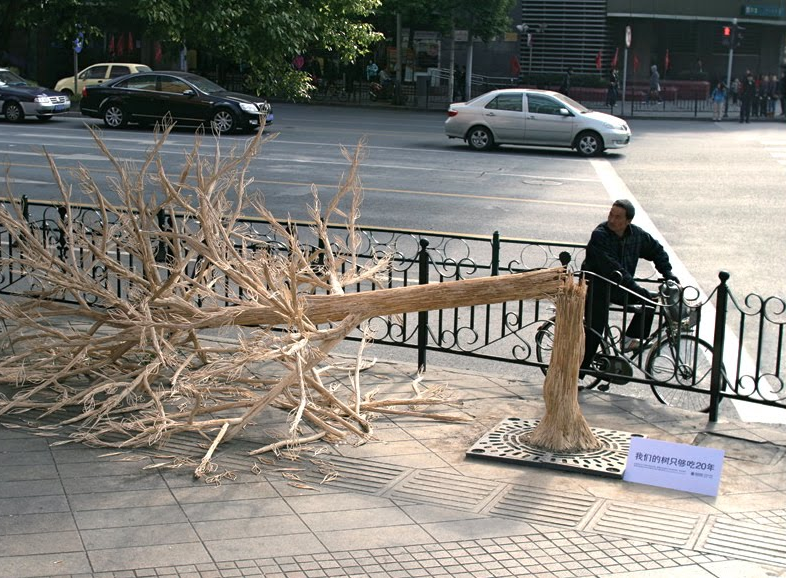
from Inhabitat
Single use-chopsticks are a notable waste issue in China - roughly 100 trees a day must be felled to create the little, wooden eating utensils. In response to the atrocities being subjected to these innocent trees, the China Environmental Protection Foundation has assembled the ghostly remains of meals past into a full-sized chopstick tree. An impressive sculpture standing beautiful and tall, this was actually far from the message they hoped to convey. So what did they do to get their point across? They broke it and handed out reusable chopstick sets and statistics near the slain tree.
The tree was built from 30,000 used wooden chopsticks, stretched five meters high. It stood along a local street in Shanghai accompanied by a laundry list of chopstick consumption statistics. And despite the likelihood they were dipped numerous times in soy sauce, the sticks were odor-free having been thoroughly cleansed before assembly.
The hope of this project was to raise awareness and encourage the use of reusable chopsticks. China’s activists estimate that the country’s current forest stock will only support chopstick production for the next 20 years.

via Treehugger
With various "bring your own chopsticks" movements making little headway against the 45 billion pairs of disposable wooden utensils used each year in China alone, a clever Chinese environmental group has brought a dramatic visible representation of the environmental impact to the streets of downtown Shanghai.I eat with chopsticks almost all the time, almost never disposeble ones, and if the are disposable, they are bamboo. There's something about stabbing food and the need for cutting at the table is usually unnecessary, with my diet. It's much calmer to just pick it up and place it in your mouth rather than cutting, stabbing and shoving it in.
Though they can be made out of porcelain, plastic, lacquered bamboo, stainless steel, and even ivory or jade, chopsticks of the disposable wooden variety have long been the most-used utensil in China's restaurants and other eateries. Some 25 million trees are required to feed the country's annual chopstick, er, yen, according to the China Environmental Protection Foundation, which notes that at this rate, "forest will disappear from China in 20 years."
Only Two Decades' Worth Of Trees Left
To raise awareness about the problem, the foundation went around Shanghai and gathered 30,000 pairs of used disposable chopsticks from the city's restaurants. After washing and preparing them, they used the little wooden sticks to build a five-meter-high tree in a busy district of the city -- and then chopped it down. Volunteers were stationed by the fallen "tree" to hand out reusable chopsticks to curious passers-by, while a sign laid out the consumption statistics and warned: "Our trees are enough to feed us for only another 20 years."
We'll agree with tipster copyranter that it was an impressive and "pretty damn industrious" idea -- and hopefully one that makes a real impact.
Wednesday, November 4, 2009
Public pajama-wearers in China...
China: real-life fashion police crack down on public pajama-wearers
Shanghai will host the World Expo next year, and city officials are preparing for the influx of foreigners with a campaign to ban citizens from wearing their pajamas out in the streets. An article in the Chengdu Business Daily expresses outrage over the campaign as a civil rights abuse. Snip:

A quick Google of "shanghai" + "pajamas" reveals many articles in Western media over the past decade about Shanghai's pajama-wearing citizenry, and their government's fruitless attempts to mandate their fashion choices. Apparently, walking around in the street in your jammies is a familiar part of local culture in old neighborhoods there, in part because the realms of public and private space are so blurred in daily life.
 The ultimate in casual, i don't give a fuck style!
Shanghai will host the World Expo next year, and city officials are preparing for the influx of foreigners with a campaign to ban citizens from wearing their pajamas out in the streets. An article in the Chengdu Business Daily expresses outrage over the campaign as a civil rights abuse. Snip:
What's wrong with a person in pajamas? [via Rebecca MacKinnon] (Thanks Xeni, BoingBoing)Many Shanghai residents are used to loitering around the streets in their pajamas. But now the municipal government is making every effort to stop them from doing so, because it would be a "loss of face" for city authorities if a foreigner sees people walking the streets in pajamas during the 2010 World Expo. (...)
As a modern international metropolis, Shanghai has been playing host to foreigners for decades. So why have pajamas become embarrassing only now? And will it be okay for people to walk the streets in pajamas after the World Expo? Why should we change our habits and customs to suit foreigners' taste when we travel abroad as well as when we play host to them? Do we suffer from a sense of inferiority?


A quick Google of "shanghai" + "pajamas" reveals many articles in Western media over the past decade about Shanghai's pajama-wearing citizenry, and their government's fruitless attempts to mandate their fashion choices. Apparently, walking around in the street in your jammies is a familiar part of local culture in old neighborhoods there, in part because the realms of public and private space are so blurred in daily life.
 The ultimate in casual, i don't give a fuck style!
Subscribe to:
Posts (Atom)


