Showing posts with label civil liberties. Show all posts

Friday, October 23, 2015

Journalist Will Potter Describes Being First and Only Journalist to Visit Federal Communication Management Unit

from the Sparrow Project :

In a new TED Talk released today, investigative journalist and TED Senior Fellow Will Potter describes his experience as the first and only journalist to visit secretive prisons on U.S. soil that are referred to by prisoners and guards as “Little Guantanamo.”
Communications Management Units, or CMUs, are experimental prison units in the United States for so-called “second-tier terrorists.” There’s an estimated 60-70 prisoners in CMUs and they are overwhelmingly Muslim, along with several animal rights and environmental activists.
“According to the Bureau of Prisons, CMUs are for prisoners with quote ‘inspirational significance.’ I think that’s a polite way of saying they are political prisons, for political prisoners,” Potter says in the talk. “Prisoners are sent to the CMU because of their race, religion, or political beliefs.”
There are currently two CMUs, located within larger federal prisons in Terre Haute, Indiana and Marion, Illinois. Neither underwent the formal review process required by law when they were opened.
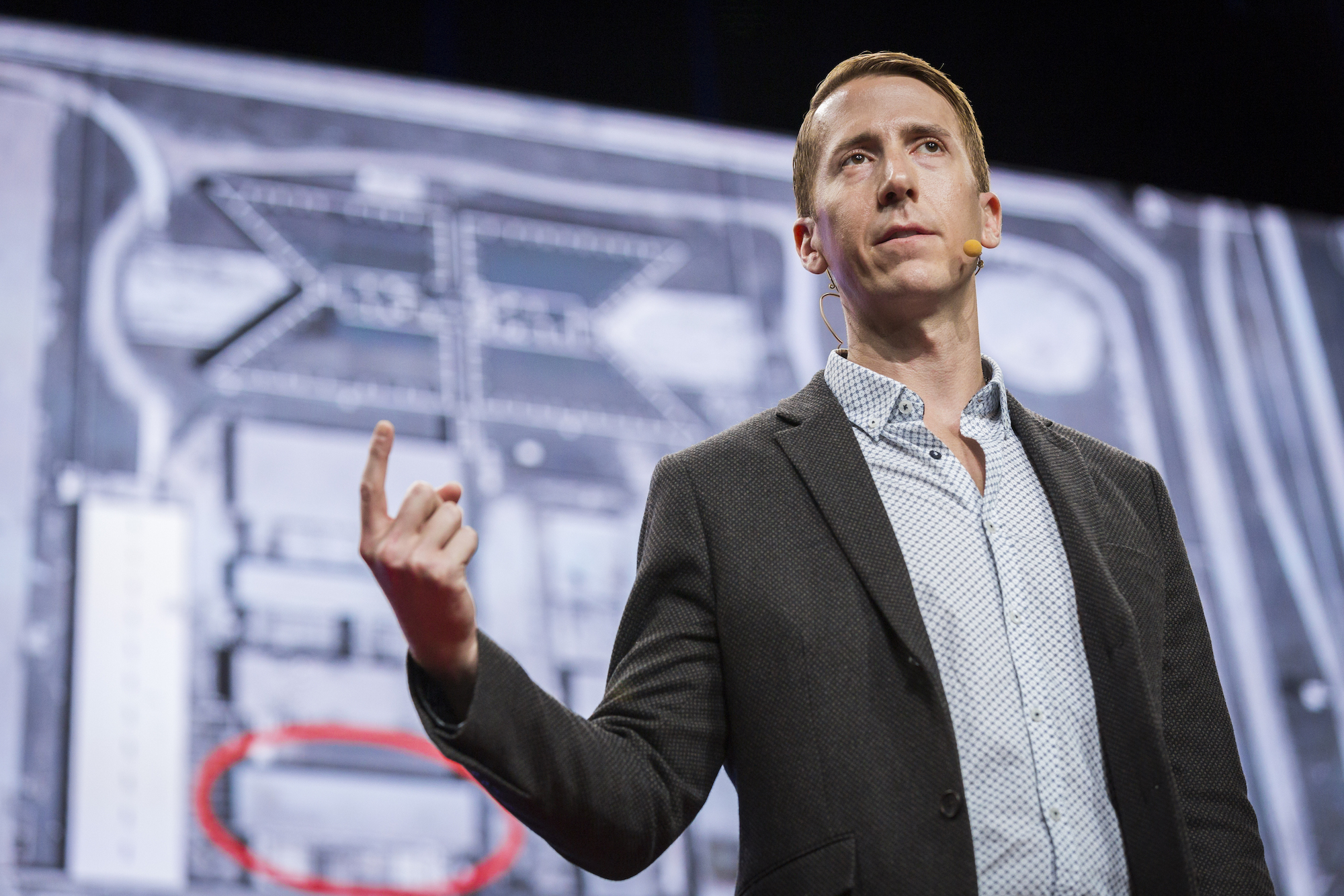
CMUs are not solitary confinement, but they radically restrict prisoner communications with the outside world to levels that meet or exceed the most extreme prisons in the country.Will Potter was allowed to visit environmental activist Daniel McGowan, who was being held at the CMU in Marion. Approval of this visit came as a shock since no other journalist has been allowed inside the CMUs and because documents obtained through the Freedom of Information Act have revealed that the Counter Terrorism Unit has monitored Potter’s speeches, articles, and his book Green Is The New Red. Attorneys and prisoners have said that inmates are transferred to the CMUs without notice and without opportunity to challenge their new designation, in what they say is a clear violation of due process rights.
“Three months after our visit, McGowan was transferred out of the CMU. Then without warning, he was sent back,” Potter says in the TED talk. “I had published leaked CMU documents on my website, and the Counter-Terrorism Unit said McGowan had called his wife and asked her to mail them. …For that, he was sent back to the CMU.”
Potter says CMUs are part of a dangerous post-9/11 trend that he has been documenting, in which the rhetoric of terrorism is used to justify rollbacks in fundamental rights.
“This story is not just about prisoners, it is about us,” he says. “It is about our own commitment to human rights.”
About Will Potter
Will Potter is an award-winning investigative journalist, author, and TED Senior Fellow based in Washington, D.C. He is the author of Green Is the New Red: An Insider’s Account of a Social Movement Under Siege. He specializes in civil liberties post-9/11 and how protest has been labeled as terrorism; Glenn Greenwald described Potter as “the most knowledgeable journalist in the country on these issues.” He is currently a Knight Fellow in Law Reporting at the University of Michigan.

Wednesday, February 8, 2012

The Oregon Bill That Would Criminalize Twitter


from Mother Jones
Under a bill debated today [yesterday] in Oregon, that tweet could be illegal.

The bill, SB 1534, would make it a felony to use "electronic communication to solicit two or more persons to commit [a] specific crime at [a] specific time and location." The punishment could include up to 5 years in prison and a $125,000 fine.

Critics worry that the bill is so broadly construed that it could outlaw everything from tweets about student sit-ins to Facebook posts calling for the occupation of Zuccotti Park in Manhattan. In Oregon, it might become a tool to crack down on Occupy Portland, which is calling for the nonviolent shutdown of corporations such as Bank of America and ExxonMobil later this month.

Earlier today, activists posted contact information for the bill's 11 co-sponsors and urged allies to call to voice their opposition. None of the lawmakers could be reached for comment this afternoon. In many cases, their phones were busy.

The author of the bill, Oregon Senator Doug Whitsett, defended it during a public hearing today. He wrote it to prevent people from saying: "'We are all going to arrive at Joe's Jewelry Store at 4:55 p.m. on Wednesday afternoon and we're going to rob him blind,'" he said. "This has been happening. At least 8 percent of the retailers in the United States have experienced that type of situation."

Still, speakers at the hearing overwhelmingly opposed the bill. "The law would inhibit somebody like Dr. Martin Luther King," said Eric Coker, an Oregon State PHD student. "It would have prevented something as simple as the Selma Bridge protest. All those people, if they had heard about it through electronic communication, they would all have been subject to a Class C felony."

Dan Meek, an attorney representing the Oregon Progressive Party, added: "I have to say, this is the kind of law that I would expect to see in Myanmar, Turkmenistan, North Korea or Zimbabwe, but not in Oregon."

UPDATE: The Oregonian reports that the bill died in committee today.

Thanks, Occupy Portland and Anonymous via Andy Stepanian

Wednesday, June 1, 2011

F.B.I. Target - someone who was unnecessarily followed

from the NYTimes
For Anarchist, Details of Life as F.B.I. Target

By COLIN MOYNIHAN and SCOTT SHANE

AUSTIN, Tex. — A fat sheaf of F.B.I. reports meticulously details the surveillance that counterterrorism agents directed at the one-story house in East Austin. For at least three years, they traced the license plates of cars parked out front, recorded the comings and goings of residents and guests and, in one case, speculated about a suspicious flat object spread out across the driveway.

“The content could not be determined from the street,” an agent observing from his car reported one day in 2005. “It had a large number of multi-colored blocks, with figures and/or lettering,” the report said, and “may be a sign that is to be used in an upcoming protest.”

Actually, the item in question was more mundane.
“It was a quilt,” said Scott Crow, marveling over the papers at the dining table of his ramshackle home, where he lives with his wife, a housemate and a backyard menagerie that includes two goats, a dozen chickens and a turkey. “For a kids’ after-school program.”

Mr. Crow, 44, a self-described anarchist and veteran organizer of anticorporate demonstrations, is among dozens of political activists across the country known to have come under scrutiny from the F.B.I.’s increased counterterrorism operations since the attacks of Sept. 11, 2001.

Other targets of bureau surveillance, which has been criticized by civil liberties groups and mildly faulted by the Justice Department’s inspector general, have included antiwar activists in Pittsburgh, animal rights advocates in Virginia and liberal Roman Catholics in Nebraska. When such investigations produce no criminal charges, their methods rarely come to light publicly.

But Mr. Crow, a lanky Texas native who works at a recycling center, is one of several Austin activists who asked the F.B.I. for their files, citing the Freedom of Information Act. The 440 heavily-redacted pages he received, many bearing the rubric “Domestic Terrorism,” provide a revealing window on the efforts of the bureau, backed by other federal, state and local police agencies, to keep an eye on people it deems dangerous.

In the case of Mr. Crow, who has been arrested a dozen times during demonstrations but has never been convicted of anything more serious than trespassing, the bureau wielded an impressive array of tools, the documents show.

The agents watched from their cars for hours at a time — Mr. Crow recalls one regular as “a fat guy in an S.U.V. with the engine running and the air-conditioning on” — and watched gatherings at a bookstore and cafe. For round-the-clock coverage, they attached a video camera to the phone pole across from his house on New York Avenue.

They tracked Mr. Crow’s phone calls and e-mails and combed through his trash, identifying his bank and mortgage companies, which appear to have been served with subpoenas. They visited gun stores where he shopped for a rifle, noting dryly in one document that a vegan animal rights advocate like Mr. Crow made an unlikely hunter. (He says the weapon was for self-defense in a marginal neighborhood.)

They asked the Internal Revenue Service to examine his tax returns, but backed off after an I.R.S. employee suggested that Mr. Crow’s modest earnings would not impress a jury even if his returns were flawed. (He earns $32,000 a year at Ecology Action of Texas, he said.)

They infiltrated political meetings with undercover police officers and informers. Mr. Crow counts five supposed fellow activists who were reporting to the F.B.I.

Mr. Crow seems alternately astonished, angered and flattered by the government’s attention. “I’ve had times of intense paranoia,” he said, especially when he discovered that some trusted allies were actually spies.

“But first, it makes me laugh,” he said. “It’s just a big farce that the government’s created such paper tigers. Al Qaeda and real terrorists are hard to find. We’re easy to find. It’s outrageous that they would spend so much money surveilling civil activists, and anarchists in particular, and equating our actions with Al Qaeda.”

The investigation of political activists is an old story for the F.B.I., most infamously in the Cointel program, which scrutinized and sometimes harassed civil rights and antiwar advocates from the 1950s to the 1970s. Such activities were reined in after they were exposed by the Senate’s Church Committee, and F.B.I. surveillance has been governed by an evolving set of guidelines set by attorneys general since 1976.

But the Oklahoma City bombing in 1995 demonstrated the lethal danger of domestic terrorism, and after the Sept. 11 attacks, the F.B.I. vowed never again to overlook terrorists hiding in plain sight. The Qaeda sleeper cells many Americans feared, though, turned out to be rare or nonexistent.

The result, said Michael German, a former F.B.I. agent now at the American Civil Liberties Union, has been a zeal to investigate political activists who pose no realistic threat of terrorism.

“You have a bunch of guys and women all over the country sent out to find terrorism. Fortunately, there isn’t a lot of terrorism in many communities,” Mr. German said. “So they end up pursuing people who are critical of the government.”

Complaints from the A.C.L.U. prompted the Justice Department’s inspector general to assess the F.B.I.’s forays into domestic surveillance. The resulting report last September absolved the bureau of investigating dissenters based purely on their expression of political views. But the inspector general also found skimpy justification for some investigations, uncertainty about whether any federal crime was even plausible in others and a mislabeling of nonviolent civil disobedience as “terrorism.”

Asked about the surveillance of Mr. Crow, an F.B.I. spokesman, Paul E. Bresson, said it would be “inappropriate” to discuss an individual case. But he said that investigations are conducted only after the bureau receives information about possible crimes.

“We do not open investigations based on individuals who exercise the rights afforded to them under the First Amendment,” Mr. Bresson said. “In fact, the Department of Justice and the bureau’s own guidelines for conducting domestic operations strictly forbid such actions.”

It is not hard to understand why Mr. Crow attracted the bureau’s attention. He has deliberately confronted skinheads and Ku Klux Klan members at their gatherings, relishing the resulting scuffles. He claims to have forced corporate executives to move with noisy nighttime protests.

He says he took particular pleasure in a 2003 demonstration for Greenpeace in which activists stormed the headquarters of ExxonMobil in Irving, Tex., to protest its environmental record. Dressed in tiger outfits, protesters carried banners to the roof of the company’s offices, while others wearing business suits arrived in chauffeured Jaguars, forcing frustrated police officers to sort real executives from faux ones.

“It was super fun,” said Mr. Crow, one of the suits, who escaped while 36 other protesters were arrested. “They had ignored us and ignored us. But that one got their attention.”

It got the attention of the F.B.I. as well, evidently, leading to the three-year investigation that focused specifically on Mr. Crow. The surveillance documents show that he also turned up in several other investigations of activism in Texas and beyond, from 2001 to at least 2008.

For an aficionado of civil disobedience, Mr. Crow comes across as more amiable than combative. He dropped out of college, toured with an electronic-rock band and ran a successful Dallas antiques business while dabbling in animal rights advocacy. In 2001, captivated by the philosophy of anarchism, he sold his share of the business and decided to become a full-time activist.

Since then, he has led a half-dozen groups and run an annual training camp for protesters. (The camps invariably attracted police infiltrators who were often not hard to spot. “We had a rule,” he said. “If you were burly, you didn’t belong.”) He also helped to found Common Ground Relief, a network of nonprofit organizations created in New Orleans after Hurricane Katrina.

Anarchism was the catchword for an international terrorist movement at the turn of the 20th century. But Mr. Crow, whose e-mail address contains the phrase “quixotic dreaming,” describes anarchism as a kind of locally oriented self-help movement, a variety of “social libertarianism.”

“I don’t like the state,” he said. “I don’t want to overthrow it, but I want to create alternatives to it.”

This kind of talk appears to have baffled some of the agents assigned to watch him, whose reports to F.B.I. bosses occasionally seem petulant. One agent calls “nonviolent direct action,” a phrase in activists’ materials, “an oxymoron.” Another agent comments, oddly, on Mr. Crow and his wife, Ann Harkness, who have been together for 24 years, writing that “outwardly they did not appear to look right for each other.” At a training session, “most attendees dressed like hippies.”

Such comments stand out amid detailed accounts of the banal: mail in the recycling bin included “a number of catalogs from retail outlets such as Neiman Marcus, Ann Taylor and Pottery Barn.”

Mr. Crow said he hoped the airing of such F.B.I. busywork might deter further efforts to keep watch over him. The last documents he has seen mentioning him date from 2008. But the Freedom of Information Act exempts from disclosure any investigations that are still open.

“I still occasionally see people sitting in cars across the street,” he said. “I don’t think they’ve given up.”

Friday, December 10, 2010

The Love Police visit the New York Subway system

I first posted about the incredible Love Police from London, on this blog, back in March. I love this crew. Here's their latest, enjoy:


via Nerdcore

Tuesday, December 7, 2010

Calling Time on Assange

Dec. 12's issue of Time casts Wikileaks in a positive light, echoing a classic image of American censorship and pointing out that harm is not yet evident in the candor forced upon an unwilling government. Imagine how sad it would be for Fareed Zakaria's lovely smile to be covered thus! America's mainstream media often seems resentful of Wikileaks' beating it, bullying it and spoon-feeding it, but has perhaps rediscovered something it loathes far more: Joementum. Here's the cover story, by Massimo Calabresi.
From BoingBoing [via @kaepora]

Tuesday, October 26, 2010

Feds forced to admit that it's legal to take pictures of federal buildings

via BoingBoing
The New York Civil Liberties Union and Libertarian activist Antonio Musumeci just won a court case that affirms the right of photographers to take pictures and record video out front of federal courthouses. The US federal government settled the case by apologizing to Musumeci for his arrest, acknowledging that it is legal to record at courthouses, and promising to issue guidelines to federal officers explaining this fact to them.
"Not only will this settlement end harassment of photographers outside federal courthouses, it will free people to photograph and film outside of all federal buildings," said NYCLU Associate Legal Director Christopher Dunn, lead counsel in the case. "The regulation at issue in this case applies to all federal buildings, not only courthouses, so this settlement should extend to photography near all federal buildings nationwide.
NYCLU Settlement Ends Restriction on Photography Outside Federal Courthouses

Sunday, September 12, 2010

OpenMike 9/11/10

Michael Moore has started a new daily blog, here's just his second entry:
If That 'Mosque' ISN'T Built, This Is No Longer America

I am opposed to the building of the "mosque" two blocks from Ground Zero.
I want it built on Ground Zero.


Why? Because I believe in an America that protects those who are the victims of hate and prejudice. I believe in an America that says you have the right to worship whatever God you have, wherever you want to worship. And I believe in an America that says to the world that we are a loving and generous people and if a bunch of murderers steal your religion from you and use it as their excuse to kill 3,000 souls, then I want to help you get your religion back. And I want to put it at the spot where it was stolen from you.

There's been so much that's been said about this manufactured controversy, I really don't want to waste any time on this day of remembrance talking about it. But I hate bigotry and I hate liars, and so in case you missed any of the truth that's been lost in this, let me point out a few facts:

1. I love the Burlington Coat Factory. I've gotten some great winter coats there at a very reasonable price. Muslims have been holding their daily prayers there since 2009. No one ever complained about that. This is not going to be a "mosque," it's going to be a community center. It will have the same prayer room in it that's already there. But to even have to assure people that "it's not going to be mosque" is so offensive, I now wish they would just build a 111-story mosque there. That would be better than the lame and disgusting way the developer has left Ground Zero an empty hole until recently. The remains of over 1,100 people still haven't been found. That site is a sacred graveyard, and to be building another monument to commerce on it is a sacrilege. Why wasn't the entire site turned into a memorial peace park? People died there, and many of their remains are still strewn about, all these years later.

2. Guess who has helped the Muslims organize their plans for this community center? The JEWISH COMMUNITY CENTER of Manhattan! Their rabbi has been advising them since the beginning. It's been a picture-perfect example of the kind of world we all want to live in. Peter Stuyvessant, New York's "founder," tried to expel the first Jews who arrived in Manhattan. Then the Dutch said, no, that's a bit much. So then Stuyvessant said ok, you can stay, but you cannot build a synagogue anywhere in Manhattan. Do your stupid Friday night thing at home. The first Jewish temple was not allowed to be built until 1730. Then there was a revolution, and the founding fathers said this country has to be secular -- no religious nuts or state religions. George Washington (inaugurated around the corner from Ground Zero) wanted to make a statement about this his very first year in office, and wrote this to American Jews:
"The citizens of the United States of America have a right to applaud themselves for having given to mankind examples of an enlarged and liberal policy -- a policy worthy of imitation. ...

"It is now no more that toleration is spoken of as if it were the indulgence of one class of people that another enjoyed the exercise of their inherent natural rights, for, happily, the Government of the United States, which gives to bigotry no sanction, to persecution no assistance, requires only that they who live under its protection should demean themselves as good citizens ...

"May the children of the stock of Abraham who dwell in this land continue to merit and enjoy the good will of the other inhabitants -- while every one shall sit in safety under his own vine and fig tree and there shall be none to make him afraid."
3. The Imam in charge of this project is the nicest guy you'd ever want to meet. Read about his past here.

4. Around five dozen Muslims died at the World Trade Center on 9/11. Hundreds of members of their families still grieve and suffer. The 19 killers did not care what religion anyone belonged to when they took those lives.

5. I've never read a sadder headline in the New York Times than the one on the front page this past Monday: "American Muslims Ask, Will We Ever Belong?" That should make all of us so ashamed that even a single one of our fellow citizens should ever have to worry about if they "belong" here.

6. There is a McDonald's two blocks from Ground Zero. Trust me, McDonald's has killed far more people than the terrorists.

7. During an economic depression or a time of war, fascists are extremely skilled at whipping up fear and hate and getting the working class to blame "the other" for their troubles. Lincoln's enemies told poor Southern whites that he was "a Catholic." FDR's opponents said he was Jewish and called him "Jewsevelt." One in five Americans now believe Obama is a Muslim and 41% of Republicans don't believe he was born here.

8. Blaming a whole group for the actions of just one of that group is anti-American. Timothy McVeigh was Catholic. Should Oklahoma City prohibit the building of a Catholic Church near the site of the former federal building that McVeigh blew up?

9. Let's face it, all religions have their whackos. Catholics have O'Reilly, Gingrich, Hannity and Clarence Thomas (in fact all five conservatives who dominate the Supreme Court are Catholic). Protestants have Pat Robertson and too many to list here. The Mormons have Glenn Beck. Jews have Crazy Eddie. But we don't judge whole religions on just the actions of their whackos. Unless they're Methodists.

10. If I should ever, God forbid, perish in a terrorist incident, and you or some nutty group uses my death as your justification to attack or discriminate against anyone in my name, I will come back and haunt you worse than Linda Blair marrying Freddy Krueger and moving into your bedroom to spawn Chucky. John Lennon was right when he asked us to imagine a world with "nothing to kill or die for and no religion, too." I heard Deepak Chopra this week say that "God gave humans the truth, and the devil came and he said, 'Let's give it a name and call it religion.' " But John Adams said it best when he wrote a sort of letter to the future (which he called "Posterity"): "Posterity! You will never know how much it cost the present Generation to preserve your Freedom! I hope you will make a good use of it. If you do not, I shall repent in Heaven that I ever took half the Pains to preserve it." I'm guessing ol' John Adams is up there repenting nonstop right now.

Friends, we all have a responsibility NOW to make sure that Muslim community center gets built. Once again, 70% of the country (the same number that initially supported the Iraq War) is on the wrong side and want the "mosque" moved. Enormous pressure has been put on the Imam to stop his project. We have to turn this thing around. Are we going to let the bullies and thugs win another one? Aren't you fed up by now? When would be a good time to take our country back from the haters?

I say right now. Let's each of us make a statement by donating to the building of this community center! It's a nonprofit, tax-exempt organization and you can donate a dollar or ten dollars (or more) right now through a secure pay pal account by clicking here. I will personally match the first $10,000 raised (forward your PayPal receipt to webguy@michaelmoore.com). If each one of you reading this blog/email donated just a couple of dollars, that would give the center over $6 million, more than what Donald Trump has offered to buy the Imam out. C'mon everyone, let's pitch in and help those who are being debased for simply wanting to do something good. We could all make a huge statement of love on this solemn day.

I lost a co-worker on 9/11. I write this today in his memory.

"The man who speaks of the enemy / Is the enemy himself."
-- Bertolt Brecht

Thursday, August 26, 2010

This Modern World asks:
A mosque near ground zero?

I'm offended even thinking about it! On earth and parallel earth alike, the wingnuts escalate the crazy BY TOM TOMORROW

(click on story image to read it full size)


getting caught in the shitstorm vortex...

Thanks, Eric

Saturday, July 24, 2010

Taking Photos In Public Places Is Not A Crime

from our friend Xeni at BoingBoing

Glenn Reynolds of Instapundit has a piece in Popular Mechanics about the growing trend of cops bullying photographers who take pictures in public places, and why officials who believe such photography is against the law are mistaken.


I believe there is a good case to be made that having lots of cameras in the hands of citizens makes us more, rather than less, safe. Here's how bad it has gotten: Not long ago, an Amtrak representative did an interview with local TV station Fox 5 in Washington, D.C.'s Union Station to explain that you don't need a permit to take pictures there--only to be approached by a security guard who ordered them to stop filming without a permit.

Legally, it's pretty much always okay to take photos in a public place as long as you're not physically interfering with traffic or police operations. As Bert Krages, an attorney who specializes in photography-related legal problems and wrote Legal Handbook for Photographers, says, "The general rule is that if something is in a public place, you're entitled to photograph it." What's more, though national-security laws are often invoked when quashing photographers, Krages explains that "the Patriot Act does not restrict photography; neither does the Homeland Security Act." But this doesn't stop people from interfering with photographers, even in settings that don't seem much like national-security zones.

Taking Photos In Public Places Is Not A Crime: Analysis (popularmechanics.com, Illustration by Rui Ricardo, courtesy Popular Mechanics)

Thursday, July 1, 2010

London cops enforce imaginary law against brave, principled teenaged photographer


I FUCKING LOVE THIS KID. check his own blog for the scoop. or read this piece from BoingBoing:
Two police officers stopped a teenaged freelance photographer from taking pictures of police cadets marching in an Armed Forces Day in London. The officers claimed (incorrectly) that it was against the law to photograph minors without parental consent. Then they pushed him down a set of stairs and detained him. The photographer recorded the incident, including the officers claiming that they didn't need any law to detain him.

Jules Mattsson, the 16-year-old photographer, is very, very good in this recording. He knows his rights, he admirably keeps his cool as two lawless goons with badges harass him and detain him. Kids like this give me hope for the future of the human race. On the other hand, cops who invent imaginary laws and demand that the public abide by them -- after the Association of Police Chiefs has made it abundantly clear that the police must not harass amateur and professional photographers.

"I was quickly and aggressively stopped by one of their adult officers asking me who I worked for," he wrote on his blog. "I responded that I was a freelance and upon being told I needed parental permission to photograph them, I explained this was a public event in a public place and that I didn't for editorial use."

The audio recording begins minutes later with an officer initially arguing that it is illegal to take photographs of children. He then claims that it is illegal to take images of army members and police officers.

Under laws that guarantee the freedom of press in Britain, there is no restriction on photography of children, police or armed forces in a public space. There is new legislation to protect the identities of some police officers but only those working undercover or in instances where an officer genuinely believes a photographer is collecting data for terrorist purposes.
from The Independent: Officers claim they don't need law to stop photographer taking pictures

Friday, June 25, 2010

Photographers' bust-card screened onto a lenscloth

Very cool, I hope someone will save one for me!


The UK Amateur Photographer magazine is giving away free lenscloths silk-screened with the Photographers' Bill of Rights with its July issue. UK anti-terror legislation gave the police sweeping powers to harass photographers for shooting in public places, and to compound matters, tabloid-driven hysteria over paedophilia has seen many photographers accused to paedophilia for taking pictures of (for example) public busses and empty playgrounds. UK law enforcement heads and the new government have spoken out against the practice, but it does not seem like word has reached the copper on the street, as there are still numerous accounts of photographers being rousted for taking pictures in public.

Photographers' rights campaign spawns lens cloth launch

thanks, BoingBoing

Friday, June 4, 2010

Are Cameras the New Guns?

from Gizmodo:
In response to a flood of Facebook and YouTube videos that depict police abuse, a new trend in law enforcement is gaining popularity. In at least three states, it is now illegal to record any on-duty police officer.

Even if the encounter involves you and may be necessary to your defense, and even if the recording is on a public street where no expectation of privacy exists.

The legal justification for arresting the "shooter" rests on existing wiretapping or eavesdropping laws, with statutes against obstructing law enforcement sometimes cited. Illinois, Massachusetts, and Maryland are among the 12 states in which all parties must consent for a recording to be legal unless, as with TV news crews, it is obvious to all that recording is underway. Since the police do not consent, the camera-wielder can be arrested. Most all-party-consent states also include an exception for recording in public places where "no expectation of privacy exists" (Illinois does not) but in practice this exception is not being recognized.

Massachusetts attorney June Jensen represented Simon Glik who was arrested for such a recording. She explained, "[T]he statute has been misconstrued by Boston police. You could go to the Boston Common and snap pictures and record if you want." Legal scholar and professor Jonathan Turley agrees, "The police are basing this claim on a ridiculous reading of the two-party consent surveillance law - requiring all parties to consent to being taped. I have written in the area of surveillance law and can say that this is utter nonsense."

The courts, however, disagree. A few weeks ago, an Illinois judge rejected a motion to dismiss an eavesdropping charge against Christopher Drew, who recorded his own arrest for selling one-dollar artwork on the streets of Chicago. Although the misdemeanor charges of not having a peddler's license and peddling in a prohibited area were dropped, Drew is being prosecuted for illegal recording, a Class I felony punishable by 4 to 15 years in prison.

In 2001, when Michael Hyde was arrested for criminally violating the state's electronic surveillance law - aka recording a police encounter - the Massachusetts Supreme Judicial Court upheld his conviction 4-2. In dissent, Chief Justice Margaret Marshall stated, "Citizens have a particularly important role to play when the official conduct at issue is that of the police. Their role cannot be performed if citizens must fear criminal reprisals…." (Note: In some states it is the audio alone that makes the recording illegal.)

The selection of "shooters" targeted for prosecution do, indeed, suggest a pattern of either reprisal or an attempt to intimidate.

Glik captured a police action on his cellphone to document what he considered to be excessive force. He was not only arrested, his phone was also seized.

On his website Drew wrote, "Myself and three other artists who documented my actions tried for two months to get the police to arrest me for selling art downtown so we could test the Chicago peddlers license law. The police hesitated for two months because they knew it would mean a federal court case. With this felony charge they are trying to avoid this test and ruin me financially and stain my credibility."

Hyde used his recording to file a harassment complaint against the police. After doing so, he was criminally charged.

In short, recordings that are flattering to the police - an officer kissing a baby or rescuing a dog - will almost certainly not result in prosecution even if they are done without all-party consent. The only people who seem prone to prosecution are those who embarrass or confront the police, or who somehow challenge the law. If true, then the prosecutions are a form of social control to discourage criticism of the police or simple dissent.

A recent arrest in Maryland is both typical and disturbing.

On March 5, 24-year-old Anthony John Graber III's motorcycle was pulled over for speeding. He is currently facing criminal charges for a video he recorded on his helmet-mounted camera during the traffic stop.

The case is disturbing because:

1) Graber was not arrested immediately. Ten days after the encounter, he posted some of he material to YouTube, and it embarrassed Trooper J. D. Uhler. The trooper, who was in plainclothes and an unmarked car, jumped out waving a gun and screaming. Only later did Uhler identify himself as a police officer. When the YouTube video was discovered the police got a warrant against Graber, searched his parents' house (where he presumably lives), seized equipment, and charged him with a violation of wiretapping law.

2) Baltimore criminal defense attorney Steven D. Silverman said he had never heard of the Maryland wiretap law being used in this manner. In other words, Maryland has joined the expanding trend of criminalizing the act of recording police abuse. Silverman surmises, "It's more [about] ‘contempt of cop' than the violation of the wiretapping law."

3) Police spokesman Gregory M. Shipley is defending the pursuit of charges against Graber, denying that it is "some capricious retribution" and citing as justification the particularly egregious nature of Graber's traffic offenses. Oddly, however, the offenses were not so egregious as to cause his arrest before the video appeared.

Almost without exception, police officials have staunchly supported the arresting officers. This argues strongly against the idea that some rogue officers are overreacting or that a few cops have something to hide. "Arrest those who record the police" appears to be official policy, and it's backed by the courts.

Carlos Miller at the Photography Is Not A Crime website offers an explanation: "For the second time in less than a month, a police officer was convicted from evidence obtained from a videotape. The first officer to be convicted was New York City Police Officer Patrick Pogan, who would never have stood trial had it not been for a video posted on Youtube showing him body slamming a bicyclist before charging him with assault on an officer. The second officer to be convicted was Ottawa Hills (Ohio) Police Officer Thomas White, who shot a motorcyclist in the back after a traffic stop, permanently paralyzing the 24-year-old man."

When the police act as though cameras were the equivalent of guns pointed at them, there is a sense in which they are correct. Cameras have become the most effective weapon that ordinary people have to protect against and to expose police abuse. And the police want it to stop.

Happily, even as the practice of arresting "shooters" expands, there are signs of effective backlash. At least one Pennsylvania jurisdiction has reaffirmed the right to video in public places. As part of a settlement with ACLU attorneys who represented an arrested "shooter," the police in Spring City and East Vincent Township adopted a written policy allowing the recording of on-duty policemen.

As journalist Radley Balko declares, "State legislatures should consider passing laws explicitly making it legal to record on-duty law enforcement officials."

Wendy McElroy is the author of several books on anarchism and feminism. She maintains the iconoclastic website ifeminists.net as well as an active blog at wendymcelroy.com.
Thanks, Chris!

Friday, May 7, 2010

Devo's Jerry Casale on the Kent State Massacre, May 4, 1970


Forty years ago [this week] at Kent State University, Ohio National Guardsmen shot four unarmed students to death and wounded nine others. In 2005 the Vermont Review interviewed Devo's Jerry Casale. Here's an excerpt from the interview in which Casale shares his memories of the Kent State Massacre and how it led to the formation of Devo.
VR: Going back to your early days. You were present at the Kent State shootings in 1970. How did that day affect you?

JC: Whatever I would say would probably not at all touch upon the significance or gravity of the situation at this point of time -- it would probably sound trite or glib. All I can tell you is that it completely and utterly changed my life. I was a white hippie boy and then I saw exit wounds from M1 rifles out of the backs of two people I knew. Two of the four people who were killed, Jeffrey Miller and Allison Krause, were my friends. We were all running our asses off from these motherfuckers. It was total, utter bullshit. Live ammunition and gasmasks - none of us knew, none of us could have imagined... They shot into a crowd that was running away from them! I stopped being a hippie and I started to develop the idea of devolution. I got real, real pissed off.


VR: Does Neil young's "Ohio" strike close to your heart?

JC: Of course. It was strange that the first person that we met, as Devo emerged, was Neil Young. He asked us to be in his movie, The Human Highway. It was so strange - San Francisco in 1977. Talk about life being karmic, small and cyclical - it's absolutely true. In fact I just got a call from a person organizing a 30th Anniversary commemoration. Noam Chomsky will be there and I may go talk there if I can get away. I still remember it so crystal clear, like a dream you will never forget . . . or a nightmare. I still remember every moment. It kind of went in slow motion like a car accident.


VR: You said that the Kent State shooting sort of served as a catalyst for your theory of Devolution, which spawned Devo--

JC: Absolutely. Until then I was a hippie. I thought that the world is essentially good. If people were evil, there was justice... and that the law mattered. All of those silly naïve things. I saw the depths of the horrors and lies and the evil. The paper that evening, the Akron Beacon Journal, said that students were running around armed and that officers had been hurt. So deputy sheriffs went out and deputized citizens. They drove around with shotguns and there was martial law for ten days. 7 PM curfew. It was open season on the students. We lived in fear. Helicopters surrounding the city with hourly rotating runs out to the West Side and back downtown. All first amendment rights are suspended at the instant the governor gives the order. All of the class-action suits by the parents of the slain students were all dismissed out of court, because once the governor announced martial law, they had no right to assemble.


Oh Yes, It’s Devo: An Interview with Jerry Casale

Further interest, read Jeff Kisselof, author of Generation on Fire: Voices of Protest from the 1960s, An Oral History remembered it on his fantastic blog too.

from BoingBoing

Tuesday, March 9, 2010

The Love Police

The Love Police show you how to beat the London cops on a bullshit terrorism stop.

Lessons here: KNOW YOUR SHIT BEFORE YOU FUCK WITH THE PO-LICE. And you may win the battle and help win the war against law enforcement abuse.

That said; However tight these guys are I don't think this would fly worth a shit in New York or Los Angeles in 2010. But it is an incredible act of a citizen who cares.


For more great examples of these guys trying to keep the law in it's place go to their youtube channel: cveitch.org

Thanks, BoingBoing

Friday, January 22, 2010

Mass Gathering in defence of street photography

Ever since I started taking pictures as a pre-teen, authorities and others have tried stopping me, usually under the pretense of trespassing. Other times the authorities wanted to destroy the evidence of their "handy-work" or to just try to discourage me from doing what i was doing: to further inspire others in a rebellious lifestyle. But taking pictures in public spaces of architecture or anything of interest in the public sphere? This should not even be a question, the paranoia and control issues with terrorism as an excuse is not only despicable, it's pathetic and disgusting.

"They that can give up essential liberty to obtain a little temporary safety deserve neither liberty or safety"
- Benjamin Franklin (1759)

The UK activist group "I'm a Photographer Not a Terrorist!" is planning a mass photo-shooting this Saturday in Trafalgar Square, London: "Following a series of high profile detentions under s44 of the terrorism act including 7 armed police detaining an award winning architectural photographer in the City of London, the arrest of a press photographer covering campaigning santas at City Airport and the stop and search of a BBC photographer at St Pauls Cathedral and many others. PHNAT feels now is the time for a mass turnout of Photographers, professional and amateur to defend our rights and stop the abuse of the terror laws."

Photography is under attack. Across the country it that seems anyone with a camera is being targeted as a potential terrorist, whether amateur or professional, whether landscape, architectural or street photographer.

Not only is it corrosive of press freedom but creation of the collective visual history of our country is extinguished by anti-terrorist legislation designed to protect the heritage it prevents us recording.

This campaign is for everyone who values visual imagery, not just photographers.

We must work together now to stop this before photography becomes a part of history rather than a way of recording it.
for more info go here:
http://photographernotaterrorist.org

(Thanks BoingBoing)

Thursday, November 19, 2009

Will Phillips, Ten Year Old American Hero

from DangerousMinds:
This young man, Will Phillips, a ten year-old student in Washington County Arkansas is very, very impressive. He’s smart, he’s articulate, he’s logical and he is passionate about doing the right thing. This kid is awesome. When Will took his stand—or rather kept his seat—against a rote recitation of the Pledge of Allegiance in his classroom until there really is liberty and justice for all Americans—including lesbians, gays and transgendered people, he had no idea that his small gesture of defiance would end up with him on CNN. But there he was and wow, this kid is just unflappable. He even looks smart, and that’s impossible to fake (Compare his countenance to Sarah Palin’s!) You can see the wheels going round in his head before he opens his mouth. And when he speaks, he speaks the truth. God bless you Will, go out there and make your mark on the world.

When you watch the video clip note how Will’s father, Jay Philllips, is obviously bursting with pride over his son’s principled act of civil disobedience. It’s a beautiful thing to watch, a private/public moment of great empathy Jay shows toward Will. Jay and his wife, Laura, are active supporters of the local LGBT community, and have clearly instilled a sense of right and wrong in their son and they, too, deserve a round of applause—make that a standing ovation—for having raised a child this fantastic.
“I’ve always tried to analyze things because I want to be lawyer,” Will said. “I really don’t feel that there’s currently liberty and justice for all.”

After asking his parents whether it was against the law not to stand for the pledge, Will decided to do something. On Monday, Oct. 5, when the other kids in his class stood up to recite the pledge of allegiance, he remained sitting down. The class had a substitute teacher that week, a retired educator from the district, who knew Will’s mother and grandmother. Though the substitute tried to make him stand up, he respectfully refused. He did it again the next day, and the next day. Each day, the substitute got a little more cross with him. On Thursday, it finally came to a head. The teacher, Will said, told him that she knew his mother and grandmother, and they would want him to stand and say the pledge.

“She got a lot more angry and raised her voice and brought my mom and my grandma up,” Will said. “I was fuming and was too furious to really pay attention to what she was saying. After a few minutes, I said, ‘With all due respect, ma’am, you can go jump off a bridge.’ ”

Will was sent to the office, where he was given an assignment to look up information about the flag and what it represents. Meanwhile, the principal called his mother.

“She said we have to talk about Will, because he told a sub to jump off a bridge,” Laura Phillips said. “My first response was: Why? He’s not just going to say this because he doesn’t want to do his math work.”
If Will represents what the next generation is gonna be like, the next twenty to thirty years are going to get very interesting, indeed… at least if the smart people continue to have kids.

(thanks, Simone)

Wednesday, November 4, 2009

Public pajama-wearers in China...

China: real-life fashion police crack down on public pajama-wearers

Shanghai will host the World Expo next year, and city officials are preparing for the influx of foreigners with a campaign to ban citizens from wearing their pajamas out in the streets. An article in the Chengdu Business Daily expresses outrage over the campaign as a civil rights abuse. Snip:
Many Shanghai residents are used to loitering around the streets in their pajamas. But now the municipal government is making every effort to stop them from doing so, because it would be a "loss of face" for city authorities if a foreigner sees people walking the streets in pajamas during the 2010 World Expo. (...)

As a modern international metropolis, Shanghai has been playing host to foreigners for decades. So why have pajamas become embarrassing only now? And will it be okay for people to walk the streets in pajamas after the World Expo? Why should we change our habits and customs to suit foreigners' taste when we travel abroad as well as when we play host to them? Do we suffer from a sense of inferiority?
What's wrong with a person in pajamas? [via Rebecca MacKinnon] (Thanks Xeni, BoingBoing)


A quick Google of "shanghai" + "pajamas" reveals many articles in Western media over the past decade about Shanghai's pajama-wearing citizenry, and their government's fruitless attempts to mandate their fashion choices. Apparently, walking around in the street in your jammies is a familiar part of local culture in old neighborhoods there, in part because the realms of public and private space are so blurred in daily life.

The ultimate in casual, i don't give a fuck style!

Saturday, September 12, 2009

Lawyers for TV überdouche Glenn Beck go after satirical website, saying the url itself is defamatory


Conservative television dirtbag Glenn Beck, formerly of CNN, now of FOX, is none too happy with the domain name glennbeckrapedandmurderedayounggirlin1990.com (website is down). Beck's lawyers are attacking this satirical website, which has only been up for one week, on the grounds that the very domain name is defamation. That's right, the url, apart from the contents. Apparently the whole thing started with Fark and Gilbert Gottfried. I'm confused, but Ars Technica has an exensive post up: Can a mere domain name be defamation? Glenn Beck says yes

from BoingBoing (via @EFF)

registering a domain name and launching a web site in order to make a point about talking head TV demagoguery. "Why won't Glenn Beck deny these allegations?" asks the site. "We're not accusing Glenn Beck of raping and murdering a young girl in 1990—in fact, we think he didn't! But we can't help but wonder, since he has failed to deny these horrible allegations. Why won't he deny that he raped and killed a young girl in 1990?" At the very bottom of the page was a small text disclaimer saying that the site was satirical.

I spoke to the anonymous owner of the site, who tells Ars that launching it "just felt right"—it flipped the "birther" non-falsifiable conspiracy theories about Obama's birth and citizenship around and applied the same tactics to one of the biggest talking heads (no pun intended?) on cable news. It's just "using Beck's tactics against him" and is a small way of "directing all this frustration" with Beck and others into action.
back up URL DidGlennBeckRapeAndMurderAYoungGirlIn1990.com

MORE ON THE SACK OF SHIT: As my good friend Shepard Fairey tells us through his website/blog:
I’m very sad to say that the right wing hate machine has successfully targeted my good friend Yosi. Yosi just stepped down from his position at the National Endowment of the Arts. Yosi is a great guy who wants only to better the country and the world. A conference call he participated in asking artists to deal with issues they care about in their art was spun by Glenn Beck as some sort of propaganda campaign. It is despicable that Glenn Beck did what he did, but equally that it got traction and impacted Yosi in his positive efforts. Yosi worked selflessly and tirelessly as a grassroots activist for Obama and it is tragic that a human being of his calibre is being targeted for trying to do GOOD. When you think of the lies Republican members of congress are telling about health care reform, it is insane that their untruthful propaganda is tolerated and Yosi is losing his job. It is more clear than ever that the Republican party is about self interest and division, and is not interested in the collective good. The ART FOR OBAMA book is about to come out and it turned out great. Yosi played a huge roll in organizing the artists and the Manifest Hope shows. Check out the book and lament the loss of a dedicated creative force in Yosi. We really needed him. I feel very sad right now.
-Shepard

READ THE ARTICLE HERE AT THE HUFFINGTON POST

Thursday, June 4, 2009

What the?

Praying man gets tazed by police and escapes...
(This certainly wasn't in Los Angeles or New York)


Two police officers pin a man to the ground and try to handcuff him. The man wriggles and prays to Yahweh. Eventually, one of the officers shoots him with a Tazer, which instead of subduing the man, gives him the strength to break free and run away.
(thanks BoingBoing)