from
Psychology Today:
Bad Brains singer shares spiritual path
“Some people look at me, and talk about me like a clown.
They just don’t realize it’s just my simple way to get down.
I’ve got that supertouch. Chances are, I’ve got too much.
I’ve come to let you see that you also can be free.”
— from “Supertouch/Shitfit” by Bad Brains
It’s no exaggeration to say that people worship Bad Brains.
Bad Brains’ legendary front man, Paul “H.R.” (“Human Rights”) Hudson, commands an almost
supernatural reverence. For example, in the book
Finding Joseph I: An Oral History of H.R. From Bad Brains, co-author Howie Abrams refers to H.R.’s voice as “otherworldly.” Norwood Fisher of
Fishbone described H.R. as a “genius madman musical prophet.” Ian MacKaye of
Minor Threat and
Fugazi described H.R. as “a visionary.” And Mark Anderson of Positive Force D.C. called H.R. “an absolute shaman.”
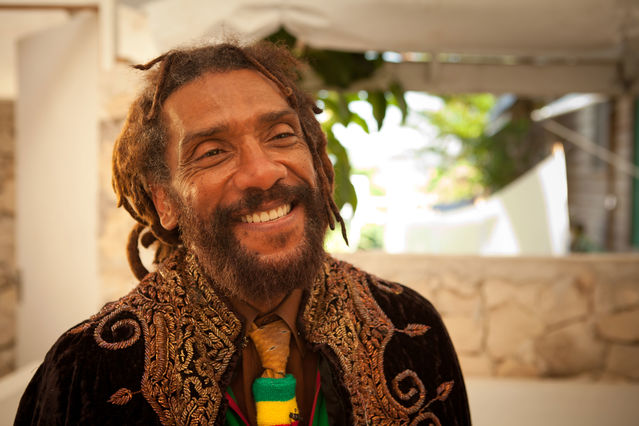
Source: Photo credit: Jeff Schmale
The admiration that H.R. commands is perhaps best summed up by
John Joseph of Cro-Mags: “Still to this day, I bow down.”
At the same time that H.R. is so highly revered, there are few
figures in music history who are as enigmatic. Far from an exercise in
abject hero worship, the portrayal of H.R. in
Finding Joseph I is one of a complex man who has defied convention at every turn, perhaps to his own detriment.
Bad Brains’
music and
live shows still
set the bar for excellence in heavy-metal music. And H.R. is admired
for his tremendous insight and strong ability to build bonds and command
loyalty. However, the book also describes erratic, violent and
self-destructive behavior by a man struggling with mental and physical
illness making commercial success less viable and at times leading him
to incarceration or homelessness.
In spite of the various struggles that H.R. has experienced in his
life, there is one incontrovertible fact: Through it all, he has
maintained an unyielding and unflinching spiritual approach to his life;
specifically, Positive Mental Attitude. P.M.A. can perhaps best be
defined as a deep sense of
optimism. And the theory of P.M.A. is that this optimism attracts positive people and situations, helping one to achieve life
goals and personal fulfillment.
So when I spoke with H.R. about his life and
career,
my goal was to deconstruct how H.R. approached P.M.A., not only as a
way of celebrating his consistent ability to maintain this mindset, but
also to learn from his example. In doing so, I became aware that P.M.A.
is not a mindset or attitude per se, but a holistic and active
spiritual, mental and behavioral practice. And while not everyone will
embrace every aspect of H.R.’s approach, his story serves as an
inspiration for each of us as we navigate our own struggles.
At the core of H.R.’s approach to P.M.A. is a deep
spirituality – particularly a connection to God and Jesus Christ. H.R. described himself as initially a
Jehovah’s Witness, but then eventually embracing
Rastafarianism. He explained how reading Napoleon Hill’s 1937 book
Think and Grow Rich introduced him to the concept of how faith can drive one to success.
“I was doing more drugs and living wild. At that time, I knew in my
heart that I wanted a better way. Just in the nick of time, God taught
me how to relate to him. It was in 1979. My father introduced me to a
book called
Think and Grow Rich,” H.R. told me. “So I read the book and found the connection to God … it introduced a new
philosophy to me.
“The new philosophy was P.M.A. Anything the mind can conceive and believe, the mind can achieve.”
That spiritual connection serves as the engine for H.R.’s approach to
P.M.A. “I think the way is better when you can believe in yourself and
believe that you are a true son of God and a true daughter of God,” he
explained. “And there will be a better way of living for those that want
to know…that can help them and save them from tragedy.”
Connecting with God is not a passive endeavor for H.R. in which he
hopes to find divine revelation, but rather an active process in which
he engages in activities specifically designed to enhance his connection
with God.
“
Love
thy neighbor as one loves thyself. Using these ideals and using the
formula that one can have through a labor of love. So they would grow up
and learn to do the things that they love,” H.R. explained..
Also, for H.R., one needs to have an open mind to embrace P.M.A. and to always be simultaneously learning and teaching. “A good
leader is
someone who would lead people to the new way, the new lifestyle of
God,” H.R. said. “But it is very important to also be a good follower
still.”
In theory, when one is focused on their connection with God and
having a loving path, different activities can help facilitate P.M.A.
“It’s not in one particular formula except for love,” he explained.
As an example, H.R. embraces going to church and reading the Bible.
“I think that the way we can do it is by studying the word … and then we
will learn for ourselves,” H.R. said. He recalled going to a local
church “and the pastor there came to visit us, and he said I was very
familiar with the Bible. And he wanted to know how I was so into the
Bible.
“And it made him feel happy and glad that I was.”
Another form of exploring P.M.A. is through music or other creative
outlets. “When someone keeps the faith, they’re able to become a better
person and also do things better. These things that I’m talking about
are like playing guitar or playing the bass or singing. Music has a lot
to do with the new person they’re transforming to be,” he said. “I knew
I’d have to continue on in music, but I’d have to do a new kind of
music to help me be a new person.”
And while there are several things that can enhance one’s P.M.A., H.R. points to racism and
discrimination as obstacles to having a loving relationship with oneself and others.
“It was easy coming to know the new way of God and this attitude or
this way of living does not interfere with one who is not a racist,”
H.R. described. “I think some people make it hard because of racism … I
think that it does interfere with their quest of life… They know what
they’re doing is wrong. But they still want to get away with it and try
another way of living.”
In the early ’80s, H.R. himself harbored discriminatory attitudes and in an anti-gay incident involving the hard-core band
Big Boys, H.R. used derogatory slurs against the band. In
Finding Joseph I, H.R. is quoted as saying, “I am much more live-and-let-live. I would not say those things today.”
Over time, science seems to have caught up to H.R.’s approach. Though
P.M.A. as a construct still has not been formally studied, we now know
that different aspects of P.M.A. predict
health and well-being. For example, research suggests that
optimism, as well as
spirituality and religion, predicts improved health and well-being. And there is consistent evidence that music can be a form of
medicine, improving conditions including Parkinson’s disease and
depression.
And while H.R. has faced many ups and downs, things seem to be headed
in the right direction. In addition to the recent book about his life,
Finding Joseph I co-author James Lathos completed a
documentary about H.R.’s life as well. And there is talk of Bad Brains making
new music together this fall.
Perhaps most importantly, however, H.R. is on a path to recovery from
the mental and physical health issues that he’s faced. In contrast to
many people whose
religious beliefs result in lower
adherence to medication regimens, H.R.’s approach to P.M.A. dictates that difficulties can often be temporary and that
medication is one way to help people through a difficult time in life.
H.R. describes how he has been willing to take medication to manage
his mental health issues, which his wife, Lori Carns Hudson, has
described as
schizophrenia.
“I think that some people … they let the medicine pass them by. Or they
may object to a certain kind of medicine. But one should know that they
are going through a phase in life,” he described.
H.R. has also embraced healthier dietary habits that become a form of self-love. “I think by eating and
drinking
new things that we’re supposed to eat and drink … So, here’s this
wonder drug called spirulina. Also, another good source of eating is the
wheatgrass. These can definitely assist mankind in taking care of
oneself,” he explained.
And to continue on his path of health, H.R. heads into surgery on
Feb. 21 to relieve him of a rare form of headache — short-lasting,
unilateral neuralgiform headache with conjunctival injection and tearing
(SUNCT).
And after years of being his followers, we can perhaps show that we are also leaders by sending support through a
GoFundMe campaign to help raise money for H.R.’s medical costs.
As we continue to understand his message and learn from his life, we can learn to find the path that works for us.
Because, hey, we’ve got that P.M.A.
Michael A. Friedman, Ph.D., is a clinical psychologist in
Manhattan and a member of EHE International’s Medical Advisory Board.
Follow Dr. Friedman on Twitter @DrMikeFriedman and EHE @EHEintl.